

Key Takeaways
Treat the honeymoon as a state you can cultivate, not a lucky accident
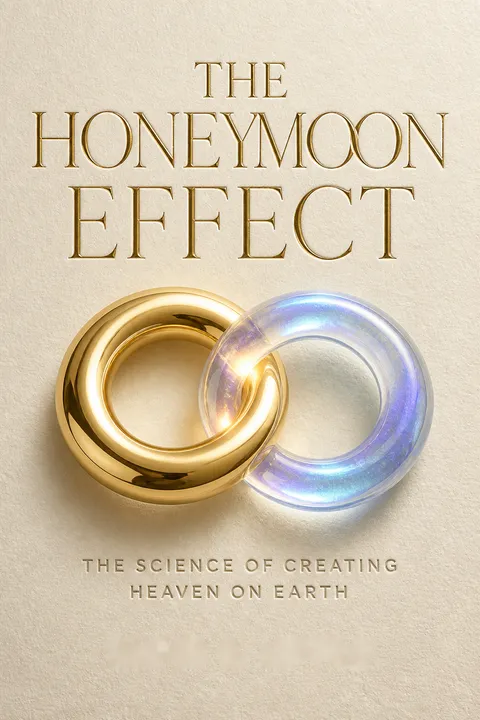
A changed relationship is possible. Bruce Lipton begins as a scientist who doubts lasting love, then describes a painful divorce, a failed affair, and years spent insisting he would never marry again. When a woman on a Caribbean island calls him too needy, he recognizes that longing for a partner cannot substitute for getting his life in order. His eventual relationship with Margaret becomes his example of the Honeymoon Effect: a sustained state of affection, vitality, and mutual enjoyment, not merely the rush of a new romance.
The book's central promise is that this experience can be built through awareness and changed behavior. Lipton and Margaret describe a loving partnership lasting 17 years at the time of writing, while acknowledging conflict and deliberate repair. Their story makes the idea personal, though it cannot guarantee the same outcome for every couple.
The strongest reading of the Honeymoon Effect is not a promise of permanent euphoria, but a challenge to treat intimacy as something partners can actively maintain. Relationship research often distinguishes early passionate intensity from the trust and responsiveness that sustain long partnerships. Lipton's story gives that distinction a memorable human shape: he does not find a perfect partner by luck, he becomes more able to participate in a healthy relationship. The limit matters too. Personal growth can improve one's choices and conduct, but it cannot make every pairing compatible or repair a relationship without the other person's participation.
Build partnership around belonging, not only sex or children
Bonding has its own pull. Lipton argues that humans seek connection for companionship and cooperation as well as reproduction. He compares people to the cells in a body, which coordinate different jobs, and to social creatures such as ants, whose survival depends on their colony. A more familiar example is the stranded man in the film Cast Away: he fashions a volleyball into a companion, then risks leaving the island to find human contact, despite having found ways to survive alone.
Family structure varies. The book points to couples who choose not to have children and to same-sex courtship and pair bonding observed across many animal species. Its point is that connection is not merely a reproductive strategy. Human relationships can be valuable in their own right, whether or not partners have children or fit a conventional model.
This framing usefully separates intimacy from a single social script: marriage need not be justified by parenthood, and care is not confined to heterosexual couples. Social neuroscience and public health research also link durable relationships with support and well-being, though connection can come from friends, family, and community, not only a romantic partner. The cell and ant comparisons make cooperation vivid, but they should remain analogies. Human beings have conflicts, rights, and individual aims that do not map neatly onto a body or insect colony. Belonging is a need, not an argument for staying in every relationship.
Let love's chemistry explain intensity, not excuse your choices
Romance has a bodily soundtrack. Lipton describes love as a shifting mix of hormones and brain chemicals. Testosterone and estrogen contribute to sexual desire; dopamine is involved in motivation and reward; oxytocin and vasopressin are associated with bonding; and serotonin changes may accompany early romantic obsession. Brain scans of people newly in love showed activity in reward-related regions. A separate study discussed in the book found similar reward activity in people who reported intense love after an average of 21 years together.
The chemicals are not a magic formula. Prairie voles, whose strong pair bonds have been studied in comparison with less social vole species, help researchers investigate how brain receptors relate to attachment. Yet oxytocin can affect trust and cooperation differently depending on social context. Lipton's practical conclusion is that chemistry can intensify attraction and distress, but people are not required to obey every impulse it produces.
The chapter's most useful scientific move is to explain why romance can feel both exhilarating and destabilizing without reducing it to mere sentiment. Reward learning helps account for persistent attention to a partner, while attachment and emotional regulation help explain how long-term love can feel calmer than new infatuation. The vole findings are informative models, not miniature human relationship manuals. Likewise, a chemical associated with bonding does not operate as a universal love switch. Context, history, and behavior shape what bodily signals mean, so a biochemical story should illuminate choices, not absolve harmful conduct.
Notice what your body signals, then test it against evidence
Signals deserve attention. Lipton recounts ignoring his discomfort around a neighbor because he wanted to be forgiving and positive. The neighbor later canceled a shipment and stole Lipton's belongings. The author presents the episode as a costly lesson in taking unease seriously. He calls energizing interactions good vibrations and draining ones bad vibrations, then uses the physics terms constructive and destructive interference to describe how people can seem to amplify or diminish one another.
The metaphor has limits. The book also points to measurable brain activity and medical technologies that interact with brain signals, then extends quantum physics into claims about human connection and attraction. Those examples do not establish that relationship intuitions are quantum effects or that thoughts attract particular partners. The grounded advice is simpler: notice discomfort, check it against observable behavior, and do not let polite words erase credible warning signs.
This section is most persuasive when read as a case for embodied attention, not paranormal detection. People integrate tone, facial expression, and context before they can always explain why an interaction feels unsafe; treating that unease as a hypothesis can prompt sensible questions and boundaries. But intuition is fallible, shaped by anxiety, bias, and past experience. Quantum terms such as interference and entanglement describe physical systems; borrowing them does not prove that people transmit relationship outcomes through an invisible field. A good rule is to listen to the signal, then seek corroboration in conduct.
Plan for four minds, because intentions cannot silence old scripts
Two partners bring more than two agendas. Lipton's Four Minds model counts each person's conscious mind, which holds explicit wishes and plans, and subconscious mind, which runs learned habits and reactions. In his account, the honeymoon often begins with partners acting from conscious intentions. Everyday pressures then pull attention elsewhere, and familiar automatic behaviors reappear. One partner's curt response can trigger the other's criticism, turning a small moment into a loop neither intended.
Old patterns can be hard to see. Lipton argues that many behaviors are learned by observing parents, family, and culture, especially early in life. He likens the subconscious to a playback system: it can repeat a familiar response without evaluating whether it fits the present. The book's claim that conscious processing guides behavior only about 5 percent of the time is a broad estimate, not a settled universal measurement. Its practical point is to examine repeated behavior, not just stated intentions.
The model offers a useful alternative to the familiar accusation that a partner is simply being difficult. Habit learning and family systems both emphasize how responses are shaped by repeated experience and by interaction loops. A person who withdraws may intensify a partner's pursuit; that pursuit can make withdrawal more likely. Naming the pattern can create room to choose a different response. The precise 5 percent figure is far less secure than the general insight that much behavior is automatic. Automatic does not mean inevitable, and childhood influence does not erase adult responsibility.
Rewrite inherited relationship patterns through repetition, not pep talks
Insight alone may not change a habit. Lipton says a conscious realization does not automatically update subconscious behavior. He recommends making desired changes concrete, then repeating them until they become familiar. His examples include noticing negative self-talk, practicing mindfulness, and using structured approaches such as hypnosis or energy psychology. He describes PSYCH-K as one method he found helpful, while also saying that no single tool works for everyone.
Start with a specific pattern. If a person repeatedly chooses distant partners or reacts to conflict with silence, the book suggests asking what behavior is being rehearsed and what alternative response could be practiced. Lipton also discusses prenatal and early childhood influences, arguing that a child's environment can shape later expectations. This can encourage compassion for learned patterns, but it should not be treated as proof that a person's adult character was fixed before birth.
The practical distinction between understanding a pattern and rehearsing a replacement is valuable. Learning science generally supports the idea that repeated actions can become more automatic, while mindfulness can help people notice a reaction before acting on it. The recommendations should nevertheless be separated by evidence. Habit practice and established psychotherapies have different levels of support from the book's more speculative claims about subliminal recordings or energy-based belief change. Prenatal stress can influence development, but it does not write a permanent script. Change is possible without blaming parents or promising a quick reset.
Turn conflict into repair with pauses, touch, and honest language
Repair is a practiced skill. Margaret recalls a road trip when the couple became lost. Bruce resisted stopping for directions; she criticized his choices, and they ended up shouting in a parking lot. Rather than treating the argument as proof the relationship was doomed, they paused, calmed down, and discussed the reactions that neither wanted to repeat. They agreed to prioritize the relationship over winning the dispute.
Build a route back to connection. The couple developed habits that helped them reconnect: affectionate words during ordinary days, physical closeness, and quiet contact during tension instead of escalating the argument. Margaret also describes stepping away to question whether a cutting remark would help. Lipton emphasizes patience because old responses may recur before new ones become reliable. These practices are not a substitute for safety or accountability, but they show how small, repeated acts can make repair more likely.
The parking-lot scene is convincing because it avoids the fantasy that a good relationship never becomes ugly. What matters is whether partners can interrupt escalation, return to the issue, and take responsibility for their own contribution. Research on emotion regulation and conflict repair broadly supports slowing an argument when arousal is high. Touch can be comforting for some couples, but it is not universally welcome, especially in frightening or coercive situations. The principle is consent-based reconnection, not a rule that physical closeness must resolve conflict.
Choose love from self-respect, not from a need to feel whole
The noble-gas image is a metaphor. In chemistry, noble gases tend not to bond under ordinary conditions because their outer electron shells are filled. Lipton turns that property into a model for people who feel secure enough not to depend on a partner to complete them. He contrasts this with codependent relationships, where two people's unresolved needs can fit together in ways that feel familiar but cause harm.
Security changes the choice. Lipton describes becoming more comfortable alone before meeting Margaret. Their relationship was not instantly effortless: Margaret wanted candid communication, while Bruce repeatedly insisted he was not ready for commitment. They gradually confronted those differences, and Bruce eventually chose marriage because he trusted her. The lesson is not to avoid dependence altogether. It is to seek connection without mistaking desperation, familiar pain, or fear of being alone for compatibility.
The image captures an important distinction between interdependence and dependence. Healthy partners can rely on each other while retaining a stable sense of self; needing support is not a defect, and independence is not the same as emotional maturity. The metaphor becomes misleading if it suggests that people should be perfectly self-sufficient before they can love. Attachment is partly built through relationships themselves. Lipton's story is strongest as an account of growing more capable of choosing and communicating, not as evidence that inner completeness must precede intimacy.
Carry relational cooperation into how you parent and build community
Private habits can have public consequences. Lipton extends his relationship argument to family life and society. He argues that children learn from the emotional climate around them, including how adults handle affection and conflict. He also presents ORGANIC INDIA, a company that worked with farmers in Azamgarh to transition to organic cultivation of crops such as tulsi. The book reports that after 15 years, the effort involved about 1,000 farmers in the region and 20,000 across India.
Cooperation needs structures. The farmers' example links shared purpose to practical support during a difficult transition, rather than relying on goodwill alone. Lipton imagines loving couples and conscious parents as contributors to a more cooperative human community. The broader claim that relationship harmony can heal the planet is aspirational, not demonstrated by the stories. Still, the examples underscore a grounded point: care becomes more durable when families and organizations build routines and systems that support it.
The book's move from couplehood to community is ambitious, and the farming story gives it a concrete institutional example: values matter more when paired with financing, shared work, and viable livelihoods. Developmental research supports the broad importance of responsive caregiving, though it does not justify making parents solely responsible for social violence. Likewise, one company's reported impact cannot establish that loving relationships will solve ecological crises. The productive connection is scale: habits of listening, cooperation, and long-term care can shape families and institutions, while structural problems still require collective policy and material change.
Analysis
The Honeymoon Effect is part memoir, part relationship advice, and part popular science argument. Its narrative begins with Lipton's skepticism about love and repeated romantic failures, then follows his change in outlook and his partnership with Margaret. That progression gives the book a memorable emotional spine: lasting intimacy is neither pure luck nor a permanent chemical high, but something shaped by learned behavior, attention, and repair. The strongest practical idea is the gap between what partners consciously want and what their automatic reactions repeatedly do. The Four Minds model helps readers notice that gap without immediately reducing conflict to bad character.
The book is most useful when it turns that model into observable practice: identify recurring interactions, pause before retaliating, communicate directly, and repeat behaviors that support trust. It also rightly treats affection and cooperation as needs broader than reproduction. Its account of hormones offers an accessible way to understand why romantic intensity can feel compulsive, while acknowledging that chemicals such as oxytocin do not guarantee kindness or fidelity.
Its scientific authority, however, is uneven. Environmental effects on cells and development are real research topics, but the book often moves from them to sweeping claims about belief, relationships, or healing. Quantum physics does not establish that thoughts attract particular partners, and brain activity measurable outside the skull does not demonstrate telepathy. Some figures, especially the estimate that conscious thought governs only 5 percent of behavior, are presented more firmly than the evidence warrants. The early-childhood account also risks making complex development sound like a fixed recording.
A further caution concerns responsibility. Encouraging readers to examine their own patterns can be empowering, but the claim that people create every failed relationship can slip into victim-blaming. Abuse, coercion, incompatibility, economic pressure, and a partner's independent choices cannot be corrected by positive thinking or self-reprogramming. Read the book's metaphors as invitations to reflection, not scientific proof or moral verdicts. Its lasting value lies in asking readers to practice the relationship they want while remaining clear-eyed about evidence, safety, and mutual responsibility.
Review Summary
The Honeymoon Effect received positive reviews for its unique blend of science and spirituality in explaining relationships. Readers appreciated Lipton's accessible writing style, personal anecdotes, and scientific explanations of love and human behavior. Many found the book insightful, offering valuable perspectives on subconscious programming and its impact on relationships. Some critics felt the content could have been condensed or found certain sections overly scientific. Overall, reviewers recommended the book for those seeking to understand and improve their relationships.
People Also Read








Glossary
Honeymoon Effect
Sustained loving vitalityLipton's term for a state of passion, energy, health, and joy associated with a deeply loving relationship. He argues that it need not be limited to early romance and can be maintained through awareness, communication, and changes to learned behavior. It is an aspirational relationship model, not a clinical diagnosis or guaranteed outcome.
Four Minds
Two partners' conscious and automatic mindsLipton's model of relationship behavior, in which each partner brings a conscious mind holding explicit wishes and a subconscious mind carrying learned habits and responses. The interaction of all four can explain why two people who sincerely want a loving partnership may still fall into automatic patterns that undermine it.
Self-biologist
Person influencing bodily chemistryLipton's term for the idea that people influence their internal biological environment through perception and behavior. He compares the body to a culture dish whose cells respond to the chemical conditions around them, and argues that brain activity helps shape those conditions. The analogy emphasizes mind-body interaction, though it simplifies complex physiology.
Noble gases
Metaphor for secure independenceLipton borrows the chemical category of elements such as helium and argon as a metaphor for people who feel sufficiently balanced not to seek a partner out of desperation. In his relationship model, secure individuals can choose a loving partnership freely rather than relying on a partner to compensate for painful patterns.
Excimer
Metaphor for energized partnershipIn chemistry, an excimer is a short-lived association involving atoms in an excited state. Lipton uses the term metaphorically for two secure people whose connection generates shared vitality and spreads positive influence. This relationship meaning is an analogy, not a psychological category or a literal description of romantic bonding.
PSYCH-K
Belief-change methodA named process Lipton describes as a way to change subconscious beliefs that he considers limiting. He reports using it himself and cites brain-mapping claims associated with the method. It is one option among the approaches discussed in the book, not a universally effective treatment, and its claims should be distinguished from established psychotherapy.
constructive interference
Waves reinforcing each otherA physics term for the reinforcement that occurs when waves align so their amplitudes combine. Lipton applies it figuratively to people who seem to energize one another, contrasting it with destructive interference, where aligned peaks and troughs reduce a combined wave. The physics concept does not establish that human relationships literally operate this way.
FAQ
What's "The Honeymoon Effect: The Science of Creating Heaven on Earth" about?
- Exploration of Love: The book delves into the concept of the "Honeymoon Effect," a state of bliss, passion, and energy resulting from a huge love, and how it can be sustained.
- Scientific Approach: Bruce H. Lipton uses principles from the New Science, including quantum physics and cell biology, to explain how love can be maintained at a cellular level.
- Personal and Planetary Love: It discusses love not only in personal relationships but also how it can extend to planetary love, promoting a harmonious existence on Earth.
- Practical Guidance: The book offers strategies and insights into creating and maintaining loving relationships, drawing from Lipton's personal experiences and scientific research.
Why should I read "The Honeymoon Effect"?
- Understanding Relationships: It provides a scientific understanding of why relationships often lose their initial magic and how to rekindle it.
- Practical Tools: The book offers practical tools and strategies to help readers create and sustain loving relationships.
- Broader Impact: It connects personal love to planetary well-being, suggesting that harmonious relationships can contribute to global peace.
- Inspiring Stories: Through personal anecdotes and scientific insights, the book inspires readers to believe in the possibility of lasting love.
What are the key takeaways of "The Honeymoon Effect"?
- Subconscious Programming: Our subconscious mind, programmed in early childhood, often sabotages our conscious desires for love and happiness.
- Energy and Vibration: Love and relationships are influenced by energy and vibrations, which can be understood through quantum physics.
- Reprogramming Beliefs: By reprogramming our subconscious beliefs, we can align our conscious and subconscious minds to create lasting love.
- Noble Gases Metaphor: The book uses the metaphor of noble gases to illustrate how balanced individuals can form harmonious relationships without codependency.
How does Bruce H. Lipton explain the science behind love in "The Honeymoon Effect"?
- Cellular Biology: Lipton explains that cells are influenced by their environment, and similarly, our relationships are influenced by the environment we create.
- Quantum Physics: The book uses quantum physics to explain how energy and vibrations affect our relationships and personal well-being.
- Neurochemicals and Hormones: It discusses the role of neurochemicals and hormones, like dopamine and oxytocin, in creating feelings of love and attachment.
- Mind-Body Connection: Lipton emphasizes the mind-body connection, showing how our thoughts and beliefs can influence our physical and emotional health.
What is the "Honeymoon Effect" according to Bruce H. Lipton?
- State of Bliss: The Honeymoon Effect is described as a state of bliss, passion, and energy resulting from a huge love.
- Initial Relationship Phase: It refers to the early phase of a relationship where everything feels magical and perfect.
- Sustaining the Effect: The book explores how this effect can be sustained beyond the initial phase through conscious effort and understanding.
- Impact on Life: When sustained, the Honeymoon Effect can lead to a life where one feels grateful and excited to start each day.
How can one reprogram their subconscious mind as suggested in "The Honeymoon Effect"?
- Mindfulness and Awareness: Being mindful of your thoughts and actions can help identify negative subconscious patterns.
- Hypnosis and Subliminal Tapes: These tools can be used to access and reprogram the subconscious mind with positive beliefs.
- Energy Psychology Techniques: Methods like PSYCH-K and Emotional Freedom Techniques (EFT) can facilitate rapid changes in subconscious programming.
- Consistent Practice: Regularly practicing new habits and thoughts can help reinforce positive changes in the subconscious mind.
What role do energy and vibrations play in relationships according to "The Honeymoon Effect"?
- Good and Bad Vibes: Relationships are influenced by the energy and vibrations we emit, which can be constructive (good vibes) or destructive (bad vibes).
- Quantum Physics Insight: The book uses quantum physics to explain how these vibrations affect our interactions and relationships.
- Reading Energy: Being attuned to the energy of others can help in understanding and improving relationship dynamics.
- Creating Positive Energy: By focusing on positive thoughts and emotions, we can create an environment that fosters love and harmony.
What are the best quotes from "The Honeymoon Effect" and what do they mean?
- "A lifetime without Love is of no account": This quote emphasizes the importance of love as a fundamental aspect of a fulfilling life.
- "Change your beliefs, change your relationships": It highlights the power of belief in shaping our relationships and the potential for transformation through changing those beliefs.
- "Be conscious of what you ask for because you’re going to get it": This quote advises mindfulness in setting intentions, as our thoughts and desires can manifest in reality.
- "Live and enjoy the fact that you are a creator, not a victim of your life": It encourages readers to take control of their lives and relationships, emphasizing personal empowerment.
How does Bruce H. Lipton connect personal love to planetary well-being in "The Honeymoon Effect"?
- Interconnectedness: The book suggests that personal love and harmony can extend to a broader planetary love, promoting global peace.
- Noble Gases Metaphor: Lipton uses the metaphor of noble gases to illustrate how balanced individuals can positively influence the world around them.
- Collective Impact: Harmonious relationships can contribute to a collective positive energy that benefits the planet.
- Vision for the Future: The book envisions a world where love and cooperation lead to a sustainable and peaceful existence for all.
What is the significance of the "Noble Gases" metaphor in "The Honeymoon Effect"?
- Balanced Individuals: Noble gases represent individuals who are balanced and do not need others to complete them.
- Excimers and Lasers: When noble gases are excited, they form excimers, which emit light, symbolizing how balanced individuals can create harmonious relationships.
- Selfless Love: The metaphor illustrates the potential for selfless love and sharing when individuals are whole and balanced.
- Global Impact: Just as excimers can create a powerful laser, balanced individuals can collectively create a positive impact on the world.
What practical strategies does "The Honeymoon Effect" offer for maintaining loving relationships?
- Communication and Transparency: Open and honest communication is essential for understanding and resolving conflicts.
- Daily Acts of Kindness: Regularly expressing love and appreciation can strengthen the bond between partners.
- Reconnecting Through Touch: Physical touch can help reconnect partners on a deeper level during conflicts.
- Mindful Living: Being present and mindful in the relationship can help maintain the Honeymoon Effect over time.
How does Bruce H. Lipton address the challenges of subconscious programming in relationships?
- Invisible Sabotage: Subconscious programming can unknowingly sabotage relationships by triggering negative behaviors.
- Awareness and Identification: Recognizing and identifying these subconscious patterns is the first step to overcoming them.
- Reprogramming Techniques: The book offers various techniques, such as energy psychology and hypnosis, to reprogram negative subconscious beliefs.
- Aligning Minds: By aligning the conscious and subconscious minds, individuals can create harmonious and fulfilling relationships.
About the Author
Other books by Bruce H. Lipton
Download PDF
Download EPUB
.epub digital book format is ideal for reading ebooks on phones, tablets, and e-readers.








