

Key Takeaways
Treat recurring chemistry as a pattern to investigate, not proof of destiny.
A familiar cycle. Therapist Ross Rosenberg describes years of relationships that began with intense attraction and ended in hurt and frustration. A friend helped him see that his partners differed in appearance but repeated a similar pattern. At a later social event, he recognized that familiar rush before it became another relationship and chose to pause. His experience anchors the book’s central idea: unconscious habits can influence whom people pursue and what they mistake for love.
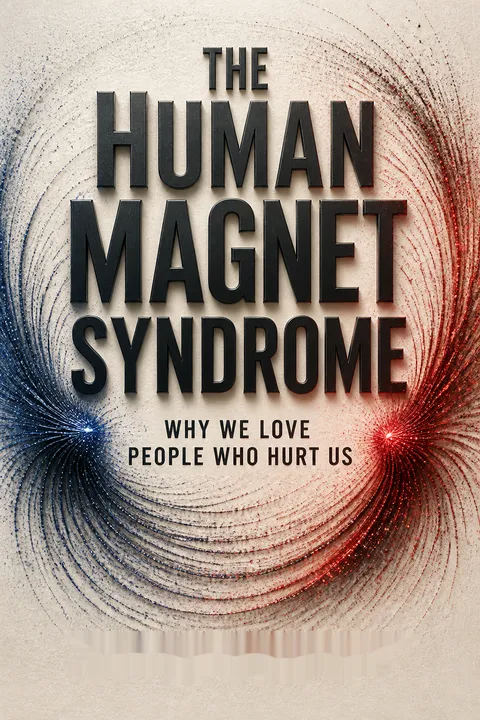
The magnet metaphor. Rosenberg calls this pull the Human Magnet Syndrome: the proposed attraction between people whose relationship styles complement each other, including partners who overfocus on others and partners who overfocus on themselves. The metaphor can explain repetition, but it does not make a harmful relationship inevitable or excuse anyone’s behavior.
What's useful here is the shift from asking why a particular partner was so compelling to asking what recurring pattern the attraction may be serving. That question can reveal choices that feel automatic without pretending they are beyond influence. Pattern recognition has a risk, though: once a person expects repetition, every new relationship can look like evidence for the same story. The book's lens works best as a prompt for careful reflection, alongside attention to concrete behavior, context, and whether a partner can respond to honest feedback.
Familiar pain can feel like safety when childhood taught you to adapt.
Early relationship lessons. Rosenberg argues that care in childhood shapes expectations about closeness. A child who receives dependable affection may learn that relationships can include safety and mutual attention. A child whose parent offers approval conditionally may instead learn to monitor moods, suppress needs, or work hard to earn connection. The book emphasizes the first five to six years, while also noting that genes and later supportive caregivers can affect development.
Repetition, not fate. The author connects adult attraction to the emotional patterns a person learned at home. Someone accustomed to appeasing a self-focused parent may later find a controlling partner strangely familiar. That is a proposed explanation, not a verdict on every adult relationship. Rosenberg's own story illustrates that recognizing the pattern and doing sustained personal work can change how a person chooses.
This account makes a valuable distinction between what feels familiar and what is actually safe. Developmental psychology and attachment-focused approaches also examine how early caregiving informs expectations of availability and trust. The strength of that perspective is explanatory, not deterministic: early experience can shape a starting point without fixing a person's future. The book sometimes gives childhood a particularly powerful role, so readers should avoid treating a difficult childhood as a complete explanation for every relationship choice. Temperament, current circumstances, and later relationships matter too.
Notice when giving and taking become fixed roles, not mutual care.
The relationship dance. Rosenberg uses a dance metaphor for a couple whose roles seem to fit: one partner tends to give, accommodate, and manage the relationship, while the other tends to lead, control, or prioritize personal needs. He calls the strongly self-neglecting pattern codependency, a habitual focus on others that can crowd out one's own needs and boundaries. The author's term emotional manipulator refers to a highly self-focused or controlling partner, as defined in this book.
A fit can hurt. The codependent may feel useful and hopeful; the other partner may feel supported and in control. Over time, this arrangement can produce resentment, conflict, and repeated breakups followed by reunion. Calling the roles complementary helps explain why a painful relationship can persist. It does not mean the partners cause equal harm or carry equal responsibility for abuse.
The dance image makes a complicated interaction visible: each person's behavior can reinforce the other's, even when neither is satisfied. Systems thinking offers a useful parallel, since it studies patterns between people rather than treating each action as isolated. But a relational pattern is not the same as equal accountability. If one person intimidates, coerces, or abuses the other, describing a shared dance must not blur who is causing immediate harm. The metaphor is most constructive when it supports insight without turning responsibility into a tie.
Do not mistake early romantic intensity for evidence of lasting fit.
The rush of limerence. Rosenberg uses the term limerence for intense, often obsessive infatuation and longing for reciprocation. A new partner can occupy someone's thoughts, make separation feel painful, and seem nearly perfect as warning signs recede from view. The book links this state to brain reward processes and describes how sex and emotional excitement can deepen a couple's bond. Intensity, however, says little by itself about trust, care, or long-term compatibility.
An illustrative contrast. Rosenberg recounts the attraction between John Dillinger and Billie Frechette, portraying Dillinger as a dangerous, self-centered figure and Frechette as a caretaker drawn to his confidence. Their story shows how a dramatic first impression can overwhelm judgment. It is an illustration of the author's theory, not a clinical assessment of either historical figure.
Strong attraction can narrow attention: a person notices confirming details and discounts inconvenient ones. That makes it useful to distinguish an emotional state from evidence about a partner's character. The book's account of brain chemistry helps explain why new love can feel consuming, but chemistry should not be treated as a diagnosis or a forecast. Nor is intensity inherently unhealthy. A more reliable test is how both people behave when disappointed, asked to slow down, or invited to respect a boundary.
Use the self-orientation continuum as a mirror, not a measuring instrument.
A map of giving and taking. The Continuum of Self Theory sorts relationship styles by self-orientation: how much a person prioritizes their own needs versus other people's needs. Rosenberg assigns Continuum of Self Values, or CSVs, from minus five to plus five. Strongly negative values represent extreme self-neglect; strongly positive values represent extreme self-prioritization; zero represents an imagined balance. He proposes that opposite values can attract and that pairs whose values add to zero may be stable.
Stability is not health. A strongly self-neglecting person paired with a strongly self-focused person might remain together for years while the relationship stays damaging. By contrast, milder differences may allow give and take. Rosenberg explicitly says the model had not undergone scientific scrutiny. Its numbers are best understood as a framework for noticing imbalance, not as a validated score or a way to diagnose a partner.
The model's useful insight is that relationship duration and relationship quality are separate questions. A couple can be highly durable because each person's habits sustain the arrangement, even if one or both suffer. The numerical scale makes that distinction easy to remember, but it also risks giving a subjective judgment the appearance of precision. Readers can retain the practical question beneath the arithmetic: Can both people ask for care, offer it, and renegotiate roles without fear? That question is more informative than assigning anyone a number.
Practice boundaries before being needed becomes your only source of worth.
Care without self-erasure. The book describes codependency as more than generosity. It can include difficulty saying no, guilt about asking for help, fear of conflict, and a tendency to feel valuable mainly when needed. Rosenberg also distinguishes passive codependents, who avoid confrontation, from active ones, who may try more openly to control a partner. Both may stay focused on changing someone who is unwilling or unable to change.
Build different habits. The practical direction is to notice personal needs, state them clearly, set limits, and allow other people to manage their own responsibilities. Rosenberg recommends psychotherapy and discusses Co-Dependents Anonymous as a peer-support option. In a case he presents, a client named Sandra changed her boundaries and relationships through therapy, eventually leaving a harmful marriage. Her story shows possibility, not a guaranteed outcome or a required path.
Boundaries are not a technique for making another person behave well. They clarify what someone will participate in and what they will do to protect their own welfare. That distinction matters because a person who has spent years caretaking may initially experience self-advocacy as selfishness. At the same time, leaving or confronting a partner can carry practical risks, especially where there is abuse or financial dependence. Support, safety planning, and professional guidance can make the advice more realistic than simply demanding greater willpower.
Read childhood adaptations as survival strategies, not permanent identities.
Two proposed adaptations. Rosenberg describes a child who learns to please a self-focused parent by anticipating moods, minimizing needs, and earning conditional attention. Drawing on Alice Miller's idea of the gifted child, he argues that this adaptation can contribute to later codependent behavior. A child who cannot or will not meet a parent's expectations may instead face rejection, neglect, or abuse, which Rosenberg links to adult emotional manipulation disorders. He also discusses repression and dissociation as possible responses to overwhelming experiences.
A theory, not a destiny. The author emphasizes that childhood harm can be buffered by a steady caregiver, relative, teacher, or other supportive adult. The pathways he describes are not a simple diagnostic test, and the same childhood circumstances do not produce identical adults. The central practical point is that behaviors once needed for survival can become costly in adult relationships and can be examined and changed.
This framing can reduce shame by asking what a behavior once helped a child endure, rather than treating it as a moral defect. It also invites compassion without denying the adult impact of those behaviors. The book's account becomes less convincing when it divides children into two neat outcomes or implies a direct line from parenting style to adult disorder. Human development is more varied than that. The survival-strategy lens remains helpful when held lightly, as a way to explore personal history rather than label oneself or one's family.
Keep labels in proportion, especially when the book groups distinct diagnoses.
A broad author-defined category. Rosenberg uses emotional manipulator for people he associates with narcissistic, borderline, or antisocial personality disorders, and for some people whose addictions lead to harmful relationship behavior. He stresses that codependency and emotional manipulator are not diagnoses listed in the DSM. The book presents these conditions as sharing a self-focused relationship orientation, but the categories are not interchangeable: the descriptions of abandonment fear, exploitation, addiction, and grandiosity differ substantially.
Focus on behavior and safety. A reader should not diagnose a partner from a book, a difficult argument, or a single hurtful act. More useful questions concern repeated conduct: Is there respect for boundaries? Can harm be acknowledged and repaired? Is anyone afraid or unsafe? Qualified clinicians can assess mental health concerns. Where there is coercion or danger, practical safety and appropriate support matter more than finding the perfect label.
Labels can give people language for experiences that were previously confusing, and the book's effort to define its terms is a strength. But bundling several distinct disorders and addiction under one label can encourage overgeneralization, especially when readers are interpreting someone else's motives. A behavior-based description is often both more precise and less stigmatizing: what happened, how often, what followed when it was challenged, and whether the person took responsibility. That approach preserves the book's attention to harmful dynamics without turning a popular label into a diagnosis.
Helpers should examine their own wounds before guiding someone else's.
Practice what is taught. Rosenberg calls this the Golden Rule of the Helping Professions: professionals should attend to their own psychological needs and examine how unresolved problems might affect their work. He argues that personal therapy can deepen a clinician's awareness of vulnerability, judgment, and emotional reactions to clients. The book cites a survey in which 84 percent of psychotherapists reported having sought therapy.
Use support and supervision. Personal therapy is not a substitute for clinical training, supervision, or sound professional boundaries. Rosenberg discusses countertransference, the therapist's emotional reactions to a client, as something to notice and manage rather than act out. His point extends beyond therapists: anyone offering guidance can be more useful when able to recognize the limits and assumptions they bring to the relationship.
The section's strongest contribution is its insistence that expertise does not exempt a helper from ordinary human blind spots. Self-reflection can help distinguish a client's needs from the professional's own history, while supervision provides another perspective on difficult cases. Yet personal therapy alone cannot guarantee competence, and the cited prevalence figure cannot establish that therapy improves outcomes. The broader principle is more defensible: ethical helping requires ongoing self-monitoring, appropriate training, and willingness to seek consultation when one's reactions begin steering the work.
Analysis
The book's enduring contribution is a memorable relational lens: attraction can be shaped not only by conscious preferences but also by familiar roles learned in early relationships. Rosenberg's personal account gives that claim emotional force, and his dance metaphor makes a recurring interaction easier to see than a list of abstract traits. Readers can use the central question, whether care is mutual or organized around fixed roles, without adopting every part of his theory.
The framework is also where the book overreaches. The Continuum of Self Theory assigns numbers to a construct the author acknowledges has not undergone scientific scrutiny. Its arithmetic can help readers picture imbalance, but claims that opposite values predict attraction or relationship stability require stronger evidence than the text provides. Likewise, the proposed routes from childhood adaptation to adult codependency or personality disorder are explanatory hypotheses, not a reliable way to predict an individual's future.
The term emotional manipulator creates a further problem by grouping narcissistic, borderline, and antisocial personality disorders with addiction-related behavior. These are distinct categories, and a partner's harmful conduct does not by itself establish a diagnosis. Readers are better served by noticing observable patterns: respect for boundaries, reciprocity, accountability, repair after harm, and safety. This preserves the book's practical emphasis while reducing the temptation to classify people from a distance.
Its advice is strongest when it shifts attention from changing a partner to understanding one's own participation, needs, and limits. That shift should not be confused with equal blame. In abusive relationships, responsibility for abuse remains with the person perpetrating it, and safety may require specialized support. The book is most valuable as a reflective map, not a diagnostic manual: it helps readers ask why a familiar relationship feels compelling, then invites them to test that story against behavior, context, and professional guidance.
Review Summary
The Human Magnet Syndrome explores why codependents and narcissists/emotional manipulators attract each other in dysfunctional relationships. Reviews are polarized: supporters praise its clarity in explaining relationship patterns and codependency as addiction, finding it life-changing and validating. Critics cite excessive repetition, self-promotional writing, questionable credentials (Masters in Education, not psychiatry), and controversial grouping of BPD with narcissistic disorders. Many note the book lacks concrete recovery solutions beyond "get therapy." Some find the dancing metaphor helpful; others find it overextended. The writing style, including lengthy personal anecdotes, frustrates many readers despite the book's helpful conceptual framework.
People Also Read






Glossary
The Human Magnet Syndrome
Opposite relationship styles attractRosenberg's name for the proposed pull between people with complementary relationship orientations. In his account, a person who routinely prioritizes others may feel drawn to someone who prioritizes themselves, and the pairing can become enduring. The term is a metaphor and theory from the book, not a validated clinical diagnosis or established measurement.
Continuum of Self Theory
A map of self-orientationRosenberg's framework for describing how people balance attention to their own needs with attention to others' needs in relationships. It places these orientations on a scale and proposes that opposite orientations can attract. The author presents it as a way to think about relational patterns, while acknowledging that the theory had not undergone scientific scrutiny.
self-orientation
Focus on self or othersIn Rosenberg's framework, self-orientation means a person's habitual focus on their own needs or on the needs of other people in a relationship. The author treats it as a dimension that can vary in degree, from balanced give and take to severe self-neglect or self-prioritization. It is a concept used in his model, not a standard diagnostic category.
Continuum of Self Value (CSV)
A proposed orientation scoreA numerical value in Rosenberg's Continuum of Self Theory, ranging from minus five to plus five. Negative values represent increasing focus on others, while positive values represent increasing focus on self; zero represents a hypothetical balance. The author uses paired values to illustrate compatibility and stability, but says the values are not intended as a measurement tool.
relationship dance
Recurring complementary rolesRosenberg's metaphor for repeated interactions between partners whose habits seem to fit together. In his main example, one partner accommodates and gives while the other leads and takes. The pattern can feel familiar and predictable even as it creates resentment or harm. The metaphor describes a relationship dynamic, not proof that both partners share equal responsibility.
limerence
Intense obsessive infatuationA term Rosenberg draws from Dorothy Tennov for an intense state of romantic infatuation, marked by intrusive thoughts, longing for reciprocation, and strong mood shifts in response to the desired person's attention. The book uses it to explain why early attraction can feel consuming and why people may emphasize a partner's appealing qualities while overlooking warning signs.
emotional manipulator
Book-specific relationship categoryRosenberg's term for people he associates with narcissistic, borderline, or antisocial personality disorders, and for some people whose addictions lead to harmful, self-focused relationship behavior. The author says the term is not a DSM diagnosis. It groups conditions that have different features, so it should not be used to diagnose a person from a book or isolated behavior.
original condition
Foundational early-life harmRosenberg's term for the childhood trauma or damaging circumstances he believes can underlie dysfunctional adult relationship patterns. The term may refer to neglect, abuse, deprivation, or other experiences that shaped a person's early sense of safety and worth. It is an explanatory concept in the book, not a formal diagnosis or a single universal cause.
Golden Rule of the Helping Professions
Helpers examine their own needsRosenberg's ethical principle that helping professionals should address their own psychological needs and consider how unresolved problems may affect their work. He encourages personal therapy and awareness of emotional reactions to clients. The principle supports self-reflection, but does not replace professional training, supervision, or other standards of clinical competence.
Download PDF
Download EPUB
.epub digital book format is ideal for reading ebooks on phones, tablets, and e-readers.








