

Key Takeaways
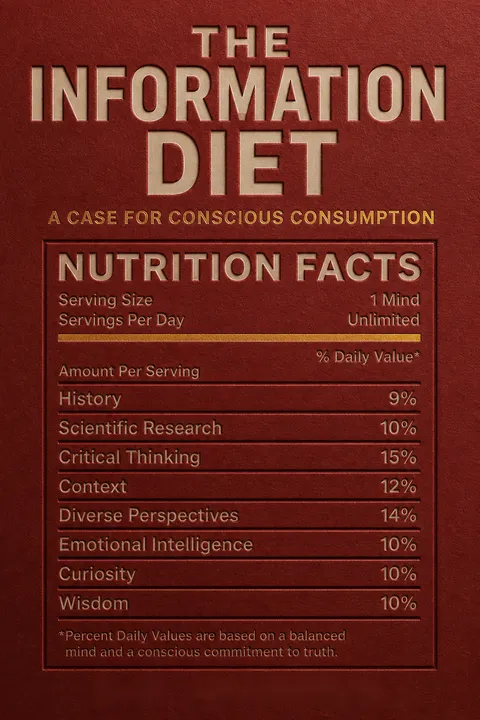
Treat information as a diet: choose what enters your mind deliberately.
A political wake-up call. Clay Johnson spent years trying to improve government through elections and transparency. Then he saw a protester demand that government keep its hands off Medicare, a government-run program. The man seemed intelligent, but his information had not helped him notice the contradiction. Johnson concluded that supplying more facts alone could not repair judgment when people mainly sought information that confirmed what they already believed.
Quality beats sheer volume. The book compares cheap, processed food with cheap, processed media: both are easy to produce and engineered to appeal to cravings. Its central advice is not to quit consuming information, but to select it consciously, favoring useful knowledge over mass-produced affirmation. The analogy is a guide, not a literal claim that reading works exactly like eating.
What's compelling is the move from productivity to health. An overflowing inbox is not merely a scheduling nuisance if its contents shape attention, decisions, and relationships. The food comparison makes a diffuse problem concrete: availability does not equal nourishment. Yet information differs from food in a crucial way. A reader can need extensive, even distressing, information for work, care, or civic life. The useful question is therefore not simply how much is consumed, but whether the intake improves understanding and supports meaningful action.
Follow the incentives: cheap media sells emotional calories, not careful reporting.
Affirmation is cheaper. Johnson argues that media businesses often profit more from content that keeps people clicking than from costly reporting. Cable news can build a loyal audience around a recognizable personality and political viewpoint without maintaining the reporting infrastructure of a large news bureau. The book contrasts Fox News's programming-heavy approach with CNN's larger investment in news operations, arguing that affirmation became a successful business model across the political spectrum.
Content gets industrialized. AOL's 2011 content strategy, as described in the book, used search demand and advertising returns to guide rapid production. Writers were expected to produce several pieces daily, with speed and traffic ranked above editorial quality. This resembles factory production: low-cost material is made to meet predictable demand. The result is abundant content, but abundance does not guarantee careful verification or public value.
The strongest insight here is structural rather than conspiratorial. A business can reward sensationalism without executives plotting to mislead anyone: metrics and revenue can select for whatever reliably captures attention. This connects media economics to other markets where firms optimize measurable demand, even when the product's broader effects are costly. Still, consumer choice is not the only lever. Ownership, labor conditions, platform ranking, and public-interest funding shape what choices are available in the first place.
Seek disconfirming evidence before your group edits reality for you.
Belief changes the filter. On Howard Dean's presidential campaign, Johnson and colleagues interpreted favorable news as proof of a coming victory and bad news as evidence of unfair treatment. The campaign's pollster predicted Dean would lose Iowa by a wide margin. Johnson rejected the forecast, then watched it come true. At Thanksgiving, he and his conservative uncle arrived with separate collections of facts and left with a damaged relationship.
A name for the distortion. Johnson calls this cognitive version of body dysmorphia “reality dysmorphia”: a person's perception of events becomes detached from what others can observe. Confirmation bias makes people favor evidence that supports existing beliefs; the book also discusses research suggesting corrections can sometimes strengthen a mistaken belief. These effects are real risks, not proof that every person or political group is incapable of changing its mind.
The campaign story shows why fact-checking alone can fail: beliefs are often tied to belonging, competence, and loyalty, not just to propositions. Research on motivated reasoning similarly suggests that people can scrutinize opposing claims more harshly than friendly ones. A practical safeguard is to ask what evidence would change a conclusion before defending it. The caution is that disagreement does not automatically make a source insightful. Diverse perspectives help only when claims remain answerable to shared evidence.
Go closer to the source, and learn to test what it says.
Truth thins through retelling. Johnson uses a “trophic pyramid” for information: as claims pass through more commentators and republishers, they can become less faithful to their original evidence. The children's telephone game illustrates the risk: a message changes as each person repeats it. For a government proposal, that might mean checking the proposal itself rather than relying only on a pundit's summary.
Build data literacy. The book defines data literacy as the ability to search, filter and process, create, and synthesize information. A fake trivia site once seeded a made-up color into Wikipedia, after which a newspaper repeated the claim. The episode shows that a familiar outlet or polished presentation is not a guarantee. Source material also needs scrutiny: intent, evidence, methods, and context all matter.
The source-first principle is a strong defense against distortion, especially when public records and research are accessible. It also encourages active citizenship: understanding a bill or local dataset can reveal what a secondhand summary leaves out. But proximity is not the same as reliability. Primary documents can be incomplete, technical, or strategically written, while skilled reporting can add verification and context. The best practice is triangulation: inspect the source, then compare independent interpretations and ask what each leaves uncertain.
Train attention by removing triggers, then lengthening focus in small intervals.
Make focus easier. Johnson treats attention as a capacity that can be practiced, not merely a trait to wish for. He recommends first noticing where time goes, using a tracking tool or a simple log. Then remove routine interruptions: silence alerts, close social feeds, and separate work from recreational browsing when possible. The aim is to stop reacting to every incoming signal and choose when to check it.
Build endurance gradually. His suggested starting pattern is five minutes of focused work followed by a one-minute break, then gradual increases toward longer sessions. He also recommends scheduling email rather than keeping it continually open. The plan is presented as adaptable, not a universal prescription. Its underlying point is that repeated, manageable practice can make sustained attention less difficult.
This advice anticipates a broader principle of behavioral design: self-control improves when environments reduce the number of decisions and temptations that demand it. The interval approach also makes an invisible skill observable, which can help someone adjust without treating every lapse as a moral failure. The specific timing is personal, not a scientifically established ideal for everyone. Work complexity, disability, caregiving, and job demands can all alter what a useful focus rhythm looks like.
Use humor to loosen beliefs before they harden into identity.
A joke can interrupt a reflex. Johnson recounts meeting Karl Rove, a political figure he had viewed as an embodiment of everything wrong with the opposing side. Rove responded with self-deprecating humor and later sent a witty note. The encounter did not change their political differences, but it made Johnson see a person rather than a caricature. That shift weakened the reflex to treat disagreement as proof of bad character.
Humor as a mental check. The book suggests that surprise and laughter can expose assumptions that have become automatic. A person who can find some humor in a position may be less fused with it and more able to reconsider it. This does not mean every subject should be treated lightly, or that comedy is a reliable source of facts. Humor can also reinforce stereotypes when it targets outsiders rather than one's own certainty.
Humor can create a brief gap between a person and a defensive reaction. That gap matters in polarized conversation, where people often interpret criticism as a threat to identity. The encounter with Rove illustrates how humanizing contact can complicate a ready-made image without requiring political agreement. The limitation is important: jokes can build solidarity inside a group while sharpening contempt for another. The useful test is whether humor opens curiosity or merely gives prejudice a more entertaining delivery.
Build a varied, local, low-ad information menu you can sustain.
Choose the menu, not the binge. Johnson advises measuring information time, setting a flexible schedule, and reducing consumption gradually. His example target is no more than six hours a day, reached by cutting about thirty minutes per week rather than attempting an abrupt fast. He also recommends limiting mass affirmation, the broad, impersonal reassurance that tells an audience what it wants to hear.
Favor useful variety. A healthier menu includes local information that can guide action, sources closer to underlying evidence, fewer advertisements, and viewpoints that challenge familiar assumptions. The book suggests keeping a list of personal biases and deliberately seeking material that tests them. Paying for trustworthy, less ad-dependent sources is another way to support better supply. These are principles to adapt around a person's work and responsibilities, not a rigid media ration.
The emphasis on a sustainable routine is more persuasive than a dramatic digital detox. Abrupt abstinence can leave the underlying habits untouched, while a schedule turns vague intentions into choices that can be reviewed. Local information also tends to connect knowledge with agency: a neighborhood issue may be more actionable than distant political spectacle. Still, locality is not a substitute for global awareness, and viewpoint diversity should not mean granting unsupported claims equal standing with well-supported evidence.
Transparency informs citizens only when they can interpret and act on it.
Disclosure is not a cure. Food labels make ingredients visible, yet visibility alone has not ended unhealthy eating. Johnson applies the lesson to politics. In studies he discusses, calorie labels had little effect on fast-food purchases, while one study of Starbucks purchases found a modest reduction where calorie counts were posted. The contrast suggests that information can help, but its effects depend on context and on whether people can use it.
Accountability needs action. The government site Recovery.gov was presented as a way for citizens to help identify waste and fraud. The book notes that its listed fraud case came from officials on the ground, not from a citizen using the site. Transparency can support oversight and teach people how systems work, but it cannot replace integrity, investigation, or public capacity to respond.
This is a useful corrective to the belief that publishing data automatically creates accountability. A disclosure can be technically public yet practically unusable, especially when interpretation requires time, expertise, or access to complementary records. That is a design problem, not a reason to abandon transparency. The strongest systems pair open information with clear explanations, independent scrutiny, and institutions responsible for acting on evidence. Otherwise, openness risks becoming a performance of accountability rather than accountability itself.
Trade national outrage for specific, solvable work inside your community.
The participation gap. Johnson uses this term for the distance between citizens and the actual mechanisms of government. In the book's account, the House of Representatives had been capped at 435 members, leaving each representative responsible for roughly 717,000 people. That scale makes direct representation difficult and increases reliance on professional staff, lobbyists, and mass media.
Work the smaller levers. Rather than treating every election as a chance to replace the entire system, Johnson urges citizens to improve how it functions. Examples include asking local governments to release public data, helping residents report neighborhood problems, and making it easier for agencies to receive public comments. These efforts may be less dramatic than national political battles, but they can address concrete problems and bring people closer to government operations.
The shift from electoral spectacle to administrative detail is a distinctive civic insight. Governments are not only collections of elected leaders; they are also procurement systems, public services, and channels for receiving evidence from residents. Small process improvements can therefore affect daily life without requiring ideological consensus. The argument does not imply that large injustices should be ignored. It suggests that durable reform often needs both public debate about ends and patient work on the machinery that turns decisions into outcomes.
Reward trustworthy information, because consumer choices reshape media supply.
Demand can change production. Johnson argues that information consumers help shape what publishers provide. If audiences reward sensational affirmation with clicks while ignoring careful reporting, businesses have reason to produce more of the former. Paying for reliable, less ad-driven work, choosing source-based reporting, and declining low-quality content can send a different signal. The book calls this an ethical choice as well as a personal one, because information habits affect public life.
Build capacity, not just preferences. Johnson also assigns responsibility to technology workers, whom he sees as modern gatekeepers of information. Search tools, social feeds, and civic software shape what people can find and do. His call is for developers and communities to use those skills on public problems, while treating accuracy and maintenance as obligations. Better media, in this view, requires informed consumers and people willing to improve the systems that deliver information.
The market argument has force: sustained demand for trustworthy work can support business models that do not depend entirely on attention-grabbing advertising. The civic dimension is equally important because software determines which information becomes visible and usable. Yet individual purchasing power is uneven, and audience choice alone cannot repair concentrated ownership or precarious journalism jobs. Consumer action is most effective when paired with institutional support, public-interest funding, and product design that makes quality easier to discover.
Analysis
The book's lasting contribution is its change of unit. Instead of asking how a person can process more information, it asks what kinds of information deserve attention and what habits make a person more capable of judging them. That move gives the book a coherent arc: political disillusionment leads to a diagnosis of information markets, then to personal practices, and finally to civic responsibility.
Its food analogy works best as a model of incentives and habit. Cheap, highly appealing products can dominate a market even when they do not serve long-term wellbeing. The analogy is less exact when it treats information as though it had a stable nutritional value. A disturbing report can be necessary, a comforting story can be true, and a primary source can mislead. The book's own strongest safeguard is therefore not a fixed list of approved sources, but a set of practices: investigate origin, examine incentives, seek counterevidence, and connect information to action.
The argument also resists a simple villain story. Media firms respond to demand, while consumers develop habits inside environments designed to retain attention. That mutual influence makes personal responsibility meaningful, but it also limits the claim that consumer choice alone can reform the system. Not everyone has equal time, money, education, or access to reliable sources. Structural remedies matter alongside individual discipline.
The civic conclusion follows from the diagnosis. A public saturated with political spectacle can become less able to engage with practical governance. Johnson's call to focus on local information and operational improvements is a useful counterweight to outrage, not a replacement for large-scale political action. The most durable reading is that healthy information culture requires three things at once: discerning individuals, accountable institutions, and suppliers rewarded for accuracy rather than mere attention.
Review Summary
The Information Diet draws mixed reviews. Many praise its core premise of mindful information consumption and the food-information analogy, finding it thought-provoking and relevant. Readers appreciate Johnson's insights on media bias, information overload, and strategies for better information habits. However, some criticize the book for being repetitive, politically biased, or lacking depth in certain areas. Several reviewers note that while the concept is strong, the execution could be improved. Overall, most agree the book raises important questions about modern information consumption, even if they don't fully endorse all of Johnson's arguments.
People Also Read










Glossary
The Information Diet
Conscious information consumptionA way of managing media and information intake by making deliberate choices about quality, source, variety, and time. The concept borrows from food dieting but does not mean simply consuming less. Its purpose is to develop habits that support sound judgment, wellbeing, and informed participation in public life.
information obesity
Ignorance through overconsumptionJohnson's term for a condition in which abundant information does not produce better understanding. People may consume a great deal while selecting sources that reinforce existing beliefs, distort reality, or crowd out useful knowledge. The result can be poor judgment and social division, despite high exposure to information.
reality dysmorphia
Perception detached from evidenceJohnson's analogy for a distorted sense of reality shaped by biased information habits. Like body dysmorphia, in which self-perception can diverge from observable reality, reality dysmorphia describes people interpreting events through a strongly reinforced belief system. The term is a metaphor in the book, not a formal clinical diagnosis.
data literacy
Finding and making sense of dataThe ability to search for information, evaluate and process it, create and share findings, and synthesize ideas from multiple sources. Johnson presents these skills as necessary for navigating abundant digital information. Data literacy does not require becoming a programmer or journalist, but it does require practice and critical judgment.
trophic pyramid
A model of source distanceJohnson adapts the ecological food-chain pyramid to information. At the base are source materials and direct evidence; farther up are layers of interpretation, republishing, and commentary. The model suggests that each additional intermediary can introduce selection or distortion, while reminding readers to investigate how a claim was produced.
agnotology
Study of manufactured ignoranceA term associated with historian Robert Proctor, used in the book for the study of how ignorance and doubt can be deliberately produced. Johnson discusses cases in which organizations circulate seemingly factual material to weaken public confidence in established evidence. The concept distinguishes manufactured doubt from ignorance caused simply by lack of access.
epistemic closure
A self-sealing information systemA condition in which a person or group treats its preferred sources as trustworthy and dismisses conflicting sources as corrupt or illegitimate. Because outside evidence is rejected in advance, the group's worldview becomes difficult to correct. Johnson applies the term to political media ecosystems on both the right and the left.
Filter Bubble
Personalized information enclosureEli Pariser's term for the personalized information environment created when digital services use a person's activity to predict what they will want to see. Such systems can narrow exposure to unfamiliar ideas. Johnson emphasizes that personalization reflects both platform design and users' earlier choices, including what they click and whom they follow.
email apnea
Breath disruption while checking emailLinda Stone's term for shallow, irregular, or held breathing observed in some people while using email and other screen-based systems. In Johnson's account, Stone noticed the pattern through personal observation and interviews. It serves as an example of how information habits may affect bodily states, though the book does not establish it as a medical diagnosis.
participation gap
Distance from governing mechanismsJohnson's term for the separation between citizens and the practical processes through which government operates. He argues that public attention often concentrates on elections and polarizing national debates while leaving less visible mechanisms, such as procurement, public comments, and local services, harder for citizens to influence.
FAQ
What's "The Information Diet" about?
- Concept of Information Diet: "The Information Diet" by Clay A. Johnson explores the idea of consuming information consciously, much like a healthy food diet. It draws parallels between food consumption and information consumption, emphasizing the need for a balanced intake.
- Mission of the Book: The book aims to transform readers' relationships with information, encouraging them to consume information that is beneficial and avoid "junk information" that can lead to misinformation and ignorance.
- Impact on Lifestyle: By adopting a healthier information diet, readers can expect to have more time for personal relationships, be more effective at work, and become more informed citizens.
- Broader Societal Implications: Johnson argues that information overconsumption is a significant issue affecting democracy and social health, necessitating personal responsibility in managing information intake.
Why should I read "The Information Diet"?
- Understanding Information Overconsumption: The book provides insights into how overconsumption of information can lead to misinformation and societal issues, making it relevant for anyone interested in media literacy.
- Practical Advice: It offers practical strategies for managing information intake, helping readers develop healthier habits in a world saturated with information.
- Empowerment: By following the book's advice, readers can become more informed and empowered citizens, capable of making better decisions in their personal and professional lives.
- Relevance to Modern Society: In an age where information is abundant and often overwhelming, the book's message is timely and crucial for maintaining mental and social well-being.
What are the key takeaways of "The Information Diet"?
- Conscious Consumption: Just as with food, it's important to be deliberate about the information we consume, focusing on quality over quantity.
- Data Literacy: Developing skills to search, filter, and process information effectively is crucial for a healthy information diet.
- Impact of Information Habits: Poor information habits can lead to societal issues like misinformation and polarization, highlighting the need for personal responsibility.
- Role of Media: The book critiques how media companies prioritize affirmation over information, urging readers to seek out diverse and reliable sources.
How does Clay A. Johnson define "information obesity"?
- Concept of Information Obesity: Information obesity refers to the overconsumption of information, leading to misinformation and a distorted sense of reality.
- Comparison to Physical Obesity: Just as unhealthy eating habits can lead to physical obesity, consuming too much information, especially of poor quality, can lead to mental and social issues.
- Symptoms and Consequences: Symptoms include attention fatigue, poor sense of time, and a distorted sense of reality, which can affect personal relationships and societal health.
- Need for a Balanced Diet: The book emphasizes the importance of a balanced information diet to avoid these negative consequences and improve overall well-being.
What is the "Infovegan" approach mentioned in "The Information Diet"?
- Infoveganism Defined: Infoveganism is a term coined by Johnson to describe a lifestyle of consuming information that is as close to the source as possible, avoiding processed and biased content.
- Ethical Consumption: Like veganism in food, infoveganism involves making ethical choices about the information one consumes, supporting sources that prioritize truth and transparency.
- Skills Required: Being an infovegan requires data literacy, the ability to critically evaluate sources, and the discipline to avoid sensationalized or affirming content.
- Moral and Health Benefits: The approach not only promotes a healthier mental state but also contributes to a more informed and ethical society.
How does "The Information Diet" suggest improving data literacy?
- Search Skills: The book emphasizes the importance of knowing how to effectively use search engines and other tools to find reliable information.
- Filtering Information: Developing the ability to critically evaluate sources and filter out misinformation is crucial for a healthy information diet.
- Content Creation: Engaging in content creation helps improve understanding and communication skills, contributing to better data literacy.
- Synthesis of Ideas: The ability to synthesize information from various sources and perspectives is key to developing a well-rounded understanding of complex issues.
What role does humor play in "The Information Diet"?
- Humor as a Tool: Johnson suggests that humor can help make the truth more palatable and reduce the emotional charge of difficult topics.
- Cognitive Benefits: Laughter and humor can improve mental health by reducing stress, increasing blood flow to the brain, and boosting the immune system.
- Encouraging Flexibility: A sense of humor can help individuals remain open-minded and flexible, preventing them from becoming too attached to their beliefs.
- Social Connection: Humor can also facilitate social connections and improve communication, making it a valuable tool in navigating complex information landscapes.
What are the symptoms of "information obesity" according to "The Information Diet"?
- Attention Fatigue: Overconsumption of information can lead to a decreased attention span and difficulty focusing on tasks.
- Poor Sense of Time: Consuming too much information can distort one's perception of time, leading to inefficiency and stress.
- Social Isolation: Information obesity can result in a loss of social breadth, as individuals become more focused on specific topics or viewpoints.
- Distorted Reality: A poor information diet can lead to a distorted sense of reality, where individuals are unable to distinguish between fact and fiction.
How does "The Information Diet" address the issue of media bias?
- Affirmation Over Information: The book critiques how media companies often prioritize content that affirms viewers' beliefs over providing balanced information.
- Economic Incentives: Media bias is driven by economic incentives to attract viewers and generate advertising revenue, leading to sensationalized content.
- Consumer Responsibility: Johnson emphasizes the importance of consumer responsibility in seeking out diverse and reliable sources to counteract media bias.
- Impact on Society: Media bias contributes to societal polarization and misinformation, highlighting the need for a healthier information diet.
What practical steps does "The Information Diet" recommend for a healthier information diet?
- Limit Consumption: Set specific times for consuming information and stick to a schedule to avoid overconsumption.
- Seek Diversity: Actively seek out diverse perspectives and topics to broaden understanding and avoid confirmation bias.
- Support Quality Sources: Financially support sources that prioritize truth and transparency, and avoid those that rely on sensationalism.
- Engage Locally: Focus on local news and issues that are more actionable and relevant to daily life, rather than being overwhelmed by national or global news.
How does "The Information Diet" propose to bridge the participation gap in politics?
- Understanding Scalability Issues: The book highlights the challenges of representing a large population and the need for more effective communication between citizens and government.
- Transparency and Accountability: While transparency is important, it must be coupled with public engagement and accountability to be effective.
- Active Participation: Encourages citizens to be active participants in government, not just during elections but throughout the year.
- Focus on Solvable Problems: Suggests focusing on small, solvable issues rather than getting caught up in polarizing debates that distract from meaningful change.
What are the best quotes from "The Information Diet" and what do they mean?
- "Transparency is the new objectivity." This quote highlights the shift from traditional objectivity to transparency as a means of ensuring honesty and integrity in information.
- "We are what we seek." Emphasizes the idea that the information we consume shapes our beliefs and perceptions, underscoring the importance of a healthy information diet.
- "Information and power are inherently related." Suggests that access to and control over information is a form of power, making responsible consumption crucial for individual and societal well-being.
- "The Internet is the single biggest creator of ignorance mankind has ever created." Warns of the dangers of misinformation and the need for critical thinking and data literacy in navigating the digital age.
Download PDF
Download EPUB
.epub digital book format is ideal for reading ebooks on phones, tablets, and e-readers.








