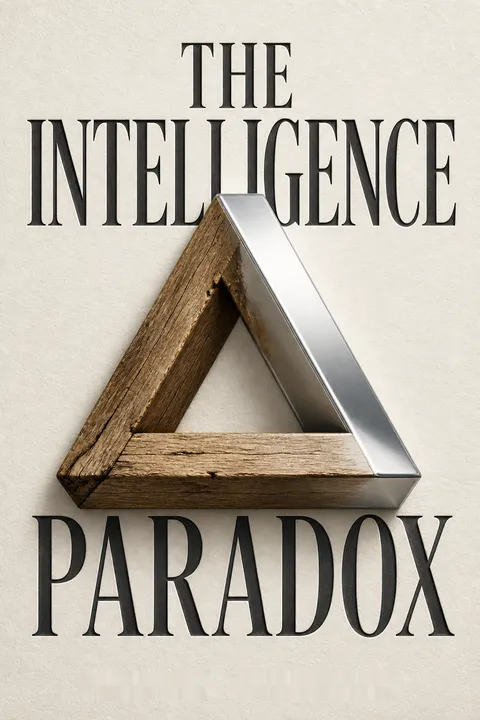


Key Takeaways
Use intelligence to explain adaptation, not to rank human worth.
A capacity, not a virtue. The book defines general intelligence as the ability to reason, think abstractly, recognize patterns, and apply knowledge in new situations. It argues that intelligence is a measurable human trait, not a score of someone’s moral value or overall merit. Its evidence draws on three large surveys: one measures verbal ability, another uses a vocabulary test, and a British birth cohort combines results from 11 cognitive tests to estimate general ability.
Keep the categories separate. Kanazawa compares intelligence with traits such as height: a measurable difference does not establish that one person is more worthy. This distinction is important because a test can predict some outcomes without measuring kindness, judgment, or the full range of human ability.
The distinction between predictive usefulness and human worth is the book’s most durable contribution. A measurement can help explain who tends to succeed in a particular institution without becoming a complete account of a person. The analogy to height is clarifying, though intelligence tests are not simple physical measures: performance can reflect schooling, health, language, and test conditions as well as cognitive ability. Rejecting moral rankings does not require treating every test as perfectly neutral or comprehensive.
Expect your brain to misread modern cues built outside ancestral life.
An old mind, a new setting. The Savanna Principle is the book’s claim that the brain can struggle with situations that did not exist in the environments where human psychological adaptations developed. Evolution, in this account, cannot prepare a species in advance for later inventions.
Modern examples make it vivid. Kanazawa points to research suggesting that familiar television characters can make people feel more socially connected, as if fictional relationships partly satisfy a need for friendship. In a computer game called Cyberball, people felt hurt when excluded from a ball-tossing game even when exclusion earned them money. The proposed explanation is that human minds learned to treat inclusion as beneficial and exclusion as dangerous, not to calculate the game’s unusual payoffs.
The framework helps explain why conscious knowledge and emotional response can diverge. Someone can know a television character is fictional and still feel attached; social pain can persist even when exclusion has a financial upside. Those observations make the ancestral-mismatch idea intuitive, but they do not prove that mismatch caused the response. Learning, social expectations, and experiment design are alternative explanations. The principle is most useful as a source of testable questions, not as a universal explanation for every modern discomfort.
General intelligence may be strongest when no inherited script fits.
A tool for the unfamiliar. The Savanna-IQ Interaction Hypothesis extends the Savanna Principle: people with greater general intelligence should be better at handling evolutionarily novel situations, while intelligence should matter less for familiar tasks shaped by long-standing adaptations. The book proposes that general intelligence itself may have evolved to help solve rare, new problems rather than the recurring challenges of ancestral life.
Novelty changes the prediction. A sudden fire, drought, or flood could demand improvisation, unlike routine tasks for which evolved instincts already supplied responses. The book cites studies in which intelligence did not predict wayfinding ability, an ancestral skill, while it did predict participation in some modern activities, such as exercise for health. These findings support a distinction between familiar and novel tasks, though the boundaries are not always clear.
This is a productive challenge to the idea that higher general ability should improve every skill equally. Expertise research also distinguishes flexible reasoning from practiced routines, which can depend on very different capacities. The difficulty is defining evolutionary familiarity independently of the results: if a task is labeled novel after an IQ association appears, the hypothesis risks explaining everything after the fact. Strong tests would classify tasks in advance and compare intelligence effects across them.
The Intelligence Paradox links IQ with preferences evolution did not design.
From ability to preference. The Intelligence Paradox applies the novelty argument to values. It proposes that people with higher general intelligence are more likely to understand and adopt preferences that would have been unusual in ancestral life. In the book’s formulation, comprehension is necessary for a preference, but it does not guarantee one.
Values become part of the explanation. Economic models can describe how people pursue what they want under constraints, but they often take those wants as given. Kanazawa argues that evolutionary psychology can help explain where preferences come from. His examples include concern for distant strangers, atheism, and voluntary childlessness, which he classifies as evolutionarily novel. That classification is the book’s central interpretive move, rather than a conclusion that the preferences are better or worse.
The effort to explain preferences, rather than treating them as fixed inputs, addresses a genuine gap in many models of choice. Yet understanding a preference does not require an evolutionary origin story alone. Institutions, education, social movements, and personal experience can also shape what people value, and culture can spread preferences far beyond the conditions in which they first arose. The framework gains explanatory power when these routes are tested against one another instead of treating intelligence as a direct cause.
Read IQ-linked politics and religion as associations, not proof of superior judgment.
Two striking correlations. In the American data discussed in the book, young adults who called themselves very liberal had an average adolescent IQ of about 106, compared with about 95 among those who called themselves very conservative. Those who described themselves as not religious also had higher average childhood scores than those who described themselves as very religious, about 103 compared with 97. The reported associations remain after the author controls for several demographic factors.
The proposed explanation. Kanazawa defines American liberalism partly as willingness to transfer resources to unrelated others, which he regards as evolutionarily novel. He describes religious belief as potentially arising from an agency-detection bias: under uncertainty, assuming an intentional agent may be safer than missing a real threat. These interpretations are hypotheses, not evidence that one political or religious group is wiser or more virtuous.
The data are memorable, but the labels need careful handling. Political ideology varies across countries and generations, and a single left-to-right scale can conceal different beliefs about economics, authority, and social life. Likewise, religious identity includes community, ritual, and moral practice, not only belief in supernatural agents. Statistical controls reduce some competing explanations but do not establish why the association exists. The book’s own operational definition of liberalism also narrows a broad political tradition to one form of redistribution.
Treat night-owl and music patterns as hypotheses, not proof of evolutionary novelty.
Modern tastes, mixed evidence. The book reports that more intelligent people tend to go to bed later, and that they show greater preference for instrumental music, including classical and easy-listening styles. Kanazawa’s explanation is that organized night life and purely instrumental music are relatively recent compared with daylight activity and vocal song.
The results do not all align. The book also finds higher intelligence associated with greater alcohol use, including binge drinking, in British and American samples. But tobacco results point in opposite directions in the two countries, and the drug-use results are mixed. Vegetarianism is strongly associated with childhood intelligence in one British cohort, but the association is much weaker in American data. The pattern invites explanation, but it is not uniform across behaviors or populations.
The cross-domain comparisons are engaging because they make the theory risky: it can be tested against patterns that do not fit neatly. The mixed findings are therefore as informative as the striking ones. However, calling a behavior evolutionarily novel does not by itself identify the mechanism behind an association. Country, generation, income, access, and changing social norms could all matter. The theory is strongest when it predicts differences before data are examined, rather than assigning novelty retrospectively to whichever behaviors correlate with IQ.
A stated preference for fidelity does not guarantee faithful behavior.
Values and actions diverge. Kanazawa reports that more intelligent boys were more likely to value sexual exclusivity as young men, while intelligence did not predict women’s stated value in the same way. Yet survey data showed a small positive association between intelligence and reported extramarital affairs for both sexes. The book’s point is that a preference does not dictate behavior, especially when circumstances and opportunities differ.
A broader evolutionary claim. The author argues that human ancestral marriage was often mildly polygynous, making strict sexual exclusivity comparatively new for men. He also stresses that observed affairs cannot be read directly from stated preferences. The available survey data do not account for every possible factor, including physical attractiveness and height, which the book identifies as related to intelligence and mating opportunities.
The distinction between stated values and behavior is valuable well beyond relationships. People can sincerely endorse a rule yet act differently under temptation, opportunity, or competing commitments. But the reported pattern does not establish that intelligence causes infidelity, nor does a male preference for exclusivity demonstrate a universal sex difference. The account of mating as primarily a matter of female choice is also too simple for modern relationships, where preferences, bargaining power, and decisions vary across people and contexts.
In one British cohort, higher-IQ women had fewer children, not men.
A specific cohort finding. The National Child Development Study followed people born in Britain in 1958. By ages 46 to 47, women with higher childhood intelligence were more likely to remain childless and had fewer children on average. The same pattern did not appear among men, even though more intelligent men had reported wanting fewer children when younger. The author reports that the association for women remains after controlling for factors including education, income, and marital history.
Do not overextend it. Kanazawa connects this finding to the evolutionary idea of reproductive success and raises the possibility that differences in fertility could affect average intelligence across generations. But one cohort cannot establish a general pattern across societies or prove a future population trend. The book’s own evidence points to a sex-specific result, not a simple rule that intelligent people universally have fewer children.
Longitudinal data strengthen this discussion because childhood test scores precede adult family outcomes. Still, temporal order is not the same as causal explanation. Fertility reflects partnership opportunities, health, contraception, economic conditions, and personal priorities, many of which change across generations. The further prediction about population intelligence requires additional assumptions about inheritance and who becomes a parent. A careful reading keeps the observed cohort result separate from the much broader forecast built upon it.
Separate evolutionary explanations from moral judgments and individual destinies.
An explanation is not an endorsement. The book distinguishes the naturalistic fallacy, treating what is natural as morally good, from the moralistic fallacy, assuming that what ought to be true must be biologically true. Kanazawa argues that evolutionary accounts should be assessed by logic and evidence, not accepted or rejected merely because their implications feel appealing or offensive.
Use the boundary both ways. An evolutionary explanation for a behavior does not make it desirable, inevitable, or appropriate policy. Nor does a moral commitment prove that people lack biological tendencies. The book’s central argument is about statistical patterns in preferences and outcomes. Those patterns cannot tell a reader what any individual should believe, whom to love, or whether to have children.
Separating description from prescription is an essential safeguard in behavioral science. It prevents biological explanations from becoming moral permission slips and prevents moral ideals from being mistaken for empirical evidence. The same discipline should apply to the book’s own claims: invoking evolution does not make a proposed explanation true, and an average association does not determine an individual’s choices. The strongest reading preserves the inquiry while demanding evidence for each causal step.
Analysis
The book’s organizing idea is both clear and ambitious: intelligence matters most when a person faces problems unlike those that shaped ancestral life, and this difference may help explain why intelligence correlates with preferences that appear counterintuitive. The framework gives readers a memorable way to connect topics as varied as politics, religion, music, substance use, mating, and fertility. Its most important conceptual move is to treat values as things requiring explanation, rather than as fixed assumptions in a model of choice.
The evidence is uneven by design and by source. The author draws on large surveys and longitudinal cohorts, sometimes measuring childhood ability before adult outcomes. That temporal structure is useful, but it cannot show that intelligence caused the outcomes. The measures also differ: some datasets capture verbal ability, others a broader cognitive factor, and outcomes range from self-reported beliefs to habits and family histories. Statistical controls help, but cannot eliminate unmeasured influences or guarantee that a proposed evolutionary mechanism is correct.
A second challenge is the classification of behaviors as evolutionarily familiar or novel. The distinction is illuminating when grounded in independent historical or anthropological evidence. It becomes less convincing when novelty is inferred from the same correlation it is supposed to explain. Cultural evolution further complicates the picture: new practices can become ordinary within a few generations, and inherited dispositions can be redirected by institutions and learning.
The book is strongest as a generator of comparative hypotheses, not as a final map of intelligence and human nature. Its moral caution is valuable, especially where it rejects equating cognitive scores with human worth. That caution should also restrain claims about reproductive success, group averages, and social policy. Biological fitness is a technical measure of gene transmission, not a universal definition of a meaningful life. Readers gain most by retaining the framework’s central question while treating each answer as provisional and independently testable.
Review Summary
The Intelligence Paradox received mixed reviews, with ratings ranging from 1 to 5 stars. Some readers found it thought-provoking and informative, praising its evolutionary psychology perspective on intelligence. Others criticized it for circular reasoning, oversimplification, and potentially offensive conclusions. The book explores why intelligent people may make seemingly unwise choices in areas like parenting and relationships. Critics argued that the author's interpretations of data were sometimes flawed or biased. Overall, readers found the book controversial and polarizing.
People Also Read





Glossary
Savanna Principle
Ancestral-mind mismatchThe claim that the human brain can have difficulty understanding and responding accurately to situations absent from the environments in which human psychological adaptations developed. Modern technologies, media, and institutions may trigger reactions shaped for older conditions. The principle describes a proposed constraint on cognition, not proof that every modern behavior is a mismatch.
Savanna-IQ Interaction Hypothesis
Intelligence and noveltyThe hypothesis that less intelligent people have greater difficulty than more intelligent people with evolutionarily novel situations, while intelligence makes little difference to handling evolutionarily familiar situations. It extends the Savanna Principle by proposing that general intelligence helps people manage problems for which ancestral adaptations provide no ready-made response.
Intelligence Paradox
IQ and novel preferencesKanazawa’s proposal that people with higher general intelligence are more likely to acquire preferences and values he considers evolutionarily novel, while intelligence has less effect on familiar preferences. The argument connects cognitive ability to what people want, not only to how effectively they pursue goals. It does not imply that such preferences are good, bad, or inevitable.
general intelligence
Shared reasoning abilityThe broad cognitive ability inferred from people’s performance across different mental tests, such as verbal comprehension, arithmetic, memory, and spatial reasoning. In the book, it refers to the common factor underlying those correlated abilities, rather than a talent in only one domain. The author treats IQ tests as measures of this general capacity.
evolved psychological mechanisms
Adaptations for mental tasksInnate psychological systems that evolutionary psychology proposes were shaped by natural or sexual selection to address recurring problems of survival or reproduction. The book describes many as domain-specific, meaning each handles a relatively narrow class of problems. Their proposed design reflects ancestral conditions and does not guarantee accurate responses in every modern setting.
Smoke detector principle
Bias toward false alarmsThe principle that a defensive system may be shaped to avoid rare but costly false negatives, even if this produces frequent false positives. A smoke alarm, for example, may be designed to signal possible danger when there is no fire because failing to signal during a real fire is much more costly. The book applies this logic to threat detection and religious belief.
naturalistic fallacy
Natural does not mean goodThe error of moving from a description of what is natural or common to a claim about what people ought to do. In the book’s discussion, an evolutionary account of a behavior cannot by itself justify that behavior morally or politically. Describing a tendency and endorsing it are separate kinds of claim.
moralistic fallacy
Good does not mean naturalThe error of assuming that a moral ideal determines biological reality. For example, the belief that people ought to be equal does not establish that every measurable human trait is identical across individuals or groups. The book argues that ethical commitments should not substitute for evidence when describing what is.
FAQ
What's The Intelligence Paradox about?
- Intelligence misconceptions: The book challenges the common belief that intelligence equates to human worth and character, highlighting this as a misleading notion.
- Intelligence vs. biological success: It argues that while intelligence is beneficial in modern contexts, it may not correlate with traditional biological success, such as reproduction and social relationships.
- Evolutionary psychology framework: Satoshi Kanazawa uses evolutionary psychology to explain how intelligence evolved and influences individual preferences and values, leading to the "Intelligence Paradox."
Why should I read The Intelligence Paradox?
- Challenging societal norms: The book encourages readers to rethink assumptions about intelligence and its implications for human behavior and societal values.
- Insight into human behavior: It offers a unique perspective on how intelligence affects preferences, values, and political ideologies, relevant for understanding contemporary social dynamics.
- Engaging and thought-provoking: Kanazawa presents complex ideas in an accessible manner, making it a compelling read for those interested in psychology, sociology, or evolutionary theory.
What are the key takeaways of The Intelligence Paradox?
- Intelligence is not everything: Higher intelligence does not guarantee success in life’s most important areas, such as relationships and parenting.
- Intelligence Paradox explained: More intelligent individuals may adopt evolutionarily novel preferences and values, sometimes counterproductive, leading to actions against their biological design.
- Political implications: Intelligence correlates with political ideologies, suggesting more intelligent individuals tend to lean liberal, affecting societal consequences.
What is the "Intelligence Paradox" as defined in The Intelligence Paradox?
- Definition of the paradox: The Intelligence Paradox states that more intelligent individuals are more likely to acquire evolutionarily novel preferences and values.
- Implications for behavior: Intelligent individuals may adopt values not aligned with their biological imperatives, leading to behaviors perceived as "stupid."
- Contrast with less intelligent individuals: Less intelligent individuals are more likely to hold values aligning with traditional evolutionary pressures, such as family and reproductive success.
How does Satoshi Kanazawa define intelligence in The Intelligence Paradox?
- General intelligence explained: Intelligence is defined as the ability to reason deductively or inductively, think abstractly, use analogies, synthesize information, and apply it to new domains.
- Misconceptions addressed: The book dispels myths about intelligence, such as the belief that IQ tests are culturally biased, arguing they accurately measure cognitive ability.
- Evolutionary perspective: Intelligence evolved as a response to novel problems faced by humans, distinguishing it from other domain-specific psychological mechanisms.
What is the Savanna Principle mentioned in The Intelligence Paradox?
- Definition of the principle: The Savanna Principle posits that the human brain struggles with entities and situations that did not exist in the ancestral environment.
- Implications for modern behavior: This principle explains why humans struggle with modern challenges that are evolutionarily novel, as our brains are wired for ancestral conditions.
- Connection to intelligence: The principle suggests less intelligent individuals may have greater difficulty adapting to novel situations than more intelligent individuals.
How does The Intelligence Paradox relate intelligence to political ideologies?
- Liberalism vs. conservatism: Kanazawa argues that more intelligent children are more likely to grow up to become more liberal than less intelligent children.
- Evolutionary context: Liberal values are evolutionarily novel, involving altruism towards unrelated individuals, contrasting with the evolutionary design to favor kin.
- Statistical evidence: Data shows higher childhood IQ correlates with liberal political views in adulthood, reinforcing the connection between intelligence and political ideology.
What are some misconceptions about intelligence that Satoshi Kanazawa addresses in The Intelligence Paradox?
- Cultural bias in IQ tests: Kanazawa argues against the misconception that IQ tests are culturally biased, stating they measure reasoning ability without cultural influence.
- IQ vs. intelligence: He clarifies that IQ tests accurately reflect general intelligence, countering the belief that they do not measure what they claim to.
- Heritability of intelligence: The book discusses the misconception that intelligence is solely determined by the environment, emphasizing that genetics play a significant role in determining IQ.
How does The Intelligence Paradox explain the relationship between intelligence and religiosity?
- Atheism and intelligence: Kanazawa posits that more intelligent individuals are more likely to be atheistic than less intelligent individuals, suggesting a correlation between higher IQ and lower levels of religious belief.
- Evolutionary origins of religion: Religious beliefs may stem from an evolutionary bias to overinfer agency in ambiguous situations, rather than being an adaptation.
- Statistical findings: Data shows higher childhood IQ is associated with lower levels of religiosity in adulthood, reinforcing the connection between intelligence and belief systems.
What are the best quotes from The Intelligence Paradox and what do they mean?
- "Intelligence is just one of many traits that humans possess." This quote emphasizes that intelligence should not be equated with human worth, suggesting other traits like kindness or social skills are equally important.
- "Voluntary childlessness is the greatest crime against nature." Kanazawa argues that choosing not to have children goes against the evolutionary drive for reproduction, provoking thought about societal values.
- "Intelligent people make the worst kind of parents." This assertion highlights that intelligent individuals may prioritize careers over parenting, challenging readers to consider the effects of intelligence on family dynamics.
How does The Intelligence Paradox address the concept of marriage?
- Marriage and intelligence: Kanazawa discusses the correlation between average intelligence in a population and the prevalence of monogamous versus polygynous marriage systems.
- Impact of income inequality: Income inequality influences marriage patterns, with women more likely to share a wealthy man in polygynous societies, reflecting evolutionary pressures.
- Intelligence and marital satisfaction: Intelligent individuals may struggle with marital satisfaction due to differing values and priorities, leading to higher rates of divorce and dissatisfaction.
What are the implications of The Intelligence Paradox for personal choices?
- Rethinking success: The book challenges readers to reconsider what constitutes success, suggesting traditional markers like career achievement may not lead to personal fulfillment.
- Awareness of biases: Kanazawa highlights biases intelligent individuals may hold, particularly regarding their own choices and values, leading to more informed decision-making.
- Encouraging balance: Advocates for a balance between intelligence-driven choices and more instinctual behaviors, potentially leading to greater satisfaction in life.
Download PDF
Download EPUB
.epub digital book format is ideal for reading ebooks on phones, tablets, and e-readers.








