

Key Takeaways
Make research a daily literacy, not a last-resort Google search
Search is only the start. Daniel Russell argues that research belongs beside reading, writing, and arithmetic as a basic skill. Search engines can return a population figure in seconds, but answering a difficult question takes more: choosing useful terms, finding appropriate collections, judging evidence, and understanding what the results actually mean. The goal is not to become a professional scholar. It is to become more capable of learning at school, at work, and in ordinary life.
Tools need fluent users. Russell has spent years studying search at Google and sees people waste half an hour on questions that could take minutes, or accept weak results when stronger ones are available. Search fluency makes the internet an instrument for investigation, rather than a pile of instant answers. The practical invitation is simple: notice what makes you curious, then learn how to find out.
What's distinctive here is the shift from search as a convenience to research as a civic and personal capacity. A quick answer can make a person feel informed while leaving the source, scope, and uncertainty invisible. Research literacy counters that false confidence by teaching people to inspect how an answer was assembled. The ideal is not endless skepticism: routine questions do not all need a scholarly audit. The skill lies in recognizing when the stakes, ambiguity, or surprise justify looking beneath the first result.
Write the question before searching, especially when it sounds obvious
Define the target. Before opening a search engine, write down what you want to know and what would count as a satisfactory answer. This brief pause exposes hidden choices. Asking when oil was first discovered in California could mean when people first noticed natural oil, when a well produced oil, or when oil became a commercial product. Those are different questions with different answers.
Keep a record of assumptions. Russell also recommends writing down initial guesses before researching. When he investigated US deaths, he expected accidents to be a leading cause. The CDC's 2015 figures instead placed heart disease and cancer first, together accounting for 45 percent of deaths, while accidents accounted for 5.4 percent. Recording the guess made the correction visible instead of letting memory quietly rewrite the prediction.
Writing a question is a small form of experimental design. It distinguishes the claim being tested from the wording that happens to express it, and recording a prediction makes it harder to claim afterward that the result was obvious. This practice is especially valuable when a term such as first, safest, or most common hides several possible definitions. Its limit is that a written question can still encode assumptions. A useful next move is to ask what alternative interpretation a reasonable person might give it.
Treat every query as a probe, then change tools with the clues
Start simply, then adapt. A short search such as killer lake led Russell to Lake Nyos in Cameroon, where a 1986 release of carbon dioxide killed nearly two thousand people. Once he learned the term limnic eruption, a specialized name for a sudden release of dissolved gas from deep lake water, he could find technical explanations and scientific papers. A focused search of the US Geological Survey's site helped locate expert reports.
Match the tool to the evidence. A photograph may call for image search, zooming, or Google Earth. A broad landscape question may need maps at several scales. Adding a context term such as diagram can favor diagrams, while the site: operator restricts results to one domain. The key is not memorizing tricks. It is using each result to decide what information, vocabulary, or tool is needed next.
The search process here resembles iterative measurement: each query tests a small hypothesis about where useful evidence might live. That is more reliable than expecting one perfectly phrased question to do all the work. Tools also shape what becomes visible. A map emphasizes spatial patterns, while a scholarly database surfaces technical vocabulary and specialist claims. The caution is that a better-fitting result set is not automatically a truer one. Search operators narrow the field; they do not certify the evidence inside it.
Count independent evidence, not the number of websites repeating a claim
Trace claims to their source. Russell found conflicting accounts of California's earliest oil production. Some called the 1876 Pico No. 4 well the first successful commercial well; other records described oil shipped from the Union Mattole Company in 1865. The dispute became clearer once he separated first observation, first production, and first sustained commercial success. The evidence supported commercial sales from Mattole in 1865, while Pico No. 4 became the longer-lived producer.
Copies do not corroborate. In another investigation, identical US death totals appeared in both CDC and United Nations material. The matching numbers were not independent confirmation: the UN was using US health statistics. Repeated wording across websites can likewise expose copying rather than separate research. Check publication dates, definitions, footnotes, and the original source before treating multiple links as multiple witnesses.
This is a useful distinction between abundance and corroboration. On the web, repetition can create an illusion of consensus because copied claims travel farther than their original evidence. Source tracing is therefore a form of dependency analysis: the question is not merely how many citations exist, but whether they arise from genuinely separate observations or datasets. Yet independence alone does not guarantee quality. A primary record can be incomplete, and an official institution can have limits or interests. Provenance and interpretation both matter.
Test the explanation that fits, then actively search for its rival
Plausible is not proven. Russell noticed bare patches around shrubs in California chaparral. Early search results suggested allelopathy, a process in which one organism releases chemicals that inhibit another plant's growth. But later research questioned whether chamise caused these gaps. Experiments showed that animals feeding near shrubs could also suppress seedlings, and the gaps appeared around coyote brush too. Field observations helped reveal that patch size and slope might matter, though Russell was careful to say his informal checks were not a proper study.
Inspect the source, not just the claim. When evaluating a striking image of a fly with insect-like wing markings, he checked the photographer's identity, consulted an entomologist, and compared the pattern with related flies. A publication that visibly corrects an earlier account can be more trustworthy than one that never acknowledges error. Expertise, evidence, and openness to alternatives are stronger signals than confident language.
The plant example captures confirmation bias in a concrete way: once a plausible mechanism is found, later observations can be forced to fit it. Looking for a rival explanation improves the inquiry by making the preferred account compete with alternatives. The editorial value is also in the restraint: Russell's walk in the field provides clues, not proof. Informal observation can generate hypotheses, but causal claims require controlled comparisons and careful measurement. That distinction lets curiosity remain productive without pretending that every curious person has completed a scientific study.
Translate names across time and culture before declaring a source missing
Search in the language of the evidence. Terms change, and historical sources may use words that have vanished from everyday speech. Civil War records may call diarrhea flux or quickstep; an eighteenth-century account of a stroke may use apoplexy. Old newspapers and books can reveal which terms people actually used, while tools such as Google Books' Ngram viewer can help estimate when a phrase became common.
Places change names too. Los Angeles was once described by a much longer Spanish name, and the Tongva village in the region appears in sources with different spellings. Comparing Wikipedia articles in different languages can also expose cultural differences in emphasis and depth. These comparisons are useful leads, not final authority: translation can blur meaning, and a popular spelling may lack a well-documented origin. Follow citations and consult specialists when the naming question matters.
Searching is partly a problem of vocabulary, and vocabulary is historically and politically situated. A missing result may indicate that the searcher is using the wrong era's language, not that the record does not exist. Cross-language comparison can expose whose perspective is centered in a reference work, though article length alone cannot establish greater accuracy or cultural authenticity. A strong approach combines language tools with dated primary material and expert knowledge, while treating every translation as an interpretation rather than a transparent window.
Use maps, archives, and experts when the web reaches its edge
Online clues can lead offline. A phone photo of wreckage near San Francisco included location metadata, called EXIF, that recorded latitude and longitude. A map label identified it as the Garden City, a ferry later burned in a 1983 fire. Newspaper archives and local historical collections filled in the story. When investigating whether naval officer Matthew Perry visited the Greek island of Delos, Russell followed online references to a finding aid, a guide to where archival material is held, then read ship logs and letters in physical libraries.
The web is not the whole record. Some useful collections are digitized, searchable, and easy to reach. Others are only discoverable through catalogs, archivists, librarians, or a visit. Asking an expert a focused question, or requesting material through a library, can move a stalled inquiry forward.
The movement between online and physical research is not a retreat from technology; it is a recognition that discovery and access are different problems. Search engines can reveal that a document exists without making the document readable. Archives preserve context that a short web snippet cannot supply, while maps and metadata can make a physical object findable. The practical limitation is uneven access: travel, time, permissions, and library resources are not equally available. A good research plan should use remote access when possible and treat local institutions as collaborators, not merely as last resorts.
Stay curious enough to follow clues, disciplined enough to stop
Let evidence refine the question. Russell's search for a connection between Francis Scott Key and British General Robert Ross began with a half-remembered name on a gravestone. Each new detail changed the inquiry: a search result connected Ross to the burning of Washington, while book research clarified when Key and Ross had met and when Ross died. The path was not linear, but writing down the original question helped keep the investigation oriented.
Protect attention from the rabbit hole. Curiosity can produce useful side discoveries, but each new lead can become a separate project. Russell suggests writing a short account of what the evidence shows, checking whether the pieces fit, and setting a time limit when necessary. Stop when the question is answered well enough, or when further searching no longer adds useful information. Save an interesting new question for another session rather than confusing it with the one at hand.
Good inquiry requires two seemingly opposite capacities: openness to unexpected connections and resistance to distraction. The gravestone story shows how prior knowledge helps a detail become a clue, while a written question serves as an external reminder of the task. This resembles attention management in other complex work: exploration generates possibilities, and synthesis decides which deserve commitment. A stopping rule should not be mistaken for certainty. It means the evidence is sufficient for the purpose, with remaining uncertainty stated rather than hidden.
Learn how information is organized, because no engine sees it all
The information landscape has gaps. Russell argues that content is divided among specialized databases, books, archives, maps, news collections, and commercial services. Some material is paywalled, some is not indexed, and some disappears when a site closes. A broad search engine can help locate these resources, but it cannot replace knowing that a specialized collection exists or understanding what it covers.
Tools change, judgment persists. The book anticipates improvements in image recognition, spoken search, and question answering, while stressing that results still need context and evaluation. A system may identify a beach in an unlabelled photograph, but it cannot make every source independent, current, or credible. The durable skill is matching a question to the right collection, checking what the collection omits, and recovering when a link or resource fails.
This is a strong argument against technological complacency. A polished answer interface can hide the boundaries of its index, turning absence from search into the mistaken belief that no evidence exists. The more capable automated retrieval becomes, the more important it is to distinguish a fluent answer from a well-supported one. At the same time, no individual can master every database or archive. Research literacy is therefore less about exhaustive tool knowledge than about recognizing uncertainty, locating likely repositories, and asking what the system has not shown.
Analysis
The book's central achievement is to make research visible as a sequence of decisions rather than a mysterious gift possessed by experts. Its stories begin with ordinary triggers: a strange flower, a map, a damaged ferry, a name on stone. Each grows into a practical demonstration of how a researcher frames a question, locates terms, changes tools, checks sources, and revises an explanation. The narrative form matters. Readers see missteps and dead ends, so searching appears as iterative work rather than a magic query that produces truth.
Its strongest intellectual contribution is a model of evidence that includes provenance and context. Matching numbers may come from one dataset; copied prose does not create consensus; and a seemingly simple word such as first can conceal incompatible definitions. These lessons align with broader concerns in data literacy: evidence is not just a claim, it is a claim with a production history, measurement choices, and limits. The book also treats search interfaces as instruments with affordances, not neutral windows onto all knowledge.
The approach has limits worth keeping in view. The case studies often benefit from an unusually persistent researcher with specialist access, time, and confidence contacting experts or visiting archives. That makes the method inspiring, but not every everyday decision can justify hours of investigation. The practical standard should scale with stakes: a casual curiosity may need a quick check, while health, policy, or reputational claims warrant deeper verification. In addition, examples tied to particular search products and websites can age quickly. The lasting value lies not in memorizing a menu or operator, but in learning to ask what a tool can see, what its evidence depends on, and what would change one's mind.
Ultimately, the book teaches a disciplined form of curiosity. It asks readers to notice anomalies, preserve their uncertainty, and pursue evidence without mistaking persistence for proof. Research becomes a repeatable craft: curious enough to discover, skeptical enough to verify, and focused enough to finish.
Review Summary
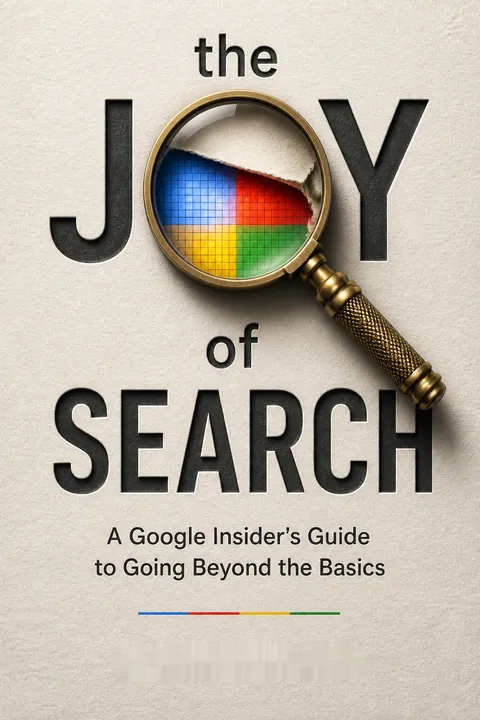
The Joy of Search receives mixed reviews, with ratings ranging from 1 to 5 stars. Positive reviews praise its insights into effective Google searching techniques and the author's engaging style. Critics find it repetitive and basic. Many readers appreciate the practical tips and research lessons, particularly in the final chapters. Some consider it best suited for novice researchers or students. The book's structure, featuring search examples and challenges, is generally well-received, though some find the content obvious or too focused on Google-specific tools.
People Also Read







Glossary
context term
result-type cueA word added to a search query to signal the kind of result being sought. Terms such as diagram, overview, or glossary can steer results toward a particular format or use. Context terms do not guarantee relevance, but they can reduce noise and make it easier to find material suited to the task.
site: operator
domain search filterA search operator that limits results to pages from a specified website or domain. For example, adding site: to a query can focus a search on a government agency or university's materials. It is useful for locating specialist information, but the restriction only narrows the search and does not verify the accuracy of the pages returned.
limnic eruption
sudden lake gas releaseA rare event in which dissolved carbon dioxide, accumulated in deep lake water, is released suddenly and forms a dangerous gas cloud. At Lake Nyos in Cameroon in 1986, such a release killed nearly two thousand people nearby. The specialized term helps searchers locate scientific explanations and technical reports about the phenomenon.
lateral reading
check sources across sitesA way of evaluating online information by opening other sources to investigate the author, organization, and claims, rather than relying only on the page being read. The comparison helps establish expertise, reputation, and context. Russell describes using parallel searches to clarify unfamiliar terms and assess whether a source is credible.
EXIF metadata
embedded photo informationInformation stored within many digital image files, including technical camera settings and, when recorded by a phone, sometimes geographic coordinates. In the book, the coordinates in a photograph helped identify the location of a shipwreck. Metadata can guide an investigation, although it may be missing, inaccurate, or removed.
finding aid
archive collection guideA guide that describes archival materials and indicates where they are held, often including collection names, dates, and identifiers. It is not the archival document itself. Finding aids help researchers move from a mention in a book or catalog to the institution and specific collection where original logs, letters, or other records can be consulted.
gazetteer
geographic reference directoryA reference work that organizes information about places, including names, locations, and geographic or social details. A historical gazetteer can help trace how place-names and political boundaries change over time. It is particularly useful when a modern search term does not match the name used in an older document.
FAQ
1. What is The Joy of Search by Daniel M. Russell about?
- Comprehensive guide to online research: The book teaches readers how to go beyond basic Google searches, offering practical strategies for finding accurate, credible, and complete answers online.
- Real-world examples and stories: Daniel M. Russell uses sixteen engaging stories and research challenges to illustrate step-by-step search techniques and critical thinking.
- Emphasis on lifelong learning: The author argues that research is an essential skill for everyone, positioning it as the "fourth R" of education alongside reading, writing, and arithmetic.
- Focus on digital literacy: The book highlights the importance of understanding how to frame questions, use search tools, and interpret results in today’s information-rich world.
2. Why should I read The Joy of Search by Daniel M. Russell?
- Improve online research skills: The book provides actionable methods to ask better questions and use search engines more effectively, saving time and increasing accuracy.
- Learn to evaluate information quality: Readers gain tools to assess the credibility of sources and avoid misinformation, a crucial skill in the digital age.
- Prepare for future search trends: The book discusses emerging technologies like AI and voice search, ensuring readers’ skills remain relevant.
- Rediscover the joy of discovery: Russell aims to make research engaging and rewarding, fostering curiosity and a love for learning.
3. What are the key takeaways from The Joy of Search by Daniel M. Russell?
- Critical thinking is essential: The book stresses the importance of skepticism, verifying sources, and triangulating information from multiple reputable sources.
- Framing questions matters: Writing down and clarifying research questions before searching leads to more focused and effective results.
- Use advanced search techniques: Employing operators, specialized tools, and domain-specific resources can dramatically improve search outcomes.
- Persistence and adaptability: Great researchers are resilient, willing to change strategies, and know when to stop searching.
4. What are the best quotes from The Joy of Search by Daniel M. Russell and what do they mean?
- “Research is the fourth R.” This quote emphasizes that research skills are as fundamental as reading, writing, and arithmetic in modern education.
- “Serendipity favors the prepared mind.” Russell highlights that being knowledgeable and attentive increases the likelihood of making unexpected, valuable discoveries during research.
- “Know when to stop.” The author reminds readers that endless searching can be counterproductive; setting goals and recognizing when you have enough information is key.
- “Be skeptical, but not cynical.” This advice encourages readers to question information critically without dismissing everything outright.
5. What research skills and attitudes does Daniel M. Russell teach in The Joy of Search?
- Careful question framing: Writing down and refining your research question helps clarify your goals and search terms.
- Critical and lateral thinking: The book encourages skepticism, cross-checking sources, and using lateral reading to understand broader contexts.
- Persistence and curiosity: Great researchers are resilient, willing to follow leads, and open to changing their approach when necessary.
- Awareness of context: Understanding the context of information, including time, place, and terminology, is crucial for accurate research.
6. How does The Joy of Search by Daniel M. Russell recommend using Google and other search tools more effectively?
- Use concise and clear queries: Formulate searches with precise keywords or well-structured questions for better results.
- Leverage advanced operators: Utilize tools like site:, Boolean operators, and the minus sign to refine and target searches.
- Explore visual tools: Google Earth and Street View can help verify locations and gather geographic context for research questions.
- Search by image and within books: Upload images to Google Images for identification and use Google Books’ “Search in this book” for targeted text searches.
7. What does Daniel M. Russell say about the importance of specialized terms and domain-specific knowledge in online research?
- Learn and use key terms: Discovering the right terminology (e.g., “limnic eruption”) can significantly improve search precision and depth.
- Contextual understanding: Knowing specialized or historical terms helps avoid confusion and ensures more relevant results.
- Combine with expert sources: Pairing domain-specific terms with authoritative sites (like USGS.gov) yields more credible and detailed information.
- Adapt to changing language: Recognize that terminology evolves, and historical research may require finding and using archaic or obsolete terms.
8. How does The Joy of Search by Daniel M. Russell address challenges with changing or ambiguous terminology and names?
- Track historical changes: The book explains how place and personal names, as well as terminology, can change over time and across languages.
- Use specialized resources: Gazetteers, place-name dictionaries, and historical thesauruses help identify correct terms for different periods.
- Clarify question context: Defining geographic, temporal, and linguistic context avoids confusion and leads to more accurate results.
- Verify term usage: Always check that the terms or names you use were appropriate for the time and place you’re researching.
9. What strategies does Daniel M. Russell recommend in The Joy of Search for evaluating the credibility of online information?
- Check author expertise: Investigate the background and authority of the source or author on the topic.
- Look for transparency and corrections: Trust sources that openly admit errors and update their content, such as reputable news outlets.
- Triangulate information: Cross-check facts across multiple reputable sources to confirm accuracy and avoid duplicated misinformation.
- Be aware of confirmation bias: Actively seek out alternative viewpoints and avoid only looking for information that supports your assumptions.
10. How does The Joy of Search by Daniel M. Russell suggest handling complex or conflicting information online?
- Organize and compare findings: Take notes on competing claims, including sources, dates, and evidence, to systematically evaluate them.
- Understand data context: Pay attention to how and when data was collected, definitions used, and potential biases in sources.
- Refine your questions: Be prepared to reframe or narrow your original question as new information and nuances emerge.
- Use timelines and context: Creating timelines and understanding the broader context helps clarify complex or ambiguous research questions.
11. What practical “How to Do It” tips does Daniel M. Russell provide in The Joy of Search for better online searching?
- Zoom in on images: Use browser tools or image editors to magnify details and extract clues from photos.
- Use advanced search operators: Employ the * operator for fill-in-the-blank searches, site: to restrict domains, and double quotes for exact matches.
- Explore with Google Earth and Street View: Virtually investigate locations to verify visual information and gather context.
- Search by image and within books: Upload images for identification and use “Search in this book” features for targeted research in texts.
12. What future trends in online search and research does Daniel M. Russell predict in The Joy of Search?
- Rise of mobile and voice search: Increasing use of phones and spoken queries will change how people interact with search tools.
- AI-powered search assistance: Artificial intelligence will enhance entity recognition, question answering, and personalized help, making search more conversational.
- Diverse content types: Growth in videos, 3D models, and virtual reality will require new search methods and media literacy.
- Fragmented information landscape: Content will remain splintered across silos, with paywalls and legal restrictions affecting access, making research skills even more vital.
Download PDF
Download EPUB
.epub digital book format is ideal for reading ebooks on phones, tablets, and e-readers.








