

Key Takeaways
Treat every utterance as a move in a shared improvisation
Communication starts in action. In 1769, Captain Cook’s crew and the Haush people of Tierra del Fuego met without a shared language. The Haush showed their sticks, then put them aside, signaling peaceful intent. They exchanged food and gifts by interpreting gestures in context, not by decoding a common code. The encounter suggests how people can improvise signs when communication is urgently needed.
Repetition builds a system. Deaf children in Nicaragua, initially taught spoken Spanish with little success, developed a shared sign language among themselves. Early signs for a horse varied from child to child; later generations converged on a simpler shared sign. The authors’ point is not that language began in literal charades, but that repeated attempts to understand one another can create conventions without anyone planning a language.
The strength of this account is that it makes communication an activity between people, not a package sent from one mind to another. This aligns with research on joint action: partners coordinate by watching one another, adjusting, and repairing misunderstandings as they go. The Cook and Haush episode also deserves its colonial setting. Their successful exchange shows human ingenuity, but it does not make the encounter equal or erase the harms that followed European settlement. A useful distinction is between evidence that people can improvise communication and proof of exactly how language first arose. The book offers the former, not a time machine to the latter.
Give listeners clues they can solve, not messages they must decode
Words are only the visible tip. A phrase rarely carries a complete meaning by itself. The authors call the unspoken cultural, social, emotional, and factual knowledge supporting an utterance the communication iceberg. A short classified notice about unused baby shoes, for instance, can prompt readers to imagine bereaved parents, although the words do not state that story. Meaning is assembled by the reader from clues and background knowledge.
Understanding is collaborative. In a Lego-building study, one person described a model to another who had to recreate it. When a barrier prevented the director from seeing the builder’s progress, the task took more than twice as long and required nearly twice as many words. Recorded instructions without interaction worked worse still. Communication improves when speakers monitor what listeners know and adapt their clues.
This model usefully reframes empathy as a practical communication skill. A doctor, mechanic, or teacher cannot assume that technically accurate wording produces understanding; the recipient’s expectations and knowledge shape the result. It also connects to distributed cognition: a conversation can function like a shared workspace in which each person contributes information and corrections. Still, inference is not automatically accurate. Listeners can fill gaps with stereotypes or mistaken assumptions, so good communicators need both perspective-taking and checks for understanding. The goal is not to guess another person’s mind perfectly, but to make it easy for them to correct the guess.
Chunk speech immediately because memory cannot hold the full stream
Language faces a bottleneck. The Now-or-Never bottleneck is the pressure to interpret incoming speech before it disappears from short-term memory. People can hold only a few ungrouped items at once, while speech arrives at roughly ten to fifteen sounds per second. The brain copes by chunking sounds into syllables, words, phrases, and larger stretches of discourse, using context to settle on an interpretation quickly.
Practice makes chunks usable. A random string of twelve letters is difficult to remember, but the same letters arranged as familiar words are easier because they become just two chunks. Speaking uses the reverse process: a rough idea is broken into phrases and words just in time, rather than planned in full detail. Common multiword expressions make up about half of everyday language, giving speakers reusable chunks under time pressure.
The bottleneck offers a strong bridge between memory science and ordinary conversation. Fluent speech looks effortless partly because familiar patterns reduce the amount of information that must be handled at once, much as expertise lets a chess player recognize positions rather than inspect every piece independently. This also explains why distraction can make a conversation suddenly incomprehensible: the stream continues, but the listener loses the chance to organize it. The account should not be mistaken for a claim that every utterance is parsed perfectly on arrival. People often settle for a workable gist, then use questions and repairs when the first interpretation fails.
Let usage, not dictionary essences, explain what words mean
Words have overlapping uses. The authors draw on Wittgenstein’s idea of family resemblance: members of a category may resemble one another in overlapping ways without sharing one defining feature. The word light can describe a meal, a color, a military unit, or a piece of music, with connections that shift by context. Its dictionary entry collects examples and uses; it does not uncover one hidden essence that explains them all.
Everyday meaning can be shallow. Psychologist Susan Carey recorded her young daughter reasoning that a toy bear was neither simply alive nor dead, and wondering how dead people used the bathroom. The child could still use these words effectively in ordinary situations. The authors argue that communication usually requires enough understanding for the task at hand, not a complete theory of life, fairness, or any other difficult concept.
This view explains why ordinary conversation succeeds despite philosophical disputes about concepts such as justice, life, and meaning. Shared use supplies practical criteria long before anyone settles a universal definition. It also warns against assuming that a dictionary definition captures how a term works in a community. Yet context-sensitive meaning does not make precision irrelevant. Medicine, law, and science often need explicit operational definitions precisely because everyday use leaves edge cases unresolved. The useful distinction is between language as a flexible tool in routine interaction and specialized vocabulary designed to make certain decisions more consistent.
Build grammar from reused phrases instead of expecting a perfect blueprint
Patterns emerge from pieces. Construction grammar treats learned pairings of form and meaning, from word endings to familiar phrases and flexible sentence patterns, as building blocks of language. Children often begin with whole expressions and gradually adapt them. A child who says “no bed” may use the phrase to refuse bedtime, deny being tired, or report that a bed is missing; the situation helps listeners infer the intended message.
Grammar has a history. Grammaticalization is the process by which ordinary words and phrases gradually take on grammatical roles. Repeated forms can erode, fuse, and change meaning. English “going to” has shortened in speech, while French “pas,” once meaning a step, became part of a standard way to express negation. Languages change through such accumulated shifts. Their irregularities are evidence of history, not proof that speech is collapsing into disorder.
The account makes grammar less like a machine designed in advance and more like a set of habits stabilized through repeated use. That perspective helps explain why familiar expressions can be both highly conventional and surprisingly flexible. It also suggests why language reformers often misread change: a form that looks like decay from one generation’s vantage point can become useful convention for another. However, spontaneous order should not be treated as a guarantee of perfect efficiency. Historical leftovers and competing patterns persist, and speakers may have to learn them through exposure rather than logic. A language can be workable without being tidy.
Learn language as culture, not as a hidden natural law
Children follow shared conventions. The authors distinguish N-learning, learning about a world whose facts do not depend on agreement, from C-learning, learning conventions by coordinating with other people. A ball’s trajectory depends on physical forces; whether a nod means yes depends on the community. Language learning is chiefly C-learning: children acquire patterns by joining interactions with people who learned them in similar ways.
Transmission reshapes language. In game-of-telephone experiments, participants passed artificial systems to new learners. Over generations, random labels developed reusable sound parts for different meanings, and meaningless letter strings became easier to remember through repeated chunks. These studies show how cultural transmission can create structure without a designer. The authors argue that language changes too quickly for genes to encode its specific grammatical patterns. FOXP2 disruptions can affect language, but the book presents evidence that the gene is also involved in broader sequence learning.
The distinction between learning nature and learning convention clarifies why a child need not solve language as an outside scientist would. The child’s task is to converge with a community, and the community’s patterns already reflect the learning biases of earlier generations. This is a powerful alternative to the false choice between a complete genetic grammar and an entirely blank slate. The lab chains make the mechanism plausible, but artificial labels are simpler than real social histories. They demonstrate that structure can emerge through transmission, not that every feature of human language arose by the same route.
Give children engaged conversation, not just more words
Interaction builds skill. A child learns language by taking part in exchanges, not simply by overhearing a large vocabulary. The book revisits the often-cited word-gap study, which estimated that children in its lowest-income families heard thirteen million words by age three, compared with forty-five million in its highest-income families. Later research suggested the famous thirty-million-word difference reflects extreme groups; one estimate put the gap closer to four million. These figures do not mean that lower-income children lack normal language ability.
Turn-taking matters. Studies discussed by the authors find that conversational exchanges predict children’s language skills better than the number of words adults say around them. Children on Rossel Island learn Yélî Dnye despite hearing less adult-directed speech than many children in industrialized settings. Their input often comes in concentrated social bursts. The practical emphasis is on responsive conversation around what interests the child, not on word-count targets.
This shift from word volume to interaction matters because it treats children as participants rather than containers. Back-and-forth talk gives them a reason to interpret, respond, and adjust, all of which exercise the skills language depends on. The evidence also challenges policies that turn family life into a tally of spoken words. Still, the book’s account does not make resources irrelevant. Poverty, discrimination, school expectations, and access to books or responsive adults shape what children can learn and how their abilities are judged. Conversation is a meaningful support, not a substitute for addressing those structural conditions.
Treat linguistic diversity as evidence of invention, not imperfection
Languages take different paths. More than seven thousand spoken languages, along with over 140 sign languages, vary in sound, word order, grammar, and how they divide up meaning. Danish offers a striking case: it has more than forty vowel sounds, often softens consonants, and can blur word boundaries. Danish children learn some language patterns more slowly than children learning closely related Norwegian or Swedish. Yet Danish speakers become skilled users of their language and draw heavily on context to understand speech.
Variation exists within languages too. Laura Bridgman, who lost sight and hearing as a child, learned English through raised letters and touch, then developed personal abbreviations and expressions. The authors call each person’s distinctive collection of words and patterns an idiolect. Shared conventions make these individual versions close enough for communication, without requiring one single, perfect English or universal grammar.
Linguistic diversity is valuable not merely as cultural heritage but as evidence about the range of solutions human communities can develop. Danish shows that a language’s sound system can shape the listener’s strategy, while Bridgman’s story makes individual adaptation vivid. The diversity argument also has a methodological consequence: theories built mainly from familiar European languages risk mistaking local features for human universals. At the same time, “no universals” is a stronger claim than the examples alone establish. Broad recurring tendencies can coexist with important exceptions, and documenting variation is the way to tell the difference.
Use language to accumulate culture and reshape what thought can do
Communication scales cooperation. The book calls language an eighth major transition in evolution because it allows knowledge, skills, and social rules to accumulate across generations. People can teach toolmaking, organize trade, argue about laws, and pass on discoveries instead of forcing each generation to start from scratch. The authors suggest a virtuous circle: communication supports richer culture, richer culture rewards greater cognitive flexibility, and more capable communicators can support more complex cooperation.
Words make some thoughts easier. The numeral zero was not useful as a sound alone; it became powerful within shared practices of counting, notation, and calculation. Tseltal speakers describe space using landscape directions rather than general terms for left and right, illustrating a different habitual way to organize spatial talk. Language can guide attention and thought, the authors argue, without permanently limiting what a person can learn or imagine.
The strongest claim here is not that language creates intelligence from nothing, but that it lets minds pool knowledge and preserve useful discoveries. This resembles distributed cognition: a group can solve problems that no isolated member could manage, provided information can be stored and coordinated. The proposed brain-culture feedback loop is compelling, but its evolutionary history remains difficult to establish, and the book acknowledges alternatives in which language followed rather than drove increased intelligence. The more secure conclusion is cultural: once language exists, it dramatically increases the speed and reach of collective learning.
Treat fluent AI as statistical performance, not proof of understanding
Fluency can be deceptive. The authors examine GPT-3, a 2020 language model trained on an enormous collection of text. It could imitate a literary style, answer many factual questions, and produce plausible responses. But in examples discussed in the book, it answered that a person’s foot had two eyes and gave a confident answer to a nonsensical question about jumping between Hawaii and seventeen. The authors argue that a system can generate convincing language by learning patterns without understanding the world those words describe.
Performance needs interpretation. The book compares such AI to a motorcar that transports people without being an artificial horse. Machines can perform useful tasks through methods unlike human communication. The authors therefore reject the idea that language fluency alone establishes humanlike intelligence or an imminent technological singularity. Their case concerns the systems they discuss, not a guarantee that future AI cannot develop different capacities.
The caution remains useful: fluent output is not, by itself, evidence that a system shares human background knowledge, goals, or experience. A test that rewards plausible sentences can mistake statistical fit for understanding. But the analogy between current AI and vehicles also leaves an open question: a system need not reproduce human cognition to acquire capabilities that matter socially or economically. The book is strongest when separating impressive task performance from humanlike comprehension, and less conclusive when using that distinction to reassure readers about future risks. Those are related debates, but not identical ones.
Analysis
The book’s central move is to replace language as a fixed code with language as collaborative improvisation. That move joins three scales that are often treated separately: the moment-by-moment work of conversation, the cognitive limits of individual learners, and the historical accumulation of linguistic conventions. Its most persuasive explanatory loop is concrete: memory limits favor chunks; repeated use stabilizes some chunks; cultural transmission makes those patterns available to new learners; and shared interaction lets speakers stretch them to new purposes. This account explains both the practical messiness of speech and the surprising regularity of grammar without treating either as an exception.
Its challenge to a language-specific genetic blueprint is also productive, particularly because it does not deny biology. General capacities for memory, sequence learning, attention, and social coordination can support language without containing a detailed grammar. That reframing avoids the stale opposition between innate knowledge and passive learning. Still, the evidence has different strengths. Laboratory transmission chains show that structure can emerge from repeated learning, not that they reconstruct the history of human language. Cross-language diversity weakens claims of universality, but does not by itself rule out every shared cognitive predisposition. The proposed language and brain feedback loop is plausible, yet the timing and causal direction remain hard to verify.
The practical consequence is a richer account of communication and learning. Meaning depends on what speakers share, so effective explanation requires feedback, not merely accurate sentences. Children benefit from conversational participation, while language preservation matters because each language carries distinctive conventions and knowledge. The argument about AI makes an important distinction between linguistic performance and grounded understanding, though it cannot settle what future systems may become. Overall, the book is most valuable as a framework for seeing language as a cultural achievement continually rebuilt through ordinary interaction, rather than as a finished system installed in individual minds.
Review Summary
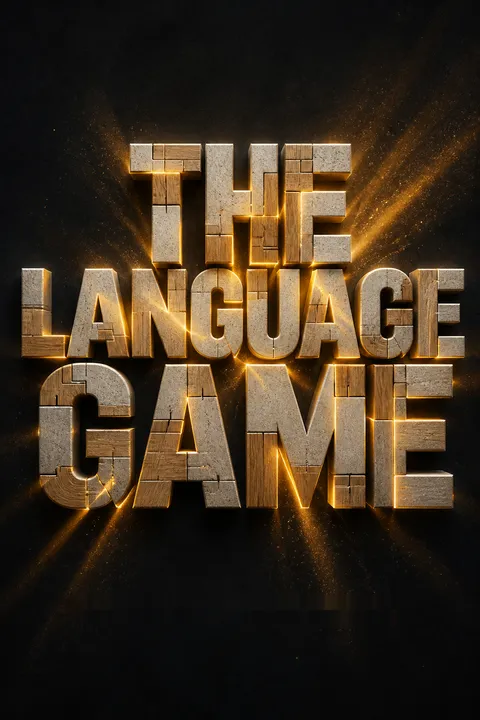
The Language Game challenges traditional theories of language acquisition, proposing that language evolves through improvisation and social interaction, akin to a game of charades. Reviewers praise its innovative approach and engaging examples, though some note repetition and lack of sociological awareness. The book explores language's role in human evolution, AI, and cultural development. While most found it fascinating and thought-provoking, a few criticized its dismissal of established linguistic theories and limited discussion of language technologies. Overall, it offers a fresh perspective on language's origins and significance.
People Also Read









Glossary
language game
Meaning through shared useA practical, socially shared activity in which words or gestures acquire meaning through how people use them. The same word can do different jobs in different situations. Learning a language therefore involves learning how to participate in familiar interactions, not simply memorizing fixed definitions and grammatical rules.
communication iceberg
Hidden knowledge supporting speechThe authors’ metaphor for the knowledge that supports spoken or signed communication but is not contained in the words themselves. Its submerged portion includes cultural expectations, social relationships, emotions, factual knowledge, and shared history. Listeners combine this background with linguistic clues to infer what a speaker means.
Now-or-Never bottleneck
The pressure to process speechThe authors’ term for the time pressure created by fleeting speech and limited short-term memory. Incoming sounds must be grouped and interpreted quickly, because their details soon disappear beneath new input. The brain manages this by forming increasingly large chunks, from sounds to words, phrases, and stretches of conversation.
family resemblance
Overlapping similarities among usesA concept associated with Wittgenstein and used in the book to explain how a word can apply across related situations without one defining feature shared by every use. Meanings connect through overlapping similarities and metaphorical extensions. The word “light,” for example, applies to different things in different, partly connected ways.
construction grammar
Language built from learned patternsAn approach that treats constructions, learned pairings of linguistic form and meaning, as the basic materials of language. A construction can be a word ending, a familiar phrase, or a more abstract pattern with open slots. Larger regularities emerge through the interaction of these pieces rather than serving as a complete blueprint from the start.
grammaticalization
Words developing grammatical rolesA historical process through which ordinary words or phrases gradually become grammatical markers. Repetition can shorten and fuse forms, while their meanings broaden or fade. The book gives examples such as “going to” developing a future meaning and French “pas,” originally a word for a step, becoming part of a negation pattern.
C-learning
Learning shared cultural conventionsThe authors’ term for learning how to coordinate with other people by acquiring the conventions of a community. Unlike learning about physical facts that remain true regardless of agreement, C-learning depends on matching shared expectations. Language learning is mainly C-learning because children learn how others use words and patterns.
N-learning
Learning facts about natureThe authors’ term for learning about the natural or physical world, where success depends on how things actually work rather than on what a community agrees to do. The trajectory of a thrown ball is an example: gravity and other physical forces determine its path, not a shared convention.
idiolect
One person’s language varietyAn individual’s distinctive collection of words, familiar phrases, grammatical patterns, and expressive habits. The book argues that people do not speak identical versions of a community language. Communication works because their idiolects overlap sufficiently and listeners use context to interpret one another.
game-of-telephone experiments
Language change through learner chainsLaboratory studies in which one participant learns or recalls material, and their responses become the input for a new participant. Across successive learners, artificial labels can develop reusable components and meaningless strings can become more memorable. The experiments test how repeated cultural transmission can produce patterns without an intentional designer.
FAQ
What's The Language Game about?
- Exploration of language origins: The Language Game investigates how language emerged through improvisation and social interaction, likening it to a series of communicative games where meaning is constructed in the moment.
- Cultural evolution focus: The authors, Morten H. Christiansen and Nick Chater, argue that language is shaped by cultural evolution rather than biological adaptations, emphasizing the collaborative nature of language learning.
- Interplay of chaos and order: The book discusses how linguistic order arises from chaotic interactions, leading to the establishment of grammatical rules and conventions over time.
Why should I read The Language Game?
- Revolutionary perspective: The book challenges traditional notions of language as a fixed system, encouraging readers to rethink their understanding of communication and language development.
- Interdisciplinary insights: Drawing from linguistics, psychology, and cognitive science, the book offers a comprehensive understanding of how language functions in human society.
- Practical implications: The ideas presented have applications in education and artificial intelligence, informing teaching methods and AI development.
What are the key takeaways of The Language Game?
- Language as improvisation: Language is portrayed as a dynamic process of improvisation shaped by social interactions, highlighting the creativity in everyday communication.
- Cultural over biological evolution: The book posits that language evolves culturally, challenging the idea of a specific "language gene" and emphasizing pre-existing cognitive skills.
- Importance of context: Meaning in language is context-dependent, relying on shared knowledge and past interactions, with cultural norms playing a crucial role.
How does The Language Game redefine language learning?
- Learning through charades: Language learning is likened to playing charades, where individuals improvise and adapt communication based on context and audience.
- Chunking and constructions: Learners break down complex input into manageable chunks, or constructions, which can be reused and adapted for effective language navigation.
- C-learning vs. N-learning: The book distinguishes between C-learning (cultural conventions) and N-learning (natural world), emphasizing the collaborative nature of language acquisition.
What is the significance of the charades metaphor in The Language Game?
- Communication as a game: The charades metaphor emphasizes language as a game of improvisation, where meaning is constructed collaboratively in real-time.
- Focal points in interaction: Language users rely on shared expectations to convey meaning, highlighting the importance of context and social cues.
- Dynamic nature of language: The metaphor illustrates how language evolves through repeated interactions, with new meanings and patterns emerging over time.
What role does improvisation play in language according to The Language Game?
- Central to communication: Improvisation allows for flexibility and creativity in expressing ideas, making language rich and adaptable.
- Emergence of meaning: Meaning is created in the moment through improvisational exchanges, reflecting the social nature of language.
- Cultural evolution: Improvisation contributes to language's cultural evolution, generating new forms and meanings through social interactions.
How do the authors of The Language Game view the role of cultural evolution in language?
- Cultural evolution as central: Cultural evolution is fundamental to understanding language development, shaped by collective experiences and interactions.
- Tailoring language to abilities: It tailors language to fit human cognitive abilities, creating focal points that facilitate communication across generations.
- Language as a dynamic system: Language is presented as a dynamic system evolving through cultural transmission, highlighting its fluidity and adaptability.
What is C-learning and how does it differ from N-learning in The Language Game?
- C-learning Defined: C-learning involves learning language through social interactions and cultural context, emphasizing community and shared experiences.
- N-learning Explained: N-learning suggests language acquisition is driven by innate grammatical rules, focusing on individual cognitive processes.
- Key Differences: C-learning emphasizes social interaction, while N-learning suggests a solitary, rule-based approach to language learning.
How does The Language Game address the complexity of language?
- Spontaneous order from chaos: Linguistic complexity arises from chaotic interactions, with patterns emerging through repeated use.
- Grammaticalization process: Concrete words evolve into grammatical structures over time, illustrating language's complexity and nuance.
- Idiosyncrasies and exceptions: Language is filled with quirks and exceptions, challenging the notion of a perfect linguistic system.
What implications does The Language Game have for artificial intelligence?
- Challenges for AI: The improvisational nature of human language makes it difficult for AI to replicate genuine communication, as understanding context and nuance is essential.
- Language as a cultural product: Language is a cultural invention shaped by human interactions, suggesting AI must account for social and cultural dimensions.
- Future of AI communication: Insights from the book can inform AI development to better mimic human-like communication by recognizing improvisation and context.
What experimental methods do the authors use to support their arguments in The Language Game?
- Game-of-Telephone Experiments: These experiments simulate language evolution, showing how language changes through social transmission.
- Artificial Language Studies: Participants learn artificial languages, revealing how linguistic structures emerge spontaneously over generations.
- Memory and Chunking Research: The authors explore how memory limitations influence language learning, highlighting cognitive processes involved.
What are the best quotes from The Language Game and what do they mean?
- “Language is like a game of charades”: This quote emphasizes the improvisational and collaborative nature of communication, suggesting meaning is constructed in the moment.
- “The spontaneous emergence of linguistic order is a story as remarkable as the emergence of life itself”: It highlights the complexity and beauty of language evolution, drawing parallels with natural processes.
- “Language is perhaps humanity’s greatest accomplishment”: This statement underscores language's significance in human culture, reflecting its role in enabling progress and connection.
Download PDF
Download EPUB
.epub digital book format is ideal for reading ebooks on phones, tablets, and e-readers.








