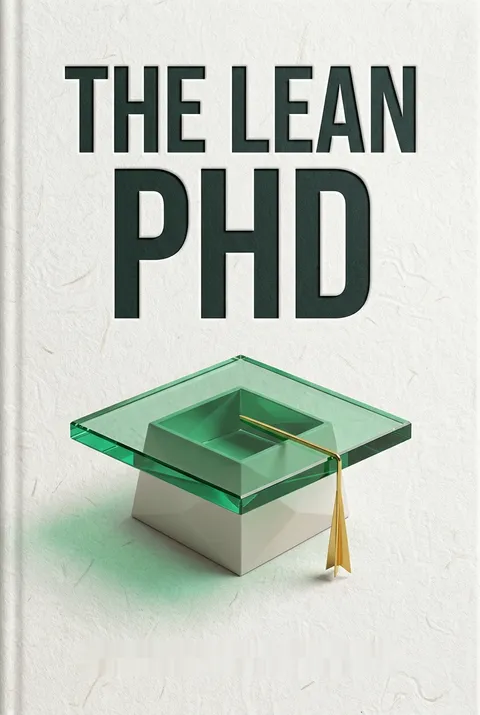


Key Takeaways
Run your PhD like an uncertain venture, testing ideas before polishing them
Treat research as discovery. A PhD resembles a start-up: both begin with limited resources, must create something novel, and face an uncertain path. The lean approach replaces long stretches of private preparation with small early versions of the work, then improves them using feedback from people who can judge or use it. A minimum viable product, or MVP, is the simplest version that contains the core idea and can be tested. In the book’s example, an online shoe seller tested demand by posting store inventory photos and buying shoes only after customers ordered. The test came before the elaborate website and warehouse.
Speed is not the only prize. Kirchherr reports submitting his Oxford PhD 21 months after starting, compared with an estimated school average of 3.8 years. He attributes this partly to iterative working, while acknowledging that supportive supervisors, access to interviewees, and a promising topic also mattered.
The useful shift is from treating uncertainty as a reason to wait until the work feels complete to treating it as a reason to test assumptions sooner. This resembles experimental design: make a claim explicit, gather evidence that could challenge it, and revise. Yet research is not always a product whose users can state what they need. A project may matter precisely because its findings unsettle accepted assumptions. Iteration should therefore improve the question and the evidence, not merely make a proposal more attractive to the people already in power.
Protect high-energy work blocks instead of worshipping long academic hours
Hours are a poor proxy. The book rejects both the fantasy of completing a PhD effortlessly and the idea that success requires punishing weekly hours. Work requires sustained effort, but long days do not guarantee progress. Kirchherr argues that rest and energy affect productivity more than simply counting hours. He continued to pursue other activities during his doctorate, including consulting projects, popular writing, and holidays, which he says helped restore his motivation.
Use targets carefully. A clear milestone can help on a low-energy day, but the advice is not to work only when inspiration arrives. Start the work; if four or five hours pass without progress, consider switching tasks or taking a break, rather than turning a stuck day into a marathon. Short, manageable goals can be more motivating than a distant finish line.
This emphasis complements research on attention and cognitive fatigue: concentrated thinking is costly, and recovery helps preserve it. It also makes doctoral work more compatible with caregiving, employment, and health needs than a culture that equates commitment with visible exhaustion. The caveat is that energy is not fully under individual control. Funding insecurity, disability, family demands, and poor supervision shape the time and attention available. A personal productivity strategy can help, but it cannot substitute for humane institutional conditions.
Choose a publishable niche, but keep the academic job market in view
Avoid crowded topics by default. A fashionable research area can attract many applicants and submissions, while a promising niche may offer more room to contribute. The author recommends looking for a topic that genuinely interests the student, has some momentum, and offers an advantage such as access to data or stakeholders. His work on dam impacts and opposition movements drew on his private-sector background to reach industry interviewees who were difficult for other researchers to access.
A niche has a career cost. The same focus that made publication and admission easier did not make academic hiring easy. Kirchherr later pitched work on the circular economy, a more prominent subject sought by a prospective employer, despite having no publication on it. He also cites evidence that faculty hiring is concentrated among a relatively small number of elite universities.
The market metaphor makes competition visible, but academic value cannot be reduced to a supply-and-demand calculation. A niche can be intellectually important even when funders, journalists, and hiring committees overlook it. The practical decision is to separate two questions: where can a student make a strong contribution, and what kinds of positions might reward it? Thinking about both early can support a deliberate research identity without forcing every project to chase current fashion.
Show supervisors compact research ideas before spending weeks on a proposal
Make the first proposal a test. The lean PhD canvas is a short planning aid for considering a research area, proposal, supervisor, dissertation format, and resources. For an initial conversation, Kirchherr recommends bringing several research ideas and early thoughts about methods, not a polished document that implies every decision is settled. His first version was a single slide with three possible projects. A discussion of roughly 45 minutes helped identify which direction interested his prospective supervisor; a later proposal took about a week to develop.
Choose supervision for engagement. A famous professor may offer prestige and networks but have little time for repeated feedback. Early-career supervisors may be more available and have stronger incentives to publish with students. Check their recent collaborations and, where possible, ask current students about their experience. Funding can also come from scholarships, employers, or crowdfunding, though each source may bring different expectations.
A compact proposal reduces the cost of changing direction and helps reveal whether student and supervisor can work together. It is a form of mutual selection, not merely a pitch. The approach also exposes a power imbalance: supervisors control access to a degree and may steer a student toward their own interests. A good early conversation should test intellectual fit in both directions, clarify expectations about feedback and authorship, and leave room for the student's independent judgment.
Treat journal rejection as high-value diagnosis, not a verdict on ability
Submit a viable paper, not a flawless one. The book favors a paper-based PhD where permitted, often built from three to five papers plus a shorter framing document. Compact papers are easier for collaborators and reviewers to assess than an entire long thesis. Kirchherr suggests revising a manuscript with a supervisor a limited number of times, then submitting it to a suitable journal. The anonymous review process can provide unusually thorough criticism, even when the outcome is rejection.
Use the criticism. One of Kirchherr’s papers was rejected because its central argument was obscured. He rewrote it in response to the review and later published it in a more prestigious journal. Peer-review judgments are inconsistent, so rejection is not a precise measure of quality. But a detailed critique can still expose weaknesses that friendly readers missed. A minimum viable paper is substantial work open to improvement, not a fragment designed to inflate publication counts.
The paper route creates short feedback cycles and a visible record of research, but it is not equally available across disciplines or universities. Peer review is also an imperfect quality-control system, not an oracle. Its value lies partly in forcing authors to answer specific objections and make their reasoning inspectable. Students should distinguish a fixable argument problem from a mismatch in scope or journal priorities, and should not treat a rejection as proof that the research itself has failed.
Write early to discover the research question hidden in your reading
Writing is a research tool. Instead of reading broadly for months before drafting, the lean approach says to read strategically and begin writing as soon as a plausible question emerges. Start with highly relevant and influential work, then read closely where it directly informs the project. Kirchherr proposes a storyboard: a sequence of bullet points that lays out the paper’s argument, with evidence, studies, and interview material attached to the relevant points. A developed storyboard of about 40 main points can become a paper of roughly 6,000 words.
Draft while collecting data. Kirchherr began writing one paper after about 20 of an anticipated 40 interviews. The incomplete draft revealed which evidence was still missing, making later interviews more focused. Early writing also lowers the pressure to produce polished prose on the first attempt. The point is not to guess the results, but to let a provisional account expose gaps and sharpen what needs investigation.
Drafting makes tacit assumptions visible. A paragraph that sounds convincing in the mind may collapse when it must connect evidence to a claim, and that failure is informative. This is close to the logic of abductive inquiry, where researchers move back and forth between observations and possible explanations. The caution is to keep provisional ideas provisional. Early storylines can bias sampling toward confirming evidence, so researchers should actively record surprises and seek cases that could complicate the emerging account.
Build a small research team to multiply feedback and field capacity
Do not confuse independence with isolation. The book presents research as collaborative work. Supervisors and co-authors can challenge arguments, contribute specialized methods, or help reach hard-to-access participants. Undergraduate and graduate students can also take on meaningful tasks, from literature searches and interview transcription to data collection and modeling. In Kirchherr’s example, an undergraduate helped create an interview questionnaire, identify participants, conduct interviews, and build a financial model for a paper.
Test methods affordably. Digital interviews can establish contacts before costly fieldwork; Kirchherr used Skype conversations to build a network before traveling to Southeast Asia. Workshops and conferences can test early ideas and expose blind spots. Agree on responsibilities and authorship before collaboration begins, and give contributors credit appropriate to their work. Short, time-limited work cycles can help a team coordinate tasks without turning every project into a meeting.
Collaboration can improve both the epistemic quality of research and the student's sense of belonging. It distributes expertise and makes feedback consequential because collaborators share responsibility for the output. The same arrangement requires careful attention to labor and credit. Students should not become invisible research assistants on projects presented as their own, and junior collaborators should not be promised authorship for routine work without clear standards. Digital methods also expand access, but they do not make every question answerable remotely.
Change the research plan when evidence says the topic is a dead end
Change direction before abandoning the researcher. Pivoting means changing the project when repeated attempts fail to produce a viable contribution, rather than interpreting the stall as proof of personal inadequacy. Kirchherr entered Oxford intending to study the social impacts of dams. As he explored the literature, he found a mature field with many strong studies and struggled to identify a distinctive contribution. Following examiner feedback, he shifted toward anti-dam movements, a less explored area.
Reuse what still fits. The change came about 11 months into the PhD, after interviews and paper submissions, yet Kirchherr submitted his doctorate 21 months after starting. He carried relevant knowledge and data forward where possible. Before pivoting, assess whether the original question can still support a doctorate, whether an alternative genuinely interests you, whether it can be funded, and whether supervision remains workable. Previous effort is a cost already paid, not a reason to continue indefinitely.
The concept counters the sunk-cost trap, the tendency to keep investing because of effort already spent. In research, however, an apparent dead end may itself be a meaningful result, and novelty is not the only measure of contribution. A pivot is strongest when it follows evidence about the literature, data, or feasibility, rather than pressure to find a trendier topic. Preserving useful work while changing the question can be more rigorous than either stubbornly persisting or starting from zero.
Submit a defensible dissertation, not a monument to perfectionism
Aim for a credible contribution. A minimum viable dissertation, or MVD, is a dissertation good enough to meet degree standards without pretending it must be a masterpiece. In a paper-based thesis, the connected introduction, literature review, methods, and conclusion are the framing document, sometimes called the coat. Kirchherr argues that this framing can be concise, while at least one substantial contribution must anchor the work. A contribution may be empirical, methodological, or theoretical.
Let assessment improve the work. Choose examiners, with a supervisor's guidance, who can understand the topic and whose scholarship the dissertation engages. In systems where revisions are common, feedback after the viva is part of the process, not a sign of failure. Kirchherr received 45 requested changes, many small and specific, and completed them in three days. Publications and a substantial dataset can help demonstrate rigor, but the work should not be padded merely to look impressive.
The distinction between a degree-worthy thesis and a career-defining book can protect students from perfectionism and make completion psychologically possible. It also challenges assessment systems that reward polish and volume more readily than sound judgment. The danger is that minimum viable becomes a euphemism for minimum effort. A defensible dissertation still needs transparent methods, ethical data practices, and a clear account of what the evidence does and does not establish. Brevity is valuable when it clarifies, not when it hides.
Translate findings for practitioners while the academic paper is still alive
Citations are not the whole audience. The book distinguishes academic impact, often approximated by citations, from practical impact on policy, organizations, or public understanding. A thesis can pass without being widely read, but the research effort need not stop at the university. Kirchherr turned findings about a dam project in Myanmar into a newspaper commentary that was shared more than 500 times on Facebook. A university press release about another paper helped attract a journalist's attention.
Make follow-up part of the work. Researchers can send published papers to interviewees and other relevant stakeholders, invite their reactions, write accessible commentary, and ask university communications staff to publicize findings. These activities can take little time and can generate useful responses that inform future work. Where feasible, researchers can also collaborate directly with practitioners to identify problems and test possible solutions.
Impact depends on translation, timing, and trust, not just on whether research is publicly available. Returning findings to participants can correct misunderstandings and make research more reciprocal. Yet visibility metrics such as shares are not evidence that policy or practice changed. Practical impact should be described honestly, distinguishing attention, uptake, and measurable outcomes. Some disciplines also have no obvious practitioner audience, so accessible writing and engagement with public debate may be more appropriate than forcing every project into a consultancy model.
Quit only after testing pivots and giving the decision time
Make quitting a considered choice. The book asks students to examine whether they have been miserable, lost interest in the topic, made little progress, received only rejections, or exhausted alternative topics and workable supervision. A cluster of such signs can justify leaving, especially if another career feels more compelling. But the author advises against resigning in a moment of crisis: talk with supervisors, mentors, family, and friends, then wait and reassess over several weeks.
Leaving is not wasted life. A PhD can build specialized knowledge, analytical habits, attention to detail, and experience managing feedback and teams. These skills may transfer to work outside universities. The academic job market is highly uncertain, and completing a doctorate does not guarantee a permanent research role. The decision should therefore weigh the life and career the student wants, not just the desire to prove that persistence was worthwhile.
This is a valuable correction to the moral prestige attached to persistence. In organizational psychology, a good decision process distinguishes commitment to a goal from commitment to a particular method of reaching it. A student can remain committed to research, public service, or intellectual work while leaving a specific program. The checklist should not become an automatic scoring rule, however. Depression, illness, financial strain, or a harmful supervisor may distort how the future appears, so support and immediate safety deserve attention alongside career planning.
Analysis
The book's strongest contribution is its change of unit: instead of treating the dissertation as one enormous deliverable, it treats doctoral work as a sequence of testable decisions. A small proposal, an early draft, a conference presentation, or a submitted paper can expose weaknesses while they are still relatively cheap to fix. This reframes feedback from a final judgment into a working resource and gives students practical ways to reduce avoidable delay.
The lean analogy also has limits. A research project is not simply a product optimized for customer satisfaction. Participants, publics, and supervisors may disagree about what matters, and the most valuable finding may be unwelcome to every immediate audience. Strong science needs openness to surprise, methodological transparency, and room for questions whose payoff is not obvious at the start. In confirmatory research, preregistration and explicit plans for disconfirming evidence can help prevent early drafts from hardening into a preferred story.
The author's 21-month completion is an arresting demonstration, not proof that the method alone caused the speed. He names fortunate conditions, including engaged supervisors, access to interviewees, and a topic suited to publication. Those conditions are not evenly distributed. Lean practices can help a student use available support more effectively, but they cannot remedy precarious funding, inequitable hiring, or a supervisor who withholds feedback. Nor should a high publication count become the new perfectionism, especially when authorship, data quality, and disciplinary norms differ.
The most durable lesson is therefore not to rush, but to shorten the distance between an assumption and evidence. Students can preserve rigor by making smaller commitments, checking them with appropriate people, documenting changes, and knowing when a project needs a new question. Institutions have a parallel responsibility: make paper-based routes accessible, recognize contributions fairly, and provide timely supervision. Efficiency is meaningful when it creates more space for careful thought and useful work, not when it merely compresses the same unhealthy demands into fewer months.
Review Summary
Readers generally find The Lean PhD helpful for improving efficiency and impact in doctoral studies. Many appreciate its pragmatic approach and tips for writing and publishing. Some readers find the startup metaphors tiresome, and there's debate about the intense time commitment proposed. The book challenges perfectionism and offers strategies for navigating academia. While not all advice applies universally, most reviewers found valuable insights for their PhD journey, particularly in research design and long-term planning.
People Also Read







Glossary
Lean PhD
Iterative doctoral researchAn approach to doctoral study adapted from lean start-up practices. It emphasizes testing ideas early, drafting compact research outputs, collecting feedback from supervisors, collaborators, reviewers, and intended audiences, and revising or changing direction in response. Its goal is to improve efficiency, research quality, and impact, rather than simply to finish as quickly as possible.
lean PhD canvas
Doctoral planning guideA brief planning framework adapted from the lean business canvas. It prompts prospective doctoral researchers to consider five areas: their academic topic or market, the research proposal, supervision, dissertation format, and resources. The author recommends using it to clarify initial choices, not as a lengthy plan that fixes the project before feedback arrives.
minimum viable product
Smallest testable versionThe simplest version of a proposed product that contains its essential features and can be tested with potential users. In the book's academic adaptation, the idea encourages researchers to share an early proposal or paper rather than spend extensive time perfecting an untested version. Feedback then guides further development.
build-measure-learn loop
Test, assess, reviseAn iterative cycle in which a researcher creates an initial version of an idea or output, gathers evidence or feedback about it, and uses what is learned to revise the next version. In a PhD, this can mean discussing proposal ideas with a supervisor, presenting a draft at a conference, or submitting a paper for peer review.
minimum viable paper
Submittable draft for reviewA substantial research paper that is developed enough to submit for expert assessment, but is not endlessly polished before reviewers see it. The term does not mean fragmenting research into the smallest possible publications. The aim is to obtain useful critique and improve a coherent contribution through revision.
paper route
PhD built from papersA doctoral format in which the central research consists of a set of papers, often three to five, connected by a shorter framing document. It can make individual pieces easier to revise, publish, and discuss than a single long thesis. Availability and requirements vary by university and discipline.
minimum viable dissertation
Degree-worthy, not perfectA dissertation that meets the standards for the doctorate and makes a clear contribution without being treated as a masterpiece. The approach encourages students to avoid polishing every section indefinitely, while maintaining sound methods, a credible argument, and sufficient evidence. Revisions requested by examiners can be part of completing the work.
pivoting
Changing the research planChanging a research topic or approach when evidence suggests that the current plan is not producing a viable contribution, rather than assuming the researcher is incapable or abandoning doctoral study immediately. A pivot should be based on considered evidence about novelty, feasibility, interests, funding, and supervision, while preserving useful work where possible.
Download PDF
Download EPUB
.epub digital book format is ideal for reading ebooks on phones, tablets, and e-readers.








