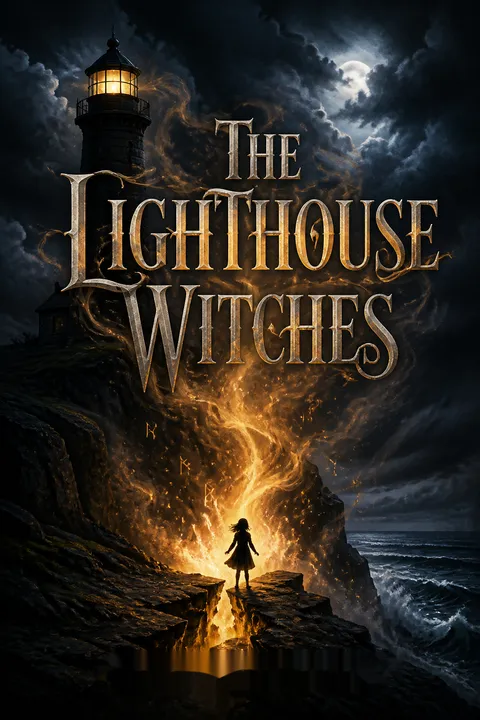


Plot Summary
Prologue
In 1662, Amy Hyndman and Patrick Roberts are bound for execution as their persecutors prepare the fire. Amy is hurt and terrified; Patrick is forced to watch as the men break his teeth and drive a knife into his chest.
The violence belongs to a witch trial, but the terror of the opening is also a promise: Lòn Haven’s past will reach across centuries, and the people caught in its old stories will pay for them.
The opening makes violence immediate before the novel explains its history. Amy and Patrick are presented first as bodies under attack, not as figures in a legend, which unsettles the island’s later confidence in its own stories. The scene also establishes fire, blood, and bodily marks as recurring evidence that can be interpreted in radically different ways. The prologue’s most important question is not whether the supernatural exists, but who gets to name an event, and what that naming permits others to do.
Liv Takes the Lighthouse Job
In 1998, artist Olivia Stay, called Liv, drives north with teenagers Sapphire and younger daughters Luna and Clover after fleeing a frightening medical result she cannot face. The mural commission at the derelict Longing lighthouse offers money, shelter, and distance from her past. Its owner, Patrick Roberts, has left Liv an obscure diagram of interlocking shapes instead of clear instructions.
Housekeeper Isla Kissick settles the family in a nearby bothy and warns that the lighthouse needs rowan wood for protection. Inside, Liv finds seawater pooled beneath the stairs and feels the place is strangely familiar. A naked doll with blacked-out eyes floats there, and Liv knows, before she sees it, where it will be.
Liv’s flight is an attempt to turn fear into a practical itinerary: a job, a place to sleep, a task with visible progress. The commission offers temporary control at the precise moment her body and future feel beyond her control. Her daughters arrive not as a harmonious family unit but as three different demands on her attention, while Saffy’s resentment already strains the fragile arrangement. The lighthouse complicates this escape from the start. Its waterlogged interior and Liv’s inexplicable familiarity suggest that the past is not behind her; it has a physical address, and her work will take her directly inside it.
Saffy Walks into the Woods
Saffy has been grieving the stepfather she loved and resenting Liv for keeping her away when he died. Their arguments sharpen after Liv drags the family from York; when Saffy calls her a poor mother, Liv slaps her, then apologizes.
Saffy bolts, carrying Patrick’s old grimoire into the forest and hiding in a hut. Its account of Patrick’s childhood describes his friendship with Amy, a healer whose rune revives dead fish. The book leaves Saffy with a way to understand the island’s frightening stories, but Liv has no such certainty.
She searches for her daughter, calls Isla for help, and tries to keep Luna and Clover calm. When Saffy returns with Isla’s daughter Rowan, the family’s immediate crisis seems over, though Saffy has not forgiven Liv.
The slap is a small physical act with a large relational consequence: it confirms Saffy’s belief that Liv cannot be trusted, while Liv’s remorse cannot undo the breach. Saffy’s escape is not simply teenage rebellion. Grief over Sean has fused with the older hurt of feeling excluded from his final hours, and the new island makes her feel that Liv has taken away the few attachments she still controls. The grimoire supplies a competing emotional language, one in which loss might be reversed through ritual. That possibility is alluring because ordinary family repair has so far failed her.
The Island Names Its Fear
As Liv begins preparing the lighthouse walls, Finn McAllen, a local plasterer and single father, helps repair the stonework and shares the strain of raising a child alone. Liv grows close to him, but keeps her suspected cancer and its family history to herself.
She also sees a filthy, frightened young boy near the lighthouse, brings him inside, and watches him vanish before she can call for help. Police chief Bram Kissick dismisses her report. Isla and local women instead insist the boy is a wildling, a fairy creature said to imitate missing children and destroy families.
They cite vanished children, storms, and marked skin as proof. Liv rejects the demand to kill any child, yet discovers the island’s legend has already shaped how its residents investigate, judge, and protect one another.
The island’s folklore works as a social system, not merely a supernatural explanation. It gives residents a shared account of disappearances, but also licenses them to stop asking ordinary questions and to treat a frightened child as a threat. Liv’s insistence on evidence separates her from the group, though her own denial of illness shows that skepticism does not make her immune to comforting stories. Finn offers a more intimate counterweight: his practical care and willingness to admit uncertainty create trust without demanding belief. The boy’s disappearance makes both positions harder to maintain, because Liv has encountered something she cannot explain and refuses to turn that uncertainty into a verdict.
Saffy Trusts Brodie
At school, fifteen-year-old Saffy is drawn to Brodie, an older boy already dating Rowan. He tells Saffy he has ended that relationship, pressures her into sex, then copies and circulates the nude Polaroids she took for him. Rowan finds Saffy and exposes the lie; later, while they explore Witches Hide, Rowan stabs her. Saffy escapes through the cave’s sea passage and disappears from 1998.
Earlier, Saffy had discovered the lighthouse’s hidden grille and a key that opens the underground cave. Clover also enters the lighthouse at night, sees a pale arm reach from under a dust sheet, and runs home terrified. The sisters’ separate encounters with the hidden place turn a local ghost story into a danger inside their family.
Saffy’s desire to be wanted makes her vulnerable to Brodie’s attention, but the narrative does not confuse vulnerability with consent. His deception and distribution of the photographs turn intimacy into leverage, while Rowan’s revenge makes the cave the site of a second violation. Saffy’s disappearance is therefore not a clean escape from a bad home or a simple supernatural accident. It follows a chain in which adults and teenagers repeatedly fail to protect her boundaries. Clover’s frightening glimpse establishes that the cave and lighthouse have affected more than one sister, but the girls interpret what they see through the island’s ready-made language of monsters.
Amy’s Mark Crosses Time
Patrick’s grimoire fills in the island’s older wound. In 1662, church elders accuse his mother Agnes, Amy’s mother Finwell, and other women of witchcraft after Amy curses the man who abused Agnes. Torture forces false confessions; the women are burned, and Amy’s sister Jenny dies with them.
Patrick and Amy grow up amid the aftermath, then marry. Amy later enters Witches Hide and emerges in another year, returning with a burn that records her destination. When the islanders mistake this mark for proof of a wildling, they condemn the couple.
Patrick enters the cave to escape, is carried through time, and eventually reaches the late twentieth century. He becomes wealthy, buys the Longing, and commissions its rune mural, hoping it will lead him back to Amy.
The historical narrative reveals how a community’s invented certainty can outlive the original violence. Amy’s healing gift and Patrick’s loyalty are recast as evidence of evil because the island needs a culprit for misfortune. The mark on Amy’s skin is real, but the conclusion drawn from it is false, a pattern that will recur in the modern story. Witches Hide gives the novel a material mechanism for the island’s missing children, yet its power is not morally selective: it displaces people across time without explaining their fate to those left behind. Patrick’s long pursuit of Amy is tender and dangerous at once, shaped by grief into an obsession that will endanger Liv.
Liv Is Told to Kill
After Saffy disappears, Bram investigates Finn, partly because Rowan plants Saffy’s Polaroids in his car. Liv’s youngest daughter Clover then vanishes too. Soon a muddy child arrives at the bothy who looks exactly like Luna and bears four digits burned behind her knee. Isla tells Liv this is a wildling and directs her to tie the girl to a tree and kill her.
Liv obeys at first, fearing for the daughters she has lost, but cannot strike the child. When the girl cuts her arm trying to escape, Liv frees her and draws the pursuers away. She returns to find that her own Luna has also disappeared. Patrick captures Liv at the lighthouse, convinced she is Amy, and prepares the mural, fire, and stolen human bones for a time-crossing spell.
Liv’s choice exposes the moral cost of acting on a story simply because it offers protection. Isla does not need to force Liv’s hand physically; she uses the mother’s terror and guilt to make violence seem like responsibility. Liv’s instinct breaks through only when she sees the child’s fear, and her refusal to kill becomes the first decisive act that contradicts the island’s myth. Yet rescue does not restore safety. Saffy and Clover remain missing, Luna is gone, and Patrick’s private grief has become another form of coercion. Each adult claims to be protecting someone, while the children bear the consequences.
The Longing Burns
Patrick restrains Liv, numbs her, and removes three ribs, believing human bones will complete the spell painted on the lighthouse walls. When he leaves to prepare the fire, Liv slips through the open floor into Witches Hide, breaks an ankle, and follows a pale boy through the cave to the sea.
The current carries her ashore in 2021, where Finn, returned to Lòn Haven, finds and rescues her. Patrick also enters the passage, but it takes him back to 1662, where Amy is about to be executed for bearing a time mark.
He persuades the priest that she is not a wildling, and the execution is stopped. They survive, but their child does not. They later conceal the cave, unable to convince the islanders that the supposed wildlings are displaced children.
The novel’s central mechanism is revealed through consequences rather than a neat explanation. Liv and Patrick both enter the same cave, yet arrive in different years, and the story refuses to make time travel feel like mastery. Patrick succeeds in reaching Amy, but his success costs Liv her safety and leaves the couple grieving a lost child. Their effort to conceal the passage is understandable, yet silence leaves the island’s false legend intact. The cave therefore reproduces the novel’s central ethical dilemma: knowledge can save an individual, but withholding it may allow a harmful story to keep governing everyone else.
Clover Returns as a Child
In 2021, pregnant Luna Stay lives apart from Ethan after refusing his marriage proposal, still haunted by the disappearance of her family. A call from police in Scotland sends her to Inverness, where she expects to meet her adult sister Clover.
Instead, she finds a seven-year-old girl who recognizes the toy giraffe Gianni and remembers details from their childhood. The child has a head injury, an unexplained numbered wound on her hip, and no memory of what happened before she was found.
Luna takes her from hospital despite social workers’ doubts. At a rented cottage, Clover cuts up Gianni, floods the bathroom, and later sets her new clothes on fire. Her insistence on returning to their mother forces Luna to confront the possibility that the child is truly Clover.
Luna’s reunion is emotionally destabilizing because recognition arrives before explanation. The familiar toy and childhood details make the girl feel like Clover, while her age and dangerous behavior make that certainty difficult to defend to others. Luna’s professional knowledge of childhood trauma cannot protect her from her own need to believe; she is both a trained caregiver and a sister who has spent decades blaming herself. Ethan’s distance and her pregnancy intensify the isolation. Clover’s destructive acts are not decorative menace: they show a child communicating fear through the only control she can claim, while Luna struggles to distinguish care from wishful thinking.
Luna Returns to Lòn Haven
After finding glass hidden in Clover’s hotel food, Luna flees a pursuer she recognizes as Brodie, who warns that the islanders expect her to be dead. On Lòn Haven, Cassie McAllen, Finn’s daughter and Luna’s childhood friend, shelters them and explains that Isla is imprisoned for killing a child. Luna’s memories return in fragments: as a girl, she entered Witches Hide, surfaced after a day had passed, and met another version of herself.
The marked double was not a fairy but Luna displaced from another time. By clasping hands, the two versions merged, restoring memories she had lost. At the burning trees, Luna faces the same choice Liv once faced and refuses to harm Clover. She understands that the cave has carried children through time.
Luna’s return transforms the island from an external mystery into a personal memory problem. Her missing years are not empty; they contain experiences her mind could not organize, and physical contact with Clover repeatedly triggers painful fragments. Cassie supplies a human witness who can challenge the island’s lore, but Luna must still recognize her own place within it. The revelation that her duplicate was herself recasts the numbered mark from evidence of monstrosity into a record of displacement. Her refusal to reenact Liv’s near-violence is the emotional hinge: she breaks the cycle not by mastering the cave, but by declining to let fear decide who counts as family.
Three Sisters Find Home
With the ferry running again, Luna leaves the island with Clover and Ethan. At the port, she recognizes a teenage girl stepping off the boat: Saffy has emerged from Witches Hide into 2021 after leaving a foster home to search for her family.
Cassie later locates Liv, who has also reached the present, badly injured after Patrick’s attack and diagnosed with advanced cancer. Luna, Saffy, and Clover reunite with their mother at Cassie’s home; Liv explains that she never abandoned Luna, then spends her remaining months with her daughters.
She dies after seeing them together again. Finn adopts Saffy and Clover, while Luna and Ethan repair their relationship and build a family. The sisters’ reunion cannot restore the years stolen from them, but it ends their separation.
The reunions answer the novel’s opening wound, but not by pretending that time can be returned. Saffy, Clover, and Liv arrive in a present that has continued without them; Luna has grown up carrying loss, and Liv’s illness leaves little time for repair. Their meeting matters because each person can finally replace an imagined abandonment with an account of what happened. Finn’s adoption offers practical belonging where the family once had instability, while Luna and Ethan’s renewed partnership depends on clearer honesty. The ending grants connection without erasing grief, making reunion a form of care rather than a fantasy of undoing.
Epilogue
Years later, Luna visits Liv’s grave with her son, Charlie, and leaves a rowan wreath. She and Ethan have a home together, and Saffy and Clover are part of their lives; Saffy studies history and researches the women accused of witchcraft on Lòn Haven.
The sisters plan to destroy Witches Hide so no one else can vanish through it, though the work is not yet done. Luna still cannot explain the cave’s physics, and she calls its unknown power a technology rather than magic. As Charlie replaces dead flowers with fresh ones, the family tends a past they cannot change while trying to prevent it from repeating.
The closing scene shifts the novel from recovery to stewardship. Luna’s family has built a home, but she does not confuse stability with a cure for history: she visits Liv’s grave, Saffy studies the erased record of accused women, and the sisters plan to close the cave. Their proposed destruction of Witches Hide is a deliberate answer to the adults’ earlier secrecy, though it also recognizes that inherited danger cannot be managed through folklore alone. The flowers give the ending a modest scale. Their work is not to reverse every loss, but to remember accurately and make fewer losses possible.
Analysis
The Lighthouse Witches is a novel about the violence produced when an explanation becomes more important than the person it is meant to explain. Lòn Haven’s wildling story gives generations of residents a framework for disappearances, but it converts uncertainty into permission to harm children. The historical witch trials provide the original pattern: women are accused, forced to confess, and killed, while the survivors inherit a distorted account of what happened. The time cave then makes that distortion literal. Children who vanish may reappear with marks from another year, and grieving adults interpret the evidence through the legend they already fear.
The novel’s alternating timelines make memory an active force rather than a reliable archive. Luna’s forgotten childhood protects her from overwhelming trauma, yet also leaves her vulnerable to blaming herself and accepting other people’s accounts. Liv’s maternal fear similarly makes her susceptible to Isla’s certainty, while her eventual refusal to kill the marked child shows that care sometimes means resisting the story that promises safety. Saffy’s disappearance adds a different wound: she is harmed not by folklore alone, but by betrayal, sexual coercion, and adults who fail to notice her distress.
Patrick complicates the distinction between love and harm. His devotion to Amy survives centuries, but his attempt to retrieve her leads him to injure Liv. Grief gives his actions emotional logic without making them just. The novel’s most durable insight is that explanation is not absolution. A community may have reasons for its fear and a parent may act from love, yet consequences still matter. Against inherited certainty, the book offers a harder form of repair: listen to the person in front of you, preserve the names of those erased, and refuse to make a child pay for an adult’s unresolved grief.
Review Summary
People Also Read




Characters
Liv
The artist motherOlivia Stay, known as Liv, is an artist and mother to Saffy, Luna, and Clover. She accepts the lighthouse mural commission while struggling to support her daughters and avoid confronting a possible cancer diagnosis. Her tenderness is genuine, but exhaustion and fear can narrow her judgment, especially when a child’s safety seems at stake. Liv’s work gives her a way to impose pattern on chaos, a quality that makes the mural both a livelihood and an uneasy point of contact with the island’s past. Her relationships with her daughters differ: she shares history and conflict with Saffy, while she tries to protect younger Luna and Clover. Liv is driven by love, yet the novel tests whether love can remain trustworthy when fear distorts what a parent sees.
Luna
The searching sisterLuna is Liv’s middle daughter, a thoughtful child who grows into a pregnant adult working in arts therapy with children affected by trauma. She is observant and highly attuned to others, but her own childhood is fractured by loss and self-blame. She has spent years searching for her sisters and trying to understand why her mother disappeared. Her resistance to marriage reflects a deeper unease about dependence and the possibility of being left, though she remains attached to Ethan. As an adult, Luna’s professional skills help her approach frightened children, but family history makes clear judgment difficult. She is motivated by the need to restore connection, and her growth depends on distinguishing care from control and recovered memory from certainty.
Saffy
The grieving eldestSapphire, called Saffy, is Liv’s eldest daughter, a sharp, bookish teenager who protects her hurt with sarcasm and defiance. She misses Sean, the stepfather who treated her as his child, and resents Liv for decisions made around his death. Removed from her school and friends, she feels that her life is being decided for her. Saffy longs to be desired and taken seriously, which makes her vulnerable to people who offer attention with hidden conditions. Her curiosity about history and mythology gives her a way to investigate Lòn Haven’s stories rather than simply accept them. Beneath her abrasive manner is a deep wish to belong, especially to her sisters, even when she cannot ask for closeness directly.
Clover
The youngest sisterClover is Liv’s youngest daughter, younger sister to Saffy and Luna. She is candid, imaginative, and quick to turn ordinary objects into play, but she is also a child who needs the adults around her to notice when curiosity becomes danger. Her love of toys, clothes, and small rituals gives her a vivid presence in the family. Clover is particularly attached to her sisters and seeks comfort from them even when she does not fully understand their conflicts. Her straightforward questions often expose what others are avoiding. The story connects her vulnerability to the adults’ competing explanations of the island, making her a reminder that children should not have to carry the weight of grown people’s fears.
Patrick Roberts
The grieving commissionerPatrick Roberts owns the Longing and commissions the mural Liv is hired to paint. He is an elusive figure with money, historical interests, and a personal connection to the island that he keeps concealed. As a child, he grows close to Amy Hyndman, and his life is shaped by the violence of the witch trials and the loss of his family. Patrick’s longing for the past gives him unusual patience and determination, but also makes it possible for him to treat other people as instruments in a private quest. His interest in runes and the cave is more than antiquarian curiosity. He embodies the danger of devotion when grief is allowed to excuse harm.
Amy Hyndman
The gifted healerAmy Hyndman is a healer’s daughter who inherits her mother’s gifts and learns to use runes associated with Icelandic family traditions. As a child, she is spirited, resourceful, and closely bonded with Patrick, whose companionship gives her a rare source of trust. Her magic is practical as well as mysterious, linked to healing, protection, and the possibility of changing what seems irreversible. The island’s history places Amy among people whose knowledge is feared and misrepresented. She is not driven by a desire for power over others, but by loyalty and the hope of repairing losses. Her story asks how a person can preserve compassion when a community has made survival depend on suspicion.
Finn McAllen
The practical allyFinn is a local plasterer, rewilding advocate, and single father to Cassie. He helps Liv repair the lighthouse and understands the daily labor of raising a child without a co-parent. His humor and practical competence make him a source of steadiness, though he also carries his own history of family loss and public suspicion. Finn is willing to listen without demanding that Liv accept his beliefs, which contrasts with the islanders’ insistence on a single explanation.
Isla Kissick
The island’s gatekeeperIsla is Liv’s first local contact, a housekeeper, café owner, and well-connected islander married to police chief Bram. She knows the community’s history and presents herself as someone able to protect newcomers. Her confidence and local authority make her persuasive, especially when fear has already made a person feel powerless. Isla’s attachment to Lòn Haven’s folklore gives her influence over how neighbors interpret disappearances and danger.
Ethan Singh
Luna’s uncertain partnerEthan is Luna’s long-term partner, a Pilates instructor and physiology student who wants marriage and a family. He is affectionate and emotionally open, but the strain of repeated arguments and pregnancy loss has left him unsure where he stands with Luna. His wish for commitment is sincere; so is his need to know whether she wants a future with him. Their relationship reveals that love can persist even when one partner cannot explain the fear shaping a decision.
Rowan
The witch’s daughterRowan is Isla’s daughter, a goth teenager who describes herself as a green witch and is drawn to ritual, identity, and the island’s history. She is Saffy’s peer and Brodie’s girlfriend. Rowan can be welcoming and perceptive, but her beliefs and loyalties are tangled with jealousy and a desire to be seen as powerful. Her self-presentation is both sincere and performative, shaped by the island’s habit of turning old violence into living identity.
Brodie
The charming betrayerBrodie is an older schoolboy who attracts Saffy with attention, local knowledge, and the promise of intimacy. He is already involved with Rowan, but hides that fact while pursuing Saffy. His charm conceals a controlling streak, and his actions make clear how easily a teenager’s desire to feel chosen can be exploited. Years later, he remains connected to the island’s long memory and its threat to Luna.
Cassie McAllen
Luna’s childhood friendCassie is Finn’s daughter and a childhood friend of Luna’s. As an adult, she works on Lòn Haven’s heritage restoration and offers Luna shelter when she returns. She remembers the Stay family with affection, but she is not inclined to accept every local legend as fact. Cassie’s loyalty makes her a bridge between Luna’s fragmented past and the island’s surviving community.
Bram Kissick
The island police chiefBram is Isla’s husband and Lòn Haven’s chief police officer. His authority gives the island’s beliefs institutional force, even when reports of missing children deserve more than dismissal. He represents the danger of a close-knit community in which personal loyalties can blur public duty. His guarded manner makes it difficult for outsiders to know whether he is protecting residents or preserving the island’s preferred version of events.
Plot Devices
Witches Hide
The island’s time passageA cave beneath the Longing contains carved runes and a passage to the sea. Those who enter can emerge in another year, sometimes far from their point of departure. The cave marks travelers with the year they reach, which islanders mistake for evidence of a wildling. Its unpredictable movements explain why children vanish and why apparent doubles appear. The passage is never fully explained in scientific terms, so it remains both a physical hazard and a challenge to the characters’ assumptions about cause and time.
The Wildling Legend
Fear disguised as evidenceLòn Haven’s residents believe that fairies can mimic missing children, carrying numbered marks and bringing disaster to a family. The story is reinforced by past disappearances, storms, and the witch trials, and by authorities who fail to challenge it. Its power lies less in proof than in the confidence it gives people to act. The legend repeatedly causes frightened adults to misidentify displaced children and endanger them, turning inherited explanations into a present threat.
The Rune Mural
A map mistaken for artPatrick gives Liv a diagram of runes and intersecting shapes to paint inside the lighthouse. Liv enriches it with sea colors and expands it to fit the curved interior. Patrick believes the symbols can help him find Amy, so the mural is both a commission and part of his attempt to return to the past. The design links Liv’s labor to the cave’s markings and gives the story a visible structure through which separate lives and eras converge.
The Numbered Marks
A false sign of monstrosityTravelers through Witches Hide acquire digits corresponding to the year in which they arrive. On Lòn Haven, residents read such marks as proof that a child is a wildling. The same physical sign therefore serves two opposing interpretations: a record of time displacement and an alleged warning of supernatural danger. Because the marks are visible but their cause is hidden, they become a test of whether characters will investigate carefully or accept the community’s most frightening explanation.
Download PDF
Download EPUB
.epub digital book format is ideal for reading ebooks on phones, tablets, and e-readers.








