

Plot Summary
A Hitchhiker in Blood
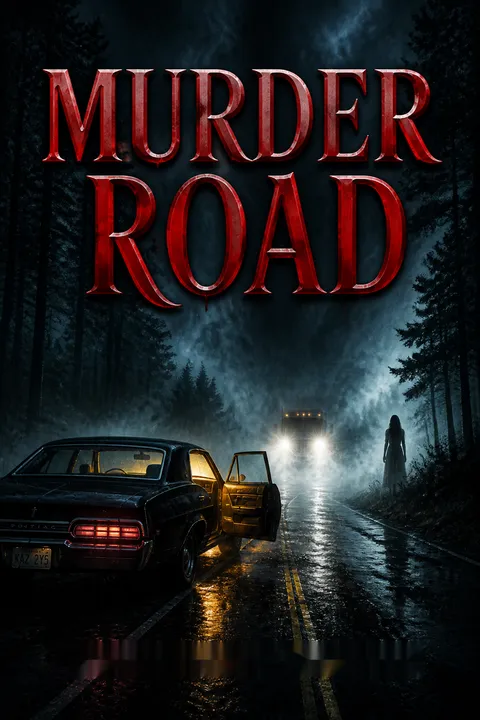
On their first night as newlyweds, April and Eddie Carter lose their way on a dark Michigan road. They stop for Rhonda Jean, a young woman walking alone, and offer her a ride to Coldlake Falls. April discovers blood soaking through Rhonda Jean’s clothes just as headlights appear behind them. The injured girl warns that the person following them is coming.
Eddie races toward the hospital while April holds Rhonda Jean’s freezing hand and tries to keep her conscious. They reach the emergency entrance, but Rhonda Jean dies. Covered in her blood, the newlyweds look like suspects, and local police arrive before they can decide whether to flee or stay.
The rescue begins with an ethical choice, not a detective’s curiosity: April and Eddie stop because abandoning an injured stranger would make them complicit in her isolation. Their honeymoon’s ordinary plans give the interruption its force. They have barely begun building a shared life when the blood of someone else’s violence enters their car. April’s calm response hints that her composure is learned rather than innate, while Eddie’s instinctive speed and care make the couple credible rescuers and immediate suspects at once.
The Town Takes Over
Detective Quentin takes charge at the hospital and bars April and Eddie from leaving town, then sends them to Rose Jones’s bed-and-breakfast under police watch. He questions their route and treats their honeymoon story with suspicion.
Before the couple sleep, Eddie confides that he saw a teenage girl in the bed of the truck that passed them. He fears his wartime visions have returned, so they keep the sighting from police.
Their guardedness is rooted in older wounds: April learned to disappear while escaping an abusive childhood, and Eddie came home from Iraq with traumatic episodes he rarely discusses. They first met when he accidentally walked into her hallway and found her in her underwear. Their unlikely marriage is now tested by a dead girl and mutual secrets.
The investigation makes privacy feel dangerous: anything withheld may look like guilt, but disclosure could expose the couple’s most vulnerable histories. April and Eddie are not simply hiding facts from police; each is trying to protect the other from a world that has misread or harmed them before. Their different coping styles emerge early. April turns fear into observation, while Eddie contains it through discipline and silence. The ghostly glimpse unsettles the boundary between trauma symptoms and external threat without yet resolving which explanation applies.
A Flower on Atticus Line
The detectives take the Carters back to Atticus Line, where the empty road offers no clear trace of Rhonda Jean. Officer Kal Syed quietly explains that hitchhikers travel between Coldlake Falls and Hunter Beach, a beachside hostel and campsite.
April finds a faded memorial flower bearing the name Katharine O’Connor, a woman murdered on the road two years earlier. At Rose’s house, Rose confirms that Katharine’s killer was never found and recognizes that April and Eddie are caught in something larger than a single homicide.
Though she trusts neither the police nor the town’s gossip, Rose lends them her late husband Robbie’s Honda so they can seek answers at Hunter Beach. The couple now investigate on their own, risking the very scrutiny they want to escape.
The memorial turns a police case into a history of neglected people. Katharine’s name survives only because someone left a small marker where official investigation failed, and April’s attention to it reflects her recognition of the vulnerable lives that institutions overlook. Rose’s help is similarly practical rather than sentimental: she offers a car because the couple need agency. Her distrust is not mere eccentricity; it comes from watching a capable local officer be denied respect. The road’s reputation begins to form through accumulated absences.
Hunter Beach's Last Witness
At Hunter Beach, the Carters find a loose community of young travelers who know Rhonda Jean as a quiet visitor from Baltimore. Gretchen says Rhonda Jean had fled an abusive home and planned to travel west for summer work. When April and Eddie explain that she is dead, Gretchen breaks down and accuses the campers of ignoring the danger on Atticus Line.
Mitchell then admits he watched Rhonda Jean leave near midnight with her backpack and saw a black pickup stop for her. She climbed into the passenger seat. Gretchen adds that the campers whisper about a Lost Girl, a hitchhiker said to haunt the road, summon lights, and bring death to anyone who sees her. April recognizes the strange light from the night they found Rhonda Jean.
The testimony shifts the story’s moral focus from a mysterious victim to the small decisions around her. Mitchell’s passivity and the group’s reluctance to intervene are painfully ordinary, which makes their guilt more recognizable than villainy. Rhonda Jean was not simply traveling toward danger; she had chosen to leave a place where she felt unseen. The Lost Girl legend offers the campers a ready-made explanation for risk, but it also lets them avoid asking who exploits the road’s isolation. April instead treats the legend as evidence worth testing.
The Truck Returns
At a Dollar Mart, the Carters learn Rhonda Jean had been there crying shortly before her death. A black pickup waits outside, and Eddie approaches it. April sees a pale, long-haired girl rise from its truck bed, just as Eddie had described. The truck flees, and April drives after it to a farm marked Shandler. They find Rhonda Jean’s backpack in the truck bed, then see the same apparition by a barn.
A man bursts from the barn and tackles Eddie; Eddie subdues him while April calls for help. Police identify the attacker as Max Shandler and charge him after finding Rhonda Jean’s blood, her backpack, Max’s jacket on her body, and the knife nearby. The evidence appears to close the murder, but not the older deaths.
The apparition’s public appearance validates Eddie without erasing the possibility that his trauma shapes what he sees. The material evidence against Max makes the supernatural encounter harder to dismiss, yet it does not explain the other victims. The chapter deliberately offers a satisfying procedural answer and then leaves its limits visible. Rhonda Jean’s backpack and borrowed jacket connect her to Max, but the evidence proves contact, not motive or a larger pattern. The investigators and readers must distinguish a solved event from an unresolved system.
Six Names in a File
After police release them, the Carters meet Beatrice Snell, a sixteen-year-old local who collects information about the Atticus Line murders. Her older sister Gracie has secretly copied police files, revealing six hitchhiker deaths between 1976 and Rhonda Jean’s murder.
The victims were killed in different ways, and none of the cases established a connection among them. The first victim was an unidentified woman, later nicknamed the Lost Girl. A letterman jacket found nearby led police to Midland, but no missing-person report existed when they investigated.
April and Eddie travel there and find a newspaper notice placed by Carla Moyer, a friend searching for Shannon Haller. Carla remembers Shannon as a troubled young woman who had been trying to get sober and rebuild her life before vanishing.
The Snell sisters turn amateur curiosity into a counterarchive. Their copied files challenge the official record not through a grand conspiracy but by preserving details that were filed away and forgotten. The six different methods of killing complicate the assumption that one ordinary serial killer explains everything. Carla’s memories give the unidentified victim a human social life, although they do not yet prove Shannon was the woman found on the road. The investigation advances because young women refuse to accept that sparse records mean a victim had no meaningful connections.
April's Buried Name
In Midland, April discovers that the emergency money she kept in a joint account with her imprisoned mother has disappeared. She calls her mother and learns she took it to fund another appeal, reopening April’s old dependence and resentment.
Back in Coldlake Falls, Detective Quentin confronts April with her mother’s murder conviction and her former identity, then reveals that Eddie was on leave near the time Katharine O’Connor died. He also cites Eddie’s psychiatric record and an unauthorized gun, making each spouse wonder what the other has concealed.
Rose defends them and explains that Robbie believed the hitchhikers were being hunted. When Quentin leaves, April chooses not to flee. She decides to face the road herself, even as Eddie withdraws and their trust strains.
The domestic betrayal and the police interrogation mirror one another: April’s mother treats survival as permission to take, while Quentin treats private history as a tool for control. April has built her identity around managing danger alone, but marriage makes secrecy costly because it now injures someone she wants to trust. Eddie’s records create a similar vulnerability for him. Rose’s account of Robbie’s theory reframes the murders as predation on people whose families may not notice their absence quickly. April’s decision marks a shift from escape to chosen responsibility.
The Ride Turns Predatory
April walks Atticus Line alone, hoping to force the Lost Girl to reveal herself. A woman named Trish offers her a ride, but the car grows unnaturally cold and the windows will not open. The Lost Girl appears in the back seat, and Trish’s eyes turn black as she pulls over and attacks April with a tire iron. April runs into the trees, where she sees the dead hitchhiker Carter Friesen.
His appearance makes the pattern clear: the Lost Girl can seize ordinary people and make them kill, perhaps leaving them without memory of what they did. April finds Trish struggling against the compulsion, throws the tire iron into the woods, and gets her back behind the wheel. Trish escapes, and April returns to Rose’s shaken but alive.
The attack converts the haunting from atmosphere into a mechanism: violence is enacted through people who may not choose it and may not remember it. That possibility complicates moral judgment without erasing victims’ suffering. April’s survival depends on recognizing Trish as both immediate danger and unwilling instrument, a difficult distinction for someone trained to flee before trust can form. Seeing Carter Friesen also makes the dead more than clues. Their appearances suggest that the road’s victims remain present, but their presence does not grant them simple power or justice.
A Camera from 1976
The Snell sisters send Rose a copy of a missing-person report for Shannon Haller, filed long after the unidentified body was found. The timing explains why police did not connect the two records. April and Eddie return to Midland, but after Officer Kal Syed questions Shannon’s father, John Haller, they wait until he leaves and break into his house.
Eddie searches upstairs while April finds an old photograph album. One picture shows Shannon with Carla; another shows her holding a small boy. Eddie takes a roll of film from Shannon’s camera, convinced it contains something important. The break-in leaves them exposed to arrest, and their silence on the drive back reflects how far Eddie has gone beyond his usual caution.
The delayed report demonstrates how bureaucracy can manufacture disappearance: a person can be missing in life and still absent from the system that might identify her after death. The Carters’ break-in is both a practical gamble and a psychological threshold. Eddie’s urgency suggests that the case has reached into his own history before he can articulate how. April recognizes the danger and follows anyway, repeating the pattern of protecting someone she loves while fearing the consequences of his choices. The camera becomes a fragile bridge between private memory and public proof.
The Photographs Name Her
The Snell sisters develop Shannon’s film in the high-school darkroom while something moves outside the door and burns out the warning light. One photograph shows Shannon alone; Eddie recognizes his birth mother’s face.
Another places Shannon at Hunter Beach, with her backpack, clothes, and Midland letterman jacket beside her. April shows Eddie the photograph from John Haller’s album of Shannon carrying a young boy, confirming that she had a child before she disappeared.
The Carters tell Quentin what they found, including their break-in, but he dismisses their supernatural explanation and orders them home. He keeps the photographs and refuses to pursue John Haller. The Carters have identified the Lost Girl, but her killer remains free and the evidence they gathered is precarious.
The photographs transform a theory into a relationship: the unidentified woman is not merely a case file but Eddie’s mother, and the child in her arms is the boy who became his life. This recognition brings grief without offering reunion. Shannon’s presence at Hunter Beach also links her to the same refuge used by later travelers, while the darkroom disturbance suggests she actively guides the investigation. Quentin’s refusal exposes the limits of evidence when it conflicts with an investigator’s chosen framework, leaving the Carters to carry knowledge the institution declines to act on.
Grandfather at the Window
John Haller tracks the Carters to Rose’s home and fires through the bedroom window. A translucent man April recognizes as Robbie Jones pushes her to the floor, saving her from the first shots. Eddie returns from the yard as Haller tries to enter, and April wounds Haller’s leg with a kitchen knife before Eddie takes control of his rifle.
Haller admits Shannon called him for help after running out of money. When she changed her mind about going home, he tried to force her into his car, held her down in anger, and killed her. He had hidden her identity and later filed the missing-person report. Kal arrives as Haller raises his handgun; Haller fires, Kal shoots him, and Eddie is left with a shattered arm.
The climax makes the family history of abandonment literal: Haller reduces his daughter to a burden, then erases the signs that could return her name. His claim of accident does not undo the force he chose to use or the concealment that followed. April and Eddie survive by combining her practiced tactical awareness with his military competence, while Robbie’s intervention turns Rose’s grief into protection. Kal’s arrival ends the immediate threat, but the cost is bodily and emotional. Justice comes through action, not through Quentin’s authority.
The Road Keeps Its Dead
Three months later, April and Eddie return to Coldlake Falls. Dental records identify the Lost Girl as Shannon, and a community group led by Beatrice raises money for a headstone bearing her name. The Snells report that Trish appears safe and that Max Shandler, still charged with Rhonda Jean’s murder, is gravely ill with brain cancer.
Rose tells April that Robbie’s spirit has remained near her, and April confirms he saved her during Haller’s attack. Quentin finally explains that a dying man confessed to one Atticus Line murder while describing memories impossible for him to possess.
Quentin came to town expecting to witness something beyond ordinary explanation. He plans to question Max near death. The Carters leave by the main road as construction signs promise a mall, whose excavation may uncover more victims.
The ending grants recognition without pretending that recognition repairs every loss. Shannon receives her name, but Eddie cannot recover the mother he knew only through fragments; Rhonda Jean’s case remains formally unsettled, and other bodies may still lie beneath the road. Quentin’s disclosure recasts his suspicion as a long, compromised experiment: he used the Carters to draw out evidence while withholding what he suspected. The coming mall threatens the landscape that concealed the dead, making development both an erasure and a possible excavation. The couple leave changed, not absolved of grief.
Analysis
Murder Road makes the act of stopping for a stranger its central ethical test. April and Eddie’s first choice is small and immediate, but it opens onto a system in which transient people are easy to erase: they travel without stable addresses, their families may not know when to report them missing, and the remote road gives witnesses time to leave town before anyone asks questions. The novel’s horror grows from that ordinary vulnerability rather than from an unknowable evil alone.
The ghost’s influence complicates responsibility without simplifying it. The living perpetrators may be compelled and may later lose their memories, but the victims still experience fear, injury, and death. April’s attempt to save Trish therefore matters as much as her pursuit of the dead woman’s identity. She refuses the convenient division between innocent victim and monstrous attacker when the evidence suggests a person can occupy both positions at once.
April and Eddie’s marriage develops through reciprocal disclosure. Each carries a past shaped by violence and concealment, and each initially believes silence is a form of protection. Their investigation makes that strategy untenable. April’s guardedness has kept her alive, but it also threatens the first future she actively wants; Eddie’s restraint similarly becomes isolation. Their progress depends not on becoming fearless but on admitting what they do not know and staying beside one another anyway.
The book also distrusts official closure. Max’s apparent guilt answers Rhonda Jean’s case but cannot explain the earlier murders. Quentin’s insistence on material evidence is professionally coherent, yet his unwillingness to name what he suspects shows how institutions can recognize a pattern and still fail to act on it. Shannon’s headstone offers belated recognition, not restoration. The possible excavation beneath a future mall leaves the ending open to further discovery: progress may uncover the past, but it cannot undo the years in which the dead were treated as if they had never mattered.
Review Summary
Murder Road is a supernatural thriller set in 1995 Michigan. Newlyweds Eddie and April encounter a dying hitchhiker on a mysterious road, becoming suspects in her murder. As they investigate, they uncover the town's dark history and paranormal elements. Reviewers praise the atmospheric setting, 90s nostalgia, and compelling characters, particularly the supporting cast. While some found the plot predictable or contrived, many enjoyed the eerie, suspenseful narrative. Overall, it's seen as an entertaining, if not groundbreaking, entry in St. James' repertoire of ghostly mysteries.
People Also Read








Characters
April Carter
The guarded truth-seekerApril is a newly married woman whose quick humor and careful observation conceal a life organized around staying unnoticed and remaining ready to leave. She reads rooms, police officers, and frightened people with the instincts of someone who learned early that safety depends on anticipating danger. Her marriage to Eddie is the first relationship in which she risks being known, even as she protects parts of her past. April is practical rather than credulous, but she follows evidence even when it leads toward the supernatural. Her compassion is active: she stops for Rhonda Jean and later recognizes that danger can turn an ordinary person into a threat without making that person a willing predator.
Eddie Carter
The steady, haunted husbandEddie is April’s new husband, a reserved former soldier who works as a mechanic and relies on routine, physical effort, and quiet attentiveness. His military service has left him with episodes in which he sees or senses things others do not, and he worries that these experiences mean he is losing control. Eddie rarely explains his pain, but he notices April closely and offers care without demanding that she perform gratitude. His courage is practical, not theatrical: he acts when someone needs help, then questions what the experience means. The tension between his disciplined self-image and his uncertain memories shapes how he confronts both the investigation and his own past.
Rhonda Jean Breckwith
The traveler who needed helpRhonda Jean is an eighteen-year-old traveler who has fled an abusive family and spent time among the young people at Hunter Beach. Quiet and self-contained, she wants work, distance, and a chance to choose her own direction. Her feelings for Mitchell and her decision to leave the camp show how much can remain unseen even among people living close together. She becomes the first person whose suffering draws April and Eddie into the town’s history.
Detective Quentin
The unnerving investigatorQuentin is a state detective who arrives quickly, takes command, and studies people with a precision that makes even routine questions feel like tests. He is disciplined, intelligent, and difficult to read, using uncertainty as an investigative tool. His focus on April and Eddie reflects both the gaps in the case and his reluctance to accept explanations that cannot be demonstrated. Quentin believes in facts, yet his work places him near events that strain ordinary logic. His interest in the Carters is personal as well as professional, but he reveals little about what has shaped that interest.
Rose Jones
The sharp-tongued hostRose runs the bed-and-breakfast where the Carters are sent, and her bluntness keeps strangers at a careful distance. Her home is crowded with keepsakes, including images of Princess Diana, and her grief for her husband Robbie is woven into her daily life. Rose knows the town’s habits and grudges, especially the ways its police department treated Robbie. Though suspicious by nature, she recognizes decency when she sees it and helps April and Eddie with food, shelter, a car, and local knowledge.
Kal Syed
The local officerKal, whose full name is Khalid Syed, is a Coldlake Falls patrol officer who knows the town and its residents. He is observant and conscientious, but he works within a hierarchy that gives local officers little influence over state investigators. His concern for the victims is personal because the road and its history belong to his community. Kal wants answers, even when the Carters frustrate him by withholding information, and he tries to balance professional duty with his sense of what is right.
Detective Beam
The overlooked partnerBeam is Quentin’s middle-aged partner, a workmanlike investigator who initially appears less imposing than the lead detective. He is more perceptive than his unremarkable manner suggests, particularly when he probes April’s hidden history. Beam has his own experience with the psychological cost of military service and recognizes that trauma does not make a person dangerous by default. His relationship with Quentin is professional but edged with frustration.
Beatrice Snell
The town's case collectorBeatrice is a sixteen-year-old Coldlake Falls resident who collects newspaper stories and information about the murders on Atticus Line. Bold, curious, and unembarrassed by her unusual interests, she approaches the Carters because she wants to know what happened to people her community would rather forget. Her confidence sometimes outruns her caution, but her research gives the investigation crucial leads. She works closely with her older sister Gracie.
Gracie Snell
The resourceful older sisterGracie is Beatrice’s older sister, a sharp-minded teenager whose temporary work in the police file room gave her access to neglected case records. She is skeptical, independent, and drawn to explanations that the town dismisses as strange. Gracie can be theatrical and conspiratorial, but her persistence is grounded in a serious belief that victims deserve attention. She and Beatrice form an energetic research partnership that helps the Carters connect fragments others have left scattered.
Shannon Haller
The unidentified travelerShannon is a young woman from Midland whose disappearance becomes central to the Carters’ search for the identity of an old roadside victim. Her friend Carla remembers her as funny, troubled, and capable of trying again after setbacks. Shannon’s history includes addiction, conflict at home, and efforts to regain stability. The little surviving evidence of her life makes her absence feel both personal and institutional: people who cared about her kept searching, while official records failed to connect the pieces.
Carla Moyer
Shannon's loyal friendCarla met Shannon in a short-lived rehabilitation program and became the person she turned to when life felt unmanageable. Now a mother and restaurant hostess, Carla carries complicated memories of their younger selves without reducing Shannon to her addictions or mistakes. She placed a newspaper notice when Shannon stopped calling and never fully believed that her friend had simply abandoned her plans. Her testimony gives the Carters a human account to set beside the official records.
John Haller
The missing woman's fatherJohn Haller is Shannon’s father, an older Midland resident whose home preserves scattered traces of his absent daughter. The Carters encounter him through a missing-person trail that seems to contradict the limited account available to police. He is guarded and difficult to read, a man whose silence leaves important questions hanging over the investigation.
Max Shandler
The farmer under suspicionMax is a young local farmer who lives along the route where Rhonda Jean was found. He has little public history of trouble, making the violence connected to his property especially difficult for the people who know him to understand. The evidence surrounding him becomes a major part of the investigation, though it does not account for the road’s older cases.
Trish Cho
The unexpected driverTrish is a local woman who offers April a ride on Atticus Line. She appears to be an ordinary, considerate passerby, the kind of stranger April might once have accepted help from without hesitation. Her encounter with April raises the frightening possibility that a person can become dangerous without acting from their own wishes.
Robbie Jones
Rose's principled husbandRobbie was a Coldlake Falls police officer, Rose’s husband, and a man she remembers as capable and fair-minded. The department’s refusal to promote him shaped Rose’s distrust of its hierarchy. His ideas about the hitchhikers suggest he paid attention to the people and patterns others dismissed.
Gretchen
Rhonda Jean's campmateGretchen shares her tent and some of her hopes with Rhonda Jean at Hunter Beach. She is emotionally direct and deeply affected by the way the group failed to notice that Rhonda Jean was leaving. Her grief makes the cost of the campers’ casual, transient community personal.
Mitchell
The reluctant witnessMitchell is a young camper who sees Rhonda Jean leave Hunter Beach and later remembers the black pickup that stops for her. He is not malicious, but his hesitation to call after her becomes a source of guilt once he learns what happened.
Todd
The beach's informal caretakerTodd is an older camper who helps manage the supplies and shared space at Hunter Beach. He values the community’s freedom from rules and resists questions that feel like outside scrutiny. His guarded manner helps reveal how the camp’s loose structure can leave people vulnerable.
Kay
The skeptical camperKay is one of the young people living at Hunter Beach. She dismisses the Lost Girl story as a legend, though her sharp reactions suggest the tale unsettles her more than she admits. Her guardedness reflects the camp’s habit of keeping outsiders at a distance.
Plot Devices
Atticus Line
The road of returnsAtticus Line is the isolated route between Coldlake Falls and Hunter Beach. Its lack of traffic and landmarks makes it a convenient place for hitchhikers to disappear and difficult for police to reconstruct what happened. The road also gathers the book’s supernatural signs: unnatural lights, sudden cold, and the Lost Girl’s appearances. Its physical emptiness mirrors the victims’ social vulnerability, while later plans to build a mall threaten to disturb the landscape and possibly expose what has been hidden.
The Lost Girl
A force behind the killingsThe haunting begins as a campfire legend about an unidentified woman whose presence is marked by lights in the trees. April and Eddie see her around the black pickup and later encounter her directly. The story eventually reveals that the ghost can influence living drivers and turn them against hitchhikers, connecting deaths that otherwise appear unrelated. Her appearances draw the Carters toward a buried identity, but they also make the investigation physically dangerous.
The Missing-Person Trail
A name hidden by delayThe old murder file identifies its victim only as Jane Doe, while a later missing-person report and a newspaper notice preserve details about Shannon Haller. The records were created at different times and by different people, so the connection remained invisible to investigators. Beatrice and Gracie’s archive, Carla’s memory, and the Carters’ persistence bring the documents together. The trail turns a faceless case into a life with friends, family, and an unfinished attempt to return home.
Shannon's Camera
Photographs unlock identityA camera preserved in John Haller’s house contains undeveloped film from Shannon’s travels. Eddie risks entering the house to retrieve it, and the Snell sisters use the high-school darkroom to develop the images. The photographs establish Shannon’s presence at Hunter Beach and help Eddie recognize his connection to her. The camera carries evidence that neither police files nor family testimony could provide on their own, while its development attracts the ghost’s attention.
FAQ
Synopsis & Basic Details
What is Murder Road about?
- Honeymoon detour turns deadly: Newlyweds April and Eddie Carter get lost on a dark Michigan backroad, Atticus Line, late one night on their way to a lakeside motel for their honeymoon.
- Encountering a wounded stranger: They encounter a young woman, Rhonda Jean, walking alone and injured, offering her a ride to the nearest hospital in Coldlake Falls.
- Entangled in a town's dark history: Rhonda Jean dies from stab wounds, and April and Eddie become suspects, uncovering a series of unsolved hitchhiker murders on Atticus Line linked to a local legend, "the Lost Girl."
Why should I read Murder Road?
- Atmospheric blend of thriller and supernatural: The novel masterfully combines a gripping murder mystery with chilling paranormal elements, creating a pervasive sense of dread and unease on the isolated Atticus Line.
- Deeply human characters facing trauma: Readers are drawn into the complex pasts and psychological struggles of April and Eddie, whose personal histories of trauma make them uniquely equipped, yet vulnerable, to the haunting events they encounter.
- Unpredictable plot with layered secrets: The narrative constantly twists and turns, revealing hidden connections, subtle clues, and surprising motivations, keeping readers guessing until the very end about the true nature of the haunting and the identity of the killer(s).
What is the background of Murder Road?
- Isolated Michigan setting: The story is rooted in the geographical isolation of Coldlake Falls and the nearby Atticus Line, a remote two-lane road surrounded by dark trees, which contributes significantly to the eerie atmosphere and sense of being cut off.
- Focus on local legends and history: The plot is driven by the town's dark history of unsolved murders and the persistent local legend of "the Lost Girl" haunting Atticus Line, suggesting a long-standing, perhaps supernatural, pattern of violence.
- Mid-1990s cultural context: Set in July 1995, the story includes subtle period details like references to the O.J. Simpson trial, The X-Files, and specific music (Smashing Pumpkins, Pearl Jam, Kurt Cobain, Waylon Jennings), grounding the paranormal events in a specific, recent past.
What are the most memorable quotes in Murder Road?
- "I'm sorry. He's coming.": Rhonda Jean's chilling, gasping words in Chapter 1 and 2, spoken just before April discovers her wounds and sees the truck headlights, instantly establish the presence of a pursuer and the imminent danger, setting the tone for the entire mystery.
- "Not every war is fought in Iraq.": April's quiet statement to Eddie in Chapter 4, acknowledging their shared, though different, experiences of trauma and survival, highlights the deeper connection forged by their difficult pasts and foreshadows their resilience in the face of the Coldlake Falls haunting.
- "If you see her, you'll be the next one found at the side of the road.": Gretchen's explanation of the Lost Girl legend in Chapter 12 encapsulates the core fear associated with the haunting of Atticus Line and raises the stakes for April and Eddie after they have already encountered the spectral figure.
What writing style, narrative choices, and literary techniques does Simone St. James use?
- First-person perspective (April): The story is primarily narrated from April's point of view, offering intimate access to her thoughts, fears, and observations, particularly her internal struggle between her past trauma and her desire for a normal life with Eddie.
- Atmospheric and sensory descriptions: St. James uses vivid descriptions of the setting, weather (darkness, rain, heat, cold), and sensory details (smells, sounds) to build suspense and create a palpable sense of place and dread, making Atticus Line feel like a character itself.
- Blending realism with the supernatural: The narrative seamlessly integrates mundane details of everyday life (honeymoon plans, bowling alley job, diner meals) with increasingly undeniable paranormal events, blurring the lines between psychological thriller and outright horror.
Hidden Details & Subtle Connections
What are some minor details that add significant meaning?
- The flickering light in the trees: First seen in Chapter 1 before encountering Rhonda Jean, this seemingly minor detail is later connected to the Lost Girl legend in Chapter 12 ("You can feel her. You can hear her sometimes, calling to you. Or you see a light in the trees."), suggesting the haunting presence was active even before they picked up Rhonda Jean.
- The Dollar Mart door bell: The bell jangling repeatedly in Chapter 14 when no one is entering or leaving the store serves as a subtle, early manifestation of the Lost Girl's presence following April and Eddie, indicating her ability to interact with the physical world beyond just appearing visually.
- The specific items in John Haller's house: Details like the empty beer bottles, auto magazines, and lack of family photos in Chapter 36 paint a picture of a lonely, isolated man's life, contrasting sharply with the vibrant photos of Shannon found later and hinting at the stagnation and grief that may have consumed him after her death.
What are some subtle foreshadowing and callbacks?
- April's feeling of being watched/exposed: From the policeman's wary gaze in Chapter 2 ("That was when I realized: Eddie and I looked like murderers.") to Quentin's penetrating stare in Chapter 3 ("His gaze fixed on me, taking in my bloody clothes... His stare wasn't sexual, but I felt exposed anyway"), April's discomfort under scrutiny foreshadows the deep dive into her hidden past and the feeling of her secrets being exposed.
- Eddie's past visions and "head problem": Introduced in Chapter 4 as something doctors thought would go away, Eddie's history of seeing things that aren't there ("You know that I see things sometimes.") foreshadows his later, more intense encounters with the supernatural and raises questions about the nature of his experiences – are they psychological or paranormal?
- The mention of Rose's husband's death: Kyle's morbid story about Robbie dying in the backyard while Rose dug in the garden in Chapter 5, initially presented as dark humor or rumor, is later revealed in Chapter 30 to be a deeply traumatic event for Rose, highlighting the hidden pain beneath her abrasive exterior and connecting her grief to the themes of unresolved death and haunting.
What are some unexpected character connections?
- Eddie's biological mother and the Lost Girl: The most significant unexpected connection is the revelation in Chapter 40 that the unidentified "Lost Girl" haunting Atticus Line is actually Shannon Haller, Eddie's birth mother, whose disappearance and murder occurred when he was a young child.
- Rose's deceased husband and the Lost Girl case: Rose's late husband, Robbie Jones, was a local Coldlake Falls police officer who, despite being sidelined by the state police (like Quentin), had his "own questions" about the hitchhiker murders (Chapter 28), suggesting a deeper, though indirect, connection to the case through his police work and Rose's subsequent involvement.
- Max Shandler and John Haller/Shannon Haller: Max Shandler, initially presented as the likely killer of Rhonda Jean, is later revealed in Chapter 43 to be dying of brain cancer, mirroring John Haller's condition. This shared, rare illness hints at a deeper, possibly supernatural, connection between the men and the haunting entity (Shannon) that influenced them.
Who are the most significant supporting characters?
- Rose Jones: As the owner of the B&B where April and Eddie stay, Rose provides not only shelter but also crucial local context, gossip, and unexpected assistance (lending her late husband's car). Her grief over Robbie and disdain for the state police offer a grounded, human perspective on the town and its secrets.
- Beatrice and Gracie Snell: These teenage sisters are invaluable allies, using their resourcefulness and access (Gracie's police station volunteering) to provide April and Eddie with vital information, including police files and the lead to Shannon Haller's father. They represent the younger generation grappling with the town's dark legacy and the desire for truth.
- Officer Kal Syed: A local Coldlake Falls police officer, Kal represents a more empathetic and genuinely concerned side of law enforcement compared to Quentin and Beam. He provides April and Eddie with information about the local area, the history of the murders, and the official investigation, while also showing a personal struggle with the town's dark reality.
Psychological, Emotional, & Relational Analysis
What are some unspoken motivations of the characters?
- April's pursuit of normalcy: Beneath her survival instincts and resourcefulness, April deeply craves a stable, ordinary life with Eddie, a stark contrast to her transient, traumatic childhood. Her determination to solve the mystery is partly driven by a need to resolve the chaos threatening the "normal" life she's finally found.
- Eddie's need for control and understanding: Eddie's military background and past trauma manifest as a need to understand and control chaotic situations. His pursuit of the Lost Girl is fueled by a deep-seated need to understand his own past, his visions, and his connection to Shannon, seeking answers that military doctors couldn't provide.
- Detective Quentin's drive for resolution: While presented as cold and professional, Quentin's relentless pursuit of the Atticus Line killer(s) and his willingness to consider unconventional theories (like Eddie's potential involvement based on his past) suggest a deeper, perhaps personal, investment in solving these long-standing, reputation-damaging cases.
What psychological complexities do the characters exhibit?
- Trauma response and adaptation: Both April and Eddie exhibit complex trauma responses. April's ability to remain calm and decisive in crisis (Chapter 2: "I bypassed surprise and felt things I didn't know existed click in my brain") is a direct result of her abusive childhood, while Eddie's visions and internal struggles (Chapter 4: "You know that I see things sometimes.") stem from his military service and possibly earlier abandonment trauma.
- The burden of secrets and identity: April's hidden past and multiple identities (Crystal Cross, April Delray, April Carter) create a psychological burden, constantly fearing exposure and the loss of her carefully constructed life with Eddie. This mirrors Eddie's struggle with his unknown birth parents and the secrets surrounding his military discharge.
- Grief, loneliness, and obsession: Characters like Rose (grieving Robbie), John Haller (grieving Shannon), and even the Snell sisters (obsessed with the murders) demonstrate how unresolved loss and isolation can manifest as bitterness, violence, or morbid curiosity, highlighting the psychological toll of the town's dark history.
What are the major emotional turning points?
- The discovery of Rhonda Jean's wounds: This moment in Chapter 1 instantly shatters the honeymoon idyll and plunges April and Eddie into a terrifying reality, triggering their survival instincts and setting the entire plot in motion.
- Eddie's confession about his visions and the girl in the truck: In Chapter 4, Eddie reveals his ongoing struggle with seeing things, particularly the girl in the truck bed. This moment of vulnerability and shared fear deepens his bond with April and confirms that the haunting is not just external but also potentially internal.
- April's confession about her mother: April's difficult conversation with Eddie in Chapter 35, revealing the truth about her mother's crime and her own complicity in keeping secrets, is a major emotional turning point in their relationship, testing the trust they've built and forcing them to confront the depth of their hidden pasts.
How do relationship dynamics evolve?
- April and Eddie's deepening bond through crisis: Their relationship, initially based on mutual attraction and a quiet understanding, is intensely tested and strengthened by the shared trauma and danger they face. They move from being newlyweds to partners in survival and investigation, relying on each other's unique strengths and vulnerabilities.
- Shifting trust with law enforcement: April and Eddie's interactions with the police evolve from initial cooperation (Chapter 2) to suspicion (Quentin's interrogation in Chapter 3), defiance (refusing to leave town in Chapter 17), and eventually a complex, wary alliance with Kal Syed (Chapter 35) and a final, unexpected understanding with Quentin (Chapter 45).
- Unexpected alliances with locals: The relationships with Rose and the Snell sisters, initially transactional or based on shared circumstances, evolve into genuine, albeit sometimes prickly, alliances. These connections provide crucial support, information, and a sense of belonging in a hostile environment.
Interpretation & Debate
Which parts of the story remain ambiguous or open-ended?
- The full extent of the Lost Girl's power: While it's clear Shannon's ghost can influence people to kill, the exact mechanism of this influence, its limitations, and why she targets specific individuals (like Trish or Max Shandler) remain largely unexplained, leaving the supernatural element with an air of mystery.
- Detective Quentin's true motives and knowledge: Quentin's character is deliberately enigmatic. While he eventually reveals his long-standing investigation into the Atticus Line murders and his theory about the dying man's confession, the depth of his understanding of the supernatural and his personal reasons for pursuing the case so relentlessly are never fully clarified.
- The future of Eddie's connection to Shannon: Although the haunting on Atticus Line seems to cease after Shannon's identity is revealed and her story is acknowledged, it's unclear whether Eddie's connection to his birth mother's spirit is truly severed or if it might manifest in other ways in the future, particularly given his history of visions.
What are some debatable, controversial scenes or moments in Murder Road?
- April and Eddie's decision to pick up Rhonda Jean: While presented as an act of kindness (Chapter 1), the decision to stop for a stranger on a deserted road in the middle of the night, especially given the later revelations about the road's history, could be debated as naive or reckless, highlighting the tension between compassion and self-preservation.
- The break-in at John Haller's house: Eddie's impulsive decision to break into his potential grandfather's home (Chapter 36), followed by April's reluctant participation, is a clear act of illegality. This scene is controversial because it forces the protagonists to cross a moral line, raising questions about the lengths they are willing to go for answers and whether their actions are justified by the circumstances.
- Detective Quentin's handling of the case and April/Eddie: Quentin's methods, including immediately suspecting April and Eddie, investigating their pasts without clear evidence, and later dismissing their supernatural claims while secretly pursuing them, are highly debatable. His actions raise questions about police ethics, the pursuit of justice versus closing cases, and whether his manipulation of April and Eddie was necessary or simply cruel.
Murder Road Ending Explained: How It Ends & What It Means
- Shannon Haller's identity confirmed: The ending reveals that "the Lost Girl" haunting Atticus Line is indeed Shannon Haller, Eddie's birth mother, whose body was unidentified for nineteen years. Dental records confirm her identity, providing Eddie with the truth about his mother's fate.
- The haunting's nature and resolution: The novel suggests that Shannon's ghost was influencing random individuals (like Trish and Max Shandler) to kill hitchhikers on Atticus Line, perhaps a twisted form of vengeance or a perpetuation of her own violent end. The haunting seems to cease after her identity is discovered and her story is acknowledged, implying that revealing the truth brought her spirit a form of peace or resolution.
- Meaning of the mall construction: The final scene reveals plans for a mall on Atticus Line, necessitating extensive digging. Quentin believes this construction will uncover the bodies of other unidentified victims, bringing closure to more cold cases. This signifies that while the supernatural haunting may be over, the tangible consequences of the violence on Atticus Line will continue to be unearthed, ensuring the victims are not forgotten. The ending suggests that justice, in this case, comes not through conventional police work alone, but through a combination of human investigation, supernatural intervention, and the inevitable uncovering of buried secrets by progress.
About the Author


Download PDF
Download EPUB
.epub digital book format is ideal for reading ebooks on phones, tablets, and e-readers.








