Key Takeaways
1. Freemasonry: An Ancient Path to Inner Truth
Freemasonry is therefore more than a mere social organization a few centuries old, and can be regarded as a perpetuation of the philosophical mysteries and initiations of the ancients.
Beyond social order. Freemasonry, at its core, is not merely a social club or a historical guild, but a profound spiritual philosophy. It serves as a modern continuation of ancient Mystery Schools, offering a path to deeper understanding of life's spiritual realities. Its symbols and rituals are not literal but allegorical, designed to reveal hidden truths about the universe and the human soul.
Cosmic university. This ancient Craft is a "university" for the soul, teaching liberal arts and sciences that extend beyond material knowledge. It provides a framework for individuals to explore cosmic principles and their own inner being, guiding them towards enlightenment. The true lodge of a Mason is the universe itself, free from the limitations of specific creeds or sects.
Seeking the Lost Word. The ultimate goal of a Mason is to find "The Word," which symbolizes divine truth and the essence of God within oneself. This quest is an eternal struggle to transcend ignorance and attain self-conscious expression of the spirit. It is a journey of self-discovery, where the individual learns to see beyond the veil of illusion and recognize the underlying reality of existence.
2. Hiram Abiff: The Spirit's Allegorical Journey
Hiram Abiff, chosen builder of your Father's house, up and to your work.
The divine builder. The central allegory of Hiram Abiff represents the divine spirit within every individual, tasked by the Great Architect to build a perfect temple (the purified self) from the chaos of primordial matter. Hiram labors with love and humility, molding darkness into form, symbolizing the spirit's creative power in shaping existence. This narrative underscores the inherent divine potential within humanity.
Murdered by lower natures. Hiram's creations—three builders symbolizing thought, desire, and action—turn against him, striking him down with his own tools. This tragic event illustrates how man's lower, unpurified aspects can "murder" the divine spirit within, hindering its expression and bringing the "temple" (the individual's life) to ruin. The "Lost Word" is then concealed within the spirit's "grave" of matter.
The quest for resurrection. God declares Hiram is not dead but asleep, and his murderers must labor to resurrect him. This signifies that humanity, through its perverted lower natures, is responsible for the spirit's imprisonment in matter. The quest for the "Lost Word" becomes the journey to purify thought, desire, and action, thereby liberating the divine spirit and rebuilding the temple of character.
3. The Three Degrees: A Ladder of Self-Mastery
There are three grand steps in the unfoldment of the human soul before it completes the dwelling place of the spirit.
Progressive unfoldment. The Masonic journey is structured into three grand degrees: Entered Apprentice, Fellow Craft, and Master Mason. These stages represent a progressive spiritual unfoldment, mirroring the human life cycle of youth, manhood, and old age. Each degree signifies a deeper level of consciousness and mastery over different aspects of one's being.
Spiritual initiation. True initiation into these degrees is a spiritual, not merely a physical, ritual. It depends on cultivating specific soul qualities and personal transformation, often occurring silently and alone, independent of formal lodge ceremonies. A candidate may be a "Grand Master" spiritually before ever entering a physical lodge, emphasizing that inner work precedes outward recognition.
Building the inner temple. The degrees guide the individual in building the "dwelling place of the spirit," moving from an external perspective to an internal realization of divine truth. This involves a systematic process of purification, learning, and service, where each step prepares the candidate for the next, ultimately leading to the liberation and full expression of the inner Master.
4. Entered Apprentice: Building the Physical Foundation
The first degree is really one of preparation; it is a material step dealing with material things, for all spiritual life must be raised upon a material foundation.
Mastering the physical. The Entered Apprentice degree focuses on the mastery of the physical body and the concrete conditions of life. It is a preparatory stage where the individual learns to purify and glorify their physical form, recognizing it as the "living temple of the living God." This involves understanding anatomy, proper self-care, and developing physical efficiency.
The rough ashlar. The "rough ashlar" symbolizes the unrefined physical body and cosmic root substance, which the Entered Apprentice must begin to shape and prepare. His work is to gather the "stones" (experiences and raw energies) from the "quarry" of the universe, laying the material foundation for spiritual growth. The "lost key" of this degree is service, acting constructively in the world.
Developing senses and character. The Entered Apprentice labors with the "seven liberal arts and sciences," which stimulate internal centers of consciousness and strengthen the mind. His ideals and actions are tied to concrete things, with both points of the compasses "under the square," signifying that heart and mind are still governed by material concerns. Through action, he builds discrimination and character, preparing for higher degrees.
5. Fellow Craft: Transmuting Emotion into Compassion
The lost key to their grade is the mastery of emotion, which places the energy of the universe at their disposal.
Mastering emotions. The Fellow Craft degree marks the transition from physical mastery to the control and transmutation of human emotions. Represented by a soldier with a sheathed sword and a book, it symbolizes strength and the responsibility of manhood. This stage addresses how perverted emotions can become "murderers" of the inner spirit, causing sorrow and destruction.
Transmutation of fire. The Fellow Craft works with "elemental fire"—the seething energies of human emotion—with the duty to transmute them into spiritual light. This involves curbing passions, controlling the lower nature, and transforming personal affection into impersonal compassion. The goal is to achieve poise and balance between extremes, making emotions constructive rather than destructive.
Heart's liberation. In this degree, one point of the compass (symbolizing the heart) is lifted from "under the square," indicating the liberation of higher emotions from the confines of material form. The Fellow Craft learns to apply the "dynamo of living power" constructively and selflessly, understanding that true strength lies in self-mastery and service to others, reflecting the "emotionless compassion of the gods."
6. Master Mason: Unlocking Divine Wisdom Within
The Master Mason is one whose life is full, pressed down and brimming over with the experience he has gained in his slow pilgrimage up the winding stairs.
Culmination of wisdom. The Master Mason represents the graduate of esoteric learning, embodying profound wisdom and understanding. He is "old" not in years, but in spiritual insight, having found the "staff of life and truth" within himself. This degree signifies the mastery of the human mind, which connects heaven and earth, allowing for higher spiritual expression and illumination.
The Lost Word found. For the Master Mason, the "Lost Word" is not found by seeking externally but by going within. He has cherished it in the "spiritual locket of his own being," having prepared a worthy shrine to contain it. This internal discovery signifies a profound realization of divine truth, making him a "sun," a great reflector of light, radiating glorious power through his purified organism.
Balance and service. The Master Mason's great work is the "art of balance," uniting thought, desire, and action in harmonious expression. He becomes a "Priest-King," a spokesman for spiritual hierarchies, laying out plans for others. With cosmic responsibility, he dedicates himself to selfless service, embodying charity and humility, and becoming a living proof of the Eternal Plan, a "living star" in the cosmic lodge.
7. Universal Brotherhood: Beyond Creed and Form
The true Mason is not creed-bound. He realizes with the divine illumination of his lodge that as Mason his religion must be universal: Christ, Buddha or Mohammed, the name means little, for he recognizes only the light and not the bearer.
One Lodge, one Brotherhood. A true Mason realizes that the "one Lodge" is the Universe itself, and the "one Brotherhood" encompasses all existence—mineral, plant, animal, and man. This understanding transcends narrow creeds and religious dogmas, recognizing the fundamental unity of all spiritual truth. The names of prophets or specific faiths become secondary to the universal light they convey.
Impersonal love and service. The true Craftsman gives up the worship of personalities, focusing instead on the evolving life principle within all forms. He recognizes the divine spark in every living thing, whether friend or foe, and strives to be divinely impersonal in thought, action, and desire. His duty as an "elder brother" is to serve all kingdoms of Nature beneath him, upholding the plan of God through universal fellowship.
Broadness of mind. There is no place for narrow-mindedness in true Masonry, as its lodge is the "divine expression of all broadness." Masons are encouraged to seek truth wherever it may be found, even in "the enemy's camp," and to see the unfolding spiritual intelligence in all manifestations of Nature. This expansive perspective fosters compassion and a commitment to the greater good of all.
8. The Robe of Blue and Gold: Weaving a Spiritual Garment
This wonderful garment, of which all earthly robes are but symbols, is built of the highest qualities of human nature, the noblest of ideals, and the purest of aspirations.
Weaving destiny. The "Robe of Blue and Gold" symbolizes the spiritual garment woven from the threads of human fate: thought, action, and desire. These three "Fates" incessantly twist a cord that, when purified, becomes a splendid garment—the "coronation robe of the priest-king," or the "Wedding Garment of the Spirit." It represents the regenerated bodies and the aura of living fire that surrounds a Master.
The seamless garment. Like the "spotless robe of white" worn by the Nazarene, this garment is woven from the actions of daily life, each deed contributing a thread, black or white, according to its motive. The Master Mason, through transmuted energy and unselfish service, slowly weaves this seamless robe, which must be worn under any earthly vestments of state, sanctifying him for higher glory.
Birth of the Christ within. When the candidate completes this task, purified and regenerated, he is "baptized of the fire," and streams of light pour forth from him. This "Robe of Glory," shining as a five-pointed star, heralds the "birth of the Christ within," signifying that man has become a "son of God." He then radiates mystic shafts of redeeming light, awakening hope and truth in others, and raising the "murdered Builder" from the tomb of crystallization.
9. Live the Craft: Actions Speak Louder Than Rituals
The Masonic ritual is not a ceremony, but a life to be lived.
Living the ideals. True Freemasonry is not about mere ceremonies or outward forms, but about living a life that embodies its profound ideals. The "secrets" of the Craft are not hidden words but spiritual qualities that must be cultivated and expressed through daily actions. "Exposures" of rituals cannot harm the Fraternity because the true meaning remains inaccessible to those who do not live the Masonic life.
The greatest broken oath. A Mason's greatest obligation is to live up to his highest ideals mentally, spiritually, and morally. Defiling one's "living temple" through perverted mental power, emotional force, or active energy constitutes a broken vow, leading to ages of misery. Daily service, purification, and constructive application of energy are the only acceptable "prayers" in the eyes of the Most High.
Inspecting the fruits. The true Masonic student is recognized not by his lodge membership or insignia, but by his "brotherly actions and common sense." He is humble, constantly striving for self-improvement, and dedicated to fitting into the Universal Plan. His life is the "sole password" to the true Masonic Lodge, and his spiritual urge is the "sprig of acacia" proving the inner fire is alight.
10. The Eternal Quest: Finding the Lost Word Within
That which we seek lives in our souls.
Inherent yearning. Humanity possesses an inherent, insatiable yearning for the Infinite, a deep desire to find God and ultimate reality. Despite countless failures and disappointments, the soul relentlessly strives heavenward, pursuing an ideal that eternally slips from its grasp. This "thirst for the Infinite proves infinity," indicating that the object of our quest resides within our own souls.
The light in darkness. The "Lost Word" is not truly lost but ever-present, concealed within the heart of darkness—the ignorance and materiality that veil our spiritual perception. Man travels afar only to find what he hungers for at home. The journey is one of unveiling illusion, slaying the "dragon of our own animal natures," and recognizing that the light we seek is already within us.
Unlocking consciousness. The path to finding the Lost Word involves unlocking the "sealed libraries of human consciousness" through self-purification and living the "mystic Mason" life. It is a continuous process of evolving one's being, awakening inner workmen, and directing them to carry out the divine plan. The ultimate truth is revealed not through external instruction, but through internal realization, making speculative Masonry operative.
Last updated:
Review Summary
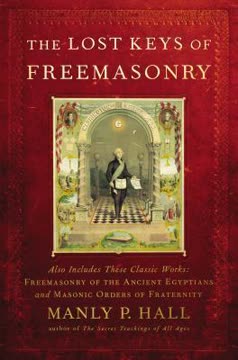
The Lost Keys of Freemasonry receives largely positive reviews (4.16/5) for its philosophical and symbolic approach to Masonry rather than historical details. Readers praise Hall's poetic, insightful writing about spiritual development and the deeper meanings behind Masonic symbolism. Many recommend it for Masons seeking esoteric understanding, particularly regarding the three Blue Lodge degrees. Critics note the book can be overly optimistic, abstract, or allegorical rather than factual. Several reviewers mention Hall wasn't yet a Mason when writing it, though this doesn't diminish their appreciation of his wisdom and beautiful prose.
Similar Books