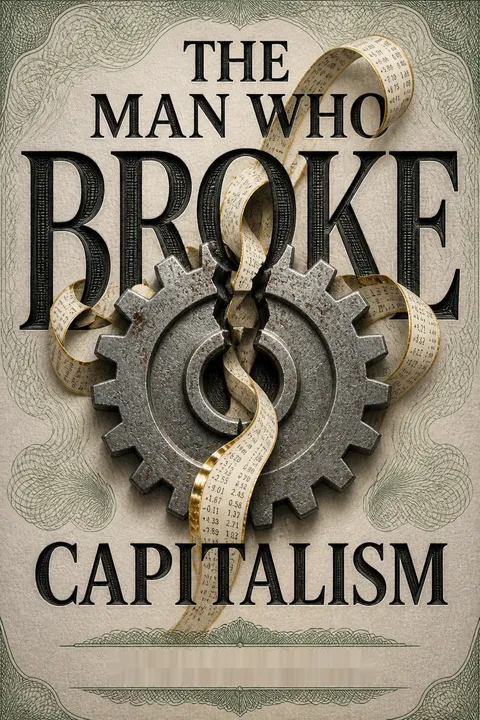


Key Takeaways
Jack Welch made GE worth $600 billion, then hollowed out its future.
A spectacular ascent. When Welch became GE’s chief executive in 1981, the company was a major industrial employer with 400,000 workers and a reputation for engineering and employee benefits. During his twenty-year tenure, annualized share-price growth averaged about 21 percent, and GE’s market value rose from $14 billion to $600 billion. He made the company the world’s most valuable, but redirected it toward layoffs, acquisitions, and financial services rather than long-term industrial strength.
The bill came due. After Welch retired, GE struggled with neglected research and development, bad acquisitions, and risky financial bets. Its shares fell sharply, and the company needed government support during the 2008 crisis. In 2021, executives announced a plan to split GE into separate companies. The book’s central argument is that Welch’s celebrated success helped normalize a model that damaged both GE and the wider economy.
The contrast between market value and institutional health is the book’s sharpest lens. A stock price can rise while a company loses technical expertise, employee trust, and resilience, much as a household can look wealthy while accumulating unsustainable debt. That distinction matters because investors often reward visible, near-term outputs more readily than hard-to-measure capabilities. Still, GE’s decline cannot be assigned to one executive alone: global competition, technological change, and financial crises also mattered. Welch’s significance is less that he caused every shift than that he made a particular response look like the definition of leadership.
Treat shareholder-first capitalism as a political choice, not a law of nature.
An idea became doctrine. Before Welch, many large companies described their responsibilities as shared among workers, customers, communities, government, and investors. The book calls the postwar decades the Golden Age of Capitalism: a period when productivity and worker pay broadly rose together and companies invested in research, employees, and future growth. This arrangement was imperfect, but it supported a large middle class.
The rules shifted. Economist Milton Friedman argued in 1970 that a business’s social responsibility was to increase profits. Later academic theories recast shareholders as the company’s principals and executives as their agents. Political organizing, deregulation, and weaker antitrust enforcement helped these ideas gain force. Welch turned them into corporate practice at GE. Yet nothing in this history makes shareholder primacy inevitable. It is a chosen account of what corporations owe, not a neutral law of economics.
The historical sequence helps separate an economic norm from an economic necessity. Once a doctrine is taught in business schools, embedded in executive pay, and repeated by boards, it can feel like common sense rather than a contested choice. That is a powerful insight about institutions: ideas endure when procedures reward them. The argument benefits from a caveat, however. Shareholders do supply capital and deserve accountability, and a firm that ignores financial viability cannot serve other groups for long. The real question is not whether profits matter, but whether they are the sole purpose and the only measure of success.
Layoffs are not a strategy when they merely shift costs onto workers.
Employment became a variable. Welch rejected the expectation that a large employer might offer long-term security. GE cut 35,000 jobs by the end of 1982, then another 37,000 the following year, despite being profitable. He also promoted outsourcing and moved work abroad, replacing stable GE jobs with contractor positions that often paid less and offered fewer benefits.
A ranking made cuts routine. The Vitality Curve divided employees into high, middle, and low performers, with the bottom 10 percent expected to leave each year. Workers called the process rank and yank. Welch presented dismissals as beneficial transitions, but the policy guaranteed recurring job insecurity even when the company was thriving. The consequences spread beyond individuals: union membership fell, communities lost employers, and workers captured less of the gains from rising productivity.
The key distinction is between adapting a workforce when a business genuinely changes and treating job destruction as an automatic route to higher returns. Organizational research discussed in the book finds little support for the claim that layoffs reliably improve performance beyond a short-term accounting gain. Ranking people against a fixed curve also makes colleagues competitors, which can suppress knowledge-sharing and mutual help. Yet employee protection cannot mean preserving every role forever. The more demanding test is whether management invests in retraining, explains the business case, and shares the costs of transition instead of placing nearly all the risk on workers.
Buying market share can mimic growth while starving the business that must sustain it.
Expansion by acquisition. Welch wanted each GE business to rank first or second in its market. If it could not, it should be repaired, closed, or sold. GE made nearly 1,000 acquisitions during his tenure, spending about $130 billion, while selling 408 businesses. The 1985 purchase of RCA brought NBC into GE, but Welch soon sold many parts of RCA. The deal enlarged the company quickly, without necessarily building stronger products.
Size is not capability. Welch said GE was not interested in incubating new businesses. Buying companies could add revenue and remove competitors, but it also diverted attention and money from research and development. The strategy helped normalize a merger boom that concentrated industries. A larger company may gain bargaining power and scale, but acquisitions do not automatically create innovation, good integration, or durable customer value.
Acquisitions can be a rational way to enter a new market or combine complementary expertise. The danger appears when deal volume becomes a substitute for a strategy, or when leaders judge a transaction mainly by its immediate effect on reported growth. This resembles a measurement problem: the visible metric, company size, can displace the harder goal, productive capability. The book’s cases also raise a useful question for boards: after a deal closes, what evidence would show that the combination works beyond increased revenue? Without clear answers, executives can keep buying growth while obscuring the weakness of the underlying business.
When finance becomes the profit engine, opaque earnings can hide systemic risk.
An industrial company changed character. GE Capital grew from $11 billion in assets when Welch took over to hundreds of billions by his retirement. The finance division lent money, issued credit, financed equipment, and entered markets far removed from GE’s traditional manufacturing. At its peak, it generated more than half of GE’s profits. Financialization means relying increasingly on financial activities and transactions, rather than producing and improving goods, to generate earnings.
Smooth numbers concealed exposure. GE Capital helped GE meet quarterly targets through acquisitions, asset sales, and complex accounting, while limited disclosure made its operations difficult for investors to assess. GE also used buybacks to raise earnings per share and returned large sums to shareholders instead of investing in products or workers. After GE entered subprime lending, the 2008 crisis revealed how vulnerable its finance arm had become. The company required a $139 billion federal loan guarantee and a $3 billion investment from Warren Buffett.
Financial engineering can be useful: credit helps customers buy products, and capital allocation can support productive investment. The warning is about opacity and dependence. When a company’s results require complicated transactions to appear steady, outsiders may mistake accounting smoothness for economic strength. That is a form of hidden fragility, similar to a system whose apparent stability depends on conditions remaining unusually favorable. The book’s critique is strongest where it connects GE’s lack of transparency to its vulnerability. It is less persuasive if taken to mean that financial services are inherently unproductive; the real issue is whether financial activity supports the core business or displaces it.
A celebrated CEO’s playbook spreads faster than its actual results justify.
GE trained its successors. Crotonville, GE’s executive campus, became a place to teach managers Welch’s methods and values. GE had long been a leading source of corporate talent, so other boards treated experience there as proof of executive ability. Sixteen public companies were run by men who had studied under Welch when he retired, and many more hired GE alumni afterward.
Copying was not competence. His protégés took over businesses as different as Home Depot, Albertsons, Fiat, and 3M. Some initially lifted profits through cuts, but several damaged morale, weakened operations, or struggled to produce lasting growth. The book contrasts this with Tom Tiller at Polaris, who grew sales while keeping manufacturing in the United States and building employee trust. A management method that works in one setting can fail when copied without regard to the company’s people, products, or customers.
The GE alumni network shows how reputations become a form of organizational capital. A board facing uncertainty may hire a recognizable executive style because it appears safer than evaluating strategy from first principles. That shortcut can turn imitation into a self-reinforcing cycle: the brand wins the appointment before results are known. The Polaris example usefully resists a simple claim that every Welch-trained manager failed. Some retained operational discipline while rejecting indiscriminate cost cutting. The transferable lesson is not to avoid managerial tools, but to test whether a tool fits the work rather than mistaking a famous source for proof of fit.
In safety-critical work, cost pressure can turn organizational fear into physical danger.
Boeing’s priorities changed. After Boeing acquired McDonnell Douglas in 1997, executives influenced by Welch-era GE pushed the company toward shareholder returns, outsourcing, and cost control. The 787 Dreamliner relied heavily on suppliers, creating quality and schedule problems. Later, Boeing modified its 737 rather than develop a new plane, then introduced MCAS, software intended to correct the aircraft’s pitch. The system depended on a single sensor, and pilots were not adequately informed about it.
Two crashes exposed the culture. Lion Air Flight 610 crashed in 2018, followed by Ethiopian Airlines Flight 302 in 2019. MCAS repeatedly pushed the planes’ noses down after sensor failures. All 346 people aboard died. The technical defects mattered, but so did compressed schedules, suppressed concerns, and decisions that prioritized cost and speed. The episode shows how an internal management culture can reach far beyond a balance sheet.
The Boeing story makes organizational culture tangible: a target set in a boardroom can shape design choices, communication, and whether an engineer feels safe raising an alarm. Safety engineering depends on redundancy, independent review, and the ability to treat bad news as useful information rather than disloyalty. The crashes had multiple technical and human causes, so no single management idea explains them all. The more defensible claim is that a culture organized around speed, cost, and deference can make known hazards harder to surface and correct. In high-consequence industries, dissent is not a morale extra; it is part of the safety system.
Corporate decisions reshape towns, inequality, and the politics of resentment.
Costs leave the ledger. As manufacturing jobs declined, factories closed, and work moved overseas, places such as Schenectady and Erie lost stable employment. The book links the period around Welch’s rise with widening gaps in pay and wealth: CEO pay at leading American companies rose from roughly $1.85 million in 1980 to $21.5 million in 2000, while the CEO-to-worker pay ratio climbed from under 50 to 368. These changes had many causes, but Welch’s practices helped make them ordinary.
Discontent became political fuel. Communities hollowed out by corporate decisions felt abandoned by both business and government. Trump later appealed to workers hurt by globalization, even as Welch supported Trump and had helped popularize the corporate practices those workers blamed. The book argues that economic insecurity helped create fertile ground for resentment, though it was only one factor in Trump’s rise.
This connection broadens the meaning of corporate performance. A factory closure is not just a line item; it can affect local suppliers, public revenues, family stability, and civic trust. Those effects are external to the firm’s accounts but not external to society. The political argument should be handled carefully: economic loss alone cannot explain voting behavior, which also reflects identity, race, media, and many other forces. Still, a durable sense of betrayal can make anti-establishment appeals powerful. Corporate leaders who describe displaced workers as collateral costs may underestimate the social and political consequences of that language.
Make stakeholder promises measurable in pay, investment, and worker power.
Some companies changed practice. Unilever chief executive Paul Polman stopped issuing quarterly guidance and pursued growth alongside lower environmental impact. At PayPal, Dan Schulman found that two-thirds of surveyed employees were running short of cash between paychecks. The company created a financial wellness program, raised pay for lower-paid workers, offered stock, improved financial education, and cut health-care costs for those employees by 60 percent. Its measure of net disposable income tracked what workers had after taxes and essential expenses.
Promises need evidence. These examples suggest that employee security and long-term investment can coexist with strong business results. But stakeholder capitalism, the idea that companies should account for workers, customers, communities, and the environment as well as shareholders, can become branding if commitments are vague. During the pandemic, many companies that publicly endorsed stakeholder values still laid off workers while maintaining shareholder payouts.
PayPal’s approach is notable because it translates concern into a measurable outcome rather than a mission statement. Net disposable income asks whether workers can meet basic expenses and retain some financial breathing room, a more informative measure than wages alone. Polman’s decision to abandon quarterly guidance also illustrates how leaders can alter the pressures investors place on a business. These cases are promising, not conclusive: successful examples do not prove that every worker-centered policy pays for itself in every industry. The pandemic comparison is especially important because crisis behavior tests whether a company’s stated values constrain decisions when trade-offs become costly.
Change incentives and rules, not just the personality in the corner office.
Companies can redistribute voice and value. The book recommends living wages, stronger benefits, profit-sharing or employee stock, and training that helps workers adapt rather than simply disappear from the payroll. Worker representation on boards, known in some countries as co-determination, gives employees a formal role in decisions about issues such as layoffs and working conditions. Longer investment horizons can reduce the pressure to optimize every quarter.
Public rules also matter. The proposed reforms include raising the minimum wage, changing taxes so labor is not penalized relative to capital, limiting incentives for companies to relocate for subsidies, strengthening antitrust enforcement, and constraining excessive executive pay. These measures address the pressures that can make short-term extraction rational for individual managers. The book’s final point is that a more balanced capitalism requires durable institutional changes, not simply better intentions from CEOs.
This is the book’s most important practical move: shifting attention from individual virtue to the architecture of incentives. A leader can choose to invest in workers, but a system that rewards quarterly targets and punishes long-term spending may steadily undo that choice. Policies such as worker board representation and stronger antitrust rules change who has influence and what costs count. Their design still requires care. A rigid compensation cap, for example, could produce unintended workarounds, while wage policy must account for differences in local costs and industries. The broader principle is sound: ethical expectations become more reliable when institutions make them consequential.
Analysis
The book’s most persuasive contribution is to treat Jack Welch not simply as a forceful executive, but as a translator. Economists and policymakers supplied an argument for shareholder primacy; Welch converted it into recognizable management routines: recurring layoffs, relentless acquisitions, financial targets, and executive incentives tied to stock performance. GE then supplied the training ground and prestige that helped those routines travel. This account explains how an idea can become powerful without being imposed by law: it can be repeated, rewarded, and taught until it seems inevitable.
The narrative also makes a strong distinction between financial success and durable capacity. GE’s rising market value did not guarantee the preservation of engineering skill, trust, or sound risk management. The Boeing chapters extend that distinction into a safety-critical setting, where the costs of organizational choices can be immediate and irreversible. The book’s argument is especially vivid when it follows one decision through several layers, from boardroom priorities to factory procedures and finally to workers and communities.
Its causal framing needs qualification. The book places Welch near a historical turning point, but globalization, automation, changing consumer markets, deregulation, and broader political choices also shaped employment and inequality. Temporal alignment is not proof that one CEO caused all the trends that followed. The stronger, more defensible claim is that Welch amplified and legitimized a set of choices, and made them easier for other executives to copy.
The proposed alternative, stakeholder capitalism, is compelling only when made operational. Pay, benefits, worker voice, research investment, and transparent reporting can be assessed; corporate declarations of purpose are easier to issue than to enforce. The pandemic examples underline this distinction. The book therefore works best as both history and institutional critique: it asks not only which leaders deserve admiration, but which measures and rules make a company’s success compatible with shared prosperity.
Review Summary
The Man Who Broke Capitalism receives mixed reviews, with some praising its critique of Jack Welch's destructive business practices and their lasting impact on corporate America. Critics appreciate the book's analysis of how Welch's focus on shareholder value and short-term profits led to widespread job losses and economic inequality. However, some reviewers find the book overly biased and lacking nuance, arguing that it oversimplifies complex economic trends. Despite these criticisms, many readers find the book enlightening and relevant to understanding current economic challenges.
People Also Read








Glossary
Welchism
Shareholder-first corporate doctrineThe book’s name for a corporate worldview associated with Jack Welch. It places shareholder returns above other corporate responsibilities, treats workers as costs to be reduced, and celebrates executives for material success with limited accountability. Its characteristic methods are downsizing, aggressive dealmaking, and financialization.
Vitality Curve
Forced employee rankingGE’s employee evaluation approach under Welch. Managers divided staff into performance groups, with the lowest-ranked 10 percent expected to be dismissed each year. Welch presented the system as a way to distinguish and reward performance; employees commonly called it rank and yank. The fixed bottom tier made job insecurity routine even when the company was profitable.
financialization
Profit through financial activityA shift in which a company increasingly earns money through financial services, lending, trading, or financial engineering rather than primarily through making and improving products. At GE, the growth of GE Capital made finance central to profits and helped smooth reported earnings, but also increased complexity and exposure to financial risk.
shareholder primacy
Shareholders come firstThe principle that a corporation’s main responsibility is to maximize returns for its shareholders. In the book, this idea gains intellectual support from Milton Friedman and later economic theories, then becomes a managerial mandate under Welch. It contrasts with approaches that balance shareholder interests with responsibilities to employees, customers, communities, and the environment.
stakeholder capitalism
Responsibility to affected groupsAn approach to corporate purpose that treats shareholders as one important constituency among several. It asks companies to consider effects on workers, customers, suppliers, communities, and the environment, as well as investors. The book distinguishes substantive practice, such as pay and worker representation, from public commitments that lack measurable follow-through.
negative externalities
Costs borne beyond the companyHarms caused by business activity that are not fully reflected in the company’s own costs or financial statements. Examples discussed in the book include pollution, job losses, weakened communities, insecurity for workers, and economic concentration. The concept helps explain why a profitable business decision can impose significant costs on people outside the firm.
net disposable income
Income after essentialsA measure developed with PayPal and outside partners to estimate how much money employees retain after taxes and essential living expenses such as housing and food. The company used it to assess workers’ financial health more directly than wages alone. PayPal treated about 20 percent as a target level that could leave room for savings and other necessary expenses.
co-determination
Worker representation in governanceA governance arrangement in which employees have formal representation in company decision-making, including board-level roles. The book points to Germany, where workers elect representatives to supervisory boards and work councils. These bodies give employees a voice in matters such as working conditions, overtime, and layoffs, rather than leaving those decisions solely to executives and investors.
Six Sigma
Process-improvement methodologyA structured quality and efficiency method promoted at GE under Welch. It uses defined processes, measurement, and analysis to identify and reduce errors or inconsistency. The book notes that its value depends on context: it can improve repeatable operations, but applying it rigidly to creative work may discourage experimentation and the learning that comes from failure.
FAQ
What's The Man Who Broke Capitalism about?
- Focus on Jack Welch: The book examines Jack Welch's tenure as CEO of General Electric and his significant impact on American capitalism.
- Critique of Shareholder Primacy: It critiques Welch's focus on maximizing shareholder value, which led to negative consequences for employees and communities.
- Legacy and Consequences: The book explores the long-term effects of Welch's strategies, including the decline of the middle class and corporate responsibility.
Why should I read The Man Who Broke Capitalism?
- Understanding Modern Capitalism: It provides insights into the evolution of corporate America and the roots of current economic challenges.
- Lessons from Leadership: Readers can learn from Welch's leadership style, understanding both its successes and societal harms.
- Relevance to Current Issues: The book addresses themes like corporate accountability and economic inequality, which are highly relevant today.
What are the key takeaways of The Man Who Broke Capitalism?
- Definition of Welchism: Welchism is a corporate philosophy prioritizing shareholder profits, often at the expense of employees and ethics.
- Impact of Downsizing: Welch's downsizing strategies altered employer-employee relationships, leading to job insecurity.
- Financialization of Corporations: Welch's focus on financial engineering over manufacturing has had lasting economic implications.
How did Jack Welch's leadership style influence corporate America?
- Shareholder Value Focus: Welch's emphasis on shareholder value became a guiding principle for many corporations.
- Aggressive Cost-Cutting: His tactics, including mass layoffs, were widely adopted, contributing to job insecurity.
- Competitive Corporate Culture: Welch fostered a cutthroat environment, leading to stress and insecurity among workers.
What is the "rank and yank" method described in The Man Who Broke Capitalism?
- Performance Evaluation System: This method involved ranking employees and firing the bottom 10 percent annually.
- Impact on Morale: It created a transactional view of work, leading to insecurity and reduced morale.
- Widespread Adoption: Many companies emulated this method, prioritizing profits over employee well-being.
How did Welch's approach to financialization affect GE?
- Shift to Finance: Welch transformed GE into a financial powerhouse, emphasizing financial engineering.
- Risks of Financialization: This shift introduced substantial risks, evident during the 2008 financial crisis.
- Long-Term Consequences: The focus on financialization led to a culture of short-termism, affecting stability.
What are the societal implications of Welchism as discussed in The Man Who Broke Capitalism?
- Erosion of the Middle Class: Welchism contributed to the decline of the middle class and growing economic inequality.
- Corporate Accountability Issues: The focus on shareholder value led to a lack of accountability and unethical practices.
- Impact on Worker Rights: Welch's strategies weakened labor unions and workers' rights, leading to a precarious workforce.
How did Welch's legacy continue to influence CEOs after his retirement?
- Continued Adoption of Welchism: Many CEOs continued to implement Welch's strategies, perpetuating cost-cutting and shareholder primacy.
- Challenges for Successors: Successors struggled to replicate Welch's success, facing backlash for aggressive tactics.
- Shift in Corporate Culture: Welch's legacy led to a culture prioritizing short-term gains over sustainability.
What are the criticisms of Welch's management style in The Man Who Broke Capitalism?
- Ruthlessness and Lack of Empathy: Welch's aggressive tactics fostered a toxic work environment and eroded loyalty.
- Short-Term Focus: His emphasis on immediate profits led to a lack of investment in innovation and growth.
- Ethical Concerns: The book highlights ethical issues, including earnings manipulation and prioritizing shareholder value over responsibility.
How does The Man Who Broke Capitalism connect Welch's practices to current economic issues?
- Income Inequality: Welch's focus on shareholder value is linked to growing income inequality, benefiting the wealthy.
- Corporate Accountability: The lack of accountability has led to public distrust of big business.
- Impact of COVID-19: The pandemic exposed worker vulnerabilities, underscoring the need for stakeholder capitalism.
What are some examples of companies that embody Welchism today?
- Amazon: The book discusses Amazon's focus on efficiency and profits, often at the expense of employee well-being.
- Boeing: Boeing's management decisions, prioritizing profits over safety, are presented as a consequence of Welchism.
- Kraft Heinz: The company's focus on cost-cutting and financialization has led to challenges like declining sales.
How does the author propose to move beyond Welchism?
- Adopting Stakeholder Capitalism: Gelles advocates for prioritizing the interests of all stakeholders, not just shareholders.
- Policy Changes: Systemic reforms like raising the minimum wage and capping executive compensation are necessary.
- Corporate Responsibility: Companies should focus on long-term growth and sustainability rather than short-term profits.
About the Author
Other books by David Gelles

Download PDF
Download EPUB
.epub digital book format is ideal for reading ebooks on phones, tablets, and e-readers.








