

Key Takeaways
Turn financial trust into political power, then spend it on lasting culture
Banking built the base. The Medici began as money-changers and became bankers in a Florence enriched by international trade. Giovanni di Bicci founded the family bank in 1397 with 10,000 florins. Its success came less from financial invention than from careful management, trusted partnerships, and a lucrative role handling papal money. The bank connected the family to merchants, rulers, and Church officials across Europe.
Money became influence. Giovanni and his son Cosimo used wealth to gain political leverage and sponsor public works, libraries, churches, and artists. The family’s story is not simply that money bought art: financial relationships gave the Medici access to power, while cultural generosity helped make that power seem useful to Florence.
The account makes finance feel less like background machinery than the plot’s engine. Credit created relationships that could be activated in politics, while public projects converted private fortunes into civic memory. That conversion was never neutral: the same network that financed art also gave one family leverage over public decisions. The Medici example therefore resists both the romantic story of disinterested patronage and the simpler claim that wealth alone explains cultural achievement. Money supplied capacity; judgment, timing, and a receptive city determined what that capacity produced.
Control a republic’s machinery, and you can rule without wearing its crown
Power hid in procedure. Florence kept republican offices, elections, and councils, but Cosimo de’ Medici became the decisive figure behind them after returning from exile in 1434. He avoided the title of prince while controlling appointments, alliances, and access to government. The appearance of civic continuity helped Florentines retain their pride in republican government, even as real authority concentrated around one family.
The system had teeth. Cosimo’s influence included the tax administration. The catasto, a register of property and wealth, could be used to impose ruinous assessments on opponents, pushing some into bankruptcy or exile. At the same time, the Medici widened voting rights for selected members of the poorer classes. The arrangement mixed limited inclusion with coercion, creating stability without equal political power.
The distinction between formal authority and practical control is central to understanding the Medici. A government can retain familiar procedures while power shifts through appointments, information, and enforcement. This helps explain why Cosimo’s rule could appear both republican and coercive. The arrangement also had a weakness: participation was granted selectively, while taxes and exile disciplined dissent. Stability, in this case, was neither pure consent nor pure force. It depended on enough citizens believing the compromise preferable to the alternatives.
Make public beauty serve civic pride, and private power gains a public face
Patronage made power visible. Cosimo supported the rebuilding of San Lorenzo, the foundling hospital Ospedale degli Innocenti, and Brunelleschi’s work on Florence’s cathedral. He also backed artists such as Donatello. These commissions were not only displays of taste. Churches and civic buildings served residents, while linking the Medici name to the city’s most admired achievements.
The scale was extraordinary. Records indicate that about 663,755 florins went to buildings and related projects between 1434 and 1471, including commitments that continued after Cosimo’s death. Cosimo also understood that public spending could outlast his political position. He feared the family might one day be expelled, but the buildings would remain. Patronage thus joined practical benefit, civic identity, family reputation, and personal ambition.
Public works offer a particularly durable kind of political persuasion: they are used by people who may not endorse the patron’s rule. The Medici could therefore attach their reputation to services and places that mattered beyond the family. Yet usefulness and self-interest are not opposites here. The works could improve the city and strengthen the dynasty at once. The harder question is who gets to define civic benefit, and who controls the resources used to provide it. Florence’s beauty was genuinely collective, but its financing and symbolism were unequally controlled.
Treat art as disciplined inquiry into bodies, space, and nature
The new art investigated. Renaissance artists did more than revive classical styles. They studied perspective, anatomy, architecture, and human expression, using art to make claims about how the world worked. Brunelleschi’s cathedral dome required engineering as well as design. Its double-shell structure and interlocking brickwork solved a construction problem that earlier builders had left unresolved.
Technique widened the questions. Donatello’s life-sized bronze David revived a lost sculptural method and presented a specific, physically convincing human figure. Leonardo da Vinci pushed observation further, filling notebooks with studies of anatomy, water, machines, and plants. These cases show why the book links Renaissance art to emerging scientific habits: careful seeing, technical experiment, and the search for reliable explanations.
The connection between art and inquiry is stronger than a claim that artists simply decorated a new age. A dome, a bronze figure, or an anatomical drawing embodies knowledge in material form. These works also show that technical skill can alter what a culture considers observable and representable. Still, the book’s story is not a clean march from medieval belief to modern science. Religious purposes persisted, and artistic investigation could coexist with astrology and other speculative practices. The change was an expanding field of inquiry, not an instant replacement of one worldview with another.
Protect trade through diplomacy, but never mistake an ally for a guarantee
Cosimo treated peace as policy. As a banker, he understood how war could disrupt credit, routes, and markets. He built relationships with rulers whose interests could protect Florence, including the mercenary commander Francesco Sforza, who became Duke of Milan. Cosimo’s support helped turn an old enemy into an ally and opened new opportunities for the Medici Bank.
Every alliance carried risk. Venice later broke with Florence, and the Medici lost business in Venetian and Neapolitan territories. Cosimo adapted by cultivating other partners, including the papacy. His network of branches and correspondents also supplied political information. Diplomacy helped preserve trade, but it could not make rulers predictable or prevent wars from changing the value of yesterday’s promises.
The Medici approach links commercial intelligence to statecraft: a banker who knows where money moves can see political danger from an unusually useful angle. It also shows why diversification matters. No single ally, market, or source of revenue remained dependable across generations. Yet Cosimo’s ability to adapt should not be mistaken for control over events. The same alliances that supported Florence could expose it to new enemies. Strategy improved the odds; it did not abolish contingency.
A failed coup can consolidate power while deepening public fear
The Pazzi plot changed everything. In 1478, conspirators attacked Lorenzo and his brother Giuliano during Mass in Florence Cathedral. Giuliano was killed; Lorenzo escaped with a neck wound. The attempted assassination failed, and the city turned violently against the conspirators. Their public executions, and the celebration of the Medici victory, warned future challengers of the cost of opposing the family.
Victory invited retaliation. Pope Sixtus IV, who had supported the plot, excommunicated Florence and went to war against it. Lorenzo survived by combining force, diplomacy, and public reassurance. The episode strengthened Medici control, but it also exposed how much depended on personal survival and how quickly political conflict could spill into religious and international affairs.
The attack shows how political violence can produce the opposite of its intended result. The conspirators sought to remove the Medici, but the failed attempt gave Lorenzo an occasion to demonstrate authority and rally supporters. That short-term consolidation came at a price: executions, papal hostility, and a war that threatened the city. The event also complicates any easy distinction between public order and private vengeance. The government restored control, but its reprisals made the boundary between justice and factional punishment difficult to see.
When civic trust collapses, moral certainty can seize the streets
Savonarola offered a sharp answer. As economic hardship and frustration with Medici rule grew, the Dominican preacher denounced luxury, corruption, and political tyranny. His message resonated with poor residents, but also reached artists and humanists unsettled by the new culture. After the Medici were expelled in 1494, Savonarola helped shape a more democratic government and called Florence a City of God.
Certainty became coercive. His followers collected books, paintings, instruments, and other objects judged morally corrupt, then burned them in the Bonfire of the Vanities. Savonarola’s influence declined as war, shortages, and political conflict intensified. In 1498 he was arrested, tortured, and executed. His rise shows that a moral movement can expose real grievances while also narrowing the space for disagreement.
Savonarola’s appeal was not merely a backlash against art or pleasure. His sermons gave language to economic strain and resentment toward a ruling family that had limited political participation. That helps explain why a religious campaign could become a program of government. The danger appears when a diagnosis of corruption turns into a claim that one faction alone knows how society should live. The episode is a reminder that reform can broaden public voice at first, then restrict it when moral authority becomes a tool of enforcement.
A successor inherits a throne, not the alliances that stabilized it
Lorenzo’s success was personal and political. He balanced Florentine factions, maintained relationships across Italy, and helped preserve a fragile peace. When he died in 1492, his son Piero inherited the family’s position but not his father’s practiced judgment. The Medici bank was already weakened, and the political machine needed constant attention.
The crisis arrived quickly. In 1494, French king Charles VIII entered Italy. Piero made concessions to the French without building support at home, and Florence’s citizens blamed him for the city’s humiliation. The Medici were expelled. Piero’s failure was not simply individual incompetence: France’s invasion destabilized Italy, and Florence was already divided. Still, the contrast shows that an inherited title cannot reproduce the relationships and conditions that made a predecessor effective.
A political dynasty can preserve office more easily than competence. Lorenzo’s methods depended on relationships, experience, and a delicate reading of Florence, not just the Medici name. Piero inherited the visible position while facing a different strategic environment, including a powerful foreign army. The book’s comparison is valuable, but its focus on character can make structural pressures seem secondary. The more complete lesson is that succession requires both capable people and resilient institutions, especially when the external conditions that once rewarded a ruler have changed.
Replace factional bargaining with administration, and authority becomes a state
Cosimo I changed the form of rule. After the Medici returned in 1530, he became Duke of Florence in 1537 and built a more centralized government. Rather than depend mainly on competing councils and family factions, he relied on a professional bureaucracy and took close interest in its records and operations.
Florence expanded into Tuscany. Cosimo secured greater independence from Emperor Charles V, conquered Siena after a long and destructive war, and strengthened Livorno as a port. In 1569 he became Grand Duke of Tuscany. These changes made Medici rule hereditary and territorial, rather than an informal family dominance within a republic. Administrative efficiency increased, but so did the distance between ruler and citizens.
This transition is larger than a change of title. A bureaucracy can coordinate taxation, defense, and administration across a territory more consistently than a loose contest among factions. But the same capacity can reduce political accountability when the ruler controls the institutions that are meant to serve the public. Cosimo I’s state-building made Tuscany more coherent and secure, while ending the remaining pretense that Florentines governed themselves. Efficiency and liberty did not move together.
Protect scientific inquiry from patrons who answer to stronger institutions
Medici support gave Galileo room to work. Galileo used mathematics and experiment to study motion, and his telescope revealed mountains on the moon, spots on the sun, and moons circling Jupiter. His observations challenged the inherited belief that the heavens were perfect and unchanging. Grand Duke Cosimo II appointed him to a prestigious Tuscan post, helping him work without the financial pressures he had faced at Padua.
Protection had limits. Galileo’s support weakened after Cosimo II died. Church authorities opposed his defense of a sun-centered system, and in 1633 the Inquisition forced him to renounce it. The Medici helped science travel farther, but their patronage could not guarantee intellectual freedom when powerful religious institutions treated new evidence as a threat.
Galileo’s story clarifies both the value and the limits of patronage. A secure salary and a sympathetic court can give an investigator time, tools, and an audience. But protection tied to one ruler is vulnerable to succession, diplomacy, and institutional pressure. The episode also shows that evidence does not settle disputes by itself when authorities disagree about who has the right to interpret reality. Support for inquiry requires more than a generous patron; it needs durable permission to question accepted explanations.
Preserve cultural wealth before political inheritance runs out
The final Medici could not preserve the dynasty. Cosimo III’s restrictive rule deepened Tuscany’s economic decline, and his heirs failed to produce a viable successor. Gian Gastone briefly eased repression and reduced taxes, but his rule could not restore the family’s political position. In 1737, Tuscany passed to Francis of Lorraine, and Medici rule ended.
The collection survived by design. Anna Maria Luisa, Gian Gastone’s sister and the last major Medici heir, arranged for the family’s galleries, paintings, statues, libraries, and other treasures to remain in Florence for public benefit. Her decision protected the artistic legacy from dispersal. Political power vanished; the cultural inheritance endured because someone made its preservation a condition of transfer.
The ending reverses the book’s opening logic. Early Medici money created power, and power financed cultural achievement; at the dynasty’s close, cultural assets outlasted political authority. Anna Maria Luisa’s decision matters because inheritance is not self-preserving. Collections can be dispersed, repurposed, or captured unless their future is deliberately secured. The contrast also prevents a purely triumphant account of the Medici: the same lineage that sponsored extraordinary works presided over economic decline and repression. Its most durable act at the end was relinquishing ownership for the city’s benefit.
Analysis
The book’s central achievement is to make the Medici family a bridge between scales of history. A bank’s ledgers lead into city politics; city politics shapes the employment of artists; Florence’s rivalries draw in popes, emperors, and kings. The family’s history therefore offers a narrative of how financial networks can become cultural and political systems, not merely a sequence of notable biographies.
Its strongest interpretive tension is between civic contribution and concentrated power. The Medici funded libraries, hospitals, churches, and art, yet also manipulated elections, used taxation against opponents, and relied on exile and force. These are not separate sides of the story. Public patronage helped make rule acceptable, while the threat of losing control gave patronage urgency. Culture was both a genuine achievement and a political instrument.
The account also challenges a simple story of Renaissance progress. Classical learning, artistic innovation, religious devotion, astrology, and political violence coexist. Humanism does not arrive as a clean break from medieval life; it develops through institutions and people still shaped by older beliefs. The scientific work of Galileo extends habits of observation and measurement, but the same systems of patronage and authority that assist inquiry can constrain it.
A caution follows from the narrative’s emphasis on vivid personalities. Cosimo, Lorenzo, Savonarola, and Galileo make history legible, but Florence’s fortunes also depend on markets, plague, foreign armies, and accidents of succession. The account sometimes treats dramatic anecdotes as windows into character, even when it acknowledges that sources are partisan or uncertain. Its most durable insight is therefore systemic: exceptional individuals matter, but their power depends on institutions, resources, and circumstances they never fully control.
Review Summary
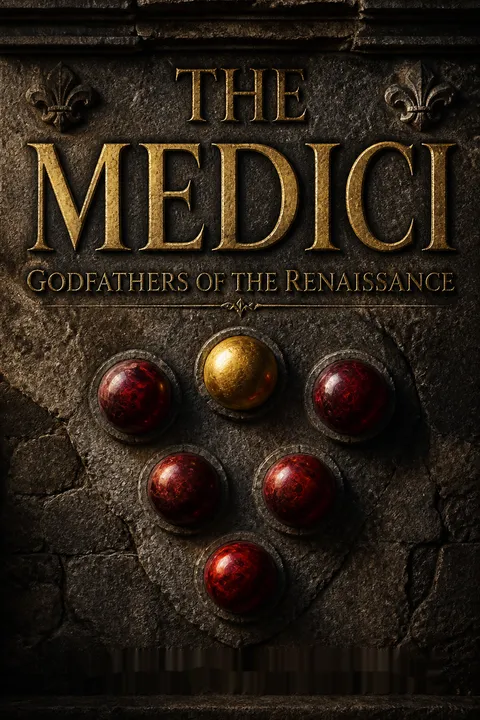
The Medici: Godfathers of the Renaissance by Paul Strathern chronicles the influential banking family from their rise through centuries of power in Florence. Readers praise the accessible, engaging narrative covering art patronage of masters like Leonardo, Michelangelo, and Donatello, alongside political intrigue and the family's lasting cultural impact. The book traces figures from Giovanni and Cosimo through Lorenzo the Magnificent to papal power and eventual decline. However, numerous reviewers criticize problematic language regarding homosexuality, women, and body weight, finding the author's personal biases intrusive and outdated, detracting from otherwise solid historical research.
People Also Read





Glossary
Medici Bank
family-run financial networkFounded in Florence by Giovanni di Bicci in 1397, the Medici Bank operated through partner-run branches and commercial contacts across Europe. Its business included currency exchange, lending, trade finance, and management of papal revenues. The bank helped build Medici wealth and political connections, although its success depended chiefly on cautious use of established practices rather than radical financial invention.
catasto
property-based wealth taxThe catasto was a Florentine tax system based on a citizen’s declared property, assets, and income, rather than income alone. Introduced after the costly war against Milan, it was presented as a fairer way to raise revenue than earlier estimates that were easy to conceal or manipulate. Under Medici influence, tax assessments could also be used to pressure opponents.
Balìa
temporary governing committeeA Balìa was a committee of citizens appointed to approve constitutional changes or major decisions taken in Florence’s name. It was created after a public assembly, but its membership could be shaped by whoever controlled the political process. The Medici and their rivals used Balìe to formalize shifts in power while preserving the appearance of civic procedure.
pax Medici
Medici-backed civic stabilityThe phrase describes the relative order established under Medici dominance in Florence. It involved political stability and periods of prosperity, but was maintained partly through the removal of opponents, punitive taxation, and limits on dissent. The term captures the book’s recurring tension: peace could benefit the city while also securing the family’s power.
virtù
political capacity to actIn Machiavelli’s usage, virtù does not mean moral goodness. It refers to a ruler’s capacity, skill, and force in shaping events and maintaining power. It operates against fortuna, the unpredictable element of chance and circumstance. A capable political actor can influence events, but cannot eliminate uncertainty or fully control what happens.
fortuna
chance and circumstanceFortuna is Machiavelli’s term for the unpredictable forces that affect political outcomes, including luck, changing conditions, and events beyond a ruler’s immediate control. It stands in tension with virtù, the ability to act decisively and shape events. The concept helps explain why preparation and political skill can improve a ruler’s prospects without guaranteeing success.
Accademia del Cimento
Florentine experimental academyFounded in Florence in 1657 by Leopoldo de’ Medici, the Accademia del Cimento brought together participants interested in testing scientific claims through experiment. Its name refers to Galileo’s preferred term for experimental trial. The academy had no formal membership structure, but its meetings and correspondence helped circulate scientific findings before similar institutions were established elsewhere in Europe.
About the Author


Download PDF
Download EPUB
.epub digital book format is ideal for reading ebooks on phones, tablets, and e-readers.








