

Key Takeaways
Build miracles through ordinary habits rather than waiting for one extraordinary event
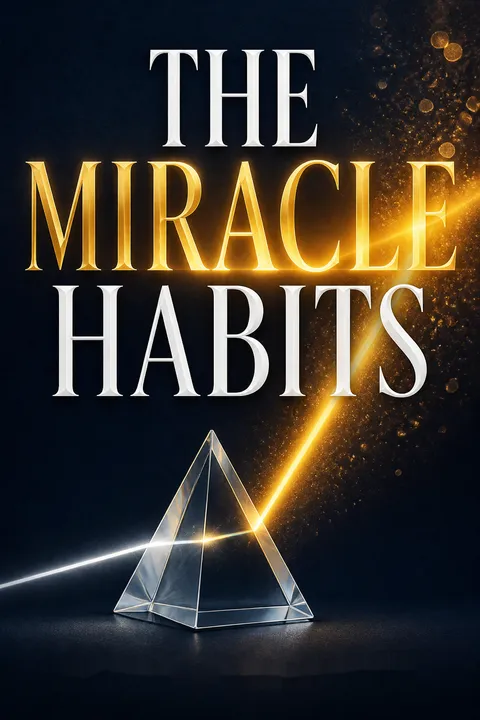
A practical definition. Horowitz calls a miracle a fortunate event or circumstance beyond ordinary expectations. His central claim is that such events need not be rare interruptions in life: repeated choices can make room for unexpected opportunities. The book is a spiritual philosophy of daily conduct, not a promise that every wish will come true. Its ethical limit is reciprocity: pursue your growth without denying another person’s chance to grow.
Practice over inspiration. Horowitz argues that inspiration comes unpredictably, while habits provide a steady foundation for effort. He draws on Napoleon Hill’s idea of recurring patterns in nature, from tides to seasons, and suggests that chosen behaviors can align a person with growth. The thirteen habits range from focus and vitality to money, speech, and relationships. Their results may look miraculous, but the groundwork is ordinary and repeated.
The useful tension here is between disciplined action and openness to surprise. In behavioral science, repeated actions can make desired conduct more reliable, while goals and routines also shape what people notice and pursue. That offers a grounded account of how habits might increase the odds of fortunate outcomes without requiring supernatural causation. Horowitz goes further and proposes that mind can affect events beyond ordinary perception. That is a philosophical commitment, not an established conclusion from the fields he invokes. Readers can still test the practices while keeping the causal claim provisional.
Name one authentic aim, then concentrate effort until it has practical form
Specify the destination. Horowitz uses Napoleon Hill’s term Definite Chief Aim for a precise, personally meaningful goal that can be pursued through real steps. A vague wish for security, for example, may conceal a more specific desire for income, leisure, or meaningful work. The point is not to justify ambition with socially approved language. It is to discover what is genuinely wanted, then check whether action toward it can begin now.
Commit in writing. Horowitz recommends reducing the aim to one sentence on a physical card and returning to it regularly. His own career illustrates the cost of divided purpose: after another reporter won a story he had been assigned, he recognized that he had not fought hard enough to remain in journalism. He left, eventually redirecting his effort toward writing subjects he cared about. A friend’s choice of lower-paid public service work also fit his real priority: time with his daughters.
A clear aim can reduce the mental switching costs that accompany competing priorities. Goal-setting research generally finds that specific, challenging goals can improve performance when people have the ability and resources to act. Horowitz adds a valuable test: a real aim should produce immediate, practical steps. Yet single-mindedness has limits. Caregiving, illness, financial pressure, and changing evidence can require revision rather than greater intensity. A written aim is best treated as a working commitment, not a contract to ignore new information or other people’s legitimate needs.
Design your surroundings to reinforce the identity and work you choose
Selfhood is embodied. Horowitz rejects a hard split between inner identity and outer life. Clothing, appearance, names, media, education, and workspaces can affect how a person feels and acts. He describes adopting his usual T-shirt style on television rather than the expected blazer. The change made him feel more like himself, and the distinctive appearance helped him stand out rather than blend in. His advice is not to imitate a look, but to notice preferences and make deliberate choices.
Make room for the work. The environment also includes practical access to tools and time. Filmmaker David Lynch’s account of artistic work emphasizes preparing a studio and protecting long stretches of attention. Horowitz also recounts a friend who thought he needed a car, then realized he wanted transportation and accepted a bicycle instead. The broader question is what condition a desired object is meant to create, and whether another arrangement serves that need better.
This view anticipates person-environment fit: behavior and well-being depend partly on whether surroundings support a person’s needs and activities. A workspace stocked for a task can lower the effort required to begin, while personal style can help make identity visible and coherent. The bicycle example also shows the value of asking what function a purchase or conventional choice is supposed to serve. Still, self-design is not equally available to everyone. Housing, dress codes, disability, money, and caregiving constrain choice, so environmental agency should be pursued within real conditions, not mistaken for unlimited control.
Treat responsibility as a testable practice, not a metaphysical guarantee
Experiment with agency. Horowitz draws on Neville Goddard’s claim that assumptions and imagination shape experience, but asks readers to test the idea rather than accept it as doctrine. His 10-Day Miracle Challenge is a focused exercise: choose a sincerely desired outcome, write it in one sentence, mark ten days on a grid, and spend time daily in prayer, visualization, affirmation, or meditation. Then watch for practical routes by which the goal might arrive.
Notice the channels. Horowitz recounts participants reporting new work, resolved legal problems, or progress on debt. These are testimonials, not controlled proof that thought caused the outcomes. He stresses that a desired result may come through ordinary means, such as a referral, treatment, or a useful offer. He also recommends combining approaches to distress. For depression, that may include therapy, medication, spiritual practice, and changes in circumstances rather than relying on one remedy.
The challenge has a plausible psychological mechanism even without its metaphysical explanation. A sharply defined goal can focus attention, make relevant opportunities easier to notice, and encourage action. The instruction to watch for ordinary avenues of fulfillment resembles practical problem-solving more than passive wishing. But testimonials cannot distinguish causation from coincidence, selective recall, or action prompted by the exercise. The strongest use is therefore experimental and bounded: clarify a goal, take useful steps, and assess outcomes honestly. Mental practices should complement appropriate medical care, not replace it.
Make solidarity measurable in time, money, loyalty, and recognition
Help must land somewhere. Horowitz distrusts public professions of service when they are not matched by concrete benefit. Giving may involve mixed motives, he argues, but the recipient’s actual benefit matters more than a spotless account of the giver’s feelings. That can mean offering money, time, reliable help, or loyalty when a colleague or friend is in trouble. It also means paying people promptly rather than using spiritual or community language to excuse delay.
Recognition can protect. In the film Monsoon Wedding, Ria tells her family that a wealthy relative abused her as a child and appears to be targeting a young girl. Her uncle Lalit ultimately tells the man to leave, despite the family’s dependence on him. The act cannot undo Ria’s past, but it acknowledges her account and protects the child. Horowitz’s larger point is that listening, believing, and acting can interrupt harm more effectively than abstract praise of compassion.
The section makes an important distinction between moral identity and moral behavior. Prosocial action is easier to assess by its effects than by claims about pure motives, and recognition can matter because people need their experiences taken seriously before they can seek help. The film example shows solidarity as costly action, not just sympathetic feeling. There is also a useful caution: loyalty should not become automatic allegiance or a substitute for careful fact-finding. Support can mean protecting someone while still responding responsibly to uncertainty and the rights of everyone involved.
Refuse gossip and gratuitous anger before they become your social style
Speech shapes character. Horowitz argues that gossip, rumor, habitual complaint, and casual insults degrade both relationships and the speaker’s own standards. He does not mean silence in the face of injustice. He means resisting talk that spreads unverified claims or supplies entertainment through another person’s humiliation. Before repeating a damaging story, he suggests asking whether it is firsthand knowledge and whether important context is missing.
Use fewer careless words. Horowitz recalls learning that an angry tone could frighten and humiliate his children, even when he had moved on from the outburst. He also urges restraint online and in email, where a private remark can be forwarded or read by the person it concerns. Feedback should be specific, useful, and welcomed; random opinions can distract people from work they understand better than their critics do. The standard is not politeness at any cost, but speech that can withstand scrutiny.
This advice connects language to social learning: repeated contempt can normalize contempt, while gossip encourages people to interpret others through suspicion. Digital communication intensifies the problem because messages travel without the immediate feedback that can moderate face-to-face speech. Still, avoiding gossip should not become a rule against reporting misconduct or seeking advice. The distinction is purpose and evidence. A careful account shared with someone able to help is different from rumor passed around for amusement. Restraint is strongest when it preserves both accountability and fairness.
Leave repeated cruelty before it teaches you to doubt your own reality
Distance can be a solution. Horowitz argues that people sometimes treat a harmful relationship as a problem to understand or forgive when first they need safety and separation. If leaving immediately is impossible because of money, family, or other constraints, he proposes recognizing the behavior privately, making a plan, and moving toward physical distance when feasible. His point is not that every conflict requires estrangement, but that chronic hostility should not be treated as harmless.
A difficult example. Horowitz recounts Frederick Douglass’s account of resisting Edward Covey, the enslaver who repeatedly beat him. Douglass’s resistance became a turning point in his sense of personhood, though he did not escape slavery for several more years. Horowitz explicitly warns against equating enslavement with ordinary interpersonal conflict. He uses the story to underline a narrower principle: the recognition that resistance is possible can change how a person understands their position, even before circumstances fully change.
The emphasis on environment is valuable because distress is not always an internal defect to be repaired. Persistent humiliation or coercion can undermine judgment, health, and self-trust, so practical separation may matter more than further self-analysis. The counsel needs a safety-conscious reading: leaving an abusive relationship can increase danger, and financial dependence or caregiving can make immediate departure unrealistic. Planning with trusted people and relevant professional services may be essential. The book’s strongest contribution is not a universal command to cut ties, but permission to treat distance as a legitimate option.
Choose collaborators and friends who make your best capacities more possible
Success is assembled. Horowitz argues that people are shaped by the company around them, from friends and partners to editors, producers, and colleagues. He describes years of modest results while trying to build television projects without a close creative team. Finding producers and a director whose judgment strengthened the work changed the atmosphere and quality of his efforts. The lesson is not to seek famous contacts, but to choose people whose standards and working habits fit the work.
Prefer fit over approval. Horowitz also warns against forcing entry into a group by overperforming, lowering personal standards, or accepting relationships marked by confusion and disrespect. He considers loneliness painful, but sometimes preferable to companionship that repeatedly diminishes a person. At the same time, he urges care when ending a productive partnership: friction is normal, and a sound collaboration should not be discarded impulsively before replacement support or new opportunities are real.
This account treats achievement as relational rather than purely individual. Teams distribute skills, attention, and emotional support, and the quality of collaboration can change what one person is able to produce. Research on psychological safety also suggests that people contribute more when they can ask questions, disagree, and take interpersonal risks without humiliation. But the idea of choosing one’s company can obscure unequal access to networks. Some people cannot simply leave a workplace or community. Where exit is limited, identifying allies and building smaller pockets of trust can still expand agency.
Spend to expand agency, while saving, paying debts, and protecting liquidity
Money buys options. Horowitz rejects the pretense that money is unimportant. It can fund education, health, projects, and independence. He recommends judging purchases by whether they build capability or support a meaningful aim, while recognizing that a carefully chosen item of clothing or leisure activity can also serve a real purpose. He also urges workers to negotiate compensation and assess offers instead of agreeing too quickly out of fear.
Use a simple order. Drawing on George Clason’s The Richest Man in Babylon, Horowitz recommends saving 10 percent of income and directing 20 percent toward debt repayment when circumstances allow. He advises freelancers to reserve 30 percent of gross income for taxes. These figures are rules of thumb, not universal laws. During a genuine financial crisis, he favors keeping cash available over aggressively paying down debt. He also stresses that medical costs and health insurance can overwhelm otherwise careful plans.
The chapter’s strongest financial insight is that money management is not merely arithmetic; it affects bargaining power, time, and resilience. Saving and reducing high-cost debt can create options, while asking for fair compensation addresses the other side of the ledger: income. The numerical rules are less portable. Tax rates, interest rates, emergency needs, and access to benefits vary, and liquid savings can be more urgent than extra debt payments. The book is right to resist financial advice that assumes stable healthcare coverage, but its prescriptions still require adaptation to a reader’s actual circumstances.
Research carefully, then act before hesitation drains commitment
Preparation is not delay. Horowitz distinguishes decisive action from impulsiveness. He describes a successful investor who gathered extensive firsthand evidence, then made decisions quickly once the research was complete. In contrast, writers in his publishing career sometimes weakened promising work by removing vivid details or changing strong titles out of fear. The danger is not caution itself, but endless hedging that slowly hollows out a project.
Keep your word. A decision creates obligations to colleagues, clients, and loved ones. Horowitz argues that missed deadlines, ignored messages, and broken promises erode trust even when the eventual failure appears minor. If a commitment cannot be met, he recommends contacting the other person early and working out a change rather than disappearing. He also warns that instinct can be informative but may be distorted by personal anxieties. Speed works best after preparation, self-knowledge, and honest communication.
The distinction between rapid execution and rushed judgment is important. Decision science identifies both analysis paralysis and overconfidence as risks; neither is solved by a blanket command to move faster. Horowitz’s sequence is more useful: gather relevant evidence, recognize when the decision is ready, and then act without repeatedly reopening it from fear. Reliability also functions as a form of social capital. Still, a timely reversal can be wiser than honoring a commitment that has become harmful or impossible. Integrity includes communicating the change, not merely adhering to the original plan.
Practice physical resistance before comfort narrows your strength and attention
Discomfort can train capacity. Horowitz presents walking, cycling, lifting, and other forms of physical effort as ways to build strength and psychological confidence. He recounts Henry Rollins’s story of beginning weight training as a bullied, insecure teenager. As his body changed through practice, he gained a sense of capability that no one else could take away. Horowitz treats such experiences as evidence that repeated effort can reshape both physical habits and a person’s sense of agency.
Do not postpone maintenance. A friend’s warning that neglected problems eventually demand more attention informs the chapter’s practical advice: protect sleep, movement, and health even during demanding work. Horowitz describes reducing alcohol and cannabis use, then finding that his productivity, sleep, and budget improved. He is not arguing that every discomfort should be endured or that exercise cures illness. His claim is that ordinary, sustainable effort can protect vitality before preventable deficits accumulate.
The connection between movement and mood is supported by a substantial body of research, though effects differ across people and conditions. Strength training can also provide visible feedback: effort produces measurable change, which may support self-efficacy. Rollins’s story illustrates that subjective shift powerfully, but one person’s transformation cannot establish a universal prescription. Pain, disability, age, and medical conditions change what safe resistance looks like. A useful reading is progressive challenge, not macho endurance: activity should build capacity without turning injury, illness, or rest into moral failures.
Choose creative freedom over prestige, and build faith through self-directed practice
Freedom may outrank status. Horowitz’s career changed when he accepted work at a less prestigious publishing house where he could shape its list and rediscover his own ambitions as a writer. He compares this with comic artist Steve Ditko, who produced some of his most distinctive work at a small publisher that gave him unusual creative latitude. The less celebrated setting was not automatically better; it suited the kind of independence each man needed.
Faith as earned conviction. Horowitz defines faith less as certainty about a conventional deity than as confidence that unseen principles and personal resources support action. He describes climbing a tower and making an improvised vow to become a writer, then developing a career through sustained work. His term anarchic magick describes personally devised spiritual practice rather than obedience to a fixed ritual system. He encourages experimentation, while presenting metaphysical effects as his belief, not a guaranteed result.
The chapter’s case for autonomy aligns with intrinsic motivation: people often persist more readily when a pursuit reflects their values and allows meaningful choice. The Ditko and publishing examples make a useful distinction between prestige and fit. Yet the choice of a less prestigious path can carry financial and social costs that not everyone can absorb, so freedom is partly a material condition. The spiritual practice offers a way to make intention embodied and memorable. Its value need not depend on proving supernatural causation, though readers should distinguish personal meaning from evidence about how the world works.
Analysis
The book’s organizing idea is that extraordinary outcomes are built from ordinary conduct, but its thirteen habits do not form a tidy, neutral productivity system. They make a more provocative claim: personal ambition, spiritual agency, ethical reciprocity, money, appearance, and physical discipline belong in one life rather than separate moral compartments. That is why the stories matter. Horowitz’s shift from journalism to writing, Frederick Douglass’s resistance to Covey, the family intervention in Monsoon Wedding, and Steve Ditko’s preference for creative latitude each dramatize a choice about agency under constraint.
The narrative method is memoir braided with intellectual history. William James, Napoleon Hill, Neville Goddard, Emerson, and New Thought writers provide vocabulary; work and family episodes provide the tests. This combination gives the advice texture and keeps abstract principles attached to decisions. It also makes the book difficult to compress: anecdotes sometimes serve several purposes, while the author moves between practical counsel and metaphysical interpretation without always drawing a sharp boundary.
The most durable contributions are concrete and ethically legible: clarify what is wanted, make surroundings support it, pay people fairly, protect attention, leave harmful situations when possible, keep commitments, and treat setbacks as occasions for adjustment. These ideas remain useful whether or not the reader accepts claims about mind influencing reality beyond ordinary pathways. The metaphysical case is the book’s least established element. Testimonials and associations with quantum mechanics or placebo research do not demonstrate that intention causes external events. The 10-day exercise can still be valuable as focused goal-setting, provided its results are evaluated honestly rather than interpreted as proof.
There is also a tension between radical self-responsibility and structural limits. The author acknowledges money, health coverage, parenting, and unequal circumstances, but the language of choosing one’s path can still overstate individual control. Read most productively, the book is not a guarantee that disciplined people receive miracles. It is a challenge to stop surrendering choices by default, and to organize the choices that remain around an aim worth pursuing.
Review Summary
Reviews of The Miracle Habits are mixed but generally positive, with an average rating of 4.15/5. Many readers praise the book for its practical advice on personal development and spiritual growth, finding it inspiring and effective. Some appreciate Horowitz's approach to reinventing classic self-help concepts for modern times. Critical reviews mention repetitive self-help tropes and concerns about references to occult practices. Overall, readers find the book offers valuable insights on creating beneficial habits, though opinions vary on its uniqueness and depth.
People Also Read









Glossary
Miracle
Unexpected fortunate outcomeHorowitz uses miracle to mean a fortunate event or circumstance that exceeds conventional expectations. He presents miracles not only as rare supernatural interventions, but as outcomes that can emerge from sustained habits, focused aims, practical action, and openness to unexpected routes. The definition expresses the book’s spiritual outlook, not a scientifically established account of causation.
Definite Chief Aim
Specific central life goalA Definite Chief Aim is a clear, personally important goal that can be translated into practical action. Horowitz adopts the term from Napoleon Hill and emphasizes that the aim should be honestly desired rather than phrased to win social approval. Writing it as a concise sentence and revisiting it helps concentrate attention and effort.
10-Day Miracle Challenge
Ten-day intention exerciseA focused practice for directing attention toward one sincerely desired outcome over ten days. The participant writes the desire in one sentence, marks a ten-day grid, and regularly uses prayer, visualization, affirmation, or meditation. Horowitz also urges close attention to ordinary and unexpected means of progress. He offers the exercise as an experiment, not a guaranteed method.
Cosmic Habit Force
Nature’s recurring patternsNapoleon Hill’s term for the recurring patterns through which nature maintains itself, such as tides, planetary motion, and seasons. Horowitz applies the idea to human behavior: people can deliberately choose repeated actions that support growth and production. The concept supplies a metaphysical interpretation of habit, rather than a behavioral-science explanation.
Total Environment
Self-shaped surroundingsHorowitz’s idea that personal identity and surroundings are interconnected rather than separate inner and outer domains. A total environment can include dress, appearance, workspace, media, education, relationships, and daily routines. Deliberately shaping these conditions may support self-expression and make meaningful work easier to pursue.
Anarchic magick
Self-designed spiritual practiceHorowitz’s name for an improvisational, personally devised approach to spiritual practice. It may involve prayer, intention, ritual, or engagement with symbols and places, without requiring membership in a group or strict adherence to prescribed ceremonies. He presents it as a spiritual form of experimentation informed by study, not as a standardized system.
Master Mind alliance
Values-aligned support groupA group of people who support one another through shared aims, practical advice, and ethical encouragement. Horowitz connects the term with support groups and describes the collective energy of a harmonious group as more than the sum of its members’ individual efforts. He interprets this added force spiritually, while the practical benefits include accountability and solidarity.
Positive Mental Attitude (PMA)
Resourceful, resilient outlookA term Horowitz associates with Napoleon Hill and the punk band Bad Brains. PMA does not mean denying hardship or pretending that everything is pleasant. It means maintaining confidence in one’s capacity to respond, create, and recover, while resisting habits such as rumor, hatred, jealousy, and habitual defeatism.
Download PDF
Download EPUB
.epub digital book format is ideal for reading ebooks on phones, tablets, and e-readers.








