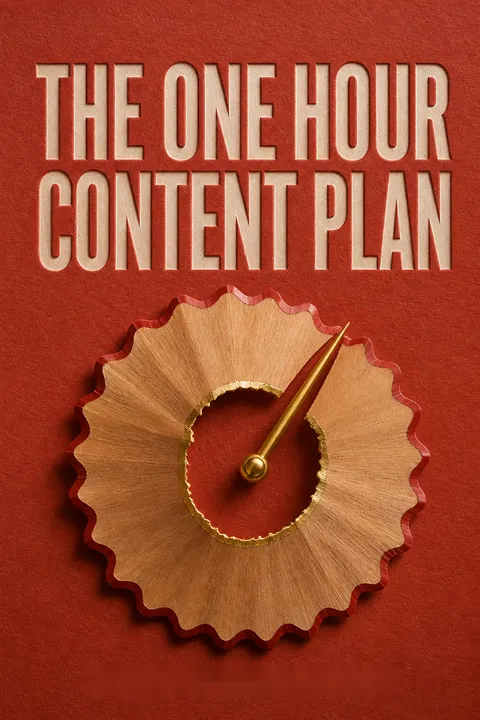


Key Takeaways
Stop collecting headline lists; build a system that connects every post to a goal.
Ideas are not the problem. A folder full of prompts can help briefly, but it cannot decide what your blog is for, whom it serves, or how a post supports your business. The book’s central promise is a year of blog ideas in an hour, but the hour works only after you set those bearings. Otherwise, a calendar becomes a tidy record of disconnected topics.
Plan before you fill. Start with the purpose of the blog, the reader it helps, and the business outcome you want. Then use the One-Hour Content Plan to generate ideas, not polished headlines. A weekly publishing schedule needs 52 ideas for a year; publishing every other week needs 24. The plan should connect each idea to a destination, not merely keep the queue full.
The distinction between idea generation and strategy is more consequential than it first appears. A prompt list reduces the blank-page problem, but it can also increase the volume of unfocused work. This resembles the difference in management between activity metrics and outcome metrics: a full publishing schedule records effort, while a purposeful schedule records choices made in service of a result. The useful test is not whether every post sells. It is whether the post has a discernible role, such as teaching, attracting, building trust, or supporting an offer.
Define the reader's before-and-after state before choosing blog categories.
Start with a transformation. The Driver of Change (DoC) Model asks you to describe the reader’s current state and the state your content aims to help them reach. Compare the two across three dimensions: what the reader is experiencing, how they feel, and what they think. For instance, a blogger might help readers move from scattered effort and overwhelm toward clearer priorities and a sense of progress.
Build categories around that destination. The book calls these categories content buckets, and recommends keeping them focused, with up to seven main buckets. A debt-reduction blog might use budgeting, intentional living, and saving or investing. Each category should help the reader make some part of the journey, rather than exist because the topic is popular.
This model gives content planning a useful causal question: what change is this material meant to support? It also resembles outcome mapping in education, where teaching begins with the capability a learner should gain, not with a list of topics to cover. The emotional and cognitive dimensions matter because a reader’s obstacle may be confusion or self-doubt, not simply missing information. Still, a blog post rarely causes a transformation alone. The model is best used to clarify direction, while recognizing that readers bring constraints and circumstances the publisher cannot control.
Write to one researched person, not an imaginary mass audience.
Make the audience concrete. A reader persona is a specific description of the person a blog is trying to help. It goes beyond age or job title to include motivations, frustrations, habits, and doubts. The book’s example is a mother considering freelance work who fears she lacks time and expertise. That portrait gives the writer a clearer audience than the broad label “people interested in blogging.”
Listen where readers speak. Search relevant Facebook groups for phrases such as “need help” or “have no clue,” review comments on other blogs, notice which topics gain attention, and ask current clients or subscribers open-ended questions. Use those observations to find the language readers use for their problems. A good headline or opening can then show that the writer understands a real situation, rather than guessing at generic pain points.
Specific audience descriptions make empathy operational. In user research, concrete accounts of goals and friction often reveal design needs that demographic categories miss; the same logic applies to editorial choices. The persona should remain a working hypothesis, however, not a fictional character treated as fact. Group discussions can overrepresent people who are especially vocal, and popular posts do not necessarily reveal what quieter readers need. Checking assumptions through direct questions and real responses helps keep the persona useful rather than decorative.
Give each piece a job in the reader's journey toward trust and purchase.
Match content to readiness. The book maps a typical path from stranger to casual reader, subscriber, engaged fan, and eventually customer or advocate. A stranger may first discover a post through social media, a guest article, or a podcast. A casual reader may subscribe for a relevant free resource. Useful follow-up material can deepen trust, while product-related content can answer questions and help a ready reader decide.
Find the stalled step. Ask what is keeping a reader from moving forward and what information would help. Someone unfamiliar with a problem may need help recognizing it. Someone who already trusts the writer but hesitates to buy may need a case study, a clear explanation of benefits, or answers to practical questions. A buyer still needs onboarding that helps them use what they purchased.
Thinking in stages prevents a common mismatch: asking an unfamiliar reader to buy before establishing relevance, or continuing to publish introductory material for people who already want a solution. The sequence also echoes the idea of progressive disclosure in design, where people receive information suited to their present task. The path should not be mistaken for a guaranteed or strictly linear funnel. Readers arrive through different routes, skip steps, and may never become customers. It remains a useful diagnostic map for identifying missing information and awkward transitions.
Generate ideas from expertise, offers, and quarterly goals, not viral guesses.
Use three sources of direction. The E.O.G. Method groups idea generation around expertise, offers, and goals. Expertise-based ideas break a core subject into categories, subcategories, and individual posts. For a virtual assistant teaching client marketing, one branch might move from marketing to pitching services, then to topics such as pitch structure, common mistakes, or follow-up.
Connect topics to business needs. Offer-based content helps people understand a problem, consider solutions, assess a product, or resolve buying questions. Goal-based content begins with a concrete target for the quarter. If the goal is to grow an email list, useful work might include creating an opt-in resource or writing guest posts. A swipe file, a central place to store promising ideas, captures research from search tools, communities, podcasts, and competing sites for later development.
The three sources balance durable educational value with immediate business priorities. Expertise gives a topic depth, offers connect that knowledge to a commercial path, and goals help limit the temptation to pursue every appealing idea. The strongest use of this system is combinatorial: one subject can teach a skill, address a reader’s concern about an offer, and support a quarterly objective. Its main risk is overfitting content to short-term targets. A healthy plan leaves room for reader curiosity and unexpected questions, rather than treating every post as a sales instrument.
Stand out through a clear point of view and a voice you can sustain.
Choose a content tilt. A content tilt is the distinctive angle or viewpoint that makes a publisher’s work recognizably different within a crowded subject area. The author’s example is email marketing: instead of treating a large list as the goal, she focused on how to use that list well. Look for unanswered audience questions, common claims you dispute, misconceptions, or methods you can explain from experience.
Make the voice deliberate. The ADDE Formula turns brand voice into practical guidance: identify a few attributes, clarify what those attributes do and do not mean, and choose expressions that fit. A brand might be warm but not vague, or candid but not cruel. Choose a content format you can produce consistently and that suits the subject. A format is not automatically right because it is fashionable.
Distinctiveness is not novelty for its own sake. A useful point of view changes how a reader interprets a familiar problem, while a consistent voice helps that perspective become recognizable. The format advice adds an important capacity constraint: a theoretically powerful channel has little value if its production demands prevent consistency or distract from the business. There is a counterweight, though. Comfort alone can become a reason never to experiment. A measured trial, judged by audience response and business outcomes rather than prestige or vanity metrics, can test whether another format is worth learning.
Design posts for skimmers before asking them to read deeply.
Earn attention in layers. The book treats a post as more than its main text. A clear, specific headline makes a promise; the opening earns another few seconds; subheads, short paragraphs, and lists help readers scan the argument. Directly addressing the reader, using questions, and linking to relevant evidence can make the piece feel more useful and credible. A conclusion should close the loop, offer a practical next step, and include a call to action suited to the post’s goal.
Make the package coherent. Use images that fit the brand and prepare them for social sharing. Related posts and easy sharing tools can help readers continue or pass the article along. Search details, such as a descriptive title and image text, can improve discoverability. These elements are not substitutes for a useful argument. They make it easier for readers to notice, navigate, and act on one.
Layered presentation respects how people encounter information online: they often inspect a page before deciding whether to commit attention. Strong headings and visual structure lower the cost of finding relevance, much as signposts help people navigate a complex document. Yet optimizing every component can create a checklist mentality, where readable prose is bent around scoring tools or keyword repetition. Search practices and platform conventions also change. The durable principle is to make the promise clear, the structure navigable, and the next action obvious, while letting the substance determine the form.
Treat promotion as part of publishing, not an afterthought.
Plan for distribution. The book groups promotion into five pathways: social media, outreach, email, automation, and paid promotion. A post might be adapted into several visual assets, shared in relevant communities, or sent to people whose work it references. Email can connect a post to an audience already interested in the topic. Automation can resurface older material, while a small advertising budget can extend reach.
Choose, then measure. Trying every channel at once spreads a solo operator thin. The author recommends testing a manageable set of recurring activities, tracking which ones bring useful attention, and focusing on the strongest pathways. She offers an 80/20 guideline, spending much more effort promoting content than writing it. Treat that split as a prompt to budget for distribution, not a universal law. A helpful post still needs a relevant audience and an easy way to share it.
Distribution is often the neglected half of publishing because writing produces a visible artifact, while outreach feels less like creative work. But a post’s value depends partly on whether the right people can find it. Repurposing and targeted sharing can extend the useful life of an article without demanding a constant stream of new material. The 80/20 ratio is best understood as a corrective to under-promotion, not a precise allocation for every business. Promotion can also be measured badly: clicks are not the same as subscribers, trust, or sales.
Batch ideas, schedule intentionally, and let analytics revise the plan.
Make the plan usable. An editorial calendar is a visual schedule for seeing what is planned, what is in progress, and how topics fit across a month or quarter. It helps a blogger prepare for seasonal events, avoid repetitive formats, and decide whether new invitations fit existing commitments. The tool can be paper, a spreadsheet, a calendar, or software. The right choice is the one that will actually be maintained.
Work in batches. Group similar tasks, such as developing ideas, outlining posts, or preparing visuals, instead of repeatedly switching between unrelated stages. Keep ideas in one central swipe file, then compare published work against analytics. Notice which posts attract readers, earn shares, or convert readers into subscribers, and use those signals to improve future planning. A calendar is not a contract: it should provide direction while leaving room for timely changes and better evidence.
Batching reduces the repeated setup costs of switching between tasks, while a calendar externalizes memory and makes trade-offs visible. Together, they turn a strategy into a routine rather than a document admired once and forgotten. Analytics add a feedback loop, but interpretation matters: a popular article may attract the wrong audience, and a low-traffic post may support a valuable offer. Looking at multiple outcomes prevents one easy metric from dictating the entire editorial agenda. The calendar should preserve consistency without making the publisher so rigid that new evidence cannot change the plan.
Analysis
The book’s most valuable move is to redefine content planning as a problem of alignment rather than inspiration. Its promised one-hour inventory is not a magic shortcut. It is the output of several prior decisions: whom the business serves, what change it supports, how readers encounter the brand, and what outcomes matter. This sequencing explains why generic idea lists disappoint. They supply topics without the criteria needed to select among them.
The framework also joins editorial thinking to business design. Content can teach, attract, reduce uncertainty, build trust, or help a reader evaluate an offer. That makes each post legible as part of a system rather than an isolated performance. The reader journey and E.O.G. method are especially useful for a solopreneur, whose limited time makes purposeful repetition more valuable than publishing for its own sake. The emphasis on a distinctive perspective further suggests that authority grows through sustained, recognizable coverage, not merely a high volume of posts.
The model is strongest as a planning heuristic, not as a predictive machine. A carefully mapped path does not guarantee that readers will move through it, and a goal-linked article does not establish that the article caused a sale. Attribution is difficult when people encounter a business through multiple channels over time. Analytics can inform decisions, but the metrics need to reflect the purpose of a post, not just traffic or social sharing.
The operational advice also comes from a specific publishing era. Several named platforms and tools in the book may change or disappear, while the deeper practices remain useful: store ideas centrally, make material easy to scan, test distribution, and choose tools with low friction. The most durable lesson is therefore not the exact software stack or promotional ratio. It is to treat content as a repeatable cycle of audience understanding, purposeful creation, distribution, and revision, while allowing evidence to reshape the plan.
Review Summary
The One Hour Content Plan receives mostly positive reviews, with readers praising its practical advice, clear structure, and actionable tips for content creation. Many found it helpful for generating blog post ideas and developing a coherent content strategy. Some reviewers noted that while the information may not be entirely new, the book's organization and presentation make it valuable for beginners and experienced bloggers alike. A few criticisms include the frequent references to external resources and its focus on business-oriented blogging rather than casual writing.
People Also Read





Glossary
Driver of Change (DoC) Model
Reader transformation mapA way to describe the change a blog aims to help its readers make. It compares a reader’s current and desired states across what they experience, feel, and think. The comparison helps a publisher select content categories and topics that support a coherent reader outcome.
E.O.G. Method (Expert-Offer-Goal)
Three sources of ideasA content ideation method organized around three sources. Expertise produces material that helps readers become proficient in a subject. Offers generate content that addresses the problems a product or service solves and readers’ questions about buying. Goals connect content to specific business priorities, often set for a quarter.
ADDE Formula
Brand voice guideA framework for making a brand’s writing voice more consistent. It uses Attribute Markers to name the desired qualities, Do’s to explain how those qualities should appear, Don’ts to specify what to avoid, and Expressions to capture distinctive stylistic habits such as greetings, emphasis, or recurring phrases.
content tilt
Distinctive subject angleThe specific perspective that differentiates a publisher’s work from other content covering the same general subject. It may come from unanswered audience questions, a disagreement with conventional advice, a neglected subtopic, or a method grounded in experience. A clear tilt helps an audience recognize what the publisher is particularly known for.
swipe file
Central idea collectionA place to save useful prompts, questions, examples, and observations that may inspire future content. It can be a spreadsheet, app, folder, or physical file. The book recommends keeping these ideas aligned with the blog’s purpose and consolidating them so promising material does not disappear across scattered notes.
FAQ
What's "The One Hour Content Plan" about?
- Purpose: "The One Hour Content Plan" by Meera Kothand is designed to help solopreneurs and small business owners generate a year's worth of blog post ideas in just 60 minutes.
- Content Strategy: It provides a method for creating content that not only hooks readers but also aligns with business goals and promotes products or services.
- Structure: The book is divided into sections that guide readers through setting up a content strategy, ideation, content creation, and promotion.
- Outcome: By the end of the book, readers should have a clear content plan that supports their brand and business growth.
Why should I read "The One Hour Content Plan"?
- Efficiency: It promises to streamline the content creation process, saving time and effort for busy solopreneurs.
- Strategy: The book emphasizes the importance of having a content strategy rather than just generating random ideas.
- Practical Tools: It offers actionable steps and tools, such as the E.O.G. (Expert-Offer-Goal) Method, to create content that resonates with the target audience.
- Growth: Reading this book can help you build a strong online presence and drive business growth through effective content marketing.
What are the key takeaways of "The One Hour Content Plan"?
- Content Strategy Importance: A solid content strategy is crucial for turning readers into customers and building a brand.
- E.O.G. Method: The Expert-Offer-Goal Method is a core strategy for generating content ideas that align with business objectives.
- Content as a Journey: Content should guide readers through a journey from being strangers to becoming brand advocates and customers.
- Editorial Workflow: Managing an editorial calendar and using tools to streamline content creation and promotion are essential for consistency and success.
How does the E.O.G. Method work in "The One Hour Content Plan"?
- Expert: Create content that helps readers become proficient in a specific category, breaking it down into sub-categories and topics.
- Offer: Develop content that promotes your products or services by addressing different stages of customer awareness and readiness to buy.
- Goal: Align content with specific business goals, ensuring each piece contributes to achieving those objectives.
- Integration: The method integrates seamlessly into the content plan, ensuring a strategic approach to content creation.
What is the "Driver of Change" concept in "The One Hour Content Plan"?
- Transformation Focus: The Driver of Change (DoC) Model views content as a catalyst for change, transforming readers from their current state to a desired state.
- Before and After: It compares the reader's 'Before' and 'After' states across three components: experiences, feelings, and thoughts.
- Content Alignment: Content should be designed to facilitate this transformation, aligning with the reader's journey and business goals.
- Strategic Content: This approach ensures that content is not just informative but also transformative, driving both reader and business progress.
How does "The One Hour Content Plan" suggest managing an editorial workflow?
- Batching Tasks: The book emphasizes batching similar tasks together, like ideation and writing, to save time and increase efficiency.
- Editorial Calendar: It recommends using an editorial calendar to visualize content plans, track progress, and ensure consistency.
- Tools and Resources: The book provides a list of tools for content organization, headline analysis, keyword optimization, and more.
- Flexibility and Planning: An editorial calendar helps plan content around key events and promotions, allowing for strategic content distribution.
What are the benefits of having a content strategy according to "The One Hour Content Plan"?
- SEO and Traffic: A solid content strategy improves SEO, leading to more backlinks and increased traffic.
- Sponsorship Opportunities: Consistent, high-quality content attracts brands looking for influencers to promote their products.
- Sales and List Growth: Purposeful content connects with the audience's needs, leading to increased sales and email list growth.
- Brand Authority: A content strategy positions you as a thought leader, building respect and mindshare in your niche.
What are the signs you need a blog content plan according to "The One Hour Content Plan"?
- Lack of Ideas: Struggling to come up with content ideas and not planning in advance are signs of needing a content plan.
- Chasing Trends: Randomly following content trends without a cohesive strategy indicates a lack of direction.
- Weak Product Links: If your content doesn't effectively promote your products or services, a content plan is necessary.
- Content Vacuum: Producing content without considering how it contributes to business goals shows a need for strategic planning.
What are the best quotes from "The One Hour Content Plan" and what do they mean?
- "Give a man a fish and you feed him for a day; teach a man to fish and you feed him for a lifetime." This quote emphasizes the book's focus on teaching readers to generate their own content ideas rather than relying on templates.
- "Content should transform your readers." This highlights the importance of creating content that not only informs but also facilitates change and growth for the reader.
- "Attention is currency." In a world full of distractions, capturing and maintaining the reader's attention is crucial for content success.
- "Content strategy is the plan that gets you there." This underscores the necessity of having a strategic approach to content creation to achieve business goals.
How does "The One Hour Content Plan" suggest promoting content?
- Social Media: Use platforms like Pinterest, Instagram, and Twitter to share and promote content, utilizing tools like Tailwind for scheduling.
- Outreach: Engage with influencers and those mentioned in your content to encourage sharing and collaboration.
- Email Marketing: Notify your email list about new content, providing exclusive insights or additional value.
- Automated and Paid Promotion: Use tools like IFTTT for automated sharing and consider small-budget paid promotions on platforms like Facebook and Pinterest.
What is the role of a swipe file in "The One Hour Content Plan"?
- Idea Collection: A swipe file is a collection of ideas and inspiration for future content, helping to streamline the ideation process.
- Organization: It can be a physical file, digital folder, or app, organized by content categories for easy access.
- Research Tool: The swipe file is fed by research from platforms like Pinterest, Facebook, and Buzzsumo, ensuring ideas align with content strategy.
- Content Alignment: Only ideas that fit the content GPS defined in the book should be included, ensuring strategic content creation.
How does "The One Hour Content Plan" define a brand voice?
- Consistent Tone: A brand voice is the consistent tone and style used across all content, reflecting the brand's personality.
- Attribute Words: Identify three words that describe your brand, such as bold, fun, or professional, to guide your writing style.
- ADDE Formula: Use the ADDE (Attribute Markers - Do’s - Dont’s - Expressions) Formula to define and maintain your brand voice.
- Unique Expressions: Incorporate unique expressions, slang, or writing quirks to make your content distinctive and memorable.
About the Author

Download PDF
Download EPUB
.epub digital book format is ideal for reading ebooks on phones, tablets, and e-readers.








