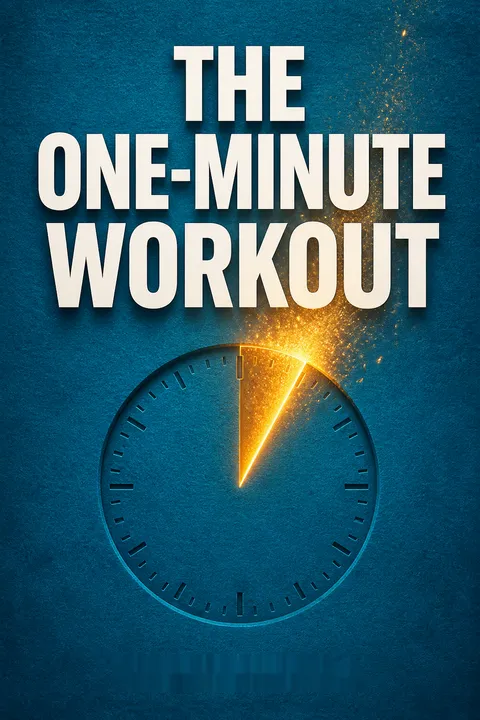


Key Takeaways
Three hard minutes weekly matched 135 moderate minutes in one trial
The central claim is about efficiency. In one 12-week study, sedentary adults who did three weekly sessions, each containing three 20-second all-out efforts, improved by about as much as a comparison group doing 135 minutes of moderate exercise each week. The hard efforts totaled just three minutes weekly, though warm-ups, rests, and cool-downs brought the full commitment to about 30 minutes.
The result has boundaries. The groups showed similar changes in measured fitness, body-fat percentage, muscle mitochondria, and blood-sugar management. That does not prove three minutes replaces every health benefit of longer exercise for every person. The book’s practical point is narrower and powerful: brief, demanding intervals can produce substantial fitness gains, so a long workout is not the only useful workout.
The comparison challenges a familiar equation: more exercise time must mean more benefit. Its most useful implication is not that everyone should abandon longer activity, but that exercise can be judged by outcomes as well as minutes. The distinction matters because a small, controlled study can demonstrate changes in fitness markers without establishing equal effects on lifelong health or adherence. The book is strongest when it treats short intervals as an additional route into exercise, rather than a universal substitute for every form of movement.
Repeated sprints train aerobic machinery, not just sprint speed
The first dramatic result came from a tiny experiment. Eight recreationally active young adults completed six cycling sessions over two weeks. Their hard exercise totaled 16 minutes. On a fixed-workload cycling test, their average time to exhaustion rose from 26 minutes to 51. A muscle marker associated with mitochondrial content also increased by 38 percent. The finding showed that sprint training could improve endurance capacity, not merely sprint performance.
A later comparison strengthened the case. Over six weeks, one group did moderate cycling for 40 to 60 minutes, five days a week. Another trained three days weekly, with less than 10 minutes of hard intervals in total each week. Their measured improvements in aerobic fitness and muscle adaptations were similar. The small samples and short interventions make these striking results a starting point, not a guarantee for every athlete or health outcome.
The story is compelling because the laboratory tested a concrete performance outcome, then examined a possible bodily change rather than relying only on participants’ impressions. The limits are equally instructive: eight people can reveal a promising effect, but cannot settle how widely it applies. Replication and larger studies matter, especially when a result is surprising. The book’s research narrative models a useful scientific habit: treat an exciting first finding as a question to test again, not as proof that the search is over.
Choose the hardest interval you can recover from, not the hardest imaginable
Intervals are a format, not a single workout. High-intensity interval training, or HIIT, alternates demanding exercise with easier recovery. Sprint interval training, or SIT, is its most intense form, using near-maximal or all-out efforts. The book presents options ranging from brisk walking with faster and slower sections to long, hard cycling intervals and 20-second sprints.
Use perceived effort when instruments are impractical. Rating of perceived exertion, or RPE, is a personal scale from 1 to 10: 1 feels very easy, while 10 is near maximal. One accessible example is the Ten by One: warm up, do ten one-minute efforts that grow progressively harder, with one-minute easy recoveries, then cool down. For a much more intense example, the One-Minute Workout uses three 20-second all-out bursts, separated by easy recovery, within a 10-minute session. The latter is not a beginner’s starting point.
The range of protocols corrects a damaging misconception: that interval training means copying an athlete’s maximal workout. Effort is relative to a person’s current capacity, and a hill walk can be a meaningful interval session for someone deconditioned. This flexibility also makes the method more usable outside a gym. The practical challenge is matching effort to recovery. A workout that is so punishing it cannot be repeated is not more efficient in real life than a gentler plan that someone can sustain.
Don't mistake interval training for a new fitness fad
Athletes used intervals long before fitness apps did. Finnish runners Paavo Nurmi and Hannes Kolehmainen trained with repeated hard efforts. Emil Zátopek built an extraordinary record through large volumes of short repeats, then won Olympic gold in the marathon despite never having raced that distance. Roger Bannister prepared for his four-minute mile record with repeated quarter-mile runs.
The method also reached ordinary settings. In the late 1950s, Canadian exercise scientist Bill Orban designed 5BX, a progressive sequence of five basic exercises for airmen stationed in remote northern posts. It took about 11 minutes and required no special equipment. Its mass appeal did not end scientific disagreement: early studies sometimes found intervals no better than continuous exercise, in part because their intervals were not as intense. Modern research refined the question from whether intervals work to which effort level and format work for whom.
The historical arc shows that practice can precede explanation. Coaches had learned that repeated hard efforts could support endurance, but the physiological rationale and public-health relevance took decades to establish. That gap is a reminder not to confuse a successful tradition with a settled scientific account. It also makes the book’s contribution more specific than inventing a new workout: the research helped test short, intense training in ordinary adults and in clinical populations, not only elite competitors.
Make short efforts feel doable, rewarding, and repeatable
Enjoyment is not only about how exercise feels mid-workout. In a study of 44 people who exercised less than twice a week, participants rated HIIT as merely okay while doing it. Twenty minutes after finishing, they felt better, and 24 chose intervals as their favorite workout, compared with 13 who preferred moderate continuous exercise and four who preferred vigorous continuous exercise. Short bouts can feel manageable because each effort has a clear finish line.
Build confidence around that experience. Start with a version that is genuinely achievable, notice what went well, and use music or supportive encouragement if it helps. The book also recommends scheduling early, treating missed sessions without self-insults, and rewarding achievable goals. These tactics do not make exertion disappear. They make the discomfort finite and give the person evidence that another session is possible.
This account separates immediate discomfort from the later judgment of whether a workout was worthwhile. That distinction helps explain why a hard session can still be preferred: its brief challenges may produce a stronger sense of accomplishment than a long, uninterrupted effort. The findings also discourage designing exercise around an imagined average person. Preferences vary, so a useful program offers choice and lets people test what they will actually repeat, rather than assuming that the least strenuous option is always the most appealing.
Treat intensity as a risk-benefit choice, especially with heart disease
Vigorous exercise carries a short-term risk. The book cites a reported rate of one sudden cardiac death per 1.42 million hours of vigorous exercise, with risk higher during vigorous activity than during rest or light activity. At the same time, regularly active people have lower overall cardiovascular risk than sedentary people. The relevant comparison is not simply hard exercise versus moderate exercise, but also exercise versus inactivity.
Health status changes the decision. Supervised studies found that some stable cardiac patients improved with interval training, including people in rehabilitation after serious heart problems. Those findings do not make maximal workouts appropriate for every patient. The book advises medical consultation before starting or changing an exercise routine, and a gradual progression from easier intervals for people who are out of shape. The more intense the effort, the more important individual risk assessment becomes.
The key distinction is between an acute event during exertion and the broader health consequences of being active over time. Collapsing those into one risk number can make exercise sound either harmless or reckless, when the decision depends on baseline health, intensity, and supervision. The cardiac-rehabilitation evidence is encouraging precisely because it involved clinical oversight and selected stable patients. It should expand informed options, not be interpreted as permission for unsupervised all-out training by people with unresolved symptoms or known disease.
Build fitness before treating body weight as the only health score
Fitness and weight are related, but not interchangeable. The book describes research by exercise scientist Steven Blair showing that fit people classified as overweight had mortality risks similar to people of normal weight. In some comparisons, moderately fit people with obesity had lower death rates than normal-weight people who were unfit. This does not mean excess weight has no health consequences. It means body weight alone misses an important part of the picture.
Start with what movement can change. Interval walking, cycling, or other accessible activity can improve aerobic capacity even before the scale moves. Exercise also supports health apart from weight loss. If reducing body fat is a goal, the book treats exercise as one tool, but not the most efficient lever for changing body weight. That distinction can prevent a slow or absent scale change from being mistaken for a failed fitness effort.
This framing protects a useful outcome from being eclipsed by a more visible one. Weight is easy to track, while improvements in capacity, blood pressure, or the ability to climb stairs may be less obvious but still meaningful. The caution is not to turn fitness into another moral ranking. A person’s weight, health, and physical ability do not reduce to one number, and the evidence described here supports prioritizing activity without claiming that every effect of excess weight disappears.
Let diet drive weight loss and exercise drive fitness
Exercise is not a reliable permission slip to eat more. The book argues that reducing food intake is generally the more efficient route to weight loss, while exercise is crucial for fitness and supports weight maintenance. A 500-calorie daily reduction is offered as a practical estimate that may produce roughly a pound of weight loss per week, but the book notes that both the calculation and individual results vary as the body changes.
Make the eating pattern livable. The advice includes eating minimally processed foods, getting protein regularly to support fullness and muscle retention, and replacing sugary drinks with water. A flexible 80/20 approach leaves room for less strict choices rather than demanding permanent perfection. Exercise can improve body composition and mood, but the book cautions against relying on workouts alone to compensate for calorie-dense foods.
The division of labor is a useful corrective to fitness marketing that promises dramatic fat loss from a particular workout. It also keeps the goals distinct: conditioning the heart and muscles is not the same task as sustaining an energy deficit. The book’s numerical targets should be treated as starting estimates, not precise laws. Its more durable point is behavioral: a nutritional approach must be tolerable enough to continue, while exercise remains valuable even when it does not produce rapid weight change.
Adapt exercise mode, intensity, and timing to your actual response
People do not respond identically to the same plan. In the HERITAGE Family Study, 742 adults completed 20 weeks of endurance training. Average aerobic fitness improved substantially, but responses varied widely. About 2 percent became less fit by the measure used. The book notes that a person who does not improve one measure may still improve another, and that much of the nonresponse research involved steady, continuous training.
Treat the prescription as adjustable. Try walking, cycling, stairs, body-weight circuits, or team sports, then notice which produces progress and which fits daily life. Exercise snacking means breaking movement into short bouts across the day; a study cited in the book found that hard walking intervals before meals helped blood-sugar control more than one continuous session of equal duration. A brief workout in a work break may be more useful than waiting for an ideal hour that never arrives.
Personalization here is practical before it is technological. It begins with matching the activity to a person’s capacity, preferences, schedule, and measurable response, rather than labeling someone an exercise nonresponder after one protocol. The book’s evidence does not establish that intervals solve every lack of response, but it suggests that one failed format is not a verdict on movement itself. The strongest prescription is therefore experimental: adjust the dose, track relevant outcomes, and preserve the activity that can fit ordinary life.
Analysis
The book’s main achievement is a change in the reader’s mental model. Fitness need not be purchased by reserving a large, uninterrupted block of time. A brief burst of sufficiently demanding movement can create a strong training stimulus, and recovery periods make repeated bursts possible. The author makes this claim memorable through a research story: a small group’s endurance test time nearly doubled after six sprint-training sessions. He then widens the argument from athletic performance to metabolic changes, clinical rehabilitation, exercise psychology, and practical workout design.
The evidence is persuasive as proof of possibility, but its scope needs careful handling. Many of the featured trials are small and short. Improvements in VO2max, muscle markers, blood pressure, or glucose regulation are important, but they are not identical to evidence that a particular minimal protocol produces the same long-term health outcomes as years of regular activity. The book itself notes that public-health guidance rests on a much larger base of long-term research for moderate activity, while interval training has fewer such trials. Its boldest comparisons should therefore be read as measured-study results, not universal equivalence claims. The practical contribution is broader than the headline workout. Intervals can be scaled from walking to maximal cycling; the person’s own effort matters more than a machine’s number. The psychological findings also complicate the assumption that easier exercise is always easier to sustain. Short challenges, visible completion, and rapid signs of progress may make effort feel worthwhile, though preferences differ. Medical screening and gradual progression are not footnotes to this approach. They are part of making intensity usable.
The book is most valuable when it lowers the threshold for beginning without pretending that exercise is effortless. Its unifying lesson is not to chase the smallest possible dose at any cost, but to find a demanding, safe, repeatable dose that can survive contact with daily life.
Review Summary
The One-Minute Workout receives mixed reviews, with an overall positive reception. Readers appreciate the scientific approach to high-intensity interval training (HIIT) and its time-saving benefits. Many find the workouts effective and accessible for various fitness levels. However, some criticize the book's organization, repetitiveness, and misleading title. The nutrition advice is considered basic by some. Despite these criticisms, most readers find value in the HIIT protocols and research presented, praising the book's potential to revolutionize workout routines and improve cardiovascular health.
People Also Read







Glossary
High-intensity interval training
Hard efforts with recoveryA training approach that alternates periods of relatively intense exercise with easier movement or rest. The lengths and difficulty of the efforts vary widely, so the term covers workouts from challenging walking intervals to demanding cycling sessions. Its central feature is the contrast between work and recovery, not one fixed workout.
Sprint interval training
Brief near-maximal effortsA particularly intense form of interval training built around very hard, short efforts, often described as all-out sprints. The book distinguishes it from less intense HIIT protocols, which may use hard but submaximal efforts. Sprint protocols can produce large training effects in little hard-exercise time, but are not appropriate starting workouts for everyone.
VO2max
Maximum oxygen useThe highest rate at which a person can take in and use oxygen during intense exercise. It is a standard measure of cardiorespiratory fitness and reflects both oxygen delivery by the heart and blood vessels and oxygen use by muscles. The book describes it as a strong indicator of health, while noting that it is influenced by factors including age, sex, and activity.
Rating of perceived exertion
Personal effort scaleA subjective way to rate how hard exercise feels. The book uses a 1-to-10 scale, where 1 is very easy and 10 is near maximal effort. RPE is useful when heart-rate monitors or laboratory measures cannot accurately capture sprint intensity. Because effort is personal, the same numerical rating can correspond to different speeds or workloads for different people.
One-Minute Workout
Three 20-second sprintsA short interval protocol consisting of three 20-second all-out efforts, with easy recovery between them, plus a warm-up and cool-down. In the book’s version, the full session takes about 10 minutes, while the hard exercise totals one minute. Studies described by the author found improvements in fitness and other measured health indicators after repeated weekly sessions.
Ten by One
Ten one-minute intervalsA submaximal interval protocol developed for people who may find all-out sprints too difficult. It uses ten one-minute hard efforts, each followed by one minute of easier recovery, with effort rising across the session. The book describes its use in studies involving sedentary adults, people with type 2 diabetes, and cardiac rehabilitation patients.
REHIT
Reduced-exertion high-intensity trainingAn abbreviation for reduced-exertion high-intensity training, a minimal-dose protocol developed from research into very short sprints. The version described in the book uses two 20-second all-out efforts within a roughly 10-minute session. It was designed to retain substantial fitness benefits while reducing the hard-exercise duration of longer sprint protocols.
5BX
Five-exercise air-force planA progressive exercise program designed by Bill Orban for Royal Canadian Air Force personnel who needed to stay fit in isolated settings without specialized equipment. Its name refers to five basic exercises, and the routines included flexibility, strength, and aerobic movements. Some versions took about 11 minutes, and the program later became widely available to the public.
PGC-1α
Mitochondria-building signalA protein involved in signaling changes within skeletal muscle, including the creation of additional mitochondria. The book explains that intense exercise can activate pathways associated with this protein, helping muscles increase their capacity to use oxygen and produce energy. The precise biology of training remains complex, but PGC-1α is presented as an important part of the muscle adaptation process.
Excess post-exercise oxygen consumption
Elevated recovery energy useThe increased oxygen use and energy expenditure that continue while the body recovers from exercise. The book also refers to this as the afterburn. More intense exercise can produce a larger recovery effect than moderate exercise, though the amount varies by person and workout. It is one reason total daily energy expenditure may not match calories burned during the workout alone.
Exercise snacking
Movement split across the dayA way of organizing physical activity into brief bouts distributed through the day instead of one continuous session. The book describes a study in which hard walking intervals before meals improved blood-sugar control more than an equal duration of continuous exercise. This approach may be useful when a single longer workout is difficult to schedule.
FAQ
What's "The One-Minute Workout" about?
- Overview: "The One-Minute Workout" by Martin Gibala explores the science behind high-intensity interval training (HIIT) and its benefits for fitness and health.
- Main Concept: The book presents the idea that short bursts of intense exercise can provide the same benefits as longer, moderate workouts.
- Scientific Backing: It is based on extensive research and studies conducted by the author and other scientists, highlighting the efficiency of HIIT.
- Target Audience: The book is aimed at people who feel they don't have time to exercise, offering a time-efficient solution to improve fitness.
Why should I read "The One-Minute Workout"?
- Time Efficiency: The book offers a solution for those who struggle to find time for exercise, showing how to achieve fitness in minimal time.
- Scientific Insight: It provides a deep dive into the science of exercise physiology, making it informative for those interested in the mechanics of fitness.
- Practical Advice: Readers receive practical workout plans and tips that can be easily integrated into daily life.
- Health Benefits: It emphasizes the health benefits of HIIT, such as improved cardiovascular health and reduced risk of chronic diseases.
What are the key takeaways of "The One-Minute Workout"?
- HIIT Benefits: High-intensity interval training can be as effective as traditional workouts in a fraction of the time.
- Intensity Over Duration: The book emphasizes that the intensity of exercise is more crucial than the duration for achieving fitness benefits.
- Accessibility: HIIT is accessible to a wide range of fitness levels, from beginners to athletes.
- Scientific Validation: The book is grounded in scientific research, providing evidence for the effectiveness of short, intense workouts.
How does "The One-Minute Workout" redefine exercise?
- Short Workouts: It introduces the concept of achieving fitness through workouts as short as one minute of intense exercise.
- Interval Training: The book explains how interval training can be adapted to various exercises, making it versatile.
- Scientific Approach: It uses scientific studies to validate the effectiveness of short, intense workouts.
- Practical Implementation: Offers practical advice on how to incorporate these workouts into daily routines.
What is the science behind high-intensity interval training (HIIT) in "The One-Minute Workout"?
- Energy Depletion: HIIT works by rapidly depleting energy stores, which triggers physiological adaptations in the body.
- Mitochondrial Growth: The book explains how HIIT increases the number of mitochondria in muscle cells, enhancing energy production.
- Cardiovascular Benefits: HIIT improves heart and lung health by increasing the heart's pumping capacity and the flexibility of blood vessels.
- Molecular Signals: The book discusses how HIIT activates molecular signals that lead to improved fitness and health.
What are the best quotes from "The One-Minute Workout" and what do they mean?
- "Intensity is more important than duration." This quote encapsulates the book's core message that short, intense workouts can be more effective than longer, moderate ones.
- "Interval training is the closest thing we have to an exercise pill." It highlights the efficiency and potency of HIIT in delivering health benefits.
- "You do not have to fit your life around your workout." This emphasizes the flexibility of HIIT, allowing workouts to be integrated into busy schedules.
- "Exercise is one of the most important things you can do to prolong your life." It underscores the book's advocacy for regular physical activity as a key to longevity and health.
How can beginners start with HIIT according to "The One-Minute Workout"?
- Start Slow: Beginners are advised to start with less intense workouts and gradually increase intensity as they become more comfortable.
- Interval Walking: The book suggests interval walking as a starting point for those new to exercise.
- Progression: As fitness improves, individuals can progress to more challenging workouts like the Ten by One or the Fat Burner.
- Consultation: It recommends consulting with a physician before starting any new exercise regimen, especially for those with health concerns.
What are some practical HIIT workouts from "The One-Minute Workout"?
- The One-Minute Workout: Consists of three 20-second all-out sprints with rest periods, totaling one minute of intense exercise.
- Ten by One: Involves ten one-minute intervals of high intensity, with one-minute rest periods in between.
- Tabata Classic: Features 20 seconds of intense exercise followed by 10 seconds of rest, repeated eight times.
- Fat Burner: Uses short, intense bursts of exercise to target fat loss and improve cardiovascular fitness.
How does "The One-Minute Workout" address common exercise myths?
- Myth of Time Requirement: The book debunks the myth that effective exercise requires long durations, showing that short, intense workouts can be equally beneficial.
- Fitness and Fatness: It challenges the notion that being overweight is inherently unhealthy, emphasizing the importance of fitness over weight.
- Exercise Nonresponders: The book addresses the idea of nonresponders, suggesting that the right type of exercise can benefit everyone.
- Calorie Burn: It clarifies misconceptions about calorie burn, explaining the role of afterburn in HIIT.
What are the health benefits of HIIT as explained in "The One-Minute Workout"?
- Cardiovascular Health: HIIT improves heart health by increasing the heart's pumping capacity and improving blood vessel function.
- Metabolic Benefits: It enhances metabolism, aiding in weight management and reducing the risk of type 2 diabetes.
- Muscle Growth: HIIT promotes muscle growth and strength, contributing to overall fitness and health.
- Longevity: Regular HIIT can extend lifespan by reducing the risk of chronic diseases and improving overall health.
How does "The One-Minute Workout" suggest integrating HIIT into daily life?
- Flexibility: The book emphasizes the flexibility of HIIT, allowing workouts to be done anywhere, anytime.
- Short Sessions: It suggests incorporating short HIIT sessions into daily routines, such as during lunch breaks or after work.
- Variety: The book encourages varying workouts to prevent boredom and maintain motivation.
- Lifestyle Integration: It advocates for integrating physical activity into daily life, such as taking the stairs or cycling to work.
What future trends in exercise does "The One-Minute Workout" predict?
- Personalized Exercise: The book anticipates a future where exercise prescriptions are tailored to individual genetic profiles.
- Exercise Pills: It discusses the potential development of exercise pills that mimic the benefits of physical activity.
- Public Acceptance: The book envisions a future where intense exercise becomes more socially acceptable and integrated into daily life.
- Technological Advances: It predicts advancements in technology that will make exercise more accessible and efficient for everyone.
Download PDF
Download EPUB
.epub digital book format is ideal for reading ebooks on phones, tablets, and e-readers.








