

Key Takeaways
Treat foresight as judgment, not a hunt for a perfect forecast
Knowledge is not readiness. Foresight means weighing what is known, and what remains uncertain, then making a choice that serves the future. Prediction estimates what may happen. Foresight asks what to do about it. The author learned this painfully after ignoring a likely tick bite in a high-risk area, despite knowing about Lyme disease. Months later, she needed extensive treatment and suffered lasting knee damage.
Prepare before certainty arrives. Better forecasts cannot guarantee wiser action. Ancient Pompeii had experienced a devastating earthquake years before Vesuvius erupted, yet residents had little reason to connect the tremors to a volcano. Today, communities may receive days of hurricane warning and still do little beyond buying bottled water. A forecast is useful only when people can imagine its consequences and act on them.
The distinction is useful because accuracy and preparedness are different problems. Forecasting is a technical task; deciding what level of precaution is justified is a question of values, costs, and uncertainty. A forecast can be uncertain and still warrant action when the potential loss is severe and prevention is affordable. The challenge is avoiding both extremes: treating every warning as prophecy, or demanding certainty before responding. Foresight is best understood as disciplined preparation under incomplete information, not as confidence about one future.
Make distant futures vivid enough to compete with today's cravings
The future needs a face. People find it hard to sacrifice for an older version of themselves or for generations they cannot picture. Psychologist Hal Hershfield tested this by showing college students virtual images of their own aged faces. Students who encountered these future selves were more willing to save for retirement than those who saw ordinary images of older people. The point is not that a simulation predicts old age, but that it makes an abstract future feel personally connected.
Imagine action, not only danger. Detailed mental scenes can help people resist impulse purchases and unhealthy food. They can also turn dread into agency. Writing a letter to a future child, or imagining how to respond during a storm, gives the mind a concrete scene to work toward. Social movements have used the same power: specific visions of everyday equality helped people endure present hardship.
Vivid imagination can bridge the emotional distance between present choices and delayed outcomes. It also explains why a frightening forecast may fail: danger without a believable response can produce avoidance rather than preparation. The strongest future scenes include both a consequence and a capable self facing it. Such exercises should not be mistaken for evidence that people can fully inhabit another person’s experience. Their value is narrower but still important: they can loosen indifference and make options easier to consider.
Audit the gauge: a rising number can hide a failing mission
A proxy can take over. The author calls this dashboard driving: treating an easy-to-track measure as if it were the real goal. A colleague in a fitness contest increased her daily steps, but the walks led past a bakery where she bought pastries. Her score improved while her health did not.
Numbers can disguise harm. In India, microlenders treated repayment rates near 98 percent as evidence that the industry was sound. Yet some borrowers were taking multiple loans, using new debt to repay old debt, or covering household emergencies rather than starting businesses. Rapid lending concentrated in Andhra Pradesh, where the state had 30 percent of the country’s microloan portfolio despite only 7 percent of its population. When the system collapsed, repayment rates had concealed mounting distress. Track trends and real outcomes, not one reassuring snapshot.
Metrics are not neutral windows. They direct attention, define success, and invite people to optimize what is counted. A useful test is whether a measure stays closely connected to the outcome that matters when people have incentives to manipulate it. The microfinance example shows why a good-looking aggregate can conceal costs borne by people with little power. Still, abandoning measurement is not the answer. Multiple indicators, field evidence, and periodic review can expose what a single score leaves out.
Build patience around trustworthy promises and real constraints
Waiting depends on context. The famous marshmallow test is often treated as proof that self-control is an inborn trait. In a later version, children waited longer when adults had first proved reliable by delivering promised art supplies. Children who had been disappointed were more likely to take the treat immediately. Their choice made sense if they doubted the promised reward would arrive.
Scarcity changes the calculation. Research with Indian sugarcane farmers found that the same people showed greater impulse control after harvest, when they had money, than before harvest, when cash was scarce. In one study, 70 percent of children from a Cameroonian farming community waited for a second treat, compared with fewer than 30 percent of middle-class German children. The findings do not make culture or poverty simple explanations. They do show that trust, resources, and social expectations shape whether waiting feels rational.
This reframes patience as partly relational and material, rather than a private virtue. A promise of future reward has little motivational force when experience says the reward may never come, or when today’s need is urgent. That insight matters for parenting, public policy, and workplace incentives: reliability can teach people that delay is worthwhile. Cultural comparisons, however, should be read cautiously. They reveal that behavior varies by context, not that one community has a universal formula others can simply copy.
Prewrite your response before pressure hijacks your judgment
Plan for vulnerable moments. Implementation intentions are specific if-then plans that connect a predictable trigger with a chosen action. A poker player who had planned how to react to different hands was less likely to make fearful, impulsive bets. The same approach can help someone facing a familiar distraction: decide in advance what to do when it appears, rather than negotiating with temptation in the heat of the moment.
Add a buffer where stakes are high. In experiments, people who used a simple plan to judge whether a person held a weapon made fewer race-related errors in a fast-paced computer game. A Portland school also used advance plans to help teachers pause before disciplining students. The school saw a decline in the disproportionate discipline of Black students. A breath, a step back, or a second opinion can interrupt reflexive decisions.
The strength of an if-then plan is that it moves some deliberation out of the moment when attention and self-control are most strained. It is a form of precommitment, but less punitive than trying to scare oneself into better behavior. The method works best when triggers are recognizable and the planned response is concrete. It cannot solve a problem created by an unfair policy or impossible workload on its own. Individual plans need institutional support if they are to change repeated patterns.
Give long-term choices an immediate payoff people can feel
Make the distant benefit attractive now. Prize-linked savings accounts offered people the chance to win cash while keeping their deposits safe. In a Michigan pilot, more than 11,000 people put over $8 million into new savings accounts, even though the financial crisis had left many families strained. The lottery-like feature made saving more appealing in the present without risking the money deposited.
Let today’s reward serve tomorrow’s goal. Wes Jackson’s Land Institute worked to breed perennial grains with deep roots that protect soil and use less water, while also producing harvests farmers could sell each year. Buyers willing to pay a premium helped make experimentation viable. The lesson is not to decorate every hard task with a prize. It is to find an immediate benefit that supports, rather than undermines, the long-term purpose.
Long-term plans often fail because their costs are immediate while their rewards are distant, uncertain, or shared with others. A present-day incentive can change that balance without requiring people to become unusually self-denying. This is a design problem as much as a motivational one. Rewards must be aligned with the intended outcome: a bonus for activity can distort behavior, while a reward for sustained progress may reinforce it. The book’s examples make the approach concrete, though the right incentive depends on who pays and who benefits.
Change the rules that reward short-term damage
Incentives can make recklessness seem sensible. Many public-company executives say they cut research or delay valuable projects to meet quarterly earnings targets. A study of long-term-oriented firms found that they generated 47 percent more revenue than peers over the period examined and spent 50 percent more on research and development. Their results suggest that patience can pay, but the market’s short reporting cycles make patience risky for individual leaders.
Rewrite the game, not just the players. Gulf of Mexico red snapper fishermen once raced to catch fish on a few designated days, worsening waste and endangering the stock. A catch share system assigned each fishing business a portion of the annual quota, allowing it to fish throughout the year. The fish population and fishermen’s revenues recovered. Better rules can make stewardship compatible with self-interest.
This is the book’s sharpest move from personal behavior to institutional design. People can sincerely value the future and still act against it when rewards, penalties, and deadlines push in the opposite direction. The remedy is not simply to ask leaders for more virtue, but to alter the payoff structure. Yet long horizons are not automatically ethical: a firm can patiently pursue exploitation, too. Durable incentives need public accountability and measures of social cost, not only a longer route to private profit.
Use history and simulations to rehearse futures, not copy the past
History offers warnings, not scripts. Before Japan’s 2011 tsunami, a local engineer’s knowledge of an ancient wave helped place the Onagawa nuclear station higher and behind a larger seawall. It survived, while Fukushima Daiichi was overwhelmed. The difference was not simply access to history. It was whether someone translated it into a concrete precaution. In two Japanese villages, old stone markers gave specific instructions about where not to build or seek shelter, and residents heeded them.
Rehearse choices, not just scenarios. At the 1972 Munich Olympics, security expert Georg Sieber imagined a hostage attack, but organizers rejected basic precautions. By contrast, role-playing games about climate risks helped participants feel more able to support local action. A scenario becomes useful when people practice decisions and see consequences, rather than merely hearing a prediction.
Historical analogy is powerful when it expands the range of possibilities, but dangerous when one precedent is treated as a template. A past event can make a risk imaginable, while a simulation can reveal how decisions interact under pressure. Both methods benefit from disagreement and diverse participants, since groups often share the same blind spots. Their limits matter too: a vivid exercise can overstate a threat or create helplessness. Rehearsal should expose uncertainty while preserving a realistic sense of agency.
Treat shared resources as inheritances, not disposable assets
Think like a custodian. The author’s idea of collective heirlooms treats valuable resources and cultural knowledge as inheritances that each generation may use, but should not destroy for the next. In Baja California, fishing cooperatives manage lobster stocks together, limit catches, and pass the fishery and its way of life to younger generations. Their shared rules helped protect both the resource and local livelihoods.
Give the future a place in decisions. Social discounting is the practice of assigning less weight to benefits or harms that arrive farther in the future. It can make climate protection or preserving natural resources appear less worthwhile today. The author argues for stronger stewardship, including legal protections and representatives who can speak for future generations. The goal is not to predict what descendants will want, but to leave them resources, knowledge, and meaningful options.
The heirloom metaphor gives intergenerational responsibility a tangible form: an inheritance can be enjoyed, but not treated as exclusively owned by the current generation. It also avoids pretending that distant descendants can be fully known. Preserving options is a more defensible aim than dictating their future. The hard question is how to decide which resources deserve protection and how to balance that duty against urgent needs today. Institutions need transparent rules for those trade-offs, especially when the costs and benefits fall on different communities.
Analysis
The book’s central contribution is to relocate shortsightedness from character to design. People do not simply fail to care about tomorrow. Their attention is pulled toward visible rewards, immediate losses, scarcity, unreliable promises, and systems that penalize anyone who waits. The recurring cases make this argument across scales: a person ignores a tick bite, a lender mistakes repayment for borrower welfare, a doctor prescribes under pressure, and a community faces incentives to build in a floodplain. In each, information exists, but the conditions for sound judgment are weak.
The proposed remedies form a practical sequence. Make the future imaginable, identify the cues that trigger poor choices, build pauses or precommitments into vulnerable moments, and change rewards and rules so future-oriented behavior is not a private sacrifice. Stories and simulations help people feel consequences; better measures reveal what short-term indicators conceal; institutions distribute responsibility beyond individual willpower. The book’s strongest examples show foresight as something built collectively, not merely summoned internally.
A useful caution is that foresight is not synonymous with preserving the status quo or maximizing duration. Some urgent present needs are legitimate, and a long-term strategy can still serve narrow or harmful interests. Likewise, warnings and simulations can become manipulative if they exaggerate danger or hide who bears the cost. The most reliable version of foresight therefore requires both imagination and scrutiny: whose future is being protected, what evidence supports the risk, and who has authority to choose? The book’s optimism is most persuasive when it means agency under uncertainty, not confidence that every danger can be prevented. Its enduring message is that societies can make the future matter by changing the everyday machinery of decisions.
Review Summary
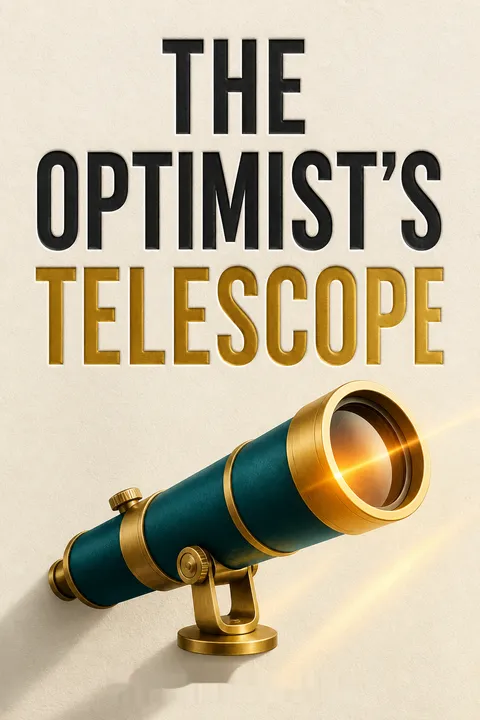
The Optimist's Telescope receives mixed reviews, with ratings ranging from 1 to 5 stars. Readers appreciate the book's exploration of long-term thinking and decision-making, praising its well-researched examples and important message. However, some criticize its organization, repetitiveness, and lack of actionable advice. The book covers topics like personal finance, corporate strategy, and societal challenges. While some find it insightful and thought-provoking, others feel it lacks depth or clear structure. Overall, reviewers agree on the significance of the topic but differ on the book's effectiveness in addressing it.
People Also Read







Glossary
foresight
judgment about future consequencesThe capacity to weigh what is known, what is uncertain, and how present choices may affect future outcomes. In the book, foresight differs from prediction: prediction estimates what may happen, while foresight uses available information and judgment to decide how to prepare or act.
mental time travel
imagining future scenesThe mind’s use of episodic memories to construct possible future experiences. People combine remembered sights, sounds, and events into scenes they have not lived, then use those imagined situations to plan or guide current choices. The process can make distant outcomes feel more immediate and personally relevant.
dashboard driving
mistaking metrics for progressThe author’s term for focusing on near-term measurements as if they represented genuine success. A metric can become a misleading substitute for the underlying goal, such as counting steps while neglecting overall health, or tracking loan repayments while borrowers accumulate unsustainable debt.
implementation intentions
specific if-then plansPlans that link a recognizable future situation to a concrete response. Often expressed as if-then statements, they help people act toward a goal when distraction, emotion, or pressure could otherwise prompt an impulsive choice. Research described in the book applies them to tasks such as eating, studying, saving, voting, and reducing biased decisions.
choice architecture
designing the choice environmentThe arrangement of options, defaults, cues, and procedures that shapes how people choose while leaving them some freedom to decide. Organizations can use it to make a future-oriented action easier or more likely, such as setting retirement saving as the default. The book emphasizes that such design can also be manipulative.
Goodhart’s law
targets distort measuresThe principle that when a measure becomes a target, people may optimize or game the measure rather than achieve the underlying goal. In the book, standardized test scores and microfinance repayment rates illustrate how a metric that begins as a useful indicator can encourage harmful behavior once rewards depend on it.
prospective hindsight
explaining a future outcome backwardA decision technique in which a group imagines that an event has already happened, then explains how it came about. By considering why a project might fail or succeed as though the outcome were known, participants can surface overlooked risks and opportunities before committing resources.
pre-mortem
finding failure causes in advanceA planning exercise that asks participants to imagine a project has failed and list plausible reasons for that failure before the project begins. The technique encourages people to voice risks that optimism, hierarchy, or commitment to an idea might otherwise keep hidden.
tragedy of time horizons
short-term gain undermines shared futuresThe author’s term for situations in which people sacrifice a future they themselves value because rules or competition reward immediate extraction. Gulf fishermen, for example, overharvested red snapper under a system that made restraint costly, even though the fishery sustained their livelihoods and communities.
collective heirlooms
shared inheritances across generationsThe author’s metaphor for resources, knowledge, and cultural objects that current communities may use while safeguarding their value for those who follow. A collective heirloom is not meant to be frozen or owned exclusively by one generation. It should be stewarded so future people inherit both its benefits and options for its use.
social discounting
reducing future benefits’ present weightA method used in public policy analysis to compare present costs with benefits or harms expected in the future. A discount rate reduces the present value assigned to distant outcomes. The book questions whether a single rate can fairly represent the values of current citizens and generations not yet able to speak.
FAQ
1. What is The Optimist's Telescope by Bina Venkataraman about?
- Explores foresight and recklessness: The book investigates why individuals, organizations, and societies often ignore future consequences and make reckless decisions, even when warnings are clear.
- Examines barriers to long-term thinking: It delves into psychological, cultural, and institutional obstacles that prevent us from planning ahead in a world obsessed with immediacy.
- Offers practical strategies: Through research, stories, and case studies, Venkataraman provides actionable methods to cultivate patience, imagination, and better decision-making for the future.
- Emphasizes intergenerational responsibility: The book advocates for stewardship of resources and legacies as "shared heirlooms" to be passed responsibly to future generations.
2. Why should I read The Optimist's Telescope by Bina Venkataraman?
- Understand human myopia: The book reveals the psychological and social reasons behind why people and societies often ignore future risks, helping readers recognize these patterns in themselves and others.
- Connects personal and societal challenges: It links individual decision-making with large-scale issues like climate change, public health, and economic stability, showing how short-term thinking exacerbates these problems.
- Provides actionable lessons: Readers gain practical strategies—from personal rituals to institutional reforms—to help cultivate foresight and patience in various contexts.
- Offers a hopeful perspective: Despite the challenges, Venkataraman highlights examples of successful long-term thinking, inspiring readers to become better ancestors and stewards of the future.
3. What are the key takeaways from The Optimist's Telescope by Bina Venkataraman?
- Foresight is a skill: The ability to think ahead is not innate but can be cultivated through specific strategies and environmental changes.
- Short-termism is pervasive: Both individuals and institutions are prone to focus on immediate rewards, often at the expense of long-term well-being.
- Cultural and institutional change is possible: By redesigning norms, laws, and incentives, societies can foster more future-oriented thinking.
- Imagination and memory matter: Vividly imagining future scenarios and learning from history are crucial for motivating better decisions and avoiding repeated mistakes.
4. What is the concept of "foresight" in The Optimist's Telescope by Bina Venkataraman?
- Definition of foresight: Foresight is the judgment to make smart choices about the future by weighing what we know and don’t know, preparing for multiple possibilities rather than just predicting outcomes.
- Difference from prediction: Unlike prediction, which tries to forecast exact results, foresight involves imagining scenarios and acting on behalf of our future selves and communities.
- Role of imagination: The book emphasizes that foresight relies on "mental time travel"—using memories and imagination to simulate future events, which motivates present actions.
- Practical application: Foresight can be strengthened through tools like scenario planning, role-play, and environmental cues.
5. What psychological factors contribute to reckless decisions, according to The Optimist's Telescope by Bina Venkataraman?
- Present bias and instant gratification: Humans tend to overvalue immediate rewards and undervalue future benefits, leading to impulsive decisions.
- System 1 vs. System 2 thinking: People default to fast, emotional "system 1" thinking, which favors short-term gains, while the more effortful "system 2" thinking needed for foresight is less frequently engaged.
- Limbic system influence: The brain’s limbic system governs emotional responses like fear and craving, often overriding rational caution about future consequences.
- Loss aversion: People fear losses more than they value equivalent gains, which can distort decision-making and reinforce short-termism.
6. How do culture and environment affect our ability to think ahead in The Optimist's Telescope by Bina Venkataraman?
- Cultural norms shape patience: Studies show that children’s ability to delay gratification varies widely across cultures, indicating that environment and social expectations influence foresight.
- Instant gratification culture: Modern society’s emphasis on speed, convenience, and immediate results undermines long-term thinking by constantly rewarding quick fixes.
- Countercultural practices: Subcultures and rituals, such as professional poker or Montessori education, are highlighted as models for fostering patience and strategic thinking.
- Environmental cues: Adjusting choice architecture and reducing sensory temptations can help individuals and groups make more future-oriented decisions.
7. What practical methods and strategies does The Optimist's Telescope by Bina Venkataraman offer to improve foresight?
- If/then planning: Anticipating future temptations and pre-deciding responses helps people resist impulsive decisions and stay aligned with long-term goals.
- Rituals and imagination aids: Practices like writing letters to future selves or using virtual reality to simulate future scenarios make abstract futures more tangible and emotionally salient.
- Environmental nudges: Designing choice architectures—such as default options or social norm feedback—can cue people toward future-oriented decisions without restricting freedom.
- Creating immediate rewards: Programs like prize-linked savings use short-term incentives to motivate behaviors that have long-term benefits.
8. How do organizations and institutions contribute to or mitigate recklessness, according to The Optimist's Telescope by Bina Venkataraman?
- Myopic metrics problem: Organizations often focus on short-term numeric targets (e.g., quarterly earnings), which can incentivize reckless behavior and mask underlying risks.
- Stewardship and norms: Successful interventions include stewardship teams, public commitments, and peer comparisons that align individual actions with collective foresight.
- Legal and governance reforms: The book advocates for legal frameworks like trusts, benefit corporations, and public trust doctrines to promote long-term stewardship.
- Corporate examples: Firms like Amazon and Eagle Capital Management demonstrate how resisting short-term pressures and focusing on long-term metrics can yield better outcomes.
9. What is the "dashboard driving" metaphor in The Optimist's Telescope by Bina Venkataraman, and why is it important?
- Definition of dashboard driving: This metaphor describes how people and organizations fixate on easily measurable, short-term indicators (like a car’s speedometer) while neglecting the broader context and long-term consequences.
- Consequences of myopic focus: Such focus can lead to decisions that seem successful in the short term but steer individuals or companies toward failure or crisis over time.
- Solutions offered: The book suggests tuning out distracting short-term metrics, setting multiple measures of progress, and binding oneself to future-oriented commitments to avoid reckless steering.
- Illustrative examples: Cases like the microfinance crisis in India and New York cabdrivers’ earnings targets exemplify the dangers of dashboard driving.
10. How does The Optimist's Telescope by Bina Venkataraman explain the failure to prepare for long-term risks and disasters?
- Imagination gap: People often fail to vividly imagine the concrete consequences of disasters, making warnings feel abstract or unlikely.
- Optimism and denial: There is a tendency to filter information to align with hopeful beliefs, reinforced by past near-misses that breed complacency.
- Social and institutional factors: Government bailouts, insurance policies, and cultural norms can discourage preparedness, making recklessness a systemic issue.
- Historical amnesia: Societies often forget or ignore historical lessons, leading to repeated mistakes like building in floodplains or underestimating climate change.
11. What are some examples of successful long-term thinking and foresight in The Optimist's Telescope by Bina Venkataraman?
- Baja California Sur lobster fishery: Fishing cooperatives manage lobster stocks as a shared heirloom, collaborating across communities to sustain the resource for future generations.
- Catch shares in fisheries: Aligning individual incentives with long-term resource health transformed overfishing into stewardship, demonstrating how policy and collective action can foster foresight.
- Biomedical research megafunds: Innovative financial models combine high-risk, long-term investments with short-term returns to fund breakthrough medical therapies.
- Legal victories for precaution: Cases like Richland County’s defense against risky floodplain development show how communities can use law to protect future safety.
12. What are the best quotes from The Optimist's Telescope by Bina Venkataraman and what do they mean?
- “Even giants stumble and fall.” This line reminds us that great civilizations, like individuals, can fail due to recklessness and ignoring warning signs.
- “It is the illusion of what we might become that draws people to Las Vegas.” This highlights how the allure of future possibilities, even if unlikely, motivates present behavior—a theme explored through prize-linked savings and innovation prizes.
- “We are not powerless. What I once believed was inevitable about human nature is rather the result of decisions we have made in the past.” This quote encapsulates the book’s hopeful message that foresight and better choices are within our reach.
- “Each generation serves as an heirloom’s steward, imbuing it with its own meaning, while carrying forth its tradition.” This reflects the vision of intergenerational responsibility and the importance of shared cultural and natural legacies.
Download PDF
Download EPUB
.epub digital book format is ideal for reading ebooks on phones, tablets, and e-readers.








