

Key Takeaways
Build character through Masonic symbols, then prove it in service.
The central purpose. Freemasonry presents itself as a moral system taught through stories and symbols, not as a religion with a shared creed. Its practical aim is to improve the individual, strengthen the community, and serve a higher ideal. A Mason’s worth is measured less by membership or ritual fluency than by conduct: generosity, self-command, learning, and fairness toward others.
The work leaves the lodge. Stavish extends this lesson to non-Masons. The building metaphor applies to anyone trying to refine character and contribute to the common good. He recommends turning reflection into action through meditation, study, family responsibilities, and nonpolitical community service. In this view, improving oneself is not a private trophy. It is the first stage of improving the world around oneself.
The strongest feature of this thesis is its practical test: private insight should become observable conduct. That resembles virtue ethics, where character is formed through repeated choices rather than declarations of belief. It also guards against treating esoteric knowledge as a status symbol. The challenge is that personal improvement can become self-congratulation unless communities have ways to question their own behavior. Service, accountability, and equal respect give the ideal a public measure, while the book’s emphasis on individual interpretation leaves room for different religious convictions.
A stonemasons' guild became a rare meeting ground across rank and creed.
From trade to fellowship. Medieval building guilds protected craft knowledge, trained apprentices, and helped traveling workers recognize one another. In the 1640s, lodges began admitting men who were not stonemasons. By the early eighteenth century, these “speculative” Masons used the builders’ tools as metaphors for moral and intellectual development.
A new social arrangement. In 1717, four London lodges formed the first Grand Lodge of England. James Anderson’s 1723 Constitutions set out standards of conduct and discouraged discussion of religion and politics in lodge, while requiring belief in a Supreme Being without naming a denomination. The arrangement let men of differing status and faith meet under shared rules. The book connects this setting to the era’s scholarly and esoteric networks, though the precise influence of those networks remains debated.
The lodge can be understood as a deliberately designed space for cooperation across differences. Its rules did not eliminate disagreement; they placed limits on the topics most likely to fracture the group. That resembles modern professional associations that build trust through shared procedures rather than total agreement. Still, the ideal of broad fellowship should not be confused with universal access. Membership was selective, and the book mainly describes male institutions. The historical achievement is best seen as a partial experiment in pluralism, not a finished model of equality.
Let initiation make moral ideas felt, not merely memorized.
A staged education. The Blue Lodge confers three degrees: Entered Apprentice, Fellowcraft, and Master Mason. Each uses a ritual story, objects, and actions to make a lesson memorable. The first emphasizes humility and learning; the second adds intellectual development through the seven liberal arts and sciences; the third dramatizes death, loss, and the possibility of renewal.
The symbols point outward. A candidate encounters tools such as a measuring gauge and a mason’s trowel, which the book interprets as reminders to use time well and to strengthen bonds with others. A Chamber of Reflection, used in some rites, places symbols of mortality before the candidate so that joining becomes a considered choice. The author argues that ritual offers an experience to reflect on, not a guarantee of transformation. What matters is how the initiate acts afterward.
Ritual can make abstract commitments memorable because it engages attention, emotion, and the body at once. The Chamber of Reflection, for example, turns a vague question about purpose into a private encounter with mortality and choice. This fits research on embodied cognition, the idea that bodily experience can shape how people understand concepts. Yet a powerful ceremony is not proof of lasting change. The book is most persuasive when it treats initiation as an opportunity and responsibility, rather than as automatic moral improvement.
Treat lodge symbols as prompts for inquiry, not codes with one answer.
A visual lesson plan. The trestle board began as a drawing that a master builder used to guide construction. In speculative Masonry, it displays symbols that can guide a person’s development. The rough stone suggests an unrefined character; the finished stone suggests disciplined work. A winding staircase, pillars, and working tools connect the degrees to learning, judgment, and self-command.
Interpretation is part of the task. Stavish stresses that Masonic symbols do not have one universally enforced explanation. Their meanings vary by rite and jurisdiction, and members are expected to study them for themselves. He encourages readers to draw the images, keep notes, and test their interpretations against daily choices. A symbol matters not because it hides a secret answer, but because it can help someone notice a neglected question about how they live.
Ambiguous symbols can sustain attention better than a slogan because they invite repeated interpretation. They also create a shared vocabulary without requiring members to adopt identical theology. The tradeoff is interpretive drift: people can project almost any preferred belief onto an image. A useful discipline is to ask whether a reading fits the ritual’s context and leads to clearer, more responsible action. The book’s invitation to investigate is strongest when paired with historical evidence and open disagreement, rather than treating every imaginative association as an ancient teaching.
Use geometry to turn abstract ideals into tangible order.
A craft with a philosophy. The book reads the Masonic letter G primarily as a reference to geometry, the practical study of measuring the earth. Geometry was essential to builders, but it also offered a way to connect number, proportion, and harmony with ideals of order. The Forty-Seventh Problem of Euclid, which expresses the relation between the sides of a right triangle, helped builders lay out accurate angles and measure distances.
Buildings shape experience. Gothic cathedrals used height, proportion, colored light, and acoustics to create spaces that could move visitors emotionally. Stavish treats architecture as a society’s values made visible: what a culture builds, and what it allows to decay, says something about its priorities. The book also explores sacred geometry, while acknowledging that some proposed hidden patterns and meanings are interpretations rather than established historical facts.
This link between geometry and ethics is unusually concrete: proportion is not only an idea but something embodied in rooms, streets, and buildings. Environmental psychology supports the broader claim that surroundings can influence mood and attention, though it does not establish that a building encodes spiritual truths. The distinction matters. A cathedral can inspire reverence without proving a secret geometric program. The book’s critique of purely functional architecture is most useful as a question about public values, not as a universal verdict on modern design.
Seek the Lost Word as inner truth, not a password to collect.
A myth about truth. In Masonic legend, the master builder Hiram Abiff is killed, and the Word he held is lost. A substitute is used in its place. Stavish interprets the story as a search for divine truth and self-knowledge: the substitute offers a provisional sign, while the deeper Word cannot simply be handed from one person to another.
Speech becomes a practice. The author connects the Lost Word to traditions that treat names and language as powerful, and to the idea that truth is discovered through inward reflection. The practical lesson is less about recovering a particular phrase than examining how words shape relationships. Clear, thoughtful speech can build trust; careless or hostile speech can damage it. The story of Hiram makes the search for wisdom a moral task, not a puzzle solved by acquiring secret information.
The Lost Word works well as a symbol for the limits of secondhand knowledge. A phrase can be transmitted, but understanding requires attention, experience, and judgment. This resembles the difference between possessing information and developing expertise. The book’s account sometimes treats organized religion as merely a substitute for direct spiritual experience, a claim that is too sweeping to fit the variety of religious life. Its more durable insight is that inherited language can point toward meaning, but should not be mistaken for the whole of it.
Study the Renaissance worldview without mistaking its magic for proven history.
A different picture of nature. Renaissance thinkers often treated nature as alive with spiritual forces and saw mathematics, medicine, astrology, religion, and magic as overlapping fields. Natural magic sought to work with perceived connections in nature; angelic magic sought communication with divine messengers. John Dee, a scholar of mathematics and the occult, became a prominent figure in this world. His assistant Edward Kelley supplied many of the visions later associated with Enochian magic.
Context is not proof. Stavish argues that this outlook helps explain the intellectual atmosphere surrounding early Freemasonry and figures such as Elias Ashmole. It makes the Craft’s symbols more intelligible as products of their time. But the book does not establish that Freemasonry inherited a single, continuous magical system from these figures. It is important to separate evidence for a historical worldview from claims that its supernatural explanations are true.
Historical empathy asks readers to understand a past worldview on its own terms, rather than dismissing it as simple ignorance. That approach can reveal how people once connected observation, imagination, and spiritual meaning. At the same time, contextual respect is not evidentiary endorsement. Dee’s documented scholarship and interest in angelic communication are different kinds of claims, and they should not be collapsed. The book is valuable when it restores this intellectual setting, and less secure when suggestive parallels are treated as evidence of direct transmission.
Separate Masonic history from the Templar and occult myths layered onto it.
More degrees, more stories. In the eighteenth century, Scottish Rite and York Rite developed additional degrees that elaborated on the Blue Lodge’s themes. Albert Pike became a central figure in the American Scottish Rite, revising its rituals and presenting an esoteric interpretation in Morals and Dogma. Other groups, including Rosicrucian-inspired orders and the Elus Cohen, combined Masonic forms with their own spiritual teachings.
Myth is not documentation. York Rite includes degrees centered on the Temple and the Knights Templar. The Templars were a medieval military order that was suppressed in the fourteenth century, but there is no solid historical proof that they founded Freemasonry or passed a hidden body of occult knowledge to it. The book treats these connections as powerful traditions and stories, while showing that rites and interpretations changed across places and periods.
Myths can give an institution a compelling sense of depth, continuity, and purpose, even when they are not reliable accounts of its origins. That distinction is crucial here: the Templars’ documented history is meaningful on its own, while later Masonic stories reveal what eighteenth-century members wanted the Craft to represent. The danger is not that a myth has no value, but that symbolic value can be mistaken for proof. Historical care lets readers appreciate the imaginative tradition without turning speculation into fact.
Keep the Craft alive through serious study, ethical work, and service.
A fraternity needs substance. Stavish argues that many modern lodges emphasize sociability, charity, and ritual memorization while giving less attention to symbolism and philosophy. He reports a long decline in membership and describes younger members seeking deeper education and personal development. Lodges of research and Traditional Observance groups are among the efforts he presents as ways to renew that intellectual life.
Make learning practical. The book is structured as a workbook, with exercises that ask readers to study symbols, reflect on their behavior, create quiet space for meditation, and help their communities. Its standard is not whether someone adopts an occult interpretation, but whether study changes how they live. The historical and esoteric material is meant to return to ordinary responsibilities: work, family, civic life, and kindness toward people beyond the lodge.
Organizations survive when their members can explain what participation is for and experience that purpose in practice. Education, meaningful ritual, and service can make a fraternity more than a calendar of meetings. Still, esoteric study alone is unlikely to solve declining membership; access, governance, inclusion, and the quality of local relationships also matter. The book’s best proposal is therefore not a return to one supposedly original doctrine, but a balance: let symbols stimulate thought, let study sharpen judgment, and let service demonstrate whether the ideals hold.
Analysis
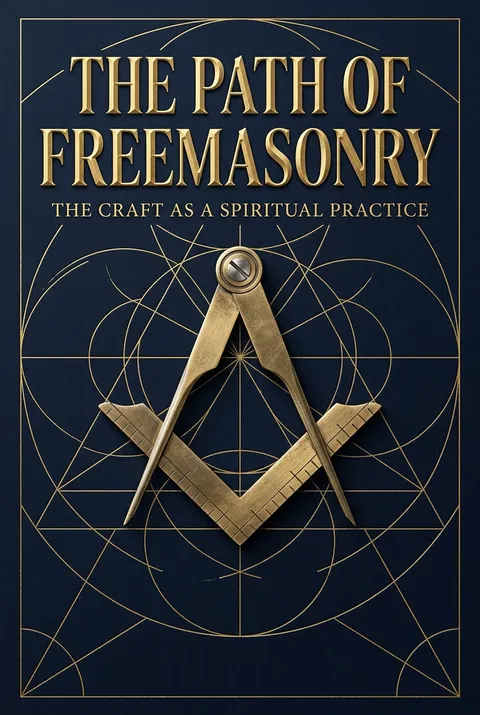
The Path of Freemasonry is at once an introduction, a history of ritual, and a workbook for spiritual self-development. Its organizing metaphor is unusually effective: the mason’s task of shaping stone becomes a way to think about shaping character, while the lodge becomes both a historical association and a symbolic model of the inner life. The sequence from medieval guilds to the first Grand Lodge, then through Renaissance esotericism and later rites, gives readers a narrative through which the symbols acquire context.
The book’s most reliable and useful claim is ethical rather than supernatural. Ritual, study, and fraternity matter when they improve how members treat people and serve their communities. The three degrees, the reflective chamber, the trestle board, and the Lost Word give this claim memorable forms. The emphasis on personal interpretation also explains why Freemasonry can accommodate members with different religious commitments.
Its historical argument requires more caution. Stavish often distinguishes documented history from tradition, especially around the Knights Templar, yet the book’s sweeping connections among Masonry, Rosicrucianism, alchemy, Qabala, and Renaissance magic can make suggestive parallels feel like a continuous lineage. These traditions influenced some Masons and Masonic-style groups, but influence, resemblance, and direct descent are not interchangeable. The same caution applies when metaphysical claims about magic or consciousness are placed beside scientific language. Those claims are part of the intellectual history under discussion, not established scientific conclusions.
This tension is also the book’s distinctive strength. It asks readers to approach symbols as living prompts rather than inert decorations, while its historical breadth shows how institutions continually reinterpret their inheritance. The result is not a definitive account of what Freemasonry has always meant. It is a case for treating the Craft as a practice of interpretation, self-discipline, and social responsibility, while keeping a clear boundary between evidence, mythology, and personal belief.
Review Summary
The Path of Freemasonry receives mostly positive reviews, with an average rating of 4 out of 5 stars. Readers appreciate its comprehensive guide to Freemasonry's history and mystical aspects. Some find it intellectually stimulating and valuable for spiritual growth. The book is praised for its insights into ancient practices and Masonic traditions. However, one reviewer criticizes perceived right-wing undertones and the author's stance on social services, which they found distracting and inaccurate.
People Also Read

Glossary
Blue Lodge
The first three degreesA Masonic lodge that confers the Entered Apprentice, Fellowcraft, and Master Mason degrees. These three degrees form the basic symbolic structure of Freemasonry. Higher rites, such as Scottish Rite and York Rite, build on or reinterpret themes introduced in the Blue Lodge.
Landmarks
Customs that define the CraftTraditional Masonic customs, practices, and identifying features that connect lodges across jurisdictions. There is no universal agreement on a definitive list or number. Landmarks help preserve recognizable elements of Masonic practice while allowing local lodges and rites to vary in how they perform rituals.
Trestle board
A visual guide to moral workA board displaying symbols used to teach Masonic lessons. It developed from drawings made on the floor of a meeting space, originally to guide builders’ work. In speculative Masonry, its tools, figures, and designs represent plans for moral and intellectual development.
Chamber of Reflection
A room for pre-initiation reflectionA small room used in some Masonic rites before initiation. Its objects can include a candle, mirror, skull, hourglass, and writing materials. These symbols direct the candidate to consider mortality, personal motives, and the responsibilities involved in entering the fraternity.
Lost Word
A symbol of sought truthA central Masonic symbol associated with the death of Hiram Abiff and the loss of a sacred Word. In the book’s interpretation, it represents divine truth or deeper self-knowledge that cannot simply be transferred as information. The search for it becomes a personal and ethical quest.
Great Work
The transformation of human potentialAn alchemical and Masonic ideal of transformation, often represented as changing base material into gold. In Stavish’s account, its human meaning is the disciplined development of character and capacity. It can carry religious, philosophical, and natural interpretations, depending on the rite or tradition using the term.
Greater Lights
The lodge’s central symbolic objectsThe Volume of the Sacred Law, the square, and the compass. The Volume represents a sacred text chosen according to the lodge and candidate, while the square and compass are traditional tools used as moral symbols. The book describes all three as necessary furnishings of a lodge at work.
Arcana Arcanorum
A system of esoteric practicesA specialized body of teachings associated in the book with Egyptian Masonry and other esoteric currents. It is described as combining angelic invocation, mineral alchemy, and inner alchemy, in which external symbolic work is related to transformation within the practitioner. Historical claims about its origins and transmission remain uncertain.
FAQ
1. What is The Path of Freemasonry by Mark Stavish about?
- Comprehensive exploration of Freemasonry: The book offers a detailed introduction to Freemasonry, covering its history, structure, beliefs, rituals, and symbolic language.
- Spiritual and esoteric focus: Mark Stavish presents Freemasonry as a spiritual practice and self-development system, connecting it to occult societies, Hermeticism, and Renaissance magic.
- Workbook and practical guide: Each chapter includes summaries, assignments, and suggested readings, encouraging readers to actively engage with Masonic philosophy, regardless of their membership status.
- Historical and symbolic analysis: The text examines the Temple of Solomon, sacred geometry, and the influence of key figures, situating Freemasonry within broader Western esoteric traditions.
2. Why should I read The Path of Freemasonry by Mark Stavish?
- Insight into Masonic mysteries: The book demystifies Freemasonry, providing both outsiders and insiders with a clear understanding of its original mission and esoteric roots.
- Bridges history and spirituality: Stavish connects ancient traditions, Renaissance worldview, and modern science, showing Freemasonry’s relevance for personal transformation today.
- Clarifies misconceptions: The author addresses misunderstandings about Freemasonry’s occult aspects, offering a balanced and scholarly perspective.
- Practical self-improvement: Through exercises and reflections, readers are guided to cultivate virtues, knowledge, and spiritual awareness using Masonic symbolism and ritual.
3. What are the key takeaways from The Path of Freemasonry by Mark Stavish?
- Freemasonry as spiritual practice: The Craft is presented as a path of moral and spiritual transformation, not just a social fraternity.
- Symbolism and ritual: Masonic symbols, rituals, and myths are tools for self-knowledge, personal growth, and the pursuit of truth.
- Historical and esoteric connections: The book traces Freemasonry’s links to alchemy, Hermeticism, Qabala, and other Western esoteric movements.
- Active engagement: Readers are encouraged to apply Masonic principles in daily life, fostering charity, reflection, and self-improvement.
4. What are the best quotes from The Path of Freemasonry by Mark Stavish and what do they mean?
- “Freemasonry is a march and struggle toward the Light.” This highlights the Craft’s focus on personal and spiritual enlightenment.
- “The secret of Freemasonry is not a secret society, but a society with secrets.” This clarifies that the organization is public, but certain knowledge and rituals are reserved for members.
- “The Lost Word is a metaphor for divine truth and self-realization.” This underscores the central quest for inner awakening and spiritual knowledge.
- “Geometry is the measure of the earth and the foundation of all Masonry.” This quote emphasizes the importance of sacred geometry in Masonic symbolism and practice.
5. How does Mark Stavish define the “secret” of Freemasonry in The Path of Freemasonry?
- Not a secret society: Freemasonry is described as a “society with secrets,” where rituals and knowledge are reserved for initiates, but the organization itself is public.
- Moral and spiritual secret: The true secret is the pursuit of Light—truth, reality, and self-improvement—achieved through ritual, symbolism, and personal transformation.
- The Lost Word as metaphor: The Lost Word represents divine truth and self-realization, accessible only through individual effort and inner awakening.
- No hidden conspiracies: The book dispels myths of conspiracies or hidden treasures, focusing instead on spiritual and ethical development.
6. What is the origin and historical development of Freemasonry according to The Path of Freemasonry by Mark Stavish?
- From operative to speculative: Freemasonry evolved from medieval stonemasons’ guilds (operative) to a philosophical and moral fraternity (speculative) by the mid-1600s.
- Key milestones: The formation of the first Grand Lodge in 1717 and Anderson’s Constitutions in 1723 established Masonic laws and principles.
- Influence of esoteric figures: Early contributors like Elias Ashmole and members of the Royal Society shaped the Craft’s philosophical and esoteric dimensions.
- Integration of esoteric traditions: The book traces how Freemasonry absorbed elements from alchemy, Hermeticism, and Renaissance magic.
7. How does The Path of Freemasonry by Mark Stavish explain the significance of the Temple of Solomon?
- Central Masonic symbol: The Temple of Solomon is the foundational myth and symbolic basis for all Masonic rituals and degrees, representing the universe’s structure and divine harmony.
- Sacred geometry and pillars: The Temple’s proportions and the pillars Jachin and Boaz are linked to Jewish mysticism (Qabala) and symbolize wisdom, strength, and beauty.
- Solomon as magician: Solomon is depicted as both a wise king and a magician, connecting Masonic symbolism to ancient magical traditions.
- Lodges as symbolic temples: Masonic lodges are seen as microcosmic temples where members work on their moral and spiritual development.
8. What is the role of initiation and the Blue Lodge in Freemasonry as described by Mark Stavish?
- Initiation as transformation: Masonic initiation is a symbolic ritual designed to transform candidates psychologically and spiritually, moving them through three degrees: Entered Apprentice, Fellowcraft, and Master Mason.
- Chamber of Reflection: Candidates often begin in a Chamber of Reflection, a space for meditation on mortality and purpose, preparing them for initiation.
- Blue Lodge symbolism: The Blue Lodge confers the foundational three degrees, emphasizing moral teachings, the seven liberal arts and sciences, and the quest for Light.
- Foundation for further study: The Blue Lodge serves as the entry point for deeper Masonic and esoteric exploration.
9. How does The Path of Freemasonry by Mark Stavish connect Freemasonry to the Renaissance worldview and Western esoteric traditions?
- Magic as mainstream philosophy: The Renaissance saw the world as interconnected, with magic, art, science, and religion intertwined.
- Role of imagination and ritual: Renaissance magicians used imagination and ritual to commune with spiritual beings and seek divine union, influencing Masonic practices.
- Influence of key figures: John Dee and other Renaissance magi contributed to the esoteric traditions that shaped Freemasonry.
- Integration of Hermeticism and alchemy: The book details how Freemasonry absorbed Hermetic, alchemical, and Qabalistic elements.
10. What is the importance of sacred geometry and Gothic cathedrals in Freemasonry according to Mark Stavish?
- Geometry as foundation: Geometry is the cornerstone of Masonic symbolism, representing order, harmony, and the manifestation of archetypal ideas.
- Gothic cathedrals as sacred art: These structures embody spiritual energy and cosmic harmony, paralleling Masonic temples as talismans of virtue.
- The Forty-Seventh Problem of Euclid: This geometric theorem is a key Masonic symbol, representing balance, proportion, and unity.
- Operative and speculative unity: Early Masons combined practical geometry with philosophical wisdom, a tradition reflected in Masonic rituals.
11. What is the Lost Word in Freemasonry and how does Mark Stavish interpret its significance in The Path of Freemasonry?
- Central Masonic quest: The Lost Word symbolizes the original divine language or true name of God, representing spiritual ignorance, revelation, and personal experience of the divine.
- Three stages of the Word: Freemasonry speaks of the Lost Word (ignorance), the Substitute Word (religion, law, authority), and the True Word (direct divine revelation).
- Creative power of speech: The Lost Word is linked to the creative power of sound and speech, echoing traditions where divine names hold transformative power.
- Mythological and symbolic context: The story of the Tower of Babel and the Masonic quest for the Lost Word illustrate humanity’s fragmentation and the need for spiritual unity.
12. What practical advice and exercises does Mark Stavish offer in The Path of Freemasonry for readers interested in Masonic spirituality?
- Engage with ritual and prayer: Begin study sessions with a prayer to the Divine Architect and create sacred spaces for meditation and reflection.
- Monitor speech and attitude: Readers are encouraged to focus on positive, clear, and meaningful communication as a reflection of inner harmony.
- Study symbols and arts: Learn and meditate on Masonic symbols, trestle boards, and the seven liberal arts and sciences to deepen understanding.
- Apply lessons in daily life: Practice charity, reflect on daily actions, and strive to build a better self and community in line with Masonic ideals.
Download PDF
Download EPUB
.epub digital book format is ideal for reading ebooks on phones, tablets, and e-readers.








