

Key Takeaways
Write through experience until its meaning begins to emerge
Letters became a workshop. Rilke began many mornings intending to write poems, yet often spent hours answering letters instead. In those exchanges, he tested images, clarified thoughts, and found language for experiences that could not yet be shaped into verse. He regarded the correspondence not as a distraction from his work but as part of its making. The editor presents this habit as a model for the book’s central idea: understanding life is not a matter of finding a ready-made answer. It requires attention, expression, and patience.
Meaning takes time. Rilke urges people to record the full texture of living, including confusion and contradiction, without deciding too early what it all signifies. Writing can make an experience more visible, but it does not promise a quick cure or a final explanation.
What's striking is the shift from writing as self-display to writing as a method of noticing. Reflective writing can help people organize emotion and recognize patterns, but its value lies less in producing a polished narrative than in making experience available for thought. Rilke's correspondence also shows that serious work may grow in forms that do not resemble the finished product. The limit is important: not every pain needs to be translated into prose, and some experiences call first for practical help, rest, or another person's presence.
Let each experience set its own pace before you judge it
Give events their tempo. Rilke argues that experiences have different speeds. A brief encounter, a long illness, a period of creative delay, and a sudden loss cannot be understood by forcing them into the same timetable. Wisdom, in his account, means sensing how quickly or slowly a particular event can be lived. He warns that demanding a lasting outcome from every joy or relationship can distort it before it has unfolded.
Patience is active. Rilke does not describe waiting as doing nothing. He treats it as a disciplined readiness to remain with uncertainty, rather than rushing to label an experience a failure, a triumph, or a permanent possession. Life, he insists, can surprise even the most carefully prepared imagination.
This is a useful counterweight to cultures that equate speed with competence. In learning and emotional processing, premature conclusions can narrow what a person notices; allowing time can reveal changes that an immediate verdict misses. Rilke's emphasis on an experience's own tempo also resists turning every moment into a productivity metric. Still, patience is not universally wise. A dangerous situation may require swift action, and waiting can become avoidance. The practical question is not whether to hurry or slow down, but what the situation actually demands.
Use solitude to become more available, not less human
Solitude is not exile. Rilke sees each person as fundamentally alone, even in close relationships. Accepting that fact can make solitude less like proof of abandonment and more like space for honest self-understanding. He connects this inward work to common life: the person who listens deeply to experience may give others language for what they have felt but could not express.
Closeness needs room. In his letters, friendship and love do not erase separateness. Their best form makes room for each person's inner life, rather than demanding constant access or agreement. The editor's introduction adds a revealing detail: Rilke's enormous correspondence helped him keep contact with others while protecting the solitude he needed to write.
The idea resembles relational autonomy: people develop a sense of self through relationships, but not by surrendering every boundary. Solitude can support attention and emotional clarity, and those capacities can deepen connection. The distinction between chosen solitude and imposed isolation matters, however. Social disconnection can intensify distress, especially when people lack reliable support. Rilke's account is strongest as a defense of inward space within a connected life, not as an argument that loneliness should be endured without help.
Love by protecting two distinct lives, not merging them
Love requires inner work. Rilke rejects the idea that a couple becomes whole by dissolving individual boundaries. A good partnership, he suggests, respects the separate inner worlds that make real recognition possible. He describes marriage not as guaranteed happiness but as a demanding task involving kindness, patience, and continued growth.
Distance can protect intimacy. When a relationship becomes turbulent, Rilke sometimes advises taking space before making irreversible decisions. He also warns against treating a beloved person as property. His letters extend this respect to same-sex love, arguing that outsiders should not reduce intimate relationships to convention or judge them without understanding their particular context. Love, for him, is not possession but sustained attention to another person's freedom.
Rilke's insistence on individuality fits modern accounts of healthy intimacy, where closeness and autonomy are not opposites. Boundaries can make honest commitment possible rather than weakening it. His defense of same-sex relationships is notably expansive for his time, especially in a culture that often treated desire as a moral category first and a human relationship second. Yet distance is not automatically constructive. It can offer perspective, but it can also become withdrawal or a way to avoid accountability. The difference lies in whether space supports clearer care or merely postpones difficult conversation.
Treat work as a way of living, not a route to applause
Work includes preparation. Rilke asks people to take their work seriously without measuring every day by visible output. He believes periods of apparent idleness can contain the inward activity from which later work emerges. His own correspondence supports the point: during years when he published little poetry, he continued to write extensively to friends, patrons, and readers.
Craft is a daily practice. Rilke rejects the notion that artistic work is effortless simply because it uses familiar materials such as words. A poem requires patient attention to each word, while public recognition can distract an artist from the work's inner demands. His advice is not simply to work harder. It is to find the task that can be approached with concentration, and to let its value exceed applause.
This account anticipates a distinction between output and the conditions that make output possible. Creative cognition often includes incubation, when attention loosens and ideas reorganize outside deliberate effort. That helps explain why a quiet period is not necessarily wasted time. But Rilke's ideal of devotion can become dangerous if treated as a universal work ethic. His life depended on patrons, and his artistic commitment came at real cost to family relationships. Work can be central without being the only legitimate claim on a person's time.
Let difficulty test your strength without calling every wound a lesson
Hardship has weight. Rilke treats difficulty as a possible measure of a person's capacities, not as evidence of failure. He argues that confronting a challenge fully can bring someone closer to the center of life and sometimes make a new order possible. He also distinguishes between difficulties that engage a person's strengths and alien hardships that leave those strengths unusable.
Pain is not automatically useful. Rilke does not recommend making suffering seem smaller or pretending that every painful event is secretly beneficial. His point is that people may discover capacities they did not know they had, and that failure can become one point in a much longer process of beginning again. Difficulty can shape a life, but it does not guarantee growth.
The distinction between challenge and overwhelming adversity is valuable. A demanding task can build skill when a person has some agency and support; an uncontrollable threat can instead damage health and narrow choices. Contemporary trauma research likewise gives no basis for assuming that suffering reliably produces wisdom. Rilke's language is most humane when it asks what strength remains available, rather than prescribing pain as a teacher. That nuance protects the insight from becoming a slogan that blames people for being hurt or for not finding meaning in harm.
Carry the dead forward by deepening the life still yours
Grief changes one's duties. Rilke doubts that time simply removes the pain of loss. Instead, it gradually alters the place loss occupies in a person's life. In a letter to someone mourning, he urges the survivor not to avoid everything connected to the deceased, but to return to shared objects and memories and let the relationship continue in a changed form.
Remember through living. Rilke imagines the dead person's influence as something carried within the survivor, rather than something that disappears with physical presence. This is not presented as proof of an afterlife. It is a way to understand why love can remain consequential after death: the living person's choices, habits, and inner life have been shaped by the person who is gone.
This view resembles continuing-bonds approaches to grief, which understand remembrance as an evolving relationship rather than a task of severing attachment. Returning to meaningful places or objects can help integrate loss into a life that has changed. The needed qualification is that grief has no required achievement. A bereaved person should not be pressured to convert sorrow into service, growth, or a tribute to the dead. Rilke's strongest suggestion is permission to remain in contact with what mattered, at a pace the survivor can bear.
Notice ordinary things before habit makes them disappear
Attention restores scale. Rilke believes adults often overlook the richness of small things because business and worry have trained their attention elsewhere. He recalls childhood as a time when a bird, a pebble, or rain changing a garden could command a whole world of feeling. The point is not that children are always happy, but that they can meet an object without assuming its significance in advance.
Nature is not our audience. Rilke insists that landscapes and animals do not share human grief or celebrate human triumph. Their indifference can unsettle people, but it also loosens the assumption that everything exists for human purposes. Art, including Rilke's closely observed poems about things, offers a way to attend to the world without reducing it to a backdrop for the self.
This is an ethics of attention as much as an aesthetic preference. Slowing down to observe ordinary details can interrupt habitual perception, while recognizing nature's indifference challenges the human tendency to treat the nonhuman world as scenery or resource. Rilke's approach is especially vivid when it joins humility with care. Yet attention alone does not protect ecosystems or animals. Respectful looking matters, but it must be joined to choices about how people use and alter the environments they observe.
Make art from experience, then let the work stand apart
Art transforms rather than decorates. For Rilke, making art begins in an encounter that presses a person to the limits of what can be understood or endured. The work gives that encounter form, but it should not be judged only by whether it comforts an audience or reveals the artist's personality. Once made, it can have a life beyond its creator.
The visible enters the inward. Rilke uses the term "the invisible" for the inward transformation through which the seen world is taken into memory, feeling, and artistic form. This does not mean escaping earthly life. It means allowing what is encountered here to become part of an inner world that can be shared through a lasting work. Art's value lies in this transformation, not simply in beauty or fame.
The distinction between a work and its maker is useful in an era that often treats biography as the key to interpreting every creation. A work can exceed its creator's intentions and remain meaningful to people the artist never knew. Rilke also resists reducing art to therapy or entertainment, preserving its capacity to unsettle as well as console. The risk is that claims about artistic necessity can romanticize exclusion and sacrifice. Creative seriousness need not excuse neglect of other people or make public response irrelevant.
Build faith as a direction of the heart, not a borrowed answer
Faith begins in experience. Rilke distrusts religion when doctrine or convention substitutes for a person's own encounter with existence. He describes religion less as agreement with a set of propositions than as an orientation toward what exceeds individual control. His language about God is often deliberately unsettled: he rejects easy assurances while continuing to search for a larger unity in ordinary, earthly life.
Do not outsource meaning. Rilke warns that ready-made beliefs can distract people from what they actually perceive and feel. The senses, relationships, work, and mortality are not obstacles to spiritual life but its immediate ground. This makes his faith difficult to reduce to a creed. It is a practice of attention and inward honesty, not a promise that the world will protect or explain us.
Rilke offers a compelling account of spirituality that does not depend on certainty: commitment can take the form of attention, reverence, and responsibility toward life. That stance can make room for religious and nonreligious readers alike. Still, private experience is not the only source of spiritual knowledge. Communities, rituals, and inherited traditions can provide forms of care and interpretation that solitary reflection cannot. Rilke's skepticism is most fruitful when it challenges unexamined conformity without dismissing the shared practices through which many people make meaning.
Analysis
This book is not a systematic philosophy written from a settled position. It is an edited selection from a vast correspondence, organized around the pressures people actually encounter: work, separation, childhood, illness, bereavement, art, and love. Its intellectual method is therefore iterative. Rilke approaches a question through images, letters, remembered encounters, and revisions of his own thought. Meaning is not delivered as a doctrine; it is made more available by attending to particular experience long enough to find language for it.
The letters also complicate the familiar image of Rilke as an aloof poet of transcendence. Their attention to bodily pain, money, ordinary objects, professional craft, and intimate relationships grounds his spiritual ambition in earthly life. His claim that solitude can deepen commonality is persuasive because the letters themselves enact it: private reflection becomes communication with people who otherwise might not have found words for their own lives. The correspondence is both an archive of thought and evidence that expression can create connection without erasing difference.
That strength comes with a serious limit. Rilke sometimes treats artistic vocation as a justification for choices that harmed others, especially his departure from family life, and his distrust of medical intervention can sound hazardous when generalized. His account of suffering also risks turning pain into a path toward insight, even though people may be injured without gaining meaning or strength. These tensions should not be erased in order to preserve the beauty of his advice. They help distinguish a compelling practice of attention from a universal rulebook.
Read Rilke, then, less as an authority whose decisions should be copied than as a demanding companion in observation. His most durable contribution is the insistence that no experience should be dismissed merely because it is small, painful, or difficult to explain. The reader need not accept his metaphysics to use that discipline: look closely, resist premature conclusions, and make room for a life whose meanings are discovered in living it.
Review Summary
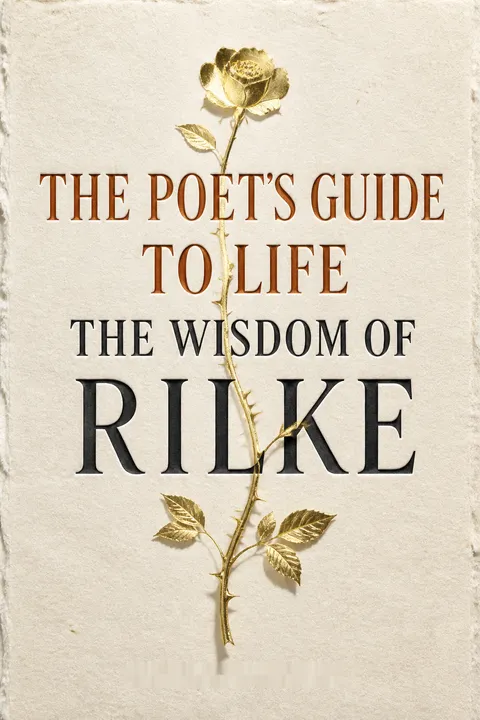
The Poet's Guide to Life receives mostly positive reviews, praised for its beautiful and inspirational content. Readers appreciate Rilke's unique perspective on embracing life's challenges and his emphasis on solitude and introspection. The book is seen as a collection of wisdom to revisit throughout life. Some criticize the organization and lack of context for the excerpts. Many find Rilke's prose equally compelling as his poetry, offering guidance on various aspects of life. The translation quality is noted as important for fully appreciating Rilke's ideas.
People Also Read








Glossary
Dinggedichte
poems focused on thingsA German term for Rilke's "thing-poems," which present an object, animal, or figure through close attention to its presence and effects rather than treating it merely as a prompt for the poet's personal feelings. The object becomes a way to examine perception and existence, not simply a decorative subject.
pretexts of life
labels that simplify experienceRilke's term for the names, roles, categories, and familiar interpretations people use to make existence manageable. These frames can be useful, but they may also limit attention by deciding in advance what an encounter means. Art and reflection can expose what such everyday explanations leave out.
the invisible
the inward life of experienceRilke's name for the inward dimension in which earthly things and experiences are taken up into memory, feeling, and consciousness. It is not simply a supernatural afterlife or a rejection of the physical world. Human beings, through attention and artistic transformation, preserve and alter what they have encountered.
background melody
the larger pattern of existenceRilke's metaphor for the broad pattern of life that individual experiences join without being able to comprehend the whole. People can find a sense of belonging by recognizing that their particular work and presence participate in something larger, even when that larger order remains uncertain or unseen.

Download PDF
Download EPUB
.epub digital book format is ideal for reading ebooks on phones, tablets, and e-readers.








