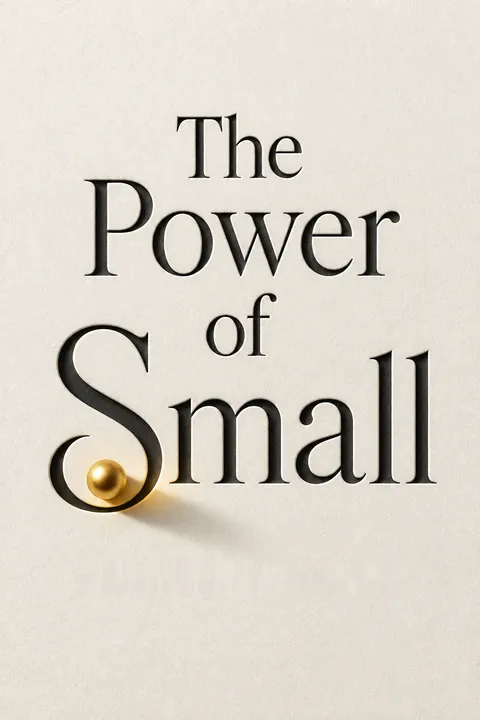


Key Takeaways
Make the first step small enough to repeat, not impressive enough to brag about
Reduce the starting cost. When life feels unmanageable, trying to fix every problem at once can freeze action or trigger a burst of effort that soon collapses. The authors recommend a 5-Minute Breakout: a brief action just beyond familiar avoidance, but still manageable enough to repeat. It can mean pausing to breathe, or taking one practical step toward a task. Sean, buried under unpaid bills, starts by opening a single one and reading it, rather than forcing himself to clear the whole pile.
Let repetition build capacity. The point is not that five minutes solves everything. It interrupts the cycle in which distress prevents action and inaction creates more distress. Small steps create practice, confidence, and information about what is workable. If a step feels too large to sustain, shrink it further.
The useful distinction is between a small action and a small ambition. The task can matter enormously while its first step remains modest. That makes the method less about lowering standards than about designing an entry point that survives an ordinary day. The caution is that tiny actions should not become another performance metric. Their value lies in making meaningful behavior more available, not in proving discipline or guaranteeing a particular outcome.
Let values, not immediate relief, decide whether your next move helps
Judge actions by direction. Values are freely chosen qualities that give life direction, such as care, learning, or connection. They are not trophies or outcomes that can be checked off once and for all. The authors distinguish toward moves, which express a value, from away moves, which mainly reduce discomfort or avoid a feared outcome. The same behavior can serve either function: a drink with friends may support connection, while drinking to escape sadness may pull someone away from self-care.
Turn direction into behavior. Alice, who felt trapped by family demands, clarified that loving her children mattered, but so did caring for herself. She began choosing time with family from affection rather than obligation, and allowing herself downtime without treating it as betrayal. Asking what a behavior is doing helps reveal whether it fits the life someone wants.
This distinction offers a more useful measure than labeling behavior virtuous or weak. It asks about context and function, making room for the fact that identical actions can mean different things at different times. Values also need to become observable: care might look like listening, setting a limit, or resting. Without that translation, values can remain attractive abstractions, or become another list of standards a person feels obliged to meet.
Stretch beyond comfort by inches, while staying inside your capacity to recover
Growth needs a safe dose. The comfort zone is familiar territory, including habits that reduce immediate anxiety but may keep life narrow. Yet pushing too far, too quickly can overwhelm rather than help. The authors call the workable middle the self-care zone: actions that challenge old patterns while remaining manageable over time. A person who avoids speaking up might first practice with a trusted listener, rather than confronting everyone at once.
Make expansion gradual. The story of Mohini, a white tiger once kept in a small zoo cage, illustrates how confinement can become internalized. When moved to a much larger habitat, she continued pacing within a small square. The authors use this as an image of how old limits can persist after circumstances change. Their lesson is to widen the range of action in increments, with nourishment and rest part of the plan.
Mohini's story makes a subtle point vivid: removing an external barrier does not instantly restore a sense of possibility. Gradual practice can help a person test what is safe and revise expectations through experience. The analogy has limits, since people have different histories, resources, and actual risks. A gradual approach should not imply that every boundary is merely fear, or that a person must stretch when circumstances call for protection or support.
Recognize what avoidance buys now, and what it quietly costs later
Map the relief loop. The authors group common avoidance patterns under D.O.T.S.: distraction, opting out, thinking traps, and self-defeating actions. These can bring short-term relief, such as scrolling to interrupt worry, avoiding a difficult conversation, or replaying an event in search of certainty. The cost may be that the original problem remains, while confidence, health, or connection erodes.
Look without self-condemnation. Michelle had tried restrictive diets, then abandoned them and regained weight. Instead of treating each lapse as proof of failure, she noticed specific away moves, including buying multipacks of sweets. She changed one part of the pattern at a time, choosing a single treat per shopping trip. The authors' key question is not whether an action is bad, but whether repeating it moves someone toward or away from what matters.
The short-term reward explains why an unhelpful pattern persists more clearly than a lecture about willpower does. Relief is real, even when the longer-term bill is high. Naming the function of a behavior can therefore reduce shame and improve choice. Still, not every distraction is harmful: temporary recovery, entertainment, and postponement can be sensible. The meaningful test is whether a strategy is flexible and proportionate, or has become the only response available.
Notice thoughts without handing them the steering wheel
Create room around the thought. The mind produces predictions, comparisons, and warnings, often as if they were settled facts. The authors describe traps such as trying to suppress a thought, becoming absorbed in it, or repeatedly turning it over. Their alternative is not to prove the thought false, but to recognize it as something the mind is saying. That small shift can make room for action guided by values rather than by the thought alone.
Practice on manageable material. One technique is to add a phrase such as, “My mind is telling me that I will fail,” before a self-critical thought. Another is to write uncensored reactions privately, then separate observable events from interpretations. In a work example, a colleague distinguishes the fact that a meeting moved quickly past his proposal from his unverified conclusion that everyone considers him incompetent.
This approach avoids a common trap in self-help: treating every difficult thought as a debate to win. Some thoughts are partly true, but their truth does not automatically make them useful instructions. The practical question becomes what action follows when the thought is taken literally. This is a precise form of distance, not denial. It also asks for care: highly distressing material may need support and a slower pace, rather than a forced exercise in exposure.
Use the body and senses to return from mental autopilot
Come back to what is happening. Under stress, attention can become trapped in imagined futures or repetitive mental commentary. The authors recommend reconnecting with immediate sensory experience: the taste of food, a speaker's expression, or the sound of traffic on a familiar route. This kind of mindfulness is deliberate attention to the present without instantly judging or fixing it.
Listen before reacting. Their AIR system offers a way to work with intense feelings: attend to the sensation, investigate what it may signal about a need or value, and release some physical struggle around it through breath and attention. Anna, who treated every anxious feeling as evidence of danger, practiced noticing anxiety without trying to force it away. The aim is not to obey every bodily signal, but to use it as information before choosing a response.
Sensory attention can interrupt rumination because it redirects awareness toward specific, current information rather than hypothetical scenarios. The body can also reveal tension or emotion that a person has been ignoring. But bodily cues are signals, not verdicts: anxiety may arise without immediate danger, and discomfort does not always identify its own cause. The strongest use of this practice is curious observation followed by considered action, not treating every sensation as a command.
Choose honest connection over pleasing others or managing them
Make room for mutuality. Fear of rejection can lead people to hide preferences, suppress feelings, or try to control how others behave. These tactics may smooth an interaction briefly, but can build resentment and distance. The authors encourage small acts of authenticity, such as naming a preference or calmly saying that a remark hurt. They also suggest loosening control by listening without immediately advising, or letting someone else choose an activity.
Expect some discomfort. Pauline, a working mother, routinely accepted weekend work and then resented losing time with her family. She began setting a limit on how often she would work weekends, despite anxiety about her manager's response. The book also cites research linking social isolation with serious health risks, while stressing that connection requires vulnerability, not simply more messages or contact.
This section resists two familiar extremes: self-erasure in the name of kindness and control in the name of care. Honest limits can protect relationships from the resentment that accumulates when consent is routinely replaced by appeasement. The same principle requires sensitivity to unequal power. Direct disclosure is not equally safe in every family, workplace, or relationship. Authenticity is not reckless candor; it is a context-aware effort to make one's needs visible.
Choose one life area, then rehearse and review small actions
Narrow the field. The authors suggest beginning with one of four areas: relationships, purpose and contribution, health and well-being, or fun and downtime. A brief review of satisfaction, values, and likely consequences can show where attention may help most. Starting everywhere at once risks recreating the overwhelm the approach is meant to reduce. The areas also affect one another, so progress in one may support another.
Plan before and learn after. Choose an action small enough to feel credible, then check confidence on a ten-point scale. If confidence is below eight, reduce the action or add support, such as a reminder or a trusted person checking in. Before a predictable challenge, rehearse useful responses. Afterwards, notice what happened without either ignoring a setback or turning it into a reason for shame.
This is a practical antidote to the fantasy that life can be reorganized in a single heroic weekend. Limiting the target reduces competition for attention, while reviewing actions turns experience into feedback. Confidence ratings are most useful as calibration, not as a pass-fail test. A low score may point to poor timing, missing resources, or a genuinely difficult environment, not a character flaw. Planning should include support and adjustment, not merely stronger resolve.
Use FUEL to restart when overwhelm knocks you off course
Keep a return route. The authors present FUEL as a compact reset for moments of overwhelm: reconnect with the value that matters now, step back from a limiting thought or story, make room for uncomfortable feelings, and respond with self-care. The sequence does not promise that distress will vanish. It helps redirect attention from controlling everything to choosing what can be done in the present.
Make responsibility realistic. The book distinguishes taking responsibility for one's choices from assuming responsibility for everything. People cannot control the past, other people's reactions, or every internal experience. They can influence their present actions and attitudes. A useful reset might be to notice fear, identify the relationship one wants to protect, and send a brief message rather than waiting to feel completely ready.
A memorable reset is valuable because overwhelm can make a large toolkit hard to access. FUEL compresses the book's central movement into a sequence that begins with direction and ends in care, rather than demanding immediate calm. Its usefulness depends on keeping the steps flexible: a person may need rest, practical help, or professional support before taking action. Responsibility is empowering when it names real choices, but burdensome when it disguises conditions beyond an individual's control.
Analysis
The book's strongest contribution is its insistence that change is not primarily a contest of willpower. It is a problem of psychological flexibility: can a person notice thoughts and feelings without treating them as orders, remain connected to chosen values, and take an action that is tolerable enough to repeat? This makes the book's small-step method more than a productivity trick. A five-minute task is also a way to practice willingness, test assumptions, and gather evidence about what happens when avoidance is interrupted.
Its use of ordinary cases gives the method traction. Unpaid bills, family care, dating anxiety, and workplace overload are recognizable problems, and the authors repeatedly ask what behavior does in the short term as well as what it costs over time. Their refusal to label actions simply good or bad is especially useful, because it replaces moral judgment with a functional question. A behavior can be protective in one setting and restrictive in another.
The approach also has limits worth keeping visible. A focus on individual action can make structural constraints seem like personal avoidance. Poverty, illness, unsafe relationships, discrimination, and impossible workloads are not reliably solved by reframing thoughts or making a smaller plan. In those cases, values-guided action may mean seeking assistance, changing conditions, or declining an unsafe stretch. The self-care zone is important precisely because discomfort is not always evidence of growth.
There is also a risk that values become a subtler set of demands. Someone who values care may overextend in its name; someone who values courage may shame themselves for caution. The book's emphasis on context, flexibility, and compassion helps guard against this, though readers must apply it actively. The approach is most convincing when treated as an experiment rather than a promise: choose a small, meaningful action, observe its consequences, and revise the next step. Its central achievement is to make agency concrete without pretending that every circumstance is controllable.
Review Summary
The Power of Small receives mixed reviews, with an average rating of 3.65 out of 5. Many readers find the book helpful for making small, manageable changes in life, praising its practical exercises and actionable steps. Some appreciate the focus on self-care and values-based living. However, critics find it basic, repetitive, or lacking innovation. The book's structure, with short chapters and real-life examples, is noted as both a strength and weakness. Overall, it's seen as beneficial for those new to self-help literature but less valuable for experienced readers.
People Also Read






Glossary
Psychological flexibility
Values-guided respondingThe ability to stay aware of the present, make room for difficult thoughts and feelings, and choose actions guided by what matters. In this book, flexibility contrasts with being pulled into past or future worries, trying rigidly to control inner experience, or acting without a clear sense of purpose.
Self-care zone
Manageable growth territoryThe range of actions that challenge familiar habits while remaining manageable enough to sustain. It lies beyond the comfort zone, where a person may avoid change, but short of a level of pressure that overwhelms their capacity. The authors define self-care as including both appropriately sized steps and activities that nourish the person.
5-Minute Breakout
Brief, manageable actionA short action, often lasting up to five minutes, that interrupts a cycle of overwhelm. It may involve approaching an avoided task or slowing down to rest and notice experience. The action should be outside the person's habitual comfort zone but remain within their self-care zone, and it is chosen to move toward what matters.
Toward and away moves
Values direction checkA way to describe actions by their function rather than labeling them good or bad. A toward move brings a person closer to a chosen value, even if it involves short-term discomfort. An away move is mainly intended to escape an unwanted thought, feeling, or possible outcome, and may create longer-term costs. The same action can function differently in different contexts.
D.O.T.S.
Four avoidance patternsAn acronym for distraction, opting out, thinking traps, and self-defeating actions. The authors use it to help identify common ways people try to avoid unwanted inner experiences. These strategies may bring temporary relief, but when used rigidly or excessively they can leave underlying problems untouched and move a person away from valued areas of life.
Unblinkering
Stepping back from thoughtsA set of practices for noticing thoughts without becoming absorbed in them or trying to eliminate them. Techniques include labeling a thought as something the mind is producing, writing down uncensored reactions, or observing thoughts as passing events. The goal is not to prove a thought false, but to choose an action without being automatically governed by it.
AIR system
Body-based emotion practiceA three-part method for responding to a difficult emotion. Attend to the sensation and the urge to escape it, investigate how it appears in the body and what need or value it may signal, then release some of the struggle through breathing and making room for the experience. The authors present it as a way to pause before choosing a response.
FUEL
Overwhelm reset sequenceA mnemonic for returning to values-guided action when feeling overwhelmed: find the value that matters in the present, unhook from a limiting thought or story, expand to make room for uncomfortable feelings, and look after oneself with compassion. It is intended as a brief, repeatable guide, not a promise that distress will disappear.
SEAT grid
Situation-response mapA journaling grid that links a situation with the emotion it brings up, a habitual away response, and a possible toward response. The exercise helps identify how someone currently reacts and choose an alternative that better reflects their values. The image of being at sea describes aimless avoidance, while being set indicates having a direction despite difficult emotions.
FAQ
What's "The Power of Small" about?
- Focus on small changes: "The Power of Small" by Aisling Leonard-Curtin and Dr. Trish Leonard-Curtin emphasizes making tiny but powerful changes to improve life when everything feels overwhelming.
- Psychological approach: The book is grounded in Acceptance and Commitment Therapy (ACT), which helps individuals become more psychologically flexible.
- Incremental steps: It advocates for breaking down overwhelming situations into small, manageable steps to achieve sustainable, long-lasting change.
- Personal and professional insights: The authors draw from their experiences as psychologists and their personal lives to provide practical tools and strategies.
Why should I read "The Power of Small"?
- Practical strategies: The book offers actionable strategies to help manage overwhelm and improve mental health.
- Evidence-based techniques: It is based on scientifically supported methods like ACT, ensuring the advice is reliable and effective.
- Personal growth: Readers can learn to make meaningful changes in their lives by focusing on small, manageable actions.
- Empowerment: The book empowers readers to take control of their lives by making incremental changes that lead to significant improvements.
What are the key takeaways of "The Power of Small"?
- Small steps lead to big changes: Incremental, manageable actions can lead to significant life improvements.
- Psychological flexibility: Developing the ability to adapt to changing circumstances and emotions is crucial for mental well-being.
- Mindfulness and presence: Being present and mindful can help reduce overwhelm and improve decision-making.
- Compassion and acceptance: Embracing self-compassion and accepting emotions can lead to a more fulfilling life.
How does "The Power of Small" suggest dealing with overwhelm?
- Break it down: The book advises breaking down overwhelming situations into smaller, more manageable tasks.
- Focus on the present: Staying present and mindful helps reduce feelings of overwhelm and anxiety.
- Use the Power of Small toolkit: The authors provide a toolkit of small skills and strategies to help manage overwhelming emotions and situations.
- Prioritize self-care: Emphasizing the importance of self-care and nurturing activities to maintain balance and well-being.
What is the "Power of Small" toolkit?
- Mindfulness practices: Techniques to help individuals stay present and connected to their senses.
- Unblinkering strategies: Methods to help individuals detach from limiting thoughts and beliefs.
- Emotional flexibility skills: Tools to help individuals manage and accept challenging emotions.
- Daily reflections: Short exercises to help individuals assess their actions and align them with their values.
How does "The Power of Small" define psychological flexibility?
- Adaptability: The ability to stay grounded in the present moment, even during distressing events.
- Value-driven actions: Letting core values guide actions rather than being controlled by unwanted thoughts and emotions.
- Mindfulness: Practicing mindfulness to become more aware of thoughts and emotions without being overwhelmed by them.
- Resilience: Building resilience by learning to accept and work with emotions rather than avoiding them.
What are some practical exercises from "The Power of Small"?
- 5-Minute Breakouts: Short exercises to help individuals step outside their comfort zones while staying within their self-care zones.
- Daily reflections: Writing exercises to track toward and away moves, helping individuals align actions with values.
- Mindfulness techniques: Practices to help individuals stay present and connected to their senses, reducing overwhelm.
- Compassion exercises: Activities to develop self-compassion and improve relationships with oneself and others.
What is the significance of the "comfort zone" in "The Power of Small"?
- Staying static: The comfort zone represents a state of being static, where no growth or change occurs.
- Incremental expansion: The book encourages gently pushing the boundaries of the comfort zone through small, manageable steps.
- Balance with self-care: It emphasizes the importance of balancing comfort zone expansion with self-care to avoid burnout.
- Foundation for change: Expanding the comfort zone is essential for making meaningful, sustainable changes in life.
How does "The Power of Small" address the concept of values?
- Core values: Values are the guiding principles that help individuals determine what is meaningful and purposeful in their lives.
- Authenticity: The book encourages individuals to identify and act according to their authentic values, rather than societal expectations.
- Values-driven actions: Aligning actions with values leads to a more fulfilling and meaningful life.
- Clarification exercises: The book provides exercises to help individuals clarify their values and align their actions accordingly.
What are the best quotes from "The Power of Small" and what do they mean?
- "A thousand-mile journey begins with a single step." This quote emphasizes the importance of taking small, initial steps to achieve significant goals.
- "The secret to achieving inner peace lies in understanding our inner core values." It highlights the importance of aligning actions with values for a fulfilling life.
- "Choose discomfort over resentment." This quote encourages individuals to face discomfort in the short term to avoid long-term resentment and dissatisfaction.
- "Most people die with their music still inside them." It serves as a reminder to live authentically and pursue one's passions and values.
How does "The Power of Small" suggest improving relationships?
- Authenticity: Encourages individuals to be authentic and express their true feelings and preferences in relationships.
- Letting go of control: Advises against trying to control others and instead focuses on understanding and empathy.
- Compassion: Emphasizes the importance of self-compassion and extending compassion to others to improve relationships.
- Communication: Encourages open and honest communication to build stronger, more meaningful connections.
How can "The Power of Small" help with personal growth?
- Incremental change: Focuses on making small, manageable changes that lead to significant personal growth over time.
- Mindfulness and presence: Encourages mindfulness practices to help individuals stay present and connected to their experiences.
- Values alignment: Helps individuals identify and align their actions with their core values for a more fulfilling life.
- Emotional flexibility: Teaches skills to manage and accept challenging emotions, leading to greater resilience and personal growth.
Download PDF
Download EPUB
.epub digital book format is ideal for reading ebooks on phones, tablets, and e-readers.








