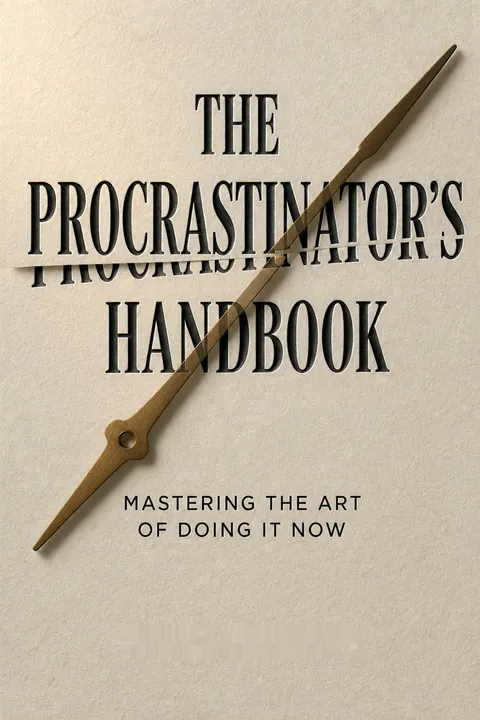


Key Takeaways
Treat procrastination as a changeable habit, not a permanent personality.
A learned pattern. Emmett argues that procrastination is not a fixed character flaw. It is a habit shaped by attitudes, fears, and routines, which means it can be changed. Her own turning point came after she delayed completing the final semester of her degree for seven years. She finally recognized that fear, not laziness, was keeping her stuck: she worried about failing, looking foolish, and neglecting her children while studying.
Progress can compound. Once she named those fears and began acting, she completed her bachelor’s degree, then earned a master’s degree while working and raising a family. Her story gives the book its central promise: change begins not with a new personality, but with a more honest account of what is blocking action.
What's useful here is the separation of identity from behavior. Calling someone a procrastinator can make a temporary pattern feel like a permanent diagnosis, which encourages resignation. A more workable question is, “What is this delay doing for me right now?” That question can reveal fear, uncertainty, or relief-seeking without turning those motives into character defects. The framing also has limits: severe depression, attention difficulties, caregiving demands, or unstable working conditions can make action genuinely harder. Recasting every obstacle as a habit would miss those realities. Still, treating delay as changeable creates room to test a different response.
Measure the task before believing the dread.
The imagined job grows. Emmett’s rule is that anticipating a task can consume more energy than completing it. In one seminar, a manager had left motivational prints in storage for five months because he believed hanging them required a full day. He eventually worked on them after lunch and finished in forty-seven minutes. The task had become a larger presence in his mind than it was in reality.
Run a small experiment. Set a timer for an uninterrupted hour and begin. If the task finishes, you learn its true size. If not, you have made progress and can plan the next session. The timer is not a promise to finish everything; it is a way to replace vague dread with evidence about what the job actually requires.
This is a practical form of reality testing: rather than debate whether a task is enormous, perform a bounded trial and collect evidence. It also targets the costly transition from intention to action, which is often the moment when avoidance feels most compelling. The method works especially well for tasks with uncertain duration, such as sorting papers or making a difficult call. It is less suitable when the work requires sustained concentration beyond an hour or depends on other people. In those cases, the experiment still helps, but the next step is a realistic plan, not an arbitrary demand to finish.
Catch the disguise your avoidance wears.
Busyness can conceal delay. Emmett calls one pattern “Hypocritical Procrastination”: avoiding a priority by doing something that seems more respectable than idleness. While postponing committee typing, she spotted a mark on a kitchen wall, cleaned it, then washed the walls and ceiling. The cleaning was real work, but it also let her avoid the task she had agreed to do.
Notice the recurring detour. Some people wander for errands, overprepare, socialize, reorganize, or rush to help others. Another pattern, “Rebellious Procrastination,” uses delay as an indirect way to resist someone else’s control. Drifting through unstructured time can also leave many tasks started and none finished. Identifying the pattern is the first move: name the detour, choose one priority, and give it a clear deadline.
The strength of this taxonomy is that it makes avoidance visible without requiring a person to be idle. In workplaces and homes, productivity can become a socially acceptable disguise: the desk gets tidier while the uncomfortable conversation remains untouched. The idea also invites a useful distinction between legitimate competing work and displacement. A helpful test is whether the substitute task matters independently, or mainly feels urgent because it provides relief from the priority. Rebellion deserves additional care: passive delay may signal a real conflict over autonomy. Naming that conflict can be more constructive than simply imposing stricter reminders.
Name the fear, then make its worst case survivable.
Fear has many faces. Emmett describes procrastination driven by perfectionism, rejection, change, mistakes, responsibility, difficult feelings, and uncertainty about decisions. One woman kept postponing a novel until she realized that success might force her to confront what she wanted from her marriage. In another story, a student feared that one strong report card would create expectations she could not meet again.
Make the threat specific. Ask what is feared, then imagine the worst plausible outcome and whether it can be survived or repaired. A rejected sales call, a flawed first attempt, or an imperfect purchase may feel painful without being permanent. Research, advice from a knowledgeable person, return policies, and small trial commitments can reduce the cost of deciding. The goal is not to guarantee a perfect outcome; it is to make action possible without that guarantee.
This approach turns a foggy emotional block into a problem that can be examined. It resembles cognitive techniques that distinguish a feared prediction from an established fact, while the emphasis on reversible choices lowers the perceived stakes. The important nuance is that “you would survive” does not make every risk trivial. Medical, financial, and relationship decisions may require expert help, careful planning, or safety measures. A sound response combines emotional courage with proportional due diligence. The book’s distinction between excellence and perfection is valuable here: high standards can guide work, while perfectionism can demand certainty that no real project can provide.
Choose fewer commitments before overload turns into delay.
Too much enthusiasm can stall action. Emmett describes “SANE,” or Super Attention and Natural Enthusiasm, as intense focus on whatever is currently exciting, followed by a sudden shift to something newer. People with this pattern may accumulate unfinished projects and commitments, not because they lack interest, but because interest keeps changing.
Make room by declining. The book also describes people who want to do everything and say yes until there is no time for family, rest, or important personal tasks. Emmett recalls using a poem about preserving small sources of delight to remind her family to pause during frantic periods. The practical advice is to set limits, schedule uncommitted time, and treat rest and connection as part of a functioning life, not prizes reserved for after every task is done.
This section challenges the assumption that time trouble always comes from poor scheduling. Sometimes the schedule itself is the problem. Saying no protects attention, but it can also protect the quality of a yes: fewer commitments allow people to follow through instead of spreading care thinly across every invitation. The SANE description is a memorable account of novelty-seeking, though it should not be treated as a clinical diagnosis. A person who repeatedly struggles to sustain attention may need more than timers and limits. For others, deliberately containing new ideas in a later list can preserve curiosity without letting it hijack the current task.
Turn overwhelming projects into steps, lists, and earlier deadlines.
Shrink the project, not the goal. Emmett compares a large task to a long journey: define the destination, map the smaller stages, and take one step at a time. A real estate office used a seventy-five-step checklist for selling a home, so new agents could see the work as a sequence rather than an intimidating blur. A written list also moves obligations out of memory, clarifies priorities, and makes progress visible.
Plan backward from the finish. “Back timing” means starting with the real deadline and setting earlier target dates for the work that must precede it. A news release, for example, needs time for drafting, proofreading, and delivery before the publication date. Small pockets of waiting time can handle brief tasks, but they do not replace focused blocks for complex work.
Breaking a project into steps reduces the cognitive burden of holding a whole uncertain undertaking in mind. A checklist is particularly useful when tasks recur or involve many dependencies, because it externalizes memory and prevents predictable omissions. Backward planning adds a second benefit: it exposes hidden lead times before they become emergencies. The caution is that a long list can become another source of overwhelm if every item appears equally urgent. Prioritization matters as much as decomposition. A useful plan distinguishes essential steps from optional polish, and includes slack for interruptions rather than assuming the calendar will behave perfectly.
Think before you plunge, especially when past attempts felt miserable.
Preparation prevents avoidable friction. Emmett describes “plunging” as starting without thinking through the tools, materials, or sequence a job requires. One man repeatedly dismantled his car before checking whether he had the necessary replacement parts. Each repair became a series of trips, delays, and frustrations, making him dread the next one.
Use four planning moves. First, take time to think through the task. Then write down actions and supplies, discuss the work with someone who may offer advice or help, and imagine the steps in sequence. A receptionist who dreaded decorating a waiting room realized she kept climbing a ladder to retrieve forgotten tools. Gathering everything in one portable kit would have removed the repeated interruptions and made the job easier to begin.
Planning is not merely administrative overhead. It can change the emotional memory attached to a task. When a poorly prepared attempt becomes exhausting, the next attempt inherits that aversion, even if the work itself is manageable. A brief rehearsal can uncover missing resources, dependencies, and needless movement. But planning has its own failure mode: it can become a refined form of avoidance. The useful threshold is practical readiness, not exhaustive certainty. Once the essential materials and first steps are clear, action supplies information that more planning cannot provide.
Give papers and possessions a home, then release what no longer serves.
Clutter taxes attention. Emmett argues that piles of papers invite repeated shuffling and make important material harder to find. Her advice is to decide what each paper requires: act on it, file it, pass it along, recycle it, or discard it. She also recommends giving recurring trouble spots a dedicated place, such as a desk stocked with envelopes, stamps, and pens for bills and mail.
Keep what matters, not everything. The same test applies to belongings. Ask whether an item is useful, still brings joy, or has genuine personal or financial value. A broken appliance kept only because it might someday provide a part may cost more in space and attention than it saves. Donations, recycling, or asking a friend to help can make letting go easier. The aim is not an empty home, but less friction and more usable space.
The central insight is environmental: disorder can turn a simple intention into a chain of small obstacles. A designated location for tools, documents, or birthday cards acts as external memory and lowers the effort required to follow through. The book wisely avoids treating all possessions as waste, distinguishing treasured collections from burdensome accumulation. That distinction matters because decluttering advice can mistake aesthetic minimalism for a universal good. Some objects carry identity, cultural meaning, or practical backup value. The better measure is whether ownership serves the person’s current life, rather than whether an item fits someone else’s ideal of tidiness.
Automate small financial actions before delay charges interest.
Delay has a price tag. Emmett connects procrastination to late fees, interest, missed applications, and lost savings time. One participant carried about $7,000 across credit cards at an average interest rate of 18 percent, costing roughly $1,260 a year before late charges. After changing how she used her cards, she paid off the debt in twenty-two months. Another example shows how a small monthly investment can grow over time, though the book’s illustration assumes a 10 percent annual return and is not a guarantee.
Make routine money tasks easier. Keep receipts and tax documents in one place, set target dates ahead of deadlines, and use automatic transfers when appropriate. If a task is confusing, seek knowledgeable help. The point is not to offer financial advice, but to show that delay can quietly turn ordinary administrative friction into a recurring expense.
Financial tasks make the book’s argument unusually concrete: postponement is not just unpleasant, it can compound into measurable costs. Automation is powerful because it removes repeated decisions from a process that benefits from consistency. Yet projected investment growth depends on assumptions, and historical rates cannot promise future results. The deeper lesson is about separating behavioral design from financial judgment. A person can automate a savings habit while still choosing an appropriate account, risk level, and amount with qualified guidance. Likewise, debt repayment plans must account for income and essential expenses, not rely on motivation alone.
Schedule one small dream-step beside the bills and chores.
Maintenance is not the whole life. Emmett separates maintenance tasks, such as laundry and bills, from enrichment, such as learning, friendship, recreation, and creative work. When every available hour goes to maintenance, people may feel depleted even while staying busy. Her advice is to place meaningful activities alongside necessary tasks instead of waiting for an imaginary day when all chores are finished.
Make a dream actionable. A large ambition can be broken into smaller moves. A young mother with three preschoolers could not attend college full time, so she chose one class each semester and made steady progress. Other first steps might be researching a course, contacting a teacher, or setting aside a regular hour. Emmett also suggests examining leisure and commuting time for opportunities, without treating every moment of rest as wasted.
The distinction between maintenance and enrichment offers a useful corrective to productivity measured only by completed chores. A life can be administratively efficient and still feel empty if its valued activities never receive calendar space. Small steps matter because they convert an identity-level wish into a near-term action with a manageable cost. The nuance is that leisure is not merely fuel for future productivity. Rest, play, and relationships can be valuable in themselves, and some people have little discretionary time because of economic or care demands. A realistic dream plan respects those limits rather than turning every spare minute into another obligation.
Analysis
Emmett’s book is practical, anecdotal self-help rather than a clinical theory of procrastination. Its central move is to treat delay as a pattern with identifiable triggers and disguises, then offer concrete countermeasures: measure the task, name the fear, write down the work, set intermediate deadlines, and improve the environment. The many seminar stories make abstract advice visible. The manager who postponed hanging prints, the student afraid of being expected to repeat success, and the woman postponing taxes show that “I cannot get started” can describe very different problems. The strongest organizing insight is that procrastination often protects a person from an immediate discomfort, even when it creates a larger future cost. That explains why reminders and time-management systems alone can fail: a calendar cannot resolve fear of judgment, resentment, perfectionism, or competing obligations. The book’s attention to those motives gives its practical tools a psychological foundation. Its advice is also unusually domestic and specific, from keeping stamps beside the mail to storing project documents together, which makes change feel less abstract.
A modern reading should add caution. Contemporary accounts often describe procrastination as short-term mood regulation, and some people face clinical, cognitive, economic, or caregiving constraints that cannot be reduced to a bad attitude. Emmett’s emphasis on agency is motivating, but it can become self-blame if applied without context. Nor is every delay a failure: incubation, rest, and deliberate prioritization may improve judgment. The book acknowledges purposeful postponement, but readers still need to distinguish wise deferral from avoidance by asking whether the delay has a reason, a boundary, and a next decision point.
Taken as a whole, the book is best used as a diagnostic kit rather than a universal formula. The reader identifies the task, the emotional or logistical obstacle, and the smallest intervention that fits. Its enduring value lies in replacing shame with investigation, then turning that investigation into a specific action.
Review Summary
The Procrastinator's Handbook receives mixed reviews, with an average rating of 3.60 out of 5. Readers appreciate the practical advice and motivational aspects, particularly the emphasis on list-making and prioritization. Many find the book's ideas helpful for overcoming procrastination, though some criticize the abundance of examples and testimonials. Common praise includes the book's concise nature and actionable tips, while criticisms focus on outdated references and repetitive content. Several readers humorously note their own procrastination in reading the book, highlighting its relevance to the target audience.
People Also Read









Glossary
Emmett's Law
Dread outlasts the taskEmmett’s name for the idea that anticipating a task can consume more time and emotional energy than doing it. The principle encourages people to test a task’s real duration by beginning, often for a limited period, rather than letting an imagined estimate keep the work intimidating.
Positive Procrastination
Purposeful, useful delayA deliberate choice to postpone an activity for a specific reason, rather than avoiding it without thought. Emmett uses the term for situations such as letting a creative idea incubate, taking a break from stale work, or limiting unnecessary revision. The delay should be intentional and should not create avoidable damage.
Hypocritical Procrastination
Avoidance disguised as workA pattern in which someone delays an important or unpleasant task by doing another activity that appears useful, noble, or necessary. Cleaning instead of completing a promised assignment is one example. The substitute activity is real work, but it functions as an excuse to avoid the priority.
Rebellious Procrastination
Resistance through delayAn indirect form of resistance in which a person postpones an agreed task, sometimes to feel control or unsettle the person making the request. The delay may express resentment or powerlessness without a direct conversation. Emmett argues that it often damages the person delaying as well as the relationship.
SANE
Intense, shifting enthusiasmAn abbreviation for Super Attention and Natural Enthusiasm. Emmett uses it to describe people who become deeply absorbed in an exciting activity, then shift their attention to a newer one. The pattern can create energy and curiosity, but it can also leave projects unfinished unless attention is deliberately redirected.
anticrastinator
Someone who acts intentionallyEmmett’s term for the opposite of a procrastinator. It does not mean a person who completes every possible task or never delays. An anticrastinator identifies what matters, makes choices about priorities, and follows through on important work, while accepting that some lower-priority tasks may remain undone.
back timing
Plan backward from deadlinesA planning method that begins with the final deadline and works backward to establish earlier target dates for the tasks that lead up to it. It helps reveal dependencies, materials, and outside information needed before the final stretch. The target dates create room for preparation and reduce last-minute pressure.
Portable Project Center
One home for project materialsA project-organizing system built around a pocket folder and a spiral notebook, often kept in matching colors. The folder holds documents, receipts, and reference material, while the notebook contains dated lists, notes, and phone numbers. Keeping related information together makes a large project easier to carry, review, and resume.
About the Author
Other books by Rita Emmett
Download PDF
Download EPUB
.epub digital book format is ideal for reading ebooks on phones, tablets, and e-readers.








