

Key Takeaways
Build around customers' appetite for choice, not a fashionable label.
Demand has many faces. Aubrey argues that local and specialty food markets bring together customers with different motives: flavor, health concerns, environmental values, family memories, or simply a desire to meet the producer. These groups overlap, but no single profile explains them all. The business opportunity lies in listening closely, then offering something customers actually want, rather than assuming one message will persuade everyone.
The numbers were rising. The book reports 4,685 U.S. farmers markets in 2008, a 6.8 percent increase from 2006, and organic sales of $24.6 billion that year. These are historical figures, not current market data. Their point is that local food and organic products had moved beyond a tiny specialty market, while still leaving room for small producers.
What's useful here is the shift from identity-based marketing to customer-centered listening. A producer may care most about soil practices, while a buyer cares about taste, convenience, or trust. Those motives can lead to the same purchase, but they are not interchangeable. The range also creates a practical challenge: a business cannot serve every customer equally well. Small producers need to identify which needs they can meet consistently, then make those benefits legible without overstating them. The book's older market figures establish a historical trend, but anyone making an investment today needs fresh local data.
A rural dream becomes workable through adaptation, not instant romance.
The move changes more than scenery. Jeannie Ralston arrived in Texas from New York City without farming experience and initially disliked the lavender business her husband wanted to start. Over time, she learned the work, found an interest in the venture, and helped turn lavender into a local attraction. Her story resists the tidy fantasy that country life automatically feels peaceful or natural to newcomers.
Expect a culture shift. Rural life can mean isolation, fewer nearby services, more self-reliance, and community customs that long predate a new arrival. Aubrey urges newcomers to learn local norms, get involved, and give themselves time to adjust. The transition is not proof that someone is unsuited to farming. It is part of the work of building a new life.
Ralston's change of heart matters because it treats adaptation as a process rather than a personality test. People often mistake discomfort with unfamiliar routines for evidence that they made the wrong choice. The better question is whether the new life becomes more manageable as skills and relationships grow. Still, adaptation should not be romanticized as endless tolerance. Isolation, family strain, and loss of services are genuine costs, so a trial period or gradual transition can reveal whether the lifestyle fits before a household commits its savings and identity to it.
Test demand and workload before investing in slow-growing inventory.
Start with a plan you can revise. A small venture may need only a concise plan, but it still needs clear goals, a product description, cost estimates, a target market, and a realistic first-year budget. Market assessment can begin informally: visit potential markets more than once, talk with shoppers and vendors, and note which products are missing or oversupplied.
Production has its own clock. Brent and Suzie Marcum began with bedding plants and modest farmers market sales, then expanded gradually on their seven-and-a-half-acre farm. They knew fruit trees might take three to five years to produce. When they planted too much too quickly, weeds and insects overtook some crops. Seasonal selling, delivery time, labor, and winter expenses also belong in the plan, not just the cost of seeds or animals.
This is a useful blend of market research and operations planning. A promising product can still fail if it matures after the business runs out of cash, or if harvesting and delivery exceed the owner's available hours. The Marcums' experience illustrates why small experiments have informational value: they reveal both customer interest and the hidden labor behind production. Informal observation is a sensible starting point, though it can be biased by a few enthusiastic buyers. Tracking sales and costs across seasons turns intuition into evidence.
Keep cash alive by combining finance and asking for help early.
One funding source can become a trap. Aubrey financed her meat business with a bank line of credit and initially ignored grants, cost-sharing programs, and outside guidance. After costly early mistakes, the credit was exhausted and her request for more was denied. The business recovered after she changed her sales model and sought support, but the episode shows how pride in self-reliance can leave a new venture exposed.
Build a funding mix. Options described include bank loans, loan guarantees, personal assets, shared ownership, and grants. Grants do not require repayment, but often require matching funds, detailed applications, and reports on spending. Jon Bednarski used conservation assistance for fencing, waterers, and winter feeding improvements. Aubrey's practical lesson is to ask local extension and development professionals what programs fit before committing to expensive plans.
The financial lesson is not that grants are easy money or that debt is inherently bad. It is that resilience improves when a business has more than one route to capital and more than one source of advice. Grants can reduce a project's cost, but their restrictions and administrative burden have a price of their own. A useful funding decision therefore compares not only interest rates, but also timing, matching requirements, repayment capacity, and the entrepreneur's ability to manage the paperwork.
Treat compliance and food safety as operating costs, not paperwork.
Selling food creates public responsibilities. The book urges producers to investigate business structure, accounting, permits, insurance, sanitation, processing, labeling, and weights and measures before opening. Rules can differ by state, county, product, and sales venue. A permit for a farm shop, for example, may not cover a farmers market in another county.
Quality depends on systems. Bob and Carol Laffranchi's Loleta Cheese Company faced inspections, regulated labels, sanitation standards, and significant inspection costs. The company used separate production procedures, protective clothing, equipment sanitation, and pasteurization to protect its product and reputation. Aubrey also warns that a poor processing partner can create delays, packaging errors, and unhappy customers. Her guidance is to consult qualified local professionals because the book's regulatory details reflect its 2010 publication context.
This section usefully frames regulation as part of product design. Food safety is not a bureaucratic layer added after production; it shapes facilities, workflow, packaging, insurance, and the promises a label can make. That systems view is especially important for tiny operations, where a single breakdown can affect the whole business. The caution is that legal and food rules change and vary widely. The book's checklists are best treated as prompts for local verification, not as a substitute for current agency guidance or professional advice.
Use a cooperative when shared ownership solves a real access problem.
A cooperative organizes shared effort. A food co-op is a consumer-owned store; a community-supported agriculture arrangement, or CSA, usually connects members to a farm's seasonal harvest through advance shares. The two models overlap in their community focus, but they are not identical. A CSA gives farmers working capital and members a share of production, while a food co-op operates as a retail business that can also serve nonmembers.
Begin with feasibility, not enthusiasm alone. Lost River Market & Deli in rural Indiana grew from a farmers market community. Its organizers recruited members, sought experienced cooperative guidance, and opened a store in 2007. The book reports 582 members and says about 60 percent of sales came from members. A cooperative also needs clear membership rules, sound governance, funding, and capable daily management.
The cooperative model converts community goodwill into an operating structure. That is its strength: members can provide capital, reliable demand, labor, and legitimacy at once. But shared ownership does not eliminate ordinary business problems. It can make decision-making slower, and members may disagree about price, mission, or the balance between local and commercial products. The model is strongest when the shared purpose is specific, such as access to local groceries or predictable markets for growers, and when governance is explicit enough to survive differences.
Sell a farm experience only if hosting people suits your life.
Agritourism makes the farm a destination. It can mean tours, U-pick activities, meals, farm stays, workshops, or entertainment connected to agriculture. Cook's Bison Ranch added tours to its meat business, helping visitors understand bison and try the product. Erica Cook reported that meat still supplied about 95 percent of the family's income, while tours supported customer relationships and sales.
The visitor experience takes real work. Cook's Ranch developed wagons, restrooms, a gift shop, meals, and programming for different ages. The family eventually hosted more than 4,000 visitors a year. That growth required scheduling, staffing, maintenance, hospitality, and insurance. Visitors may arrive outside planned hours, and farms contain hazards unfamiliar to guests. Aubrey recommends setting clear hours, marking safe and restricted areas, and consulting an insurer who understands agricultural operations.
Agritourism sells access, interpretation, and hospitality, not merely a view of fields. The model can deepen consumer understanding and give rural businesses another reason to be visited, especially when linked to local tourism partners. Yet its appeal can conceal a serious trade-off: opening a home landscape to the public means surrendering privacy and taking on visitor management. A useful test is whether the owner enjoys repeated social contact, not just the idea of people appreciating the farm. Revenue projections should include staffing and safety costs.
Set prices from costs, labor, and customer value, not imitation.
Know the break-even point. Before setting a price, count the costs of inputs, labor, transport, packaging, marketing, equipment, and the time between investment and sale. Rebecca Terk priced vegetables by considering seed, pest control, harvest time, local store prices, and what her customers would pay. She did not automatically undercut grocery stores, because she believed the freshness and quality of her produce justified a different price.
Choose the sales model deliberately. Retail sales usually bring the producer a higher price and immediate payment, but require more time in selling and customer service. Wholesale reduces the producer's price in exchange for larger or simpler transactions, and payment may arrive later. A more finished, ready-to-use product can command more, but it may also require extra labor and storage. The right price must support both the product and the work needed to sell it.
Pricing here is treated as both arithmetic and communication. The cost calculation protects the producer from mistaking revenue for profit, while the customer-facing explanation makes invisible labor and quality easier to understand. There is a tension: a price based only on costs can exceed what a market accepts, while a price copied from competitors may fail to cover an unusually labor-intensive product. Testing prices and tracking margins helps resolve that tension. The producer must also distinguish a premium that reflects real value from one supported only by appealing language.
Choose sales channels for fit, then cap the workload they create.
A venue is part of the business model. Farmers markets, farm shops, consignment stores, restaurants, delivery routes, and online orders reach different customers and demand different amounts of labor. Denise Baarda's Veggie Van brought produce to senior residences, where customers had limited mobility and often wanted small quantities. The idea solved a local access problem, but required routing, vehicle costs, scheduling, and permission from facilities.
Use several channels only when they work together. Aubrey describes five necessary business functions: pricing, marketing, choosing selling venues, prospecting for customers, and retaining them. Combining channels can spread risk and make a trip more efficient, but each adds work. Brent and Suzie Marcum dropped a market that required too much driving and reduced plant deliveries when they drained too much time. A channel's sales are not enough; its net return and manageability matter.
The strongest point is that distribution is not a neutral final step. It determines who can buy, how much time the producer spends away from production, and whether customers experience the product as convenient. Baarda's van demonstrates how a niche channel can be designed around a specific barrier rather than a generic desire for more sales. The same logic calls for disciplined limits: a channel that adds gross revenue may still weaken the business if transport, setup, and staffing consume the margin.
Build a customer list, then earn its attention with useful contact.
A customer base needs active care. Aubrey recommends collecting names and contact details at markets, stores, and online, with customers' permission. Record what people buy and any useful preferences, organize the list into practical groups, and back it up. In her meat business, she reports that roughly 80 percent of customers agreed to join the email list when asked.
Communicate with a reason. Newsletters can announce seasonal openings, new products, recipes, and events, but frequent messages without value risk becoming noise. At Raven's Glenn Winery, Bob and Renee Guilliams emailed customers six times a year and personally answered customer messages within 48 hours. Their approach joined practical information with gratitude. A database is useful only when it supports genuine, relevant contact, and customers should be able to decline or unsubscribe.
The customer list turns fleeting transactions into an institutional memory. It can reduce dependence on chance encounters and help a small producer coordinate seasonal supply with known demand. But access to a customer's inbox is a form of trust, not an entitlement. Asking permission, keeping messages relevant, and making departure easy preserve that trust. Personal replies can feel distinctive at small scale, although they may become hard to sustain as a list grows. Communication systems should expand at a pace the business can honor.
Protect the first year by staying small, solvent, and teachable.
The first year tests the whole design. Aubrey's list of survival priorities includes financial preparation, a manageable business model, paced growth, continued learning, and organization. She advises keeping outside income when possible, budgeting before revenue becomes uncertain, paying down burdensome expenses, and starting with a workload the household can sustain.
Growth can outrun capacity. Aubrey's meat business went from supplying one restaurant to 25 in its first three months, then fell to ten by month eight. The rapid expansion strained delivery systems and cash flow. She recommends tracking ideas rather than implementing every inspiration immediately, learning from peers, and keeping records and invoices current. Jenna Woginrich's experience offers another version of gradual progress: she kept a full-time design job while building a small farm life around it.
The book's most durable advice is about sequencing. Entrepreneurs often interpret demand as an instruction to expand, but demand becomes an asset only when production, delivery, cash, and quality can keep up. A slower pace can protect both reputation and household life. This is not an argument against ambition; it is an argument for making capacity visible before promising more. The first year also generates unusually valuable information, so a modest launch can function as a paid learning period rather than a failed attempt at instant scale.
Analysis
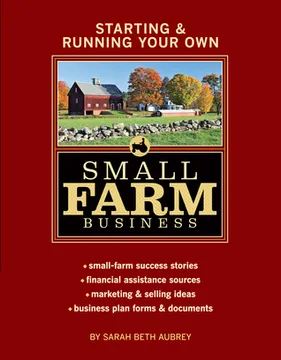
The book is a practical guide to building small agricultural and local-food ventures, but its deeper argument concerns translation: turning a desire for rural life into an operation that can serve customers without consuming the owner's finances, time, or household. Its structure moves from market opportunity and planning through funding, rules, cooperative and tourism models, sales, marketing, customer care, and first-year survival. Case studies keep that sequence grounded. A city transplant learning lavender, a family growing produce on a few acres, a bison ranch adding tours, and a cheese maker managing inspections each show a different route from consumer interest to enterprise.
The central strength is its refusal to treat romance and business as opposites. A small producer can value land, family, and community while still calculating labor, price, liability, and cash flow. The recurring advice to begin modestly, consult peers, and adjust from evidence is especially powerful because agricultural production has long lead times and seasonal cash needs. The book also treats customer relationships as infrastructure, not decoration. Trust, repeat buying, and local visibility help connect production to markets that large distribution systems may not serve well.
The main limitation is temporal and geographic. The statistics, regulatory references, and funding programs reflect a 2010 publication, so they should not be used as current market or compliance guidance. A present-day reader must verify local rules, program availability, and demand before investing. The book's optimism about open market niches also needs a hard business test: a growing category does not guarantee a viable customer base for a particular product in a particular place. Yet its practical framework remains valuable. The enduring question is not whether small farming is broadly promising, but whether a specific producer can match a specific community need with a safe, financially resilient, and personally manageable way to deliver.
Review Summary
The Profitable Hobby Farm receives mixed reviews, with an average rating of 3.72 out of 5. Readers appreciate its informative content, practical advice, and real-world examples for aspiring hobby farmers. Many find it helpful for understanding the challenges and opportunities in small-scale farming. Some readers enjoy the marketing and business aspects, while others find them less relevant. The book inspires some to pursue farming dreams, while deterring others due to its realistic portrayal of the difficulties involved. Overall, it's considered a valuable resource for those interested in profitable hobby farming.
People Also Read









Glossary
Veraison
early business transformationA winemaking term for the stage when grapes begin changing color and ripening. Aubrey uses it metaphorically for the early phase in which a farm or local-food idea begins to become a real venture. It describes the transition between imagining a new life and learning how to operate within it.
Five Pillars of Small Farm Business
five operating essentialsAubrey's organizing framework for the core commercial tasks of a small farm venture: effective pricing, marketing, choosing sales venues, prospecting for customers, and retaining customers. The pillars are interdependent. Production alone does not create a sustainable business unless customers can find, buy, and continue buying the product.
Community-supported agriculture
members share farm harvestA CSA is a farm-based arrangement in which members pay in advance or through a structured membership for a share of the farm's seasonal production. Member payments provide working capital, while members receive food and share some production risks, such as weather or crop losses. Unlike a retail food co-op, the CSA centers on a farm and its harvest.
Agritourism
paid visits to farmsA business model that invites visitors to an agricultural setting for activities such as tours, farm meals, U-pick harvesting, workshops, overnight stays, or entertainment. It may educate visitors about farming and food, generate income directly from visits, and help sell farm products. It also requires visitor management, adequate staffing, and liability planning.
Value-Added Producer Grant
funding for processed productsA USDA grant program described in the book as supporting producers who transform raw agricultural goods into products with added market value. Examples include processing a farm commodity into a packaged food for sale. The program's rules, funding, and eligibility can change, so the book presents it as a resource to investigate, not guaranteed financing.
About the Author
Download PDF
Download EPUB
.epub digital book format is ideal for reading ebooks on phones, tablets, and e-readers.








