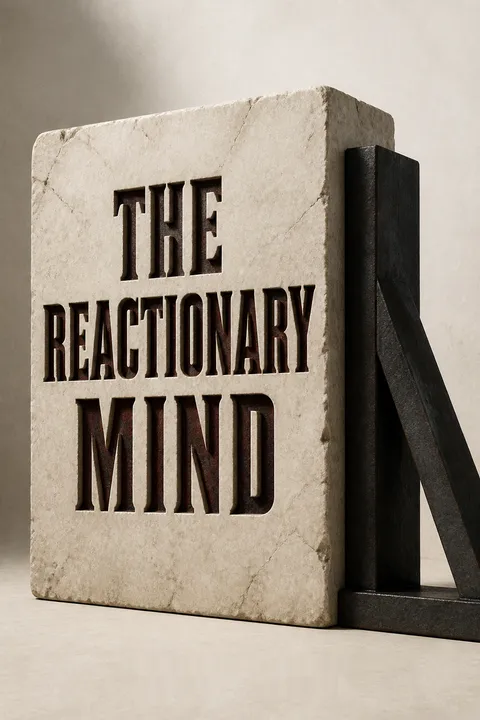


Key Takeaways
Read conservatism as a counter-movement against emancipation, not a museum of tradition.
Power under pressure. Robin defines conservatism as a counterrevolution: a political response to movements that threaten established hierarchies, and an effort to recover or remake the power those movements challenge. Its core is not simply a preference for old customs. Across different eras, the right has defended the authority of employers, husbands, slaveholders, and political elites against demands for independence and equal standing.
A recurring conflict. Burke opposed the French Revolution because he saw it breaking relationships of command and deference. Robin connects that fear to later resistance against labor organizing, civil rights, feminism, and welfare. The arguments change, but the recurring anxiety is that people lower in a hierarchy are claiming the right to act and speak for themselves.
This approach treats conservatism as a political relationship, not a checklist of policies. That makes it useful for comparing movements that disagree about religion, markets, or the state but defend forms of unequal authority. It also corrects the assumption that conservative politics is merely passive resistance to change. The risk is breadth: if opposition to emancipation defines the right, genuine differences among conservative traditions can become difficult to distinguish. The frame works best as a recurring pattern to test, rather than a complete explanation of every conservative belief.
Follow political conflict into homes and workplaces, where authority is first challenged.
Power in private. Robin calls the home, factory, and field part of the private life of power: everyday relationships where one person can direct, discipline, or constrain another. Formal consent does not necessarily make these relationships equal. The book notes that, until 1980, marital rape was legally exempt from prosecution in every U.S. state. Employment contracts, too, could be interpreted as carrying obligations workers had neither negotiated nor understood.
Agency changes the stakes. A demand for safer machinery or an end to sexual coercion can threaten more than a specific practice. It makes subordinates into people who set terms and speak publicly. Robin uses the backlash to Guatemala's land reform to show how ruling groups feared peasants gaining a political voice as much as losing land.
The connection between intimate authority and public politics helps explain why apparently narrow reforms can provoke outsized reactions. A workplace rule or family law changes not only outcomes but who gets to make decisions. This resembles a broader insight from institutional analysis: power is sustained by routines as much as by formal rules. Still, not every domestic dispute is a miniature constitutional crisis. The framework is most illuminating when it shows how private practices are protected, or overturned, by public institutions.
Expect reactionaries to borrow their opponents' tools to rebuild the order they defend.
Preservation takes invention. Robin argues that a threatened old order rarely survives by simply repeating its inherited justifications. Burke and Joseph de Maistre both criticized the aristocracy, church, and monarchy they wanted to defend, judging their leaders too complacent or weak to meet revolutionary challenges. Preserving hierarchy therefore required changing its political form.
Borrowing becomes strategy. Conservatives have adopted techniques and language associated with reformers, from popular pamphlets to arguments about rights and inclusion. The chapter traces this pattern from eighteenth-century religious writers who used accessible mass persuasion to modern political strategists who recast racial appeals in coded language. The aim is not to accept the left's goals. It is to use new forms of persuasion to make an old distribution of power seem legitimate again.
Political movements rarely win by preserving an unchanged vocabulary. They survive by making their claims legible to people whose expectations have shifted. Robin's account highlights this process of adaptation, where an opponent's language can be borrowed without accepting its original purpose. That is more subtle than describing political change as either sincere conversion or cynical disguise. In practice, borrowing can also alter what a movement believes. The boundary between tactical imitation and genuine transformation is therefore a question, not an assumption.
Make hierarchy feel democratic by giving ordinary people someone to rule.
Status travels downward. Robin calls democratic feudalism a system in which members of a dominant group gain a sense of rank, and sometimes real authority, over a more vulnerable group. The antebellum South offered poor white men status within a racial order even when they owned no enslaved people. Some slaveholders also argued that wider access to slave ownership would bind more white families to the system.
Inclusion has limits. This kind of populism invites ordinary people to identify with rulers without giving them equal control over public power. The poor white man may feel like an aristocrat because Black people are placed below him. Robin's related idea of upside-down populism describes a similar identification: people imagine themselves reflected in powerful leaders while the underlying hierarchy remains intact.
Status can be a political resource even when material gains are limited. Social identity research helps explain why group membership can feel like compensation for economic disadvantage, especially when a visible out-group is cast as a threat. Robin's account shows how that feeling can connect popular participation to elite power. The important distinction is between inclusion in a dominant identity and access to shared decision-making. The former can feel empowering while leaving the institutions that distribute resources and authority largely untouched.
Separate personal liberty from political power, and submission can resemble freedom.
Hobbes redraws liberty. During the English Civil War, Thomas Hobbes confronted the republican argument that freedom requires citizens to share in governing themselves. He instead defined liberty mainly as the absence of physical impediments to movement. Someone obeying a sovereign out of fear could still count as acting freely, because fear shaped that person's will rather than physically stopping their action.
Consent without control. Hobbes imagined individuals authorizing a sovereign to rule with concentrated power in exchange for protection from violence and disorder. People could then regard the sovereign as representing them, although they could not direct his decisions. Robin presents this as a counterrevolutionary innovation: it accepts popular consent while separating it from popular self-government. In this account, political submission can secure a narrow form of personal freedom.
Hobbes clarifies a tension that remains central to political theory: protection from interference is not the same as influence over the rules. His model takes seriously the need for a state capable of preventing violence, but it risks treating political participation as optional once security is provided. The distinction is useful in contemporary debates about strong executives and individual rights. It also shows why a policy can expand private choice while concentrating public authority. Those are separate dimensions of liberty, not interchangeable measures.
Ask whether market freedom protects individuals or private rulers.
Freedom can shelter command. Robin argues that some defenses of the free market focus on freedom from government while overlooking authority inside families and workplaces. A business owner may have broad control over employees; a father may govern a household. These private hierarchies can persist even where the state limits its direct role.
The heroic individual. Ayn Rand's novels sharpen this tension by casting exceptional producers against people portrayed as dependent or obstructive. Robin argues that this story elevates individual achievement while presenting inequality as a natural result of differences in ability. The chapter also points to the compatibility, in some cases, of market reform and authoritarian government. The political question is therefore not only how much freedom individuals have, but who holds power over other people's work and choices.
The distinction between state coercion and private authority is essential to evaluating claims of freedom. A person may face fewer public restrictions yet remain highly dependent on an employer, spouse, or property owner. That does not make every private hierarchy equivalent to state repression; the sources and limits of power differ. But it does mean that individual choice cannot be assessed by looking only at government rules. The relevant test is whether people have meaningful ways to refuse, negotiate, and leave.
See violence as a promised cure for elite decay, not an anomaly.
The appeal of danger. Robin uses Burke's idea of the sublime, an intense response to experiences of danger, power, or terror, to explain why conservative thinkers can regard conflict as invigorating. In this view, comfort risks making ruling groups passive, while struggle forces them to prove their strength. The attraction appears in very different figures, from Churchill's youthful fascination with the Cuban war to Tocqueville's sense of relief when political upheaval ended parliamentary routine.
The promise fades. Robin stresses that actual violence rarely delivers the renewal imagined from a distance. Real war brings suffering, bureaucracy, and unintended consequences. The fantasy of a rejuvenated nation can survive longer than the conflict's political achievements. Violence is thus both an imagined cure for complacency and a source of disillusion when its realities become unavoidable.
The argument links political violence to status and identity, not merely to strategic calculation. Conflict can make a group feel purposeful, disciplined, and historically significant. That helps explain why calls for struggle can attract people even when the practical aims are vague. Yet the emotional appeal should not be mistaken for evidence that violence renews institutions. War can strengthen some authorities while destroying others, and its costs are rarely shared equally. Robin's distinction between imagined danger and lived violence is especially important here.
Ask whose security counts, and whose rights become its price.
Security is political. Robin challenges the idea that freedom and security are neutral goods that can be balanced like weights. Governments and political movements decide what counts as a threat, and those decisions often reflect existing power. During the Cold War Lavender Scare, thousands of gay and lesbian federal workers lost their jobs. Officials claimed they were vulnerable to blackmail, but investigators found no meaningful evidence of such blackmail during the Cold War.
Costs fall unevenly. The same logic can target immigrants, Muslims, political dissenters, or workers. In Robin's account, national security expands beyond military defense into schools, workplaces, sexuality, and protest. The burden of proving loyalty often lands on groups with little political influence, while the majority is told that its freedoms remain intact.
Security language can transform a contest over social norms into a claim of urgent necessity. That shift narrows debate because skepticism begins to look irresponsible. Political theory can help expose this move by asking who defines the danger and who receives protection. The framework should not imply that every security threat is invented. Real threats exist, but evidence, proportionality, and oversight matter precisely because fear can make exceptional powers feel ordinary.
Measure Cold War victory in Guatemala by the voices silenced.
Reform created citizens. Guatemala's 1952 land reform redistributed about 1.5 million acres to 100,000 families and gave peasants a role in local political decisions. Its architects were Communists, but the program aimed to build a more democratic capitalism, with property rights and legal appeals. Peasant organizers gained a chance to travel, read, organize, and speak publicly. That new agency alarmed local elites alongside the loss of land and labor control.
Counterrevolution turned deadly. The United States helped overthrow elected president Jacobo Árbenz in 1954. Decades of conflict followed, ending with a 1996 peace accord. The book reports roughly 200,000 dead, primarily Mayan Indians, and describes a military campaign that the United Nations truth commission classified as genocide. The story makes the Cold War more than a contest between superpowers: it was also a struggle over who could govern locally.
Guatemala complicates any account of the Cold War that treats democracy and anticommunism as natural allies. The reform's combination of property rights, popular participation, and redistribution resists simple labels. It also shows how local political agency can become a geopolitical concern when it threatens established interests. The case should not stand in for every Cold War conflict, but it forces a useful question: which outcomes are counted as victories, and whose losses disappear from that accounting?
Notice how Scalia makes competitive inequality look like constitutional principle.
A method becomes influential. Antonin Scalia's originalism asks judges to interpret constitutional language according to its public meaning when it was adopted. He presents this as a constraint on unelected judges, limiting their ability to update the Constitution according to personal values. Robin notes that even jurists who reject Scalia's politics increasingly made historical meaning central to their arguments.
Competition reveals rank. In a case involving disabled golfer Casey Martin, the Court allowed Martin to use a cart under the Americans with Disabilities Act. Scalia dissented, arguing that walking was part of golf's competitive test. Robin reads the opinion as more than a technical dispute: Scalia treats sport as a public stage where unequal abilities should determine winners and losers. A procedural theory of law thus carries a vision of social hierarchy.
Originalism offers a serious democratic concern: judges should not casually replace enacted law with personal preference. Its force comes partly from giving that concern a repeatable method. But historical meaning is not self-interpreting. Choosing which sources, usages, and contexts count requires judgment, so the method cannot eliminate discretion. The Martin case makes the stakes vivid: even apparently neutral rules define which differences matter and which accommodations are fair. A legal method can constrain power while also embedding contested assumptions about merit.
Remember that conservative success can drain the conflict that renews it.
Defeat creates pressure. Robin argues that conservatism becomes intellectually inventive when a social movement threatens established power. The New Deal, civil rights activism, and feminism each forced conservatives to develop new arguments, organizations, and political alliances. The right's adaptations were not always attempts to restore the past exactly. They often reshaped institutions so that older hierarchies could survive under changed conditions.
Victory can stagnate. When a movement's opponents lose influence, conservative politics can become less coherent and more complacent. The book's conclusion suggests that electoral strength alone does not guarantee new ideas. If the right succeeds in weakening its challengers, it may also lose the pressure that sharpened its arguments. This is not a prediction that conservatism disappears, but a claim that its vitality depends partly on the conflicts it answers.
This is a provocative account of political creativity as a response to threat. It helps explain why movements often innovate while defending power rather than simply repeating inherited doctrine. Still, intellectual stagnation is not the only possible result of political success. Institutions, donors, media, and party organizations can sustain a movement even without a strong popular challenger. The claim is most persuasive as an account of ideological renewal, not as a law predicting when a political coalition will rise or fade.
Analysis
Robin's central achievement is to make conservatism legible as a response to democratization rather than as a stable temperament. The approach redirects attention from declared principles to the relations those principles protect. Liberty, tradition, security, and merit are not treated as neutral ideas; their political meaning depends on who has authority, who can refuse, and who is expected to obey. This relational lens lets the book place Burke, Hobbes, slaveholders, Scalia, and neoconservative advocates of war in a shared argument without pretending that they held identical policies.
The strongest evidence comes from cases where public language and private power meet. The legal history of marriage and employment, the racial politics of the Old South, Guatemala's land reform, and the Lavender Scare show how demands for agency can unsettle arrangements that appear ordinary to those who benefit from them. The account of Hobbes adds philosophical depth: a theory can affirm consent while sharply limiting self-government. The essays on violence and national security extend the same analysis to state power, showing how urgency and heroic struggle can make coercion appear meaningful or necessary.
The book's unifying definition also creates its main analytical risk. If conservatism means resistance to emancipation, then counterexamples can be reclassified as tactical variation, and the concept may explain too much. The history of political movements includes real disagreement about hierarchy, state capacity, religion, and markets. Those differences matter because they shape institutions and material outcomes, not just rhetoric. A productive use of Robin's thesis therefore treats it as a diagnostic: ask which forms of agency are resisted, whose freedom is expanded, and where authority is relocated. It is less convincing as a claim that every conservative commitment reduces to a single motive. Its enduring contribution is to make the distribution of power the first question, rather than the last.
Review Summary
The Reactionary Mind receives mixed reviews, with many praising its incisive analysis of conservatism as a reactionary movement aimed at preserving hierarchy and power. Readers appreciate Robin's examination of conservative thinkers from Burke to Trump, finding his arguments thought-provoking and well-supported. Some criticize the book's structure as disjointed and its portrayal of conservatism as overly simplistic. Despite disagreements, many find value in Robin's exploration of conservative ideology, particularly his insights on the right's co-option of revolutionary tactics and its obsession with heroic individualism.
People Also Read





Glossary
Counterrevolution
Reaction against emancipationRobin uses counterrevolution to describe organized efforts to defeat or contain movements that challenge established hierarchies. It is more than reflexive opposition to change. It can involve rebuilding institutions, adopting new political methods, and borrowing the language of reform in order to preserve or restore unequal relations of power.
private life of power
Everyday relations of ruleThe private life of power refers to authority exercised in settings such as families, workplaces, and plantations. These relationships shape who gives orders, who must comply, and who can refuse. Robin argues that political struggles over rights and democracy often reach into these intimate arrangements, rather than remaining confined to government.
democratic feudalism
Popular status through dominationDemocratic feudalism describes a hierarchy that gives members of a dominant group opportunities for status or authority over a subordinate group. Robin uses the antebellum South as a central example: white men could identify with a ruling class, including when they owned no enslaved people, because racial hierarchy placed them above Black people.
upside-down populism
Mass identification with rulersUpside-down populism allows people with little political power to see themselves symbolically represented by powerful leaders or a dominant nation. Rather than distributing decision-making power, it offers identification with those at the top. Robin describes it as one way conservative politics can mobilize popular attachment while leaving elite authority in place.
the sublime
Awe mixed with terrorIn Burke's account, the sublime is an intense experience produced by danger, pain, vastness, or overwhelming power. It can make a person feel diminished and unusually alive at once. Robin uses the concept to explain why conservative thought can associate conflict and violence with vitality, while also emphasizing that real violence can destroy the appeal of its imagined drama.
original public meaning
Historical meaning of textOriginal public meaning is Scalia's approach to constitutional interpretation. Judges seek the meaning that the Constitution's words would have conveyed publicly when adopted, using historical language and context rather than the private intentions of individual framers. The method aims to constrain judicial discretion, although deciding which historical evidence is relevant still requires interpretation.
thymotic man
Honor-driven political actorRobin uses thymotic man in discussing Fukuyama's account of people motivated by honor, recognition, and ideals rather than material comfort. Such a person is willing to risk life for a cause. The figure matters to Robin's argument because conservative thinkers can admire this intensity while regretting that peaceful market society appears to weaken it.
FAQ
What is The Reactionary Mind: Conservatism from Edmund Burke to Sarah Palin by Corey Robin about?
- Comprehensive history of conservatism: The book traces the evolution of conservatism from its origins with thinkers like Edmund Burke to contemporary figures such as Sarah Palin.
- Conservatism as reaction: Corey Robin argues that conservatism is fundamentally a reactionary ideology, formed in opposition to democratic and emancipatory movements.
- Focus on power and hierarchy: The central thesis is that conservatism seeks to preserve hierarchical power structures and social order, often resisting movements for equality and agency.
- Connection to modern politics: The book links historical conservatism to current political events, showing how its core principles adapt to new challenges.
Why should I read The Reactionary Mind by Corey Robin?
- Challenges common misconceptions: The book reframes conservatism, showing it as a dynamic, often radical force rather than simply about tradition or limited government.
- Deepens understanding of politics: It provides historical depth and context for understanding the ideological evolution of the right, from the French Revolution to the present.
- Relevance to current events: By connecting past and present, Robin helps readers make sense of ongoing political debates and conflicts.
- Critical perspective on power: The analysis encourages readers to critically assess how power and inequality are maintained in society.
What are the key takeaways from The Reactionary Mind by Corey Robin?
- Conservatism as defense of hierarchy: The right fundamentally seeks to preserve social hierarchies and resist emancipatory movements.
- Adaptability of reactionary ideology: Conservatism is not static; it borrows from the left’s language and tactics to sustain privilege and power.
- Violence and struggle central: The book highlights how violence and conflict are often embraced as means to assert and maintain superiority.
- Private sphere focus: Conservatism prioritizes maintaining hierarchical power in intimate settings like the family and workplace.
How does Corey Robin define conservatism in The Reactionary Mind?
- Counterrevolutionary ideology: Robin defines conservatism as a political practice born in reaction to democratic revolutions and reform movements.
- Opposition to subordinate agency: Conservatives believe power and authority should remain with elites, resisting the self-governance of subordinate groups.
- Dynamic and activist: Rather than being cautious or moderate, conservatism is portrayed as restless, militant, and often radical in reconstructing regimes to maintain hierarchy.
How does The Reactionary Mind by Corey Robin explain the relationship between conservatism and violence?
- Violence as a virtue: The book argues that conservatives have historically embraced violence as a legitimate and necessary means to defend and demonstrate power.
- Vitality and struggle: Violence is linked to the experience of the sublime and personal vitality, invigorating both individuals and political movements.
- Modern manifestations: Robin connects this tradition to contemporary conservative enthusiasm for military action and law-and-order policies.
- Ambivalence and necessity: While sometimes publicly denounced, violence is often seen as essential for maintaining order and hierarchy.
What role does the private sphere play in conservatism according to The Reactionary Mind?
- Private power as core: Robin emphasizes that conservatism prioritizes maintaining hierarchical power in the private sphere—family, workplace, and local communities.
- Resistance to democratization: Conservatives fear that public democratic advances will threaten traditional authority structures in private life, such as patriarchy and employer control.
- Historical examples: The book discusses how slaveholders and other elites fought to keep subordinate groups in submission at home, illustrating the centrality of private power.
How does Corey Robin analyze the relationship between conservatism and capitalism in The Reactionary Mind?
- Complex relationship: Conservatism sometimes embraces free markets but also critiques capitalism’s destabilizing social effects.
- Capitalism as hierarchy: Conservatives defend capitalism as a means to preserve hierarchy, but worry about its potential to undermine social order.
- Neoconservative adaptation: Neoconservatives seek to infuse capitalism with martial spirit and imperial ambition, resisting the complacency of bourgeois prosperity.
- Critique of decadence: The book highlights conservative concerns that capitalism’s comforts can weaken the will to power and social cohesion.
What insights does The Reactionary Mind by Corey Robin provide about conservatism’s stance on democracy and equality?
- Skepticism of democracy: Conservatism is often wary or hostile to democracy when it threatens established hierarchies.
- Opposition to equality: The right resists egalitarian movements, viewing equality as a threat to social order and natural hierarchy.
- Defense of inequality: Conservatives justify inequality as necessary for excellence, order, and social cohesion, often invoking tradition or natural law.
- Preference for managed democracy: Conservatives may support limited or managed forms of democracy that preserve elite control.
How does Corey Robin interpret the influence of Thomas Hobbes and Ayn Rand on conservatism in The Reactionary Mind?
- Hobbes as first counterrevolutionary: Robin presents Hobbes as the earliest thinker to articulate a counterrevolutionary political theory, defending absolute sovereignty.
- Redefinition of liberty: Hobbes separates personal liberty from political power, justifying submission to authority.
- Rand’s Nietzschean roots: Ayn Rand’s philosophy, influenced by Nietzsche, celebrates inequality and struggle, rejecting altruism and Christianity.
- Capitalism and morality: Rand provides a metaphysical justification for capitalism as the natural order of survival and excellence, resonating with reactionary themes.
How does The Reactionary Mind by Corey Robin analyze the impact of the Cold War and post-9/11 era on conservatism?
- Cold War as conservative triumph: The period solidified conservative power by opposing communism and promoting anti-democratic, hierarchical values.
- Post-9/11 imperialism: The book discusses how 9/11 revitalized conservative ambitions, especially among neoconservatives seeking to reshape the world through American power.
- Cultural contradictions: Robin highlights the failure of post-9/11 conservatism to achieve national renewal, revealing the limits of conservative power in a market-driven society.
- Security as ideological tool: National security concerns are used to justify repression and expand state power, continuing a pattern from the Cold War.
What is the significance of the "Lavender Scare" and national security in The Reactionary Mind by Corey Robin?
- Lavender Scare as repression: The book examines the Cold War persecution of gays and lesbians in government as part of a broader conservative backlash against social change.
- National security as justification: Robin argues that national security is often used to suppress dissent and expand state power, targeting marginalized groups.
- Security vs. freedom paradox: The book critiques the idea of balancing freedom and security, showing how security measures can undermine democratic rights.
- Continuity in the war on terror: The war on terror is presented as a modern extension of these repressive tactics.
How does Corey Robin explore the role of the Supreme Court and figures like Antonin Scalia in conservatism in The Reactionary Mind?
- Originalism as conservative tool: Scalia’s originalist approach to the Constitution is used to limit judicial activism and preserve hierarchical social orders.
- Impact on civil rights: Scalia’s opinions often limit protections for marginalized groups, reflecting conservative priorities.
- Judicial conservatism as power: The Supreme Court is portrayed as a key arena for advancing conservative agendas, shaping law to maintain hierarchy and tradition.
- Dependence on liberal tolerance: Robin notes the irony that conservative influence in the judiciary often relies on the civility and indulgence of more liberal colleagues.
Download PDF
Download EPUB
.epub digital book format is ideal for reading ebooks on phones, tablets, and e-readers.








