

Key Takeaways
Turn risk appetite into disciplined service, not self-destruction.
Risk is not a virtue. The memoir opens with Emerson facing a threatening encounter on a dark Texas highway. He reacts decisively, but the arrival of state troopers reveals how easily a personal survival story can also become a dangerous misreading of events. His career repeatedly rewards a taste for risk, yet his youth shows that the same appetite once fueled reckless driving, theft, and violent pranks.
Purpose changes the equation. Emerson’s central claim is not that impulsiveness makes someone exceptional. It is that daring can become useful when discipline, training, and responsibility shape it toward a mission. The distinction matters because the thrill of danger can feel like courage even when it is merely poor judgment.
What's striking is the difference between accepting risk and being governed by it. Under threat, attention can narrow toward immediate danger, helping a person act quickly while obscuring alternatives and bystanders. Training and clear purpose can make that response more controlled, but neither guarantees good judgment. The memoir also carries the usual survivor's bias: a risky decision looks impressive partly because the narrator lived to describe it. Its strongest lesson is therefore not to imitate his appetite for danger, but to ask what disciplines it.
Give youthful mischief a demanding craft before it becomes destructive.
Trouble needed direction. As a boy on an American oil-company compound in Saudi Arabia, Emerson and his friends had room to roam and little supervision. They started fires, played dangerous pranks, and later he stole from classmates’ families for the rush rather than the money. The memoir does not turn those acts into harmless precursors to heroism. They were real risks to other people.
Scouting offered a channel. Emerson became an Eagle Scout, learned swimming, diving, first aid, and wilderness survival, and spent nights in the desert with minimal equipment. Those skills helped prepare him for SEAL training. The useful contrast is clear: an energetic, risk-seeking temperament can develop into competence, but only when practice, responsibility, and structure replace aimless escalation.
The story resembles a broader developmental pattern: a trait such as sensation-seeking can lead to exploration, but its consequences depend heavily on supervision, peers, and available outlets. Scouting supplied structured challenges and practical skills, though it did not erase the harm of Emerson's earlier behavior. This distinction avoids the comforting myth that childhood recklessness is secretly just future leadership in disguise. Productive redirection matters, but it does not retroactively make dangerous conduct admirable.
BUD/S rewards composure and persistence more than raw athletic dominance.
Training tests the whole person. BUD/S, or Basic Underwater Demolition/SEAL training, is the Navy SEAL selection course. Emerson entered as a middling athlete, not a standout runner or swimmer. In his class, about 28 of the original 180 candidates made it through without quitting, being dropped, or being rolled back; later arrivals brought the graduating group to roughly 40.
Pacing beat bravado. He learned to handle the course in short stretches, focusing on the next exercise or meal rather than the entire ordeal. He also had to regulate his effort, conserving energy for the long day. Physical ability mattered, but the course was also designed to expose who could keep functioning under exhaustion, discomfort, and pressure alongside a team.
This account makes endurance more concrete than a slogan about mental toughness. Breaking an overwhelming task into manageable intervals is useful in endurance sport, emergency work, and long projects because it directs attention toward the next controllable action. Yet selection is not a perfect test of future performance. Attrition can reflect injury, circumstance, or fit with a particular training culture, not simply character. The memoir's more defensible insight is that strength includes regulating effort, not just tolerating pain.
Elite skill cannot compensate for timid leadership or broken logistics.
The mission succeeded. In 2003, a large SEAL-led operation secured Iraqi offshore oil facilities before they could be sabotaged. The coordinated effort involved roughly 250 people, captured prisoners and explosives, suffered no casualties, and left the infrastructure intact. But a nervous gunner accidentally fired into an oil pipeline, a reminder that even a successful operation can hinge on small human errors.
The ground war exposed gaps. In Iraq, Emerson’s platoon encountered unclear direction, fragile transport, and communications that failed to connect with other forces. A Marine general requested help against attackers, but SEAL leadership canceled the mission over risk concerns. Later, a convoy moved off without the platoon. Skill mattered, but coordination and leadership determined whether that skill could be used.
The book's contrast is valuable because it refuses to treat elite training as a cure-all. High-reliability work depends on coordination across people, equipment, and authority, not merely individual excellence. At the same time, caution is not automatically cowardice: leaders must weigh uncertain threats and avoidable casualties. The hard question is whether restraint reflects sound risk management or a preference for avoiding blame. Better communication and clear decision rights help distinguish the two.
Find the threat before force becomes the only available answer.
The work changed after 9/11. Emerson moved from direct combat roles toward intelligence gathering and training small teams to observe threats before an assault. His work drew inspiration from the Second World War Jedburgh teams, small Allied groups sent behind enemy lines to build local resistance and report information. The operational phrase Find, Fix, Finish describes a sequence of locating a threat, establishing where it is and how it moves, then acting against it.
Information takes time. Emerson’s work included surveillance connected to al-Qaeda targets, but he describes himself as one participant among many agencies, sources, and technologies. The hunt for Anwar al-Awlaki involved missed opportunities and misleading information before a drone strike killed him. The shift from assault to intelligence made patience and accurate identification central to the mission.
This shift reflects a basic principle of intelligence work: action depends on the quality of the picture that precedes it. More observation can reduce uncertainty, but it cannot eliminate it, and multiple sources can still reinforce the same mistaken assumption. Intelligence systems therefore need ways to challenge a prevailing interpretation, not simply accumulate confirming details. The memoir captures the operational value of patient human observation while raising a question that technical success cannot answer: who decides when the evidence is sufficient?
In covert work, patience and cultural fluency beat theatrical bravado.
Context can undo a plan. In Somalia, Emerson trained local security personnel and learned how hard it was to explain basic observation techniques across differences in experience and perspective. On another trip, a local fixer warned him that a mob was approaching after anger over a Danish cartoon had spread. Emerson escaped with help from that local contact. The danger had little to do with the task he had been performing; local events changed what his presence meant.
Ordinary life matters. His training emphasized that people under surveillance still work, travel, and carry out mundane routines. A successful observer must notice what is unusual without assuming that every unfamiliar behavior is suspicious. In this work, patience, local knowledge, and restraint matter as much as technical skill.
What's important here is that operational competence is not culturally portable by default. A behavior that seems ordinary to an outsider can carry political meaning locally, while a carefully planned cover can collapse under events the operator barely understands. Anthropology and intelligence analysis share a useful discipline: interpret actions within the setting that gives them meaning. Still, cultural fluency cannot be reduced to memorizing customs. It requires listening to local partners and accepting that an outsider's understanding may remain incomplete.
Service can protect strangers while quietly consuming family life.
Absence has consequences. Emerson’s military work repeatedly took him away from home. After his father died, he brought his troubled teenage brother into his household without first discussing the decision with his wife, Carrie, leaving her to manage much of the daily strain. Later, blurred boundaries with a colleague deepened distrust. The marriage ended after fourteen years, following years of distance and conflict.
Loss reached beyond home. Emerson also describes the deaths of SEAL friends, including Glen Doherty in Benghazi and Matt Mills in Afghanistan. He remembers them as friends with ordinary lives and families, not just names in official ceremonies. His account makes the personal cost of service visible without presenting every decision as unavoidable: he acknowledges that some damage came from his own choices.
Military service often shifts its hidden labor onto spouses and families, who must absorb uncertainty, solo parenting, and disrupted plans while the institution receives the operator's time. That context helps explain strain without excusing it. Emerson's account is most persuasive where he names his own role, particularly the unilateral family decision and intimacy that crossed professional boundaries. The larger point applies beyond military life: a demanding vocation can be meaningful and still impose costs that employers, teams, or public praise rarely acknowledge.
Treat trauma and vigilance as costs to address, not medals.
Symptoms emerged slowly. Near retirement, Emerson sought help for anxiety, migraines, nightmares, and memory problems he had largely ignored. A four-week program at the National Intrepid Center of Excellence brought together medical and mental-health specialists. Testing found, among other issues, seven scars in the lower part of his brain; his symptoms were consistent with mild traumatic brain injury and low-grade PTSD.
Assessment changed his view. Emerson had once dismissed some PTSD claims as opportunistic. Therapy, sleep evaluation, and other care helped him recognize that distress can be real even when it is not immediately visible. He also connects physical wear to years of repeated exposure to blasts, gunfire, parachute openings, and rough boat rides. His experience is one case, not a universal diagnosis.
The memoir illustrates why occupational identity can delay care: symptoms may be interpreted as weakness, ordinary aging, or simply the price of doing the job. A multidisciplinary evaluation can be useful because sleep, hearing, cognition, and anxiety interact, and no single complaint tells the whole story. At the same time, one person's scan cannot establish how common a particular injury is or prove its cause. The responsible lesson is to take persistent changes seriously and seek qualified assessment rather than treating suffering as either proof of toughness or proof of a diagnosis.
Test the human system, not just its digital defenses.
Red Teaming tests assumptions. Red Teaming is an authorized attempt to think and act like an adversary so an organization can discover weaknesses before a real attacker does. After leaving the Navy, Emerson used it in corporate security. In one exercise at a major company, the team found sensitive business and personal information exposed inside an executive office, despite the firm's substantial security investment.
People shape the perimeter. In another assignment involving a business trip to China, his security team found signs of attempted access to a company laptop and listening devices on an aircraft. These examples show why security is not just software, cameras, or fences. Human routines, access practices, and assumptions can create openings that technology alone does not close.
Red teaming connects security engineering with behavioral science: systems fail not only through technical defects but through habits, incentives, and processes that make unsafe actions convenient. The approach is strongest when tests are authorized, bounded, and followed by practical fixes rather than humiliation. Calling employees the weakest link can obscure the design choices that shape their behavior. A better audit asks how an organization's procedures invite predictable mistakes, then changes the environment so that safe practice is easier.
Precision cannot replace legal accountability for targeted killing.
The final proposal was hypothetical. Near the end of his career, Emerson imagined a covert program called Violent Nomad, built around operators who could kill targets at close range without the visibility of a missile strike. The Navy never approved the idea. He connects it to the post-1976 prohibition on political assassination and the later effort to classify some targets as enemy combatants or imminent threats.
Efficiency is not legitimacy. Emerson argues that a precise strike can reduce collateral damage compared with a large explosive attack. But the memoir also acknowledges the controversy of killing a U.S. citizen without trial. Precision describes how force is delivered; it does not decide whether the target is correctly identified, the action lawful, or the decision accountable.
This is the book's sharpest ethical tension. Lower collateral damage is a serious consideration, but it does not settle questions of jurisdiction, evidence, due process, or political abuse. A covert operation may reduce public visibility at the same time that it reduces opportunities for scrutiny. The relevant test is therefore broader than accuracy: who authorizes the act, what standards govern it, and what review follows? Treating those questions as operational details rather than democratic obligations risks making efficiency its own moral permission.
Analysis
This memoir is at its most revealing when it treats professional identity as both a source of purpose and a potential trap. Emerson's restless childhood, appetite for risk, and early technical curiosity become legible as parts of a SEAL career, but the narrative does not prove that recklessness naturally matures into courage. It shows how training, institutions, teammates, and circumstance can redirect a temperament, sometimes successfully and sometimes not.
The career arc also tracks a change in what counts as expertise. The early chapters emphasize physical selection and direct action. The later work depends more on observation, patience, local relationships, and the ability to see ordinary routines as information. This is a meaningful shift from force as the center of the story to knowledge as a precondition for force. Yet the account's many redactions limit readers' ability to assess some operations, while its irreverent voice can make extraordinary risk feel entertaining. The candor is part of the appeal, but style can soften the perceived consequences of violence.
The memoir's strongest complications are personal and institutional. A man trained to notice threats abroad describes delayed recognition of injuries at home, trouble sustaining a marriage, grief for colleagues, and punishment by a command that he experienced as arbitrary. Those threads challenge the uncomplicated warrior myth without abandoning his belief in service. They also show that competence is collective: even skilled operators depend on sound leadership, functioning logistics, and trust. The closing discussion of targeted killing leaves a deliberate unease. Technical precision may reduce unintended harm, but it cannot supply legal or moral legitimacy. The book is therefore most useful not as a template for becoming tougher, but as a portrait of how a demanding institution shapes a person, and of what that shaping can cost. Its unresolved ethical questions are part of its value, not loose ends to be explained away.
Review Summary
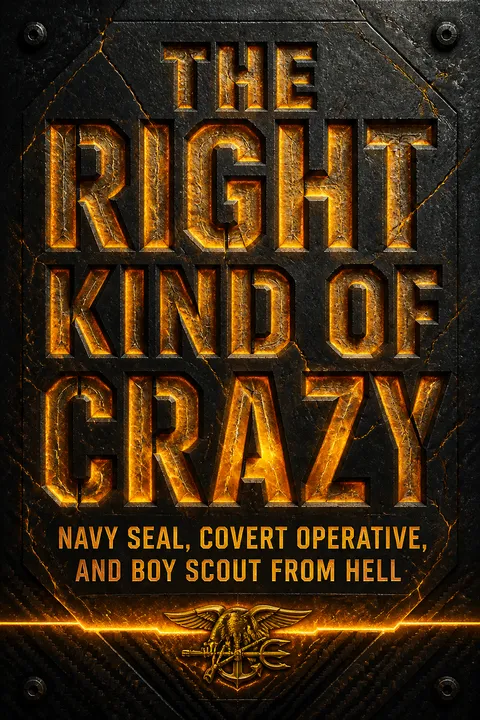
The Right Kind of Crazy receives mixed reviews, with an average rating of 3.84/5. Readers appreciate Emerson's unique perspective on SEAL life and his entertaining storytelling. Many find his experiences fascinating and admire his service. However, some criticize the writing style as disorganized and rambling. The extensive redactions frustrate some readers. Opinions vary on Emerson's personality, with some finding him relatable and others perceiving him as arrogant. The book's raw honesty and humor resonate with many, while others are put off by the crude language and graphic content.
People Also Read








Glossary
BUD/S
SEAL selection and trainingBasic Underwater Demolition/SEAL training, commonly called BUD/S, is the demanding Navy course that selects and trains candidates for the SEAL community. Emerson describes its physical and psychological pressure, its high attrition, and the importance of managing effort over time. Completing it is not the end of preparation: graduates continue through advanced training and team evaluation.
Find, Fix, Finish
Locate, track, actA military and intelligence phrase describing a progression from locating a potential target, to establishing its position or pattern, to taking action. Emerson uses it to explain why special operators were asked to build stronger reconnaissance and intelligence capabilities after 9/11, rather than focusing only on capture or direct action. The phrase does not itself specify whether the final action is capture or lethal force.
Red Teaming
Authorized adversarial security testingA method of assessing security by having an authorized team simulate an adversary and attempt to expose vulnerabilities. The purpose is to reveal gaps in technology, physical protection, procedures, or human behavior before an actual attacker exploits them. In Emerson's corporate work, exercises produced findings that ordinary technical audits could miss, such as sensitive information exposed through everyday access and workplace practices.
Violent Nomad
Unapproved covert operator conceptEmerson's hypothetical proposal for a small, discreet program of operators who could conduct close-range targeted killings without a conspicuous military strike. He describes it as an idea he developed privately, not an authorized Navy program. The concept raises the book's central questions about violence, psychological selection, legal authority, and whether reducing a mission's visibility makes it more or less accountable.
Visit, Board, Search, and Seizure (VBSS)
Maritime boarding and inspectionA naval mission in which a team approaches a vessel, boards it, searches it, and takes control or seizes prohibited material when authorized. Emerson describes VBSS operations against suspected smugglers in the Persian Gulf, where teams enforced sanctions on Iraqi oil exports. These missions combined maritime skills with the risk of resisting crews, difficult sea conditions, and political limits on operating in territorial waters.
About the Author
Other books by Clint Emerson

Download PDF
Download EPUB
.epub digital book format is ideal for reading ebooks on phones, tablets, and e-readers.








