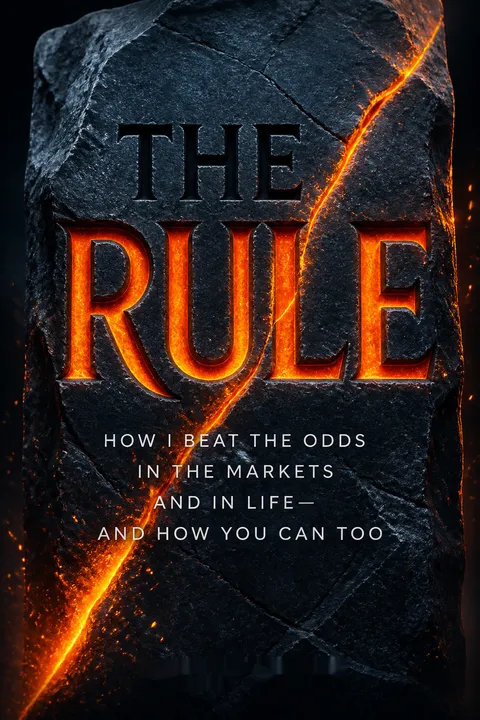


Key Takeaways
Turn a limitation into a filter, then enter a game you can play
Choose the workable arena. Larry Hite grew up in Brooklyn with severe dyslexia and poor eyesight. School, reading, and sports made him feel like a failure. An oral assessment, however, revealed strong mathematical reasoning, and his struggles had already taught him to improvise and find alternate routes. Rather than wait to become good at everything, he began ruling out paths that did not fit and looking for a game suited to his strengths. His early ambition was to become rich, which he understood as freedom and protection from dependence. Trading eventually offered a challenge he genuinely enjoyed, as well as a way to measure results without caring about his background.
Want needs a direction. Hite argues that clear goals make choices easier: they show whether an opportunity moves someone toward what matters or merely consumes effort. His story is not proof that every barrier can be overcome by determination. It is an argument for identifying the abilities and opportunities that remain available, then making a serious attempt.
What's useful here is the distinction between changing oneself and choosing a better fit. In career design, the same person can appear ineffective in one environment and highly capable in another because the task, tools, and evaluation criteria differ. Hite's discovery of his oral reasoning illustrates why a single measure, such as grades, can obscure ability. The necessary nuance is that individual adaptation cannot replace accessible schools, fair hiring, or support for disability. A good personal strategy includes both agency and an honest account of structural constraints.
Judge a bet by its odds, not by whether it wins today
Separate process from outcome. Hite distinguishes the quality of a bet from what happens next. A good bet has favorable odds and a worthwhile possible payoff; a bad bet risks too much for too little. Winning and losing describe outcomes, not the original decision. A fair coin toss that risks one dollar to win two can be a good bet, even when the coin lands the wrong way. A reckless decision can be a bad bet, even when luck lets it succeed.
Count what can be counted. Hite learned to think this way through card games, test questions, and trading. In a multiple-choice exam, eliminating implausible answers improved his chances; in a market, he wanted repeated observations rather than a compelling story. The same lens applies to choices involving time, money, energy, and relationships: estimate the likely payoff, the odds, and the cost of being wrong.
This is a practical antidote to outcome bias, the tendency to call a decision smart simply because it worked. Decision science instead asks what was knowable beforehand and whether the choice used that information well. The distinction matters because uncertain systems produce losses even when the process is sound. Still, probabilities are only as good as their assumptions. A confident numerical estimate can disguise guesswork, especially when conditions are changing or the sample is small. Counting is most useful when paired with humility about what the numbers leave out.
Set the maximum loss before ambition starts negotiating
Protect the chance to continue. Hite's early success with a pork-belly trade was followed by a painful lesson in corn. He joined a colleague's trade without doing his own research and took on far more risk than he could afford. Heavy rain produced an unusually large crop, prices fell, and Hite feared he would owe more than he had. The market recovered enough for him to break even, but luck did not erase the mistake: he had sized the bet around its possible upside rather than its worst plausible loss.
Plan for survival first. In 1979, a business partner secretly left a large options position unhedged. Hite's firm found itself owing about $7 million more than it had. The episode reinforced his insistence on defining the loss limit in advance and never risking one's basic livelihood. A loss that ends participation also erases every future opportunity.
The deeper principle is risk of ruin. A strategy can have positive average returns and still be unusable if a single bad outcome destroys the capital or stability needed to keep going. This resembles safety engineering, where designers plan around catastrophic failure rather than average operating conditions. Yet worst-case thinking needs discipline: imagining the most frightening scenario without estimating its likelihood can paralyze action. The useful practice is to identify credible severe outcomes, build a buffer, and size exposure so that an adverse event remains survivable.
Follow price evidence, not forecasts about why the market should move
Let the market provide the signal. Trend following is Hite's method of buying or selling in the direction prices have already been moving, then leaving when preset rules indicate the trend has weakened. A moving average summarizes prices over a chosen period. Shorter averages can react quickly but produce more false starts; longer ones respond more slowly. Hite used price behavior, such as a sustained move above a prior range, rather than a prediction about what a company or commodity ought to be worth.
Expect uncertainty. David Ricardo's trading principle, which Hite adopted, was to exit losing positions promptly and stay with profitable ones while the trend persists. Hite applied this across commodities, stocks, and other markets. His objection to prediction is practical: a persuasive account of the future is not the same as evidence that prices are moving that way. The method can also miss early gains or exit during temporary reversals.
Trend following replaces the demand to explain every movement with a rule for responding to observed movement. That is a meaningful shift from narrative certainty to adaptive behavior, and momentum strategies have been studied across financial markets. The tradeoff is that a trend signal arrives after a move has begun and can reverse suddenly. Frequent false signals, transaction costs, and periods when markets move sideways can erode results. The approach is best understood as one way to manage uncertainty, not as a forecasting machine or a universal substitute for other investment methods.
Keep small losses affordable so rare winners can carry the results
Build room for outliers. Hite's trading did not depend on being right most of the time. He sought many manageable losses and a smaller number of gains large enough to outweigh them. In the mid-1970s, he researched the coffee market and bought options as prices began rising. Coffee moved from about 60 cents to more than $3 a pound. His initial $500,000 grew to about $15 million at the peak; he exited with roughly $12 million after the trend turned down.
Do not mistake a winner for proof of genius. The size of the gain surprised Hite, but the structure mattered: he had been prepared to lose the amount risked, and he let the position continue while the trend remained favorable. This unequal relationship between potential gain and controlled loss is central to his approach. It depends on surviving enough losing trades to remain invested when an unusually large opportunity appears.
Many venture investments, scientific discoveries, and creative careers have a similar shape: numerous attempts fail, while a few successes generate disproportionate value. That makes it important to distinguish a portfolio of small experiments from one oversized gamble. Hite's coffee story vividly shows the appeal of a large outlier, but it can also create hindsight bias. The gain does not establish that the outcome was predictable or repeatable. Position sizing and a predefined exit rule are what make pursuing such opportunities less dependent on luck alone.
Test a repeatable system across many markets, not one persuasive story
Replace intuition with trials. After seeing a colleague trade trends successfully, Hite wanted rules that could be tested rather than decisions based on instinct. With statistical and computing partners, he built an automated system for trading many markets. Backtesting means applying a proposed strategy to historical data to estimate how it would have behaved. The work helped the team compare rules, diversify positions, and remove the temptation to override the system in the heat of a trade. At Mint, the firm limited the risk assigned to an individual trade to about 1 percent of its equity.
History is evidence, not a promise. Later, Hite's team analyzed 84 markets across data reaching back as far as eight centuries. Their reconstruction reported annualized returns of about 13 percent for trend following, compared with 4.8 percent for buy and hold. The scope is striking, but the result depends on how markets and historical data are selected.
Systematic rules can reduce the effects of panic, overconfidence, and selective memory. Backtesting also forces an idea to face more than a handful of memorable examples. But a model can look excellent because it has been tuned to past data, because old records are incomplete, or because real-world costs were understated. This is the classic problem of overfitting: a rule explains its training history without generalizing well. Stronger tests reserve data, model fees and slippage, and accept that historical performance cannot guarantee future results.
Use time, expertise, and partners to create upside beyond your own capital
Make the structure work for you. Hite called asymmetrical leverage a way to gain meaningful upside without taking a proportional share of the downside. He identified three ingredients: time to wait for favorable opportunities, knowledge to judge the risks, and money or resources that extend what one person can do. His partnership with the London firm ED&F Man illustrates the idea. In exchange for half of Mint, Man provided salaries for five years, access to powerful computers, and a $5 million credit line. Mint brought its trading system; Man brought resources and connections.
Protect the downside explicitly. Mint also created a fund that placed 60 percent of investors' money in five-year zero-coupon Treasury bonds and used the other 40 percent for trading. The structure aimed to return the original principal at maturity even if the trading portion failed, while leaving room for gains. The investor still gave up time and faced the terms and risks of the arrangement.
This is a useful way to see leverage beyond borrowing: a partnership, a long time horizon, or specialized expertise can multiply the value of limited resources. The Oakland A's example in the book makes a related point: statistical analysis helped a low-budget team identify undervalued players. But leverage does not remove risk; it relocates and reshapes it. Guarantees depend on institutions, contracts, and assumptions, while borrowed money can magnify losses as well as gains. The key question is not whether leverage exists, but who bears which downside if the plan fails.
Treat careers and relationships as choices you can reassess, not sunk costs
Use low-cost trials. Hite carried his betting approach into dating. He chose public places where he could meet people and start with coffee rather than committing immediately to an expensive evening. About one in four women accepted coffee, and about one in three of those agreed to dinner. The point is not that romance can be reduced to arithmetic; it is that small, reversible steps can reveal whether a promising connection is real.
Notice when the trend has changed. Hite also urged people to reconsider jobs, businesses, and relationships when the evidence consistently turned against them. He describes a teacher who wanted to become a therapist but stayed in a frightening school job for the sake of a future pension. She ultimately left and pursued psychology. Past effort and anticipated benefits can make departure difficult, but they do not guarantee that staying is wise.
The connection to sunk-cost reasoning is powerful: time already spent cannot be recovered, so it should not by itself justify investing more. Low-cost experiments can help people learn before making a larger commitment. However, relationships are not liquid positions with clean price signals. A difficult period may call for repair, patience, or outside support rather than immediate exit. A sensible application of Hite's principle asks whether the situation is improving, whether change is possible, and what continued exposure costs, while respecting obligations and the complexity of human attachment.
Rebuild after loss by changing the mechanism, not just trying harder
Restart with a better design. The unhedged position that brought Hite's firm close to collapse left him facing debts, frightened investors, and the possibility of legal trouble. Instead of pretending the damage had not happened, he negotiated with creditors and investors, then began designing a trading operation that depended less on any one person's judgment. A consulting fee gave him breathing room; a new partner supplied statistical expertise, and a programmer helped test the system. Mint began trading in 1981 and grew into the first commodity trading adviser to manage more than $1 billion.
Persistence can include changing direction. Hite's resilience was not simply enduring pain. It meant acknowledging the loss, recruiting people with skills he lacked, and creating rules to reduce the chance of the same failure. He also used wealth to support causes including foster care, medical research, and scholars escaping repression, extending his attention from personal security to broader impact.
The distinction between persistence and stubbornness is central. Resilience is often portrayed as returning to the same effort with more force, but organizational learning offers a stronger model: make failure visible, identify the process that allowed it, and redesign the process. Hite's recovery depended on collaborators and negotiated relief, not willpower alone. His story also has the advantage and limitation of hindsight. A successful restart is memorable, while people who face similar losses without resources or a second chance are less visible. Persistence matters, but so do support, timing, and access.
Analysis
Hite's central contribution is not a secret market signal. It is a disciplined way to make decisions when the future cannot be known: define the objective, estimate the possible loss, choose a position that remains survivable, and update behavior as evidence changes. His personal history gives this method unusual coherence. A boy repeatedly judged by conventional measures learns to distrust confidence unsupported by observable results. The same skepticism shapes his trading, where a position's market behavior matters more than a polished explanation of what should happen.
The book is strongest when it connects emotional realism to system design. Hite does not claim traders can eliminate fear by becoming smarter. He describes rules that make fear less consequential: limits on individual exposure, diversification, and preset exits. His own catastrophic business loss gives that advice weight. It also reveals a tension: automated systems can constrain one person's discretion, but they cannot remove organizational failures, hidden positions, unreliable data, or poor governance. The episode shows that risk control must include oversight, not just mathematical limits.
The extension from markets to love, work, and personal ambition is memorable because it emphasizes reversible experiments and the cost of staying in a deteriorating situation. Yet these domains have different feedback. Prices update continuously; a relationship or career may improve only after investment, repair, or time. The rule therefore transfers best as a question, not a mechanical formula: What evidence would justify continuing, and what loss is no longer acceptable?
The autobiography also invites caution about survivorship bias. Hite's success demonstrates that an unconventional path can work, not that every person who takes risk will succeed. His advantages included collaborators, capital, opportunity, and luck. That nuance strengthens rather than weakens the practical lesson: ambition becomes more robust when paired with measured exposure, honest self-knowledge, and a plan for being wrong.
Review Summary
The Rule receives mostly positive reviews, with readers praising its inspirational story and valuable insights on trend following and risk management. Many appreciate Hite's personal anecdotes and his emphasis on cutting losses and letting winners run. Some criticize the book for being too simple or repetitive, while others find it a worthwhile read for both novice and experienced traders. Reviewers highlight the book's focus on persistence, goal-setting, and overcoming personal limitations, as well as its applicability to both trading and life in general.
People Also Read






Glossary
The Rule
Limit losses, keep winnersHite's name for a decision principle drawn from trader and economist David Ricardo: leave positions that are moving against the plan, while allowing successful positions to continue as long as their conditions remain favorable. Applied beyond trading, it means reassessing choices in light of current evidence rather than remaining committed only because of past effort.
Trend following
Trade in price directionA systematic approach that uses observed price movements to decide whether to enter, hold, or exit a market position. A trend follower does not need to predict the underlying cause or the trend's duration. The method uses rules, often based on price averages or highs and lows, to participate in sustained moves and limit exposure when the direction changes.
Four kinds of bets
Odds and outcomes separatedHite's distinction between good or bad bets, which describe the odds and potential payoff, and winning or losing bets, which describe what happened. A sound bet can lose, and a poor bet can win by chance. Separating decision quality from outcome helps people learn from repeated choices without treating luck as proof of skill.
Asymmetrical leverage
More upside than downsideA structure that seeks substantial potential gains without requiring a comparable amount of risk from the person or organization pursuing them. Hite describes time, knowledge, and money as ingredients. Partnerships, financing arrangements, and protected investment structures can create this asymmetry, but they do not eliminate risk or guarantee a favorable result.
Assumption of wrongness
Plan for being mistakenHite's practice of treating personal error as an expected possibility rather than an exceptional failure. Before acting, a person asks how the decision could be wrong, what the worst plausible outcome would be, and what limit would prevent that outcome from becoming ruinous. The idea supports humility and advance risk controls.
Positive mean game
Small losses, larger gainsHite's description of a strategy designed to lose modest amounts on unsuccessful positions while allowing successful positions to produce much larger gains. The strategy depends on repeated opportunities and controlled exposure, not on winning every trade. It is not a guarantee of profit, since costs, bad sizing, or changing conditions can overwhelm the intended advantage.
Bayesian statistics
Update odds with evidenceA statistical approach that revises the estimated probability of an event as new information becomes available. Hite's team used this idea to reason about changing markets rather than relying on a single fixed probability. The concept is related to everyday updating, such as revising expectations as new observations arrive, though reliable estimates still depend on relevant data and assumptions.
FAQ
What’s "The Rule: How I Beat the Odds in the Markets and in Life―and How You Can Too" by Larry Hite about?
- Personal and Trading Journey: The book is both a memoir and a guide, chronicling Larry Hite’s journey from a dyslexic, visually impaired youth to a pioneering multimillionaire hedge fund manager.
- Core Philosophy: Hite shares the philosophy and principles that made him successful in both trading and life, emphasizing that the same rules apply to both.
- Trend Following and Risk Management: The book explains trend following as an investment strategy and details Hite’s systematic, risk-controlled approach to markets.
- Life Lessons: It’s also about overcoming limitations, making smart choices, and using failure as a foundation for success.
Why should I read "The Rule" by Larry Hite?
- Proven Success Story: Hite is a legendary trader who co-founded Mint Asset Management, the first billion-dollar hedge fund, and was featured in "Market Wizards."
- Applicable Life Lessons: The book’s lessons go beyond trading, offering practical advice for making better decisions in any area of life.
- Accessible Wisdom: Hite’s writing is approachable, filled with humor, and free of unnecessary jargon, making complex concepts easy to understand.
- Inspiration for Underdogs: Readers facing adversity or self-doubt will find encouragement in Hite’s story of turning severe disadvantages into strengths.
What are the key takeaways from "The Rule" by Larry Hite?
- Get in the Game: You can’t win if you don’t participate; taking action is essential.
- Control Your Losses: Always know how much you can afford to lose and never risk more than that.
- Let Winners Run: Cut your losses quickly and let your profitable trades or decisions continue.
- Know Yourself and Set Goals: Self-awareness and clear goal-setting are foundational to success in both life and markets.
- Embrace Failure: Failure is inevitable and can be a powerful teacher if you learn from it and move on.
How does Larry Hite define and apply "The Rule" in trading and life?
- Cut Losses, Let Profits Run: "The Rule" is to cut your losses short and let your winners run, a principle borrowed from economist David Ricardo.
- Systematic Approach: Hite applies this rule through systematic, rules-based trading, using stop-losses and trend-following strategies.
- Life Application: The same rule applies to relationships, careers, and personal decisions—leave what isn’t working and invest more in what is.
- Risk Management: The rule is fundamentally about managing risk and maximizing opportunities, not just in markets but in all major life choices.
What is trend following, and why does Larry Hite advocate it in "The Rule"?
- Definition: Trend following is an investment strategy that buys assets when their prices are rising and sells when they are falling, without trying to predict market tops or bottoms.
- Evidence-Based: Hite and his partners used data and backtesting to prove that trend following works over the long term, especially during market crises.
- Emotion-Free Trading: The approach removes emotion and prediction from trading, relying instead on observable price trends and systematic rules.
- Broad Application: Hite shows that trend following can be applied to any market—stocks, commodities, or even life decisions—because it’s based on human behavior and probabilities.
How does Larry Hite approach risk management in "The Rule"?
- Never Risk More Than You Can Lose: Hite’s cardinal rule is to decide in advance how much you’re willing to lose on any trade or decision.
- Diversification: He spreads risk across many small bets rather than concentrating on a few large ones.
- Use of Stop-Losses: Hite uses stop-loss orders and trailing stops to automatically exit losing positions and protect capital.
- Worst-Case Scenario Planning: He always considers the worst possible outcome before making a decision, which provides freedom and reduces fear.
What is asymmetrical leverage, and how does it feature in "The Rule"?
- Definition: Asymmetrical leverage means structuring bets or investments so that the potential upside is much greater than the downside risk.
- Practical Examples: Hite used this concept to design investment products like the Mint Guaranteed Fund, where investors could potentially gain a lot while risking little.
- Three Ingredients: Time, knowledge, and (other people’s) money are the key elements to creating asymmetrical leverage.
- Life and Business Application: The concept applies beyond finance—look for opportunities where you can risk little for a chance at a big reward.
How does Larry Hite use failure as an advantage in "The Rule"?
- Comfort with Failure: Hite’s early struggles with disability and academic failure made him comfortable with losing, which is essential in trading.
- Learning from Losses: Each failure is a lesson; understanding why something didn’t work improves future decisions.
- Assumption of Wrongness: He always assumes he could be wrong, which keeps him humble and vigilant.
- Resilience: Persistence and the ability to get back up after setbacks are highlighted as keys to long-term success.
What are the four foundational principles Larry Hite shares in "The Rule"?
- Get in the Game: Take action and participate; you can’t win if you don’t play.
- Don’t Lose All Your Chips: Protect your capital so you can keep playing and take advantage of future opportunities.
- Know the Odds: Make decisions based on probabilities, not stories or predictions.
- Cut Losers, Run with Winners: Exit losing positions quickly and let profitable ones continue to grow.
How does Larry Hite’s personal story influence his trading philosophy in "The Rule"?
- Overcoming Adversity: Hite’s experiences with dyslexia, poor eyesight, and repeated failure shaped his risk-averse, systematic approach.
- Imagination and Adaptability: His need to adapt and use imagination as a child translated into creative problem-solving in trading.
- Skepticism of Conventional Wisdom: Early experiences taught him to question authority and established narratives, leading to a data-driven, skeptical approach.
- Empathy for Underdogs: His background makes his advice relatable to anyone who feels disadvantaged or overlooked.
What practical steps does "The Rule" by Larry Hite recommend for new investors or readers?
- Start Small, Save Consistently: Begin by saving a portion of your income and making small, calculated bets.
- Count, Don’t Predict: Focus on counting and probabilities rather than trying to forecast the future.
- Diversify and Use Stops: Spread your investments and always use stop-losses to limit risk.
- Stick to Your System: Develop a rules-based approach and have the discipline to follow it, even during losing streaks.
What are the best quotes from "The Rule" by Larry Hite and what do they mean?
- “Cut your losses and let your winners run.” — The core of Hite’s philosophy: don’t hold onto losing positions, but allow profitable ones to grow.
- “You can’t win if you don’t play.” — Encourages readers to take action and not let fear keep them on the sidelines.
- “Your dreams are more important than your limitations.” — Reminds readers that ambition and goal-setting can overcome even severe disadvantages.
- “You can make a good living selling hype, but you can get rich by buying truth.” — Warns against following stories and predictions; focus on facts and numbers.
- “If you don’t know what you really want, every tough choice that comes along can be overwhelming.” — Stresses the importance of self-knowledge and clear goals for making smart decisions.
Download PDF
Download EPUB
.epub digital book format is ideal for reading ebooks on phones, tablets, and e-readers.








