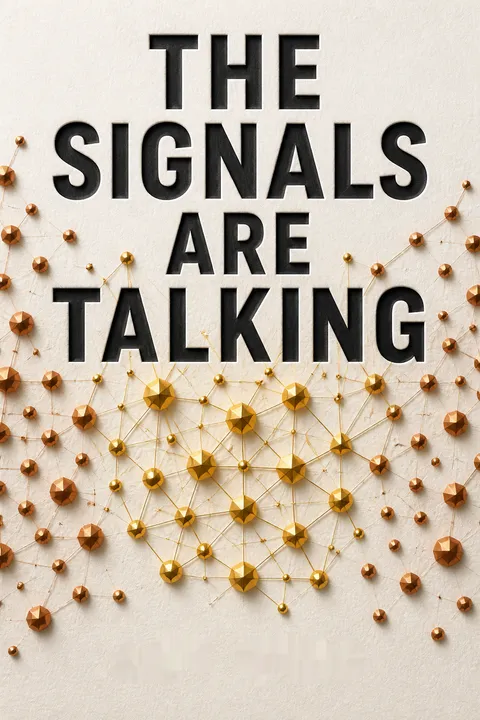


Key Takeaways
Track the human need, not the shiny device that happens to serve it.
Look beneath the gadget. In 1997, Amy Webb saw an experimental Japanese phone link messaging, internet access, cameras, and location services. The phone itself was not the trend. The deeper shift was people gaining useful information and communication wherever they went, enabled by several technologies converging. A trend, in Webb’s framework, is sustained change that joins a human need with enabling technology and begins to reshape behavior or institutions.
Success can hide change. BlackBerry’s leaders focused on improving a successful business phone while Apple pursued a device for work and personal life alike. BlackBerry’s market share later fell from about 70 percent to 1 percent. Nintendo offers the counterexample: it kept adapting from playing cards to toys and video games while remaining in the games business. The lesson is not to chase every novelty, but to ask what durable human problem it serves.
The distinction between tool and need resembles systems thinking: a visible product is often only one component in a larger change involving habits, infrastructure, and expectations. That view helps prevent both gadget worship and premature dismissal. It also keeps the analysis practical: a technology matters when it changes what people can reliably do, not merely because it looks futuristic. Still, a persistent need does not guarantee that any particular technology will satisfy it. Multiple solutions can compete, and regulation, cost, or user distrust can block adoption. The need is a strong starting point, not proof of a winning product.
Map the fringe beyond your industry before competitors define the future for you.
Search outside the obvious. Webb calls the experimental edge of science, technology, design, and society the fringe. Its “unusual suspects” include researchers, hackers, artists, investors, and communities whose work may seem unrelated to a company’s immediate business. A fringe sketch maps these people and organizations as nodes, then adds the relationships connecting them. It is a way to broaden the question, not yet a forecast or a business plan.
Ask who is connected. Consider genetic editing: researchers are only part of the picture. Pharmaceutical firms, farmers, insurers, patent lawyers, regulators, and bioethicists could all shape what happens. Galileo’s astronomy and Jane Goodall’s observations of chimpanzees also show how unconventional investigators can challenge established assumptions. Traditional market research often describes existing customers and products. By the time an emerging idea appears there, it may already be moving toward the mainstream.
A fringe map is valuable because it shifts attention from isolated invention to relationships and incentives. In network terms, a weak signal can gain importance when it connects groups that previously had little reason to interact. This also gives organizations a concrete way to widen their field of view: ask who funds, opposes, uses, or could repurpose a development. The map should not be mistaken for evidence that every listed connection matters. It is a search instrument, and its usefulness depends on revisiting assumptions and checking whether proposed links have support.
Use CIPHER to turn odd signals into a trend worth investigating.
Sort the signals. Webb’s CIPHER model is a checklist for finding patterns in fringe information: Contradictions, Inflections, Practices, Hacks, Extremes, and Rarities. Contradictions reveal opposing movements happening together. Inflections mark accelerations, such as new funding or legislation. Practices show established norms being challenged. Hacks are improvised new uses. Extremes push boundaries, while rarities are unusual developments that may meet a real need.
Look for convergence. Google’s experiments in voice recognition, email, calendars, and other services initially looked disconnected. Together, they suggested a company learning how to anticipate users’ needs through connected personal data. CIPHER helps generate a trend candidate, not certify a trend. Webb notes that not every pattern appears in all six categories. The purpose is to organize observations and expose possible connections, then gather more evidence before treating the pattern as real.
CIPHER functions like a disciplined notebook for noticing anomalies. Its strength is not that each category proves a future, but that the categories prompt questions people may otherwise skip. In scientific reasoning, unexpected observations can be more informative than confirming data, yet anomalies also arise from measurement error or chance. The same caution applies here: a rare event is a clue only if it connects to a wider pattern. A useful practice is to record what is observed separately from what is inferred, so an appealing story does not quietly become a fact.
Try to break your trend hypothesis before investing in its promise.
Challenge the attractive story. Webb uses the popularity of “Uber for X” to show how a catchy analogy can make a business idea seem like a trend. Hundreds of startups borrowed Uber’s label, but copying its app did not reproduce its underlying platform, payment system, or ability to connect riders and drivers. By contrast, the flash-sale companies Gilt, Zulily, and One Kings Lane rose quickly, then lost value as customers and competitors changed their behavior.
Argue the other side. Webb recommends constructing “disads,” or disadvantages: counterarguments that test the assumptions behind a claim. Two cognitive traps make this essential. The availability heuristic makes a possibility seem common when examples are easy to recall. Belief bias encourages people to accept conclusions that fit what they already believe. Ask whether the proposed change meets a persistent need, alters behavior, and survives competition, rather than mistaking headlines or funding for proof.
This deliberate attempt to falsify a forecast is closely related to the logic of scientific testing: a claim becomes more useful when it faces serious attempts at refutation. It also counters groupthink, especially in markets where investors and journalists reinforce each other’s enthusiasm. The exercise is not an argument for reflexive cynicism. A hypothesis that survives scrutiny is stronger, but even strong evidence cannot remove uncertainty. Teams should distinguish between disproving a weak business model and disproving the broader social or technological shift it may be responding to.
Estimate timing by tracking technical progress and outside events together.
Follow the whole route. Webb’s estimated time of arrival, or ETA, asks forecasters to track a trend’s internal technological progress alongside external events that can speed it up or slow it down. A useful shorthand is: trend timing depends on internal developments plus or minus external events. Internal steps might include better sensors or software. External influences might include regulation, available components, public acceptance, or infrastructure.
Expect delays and leaps. An S-curve can summarize how adoption often moves from slow experimentation to rapid uptake, then levels off. But it cannot show every roadblock. Smartphones existed as prototypes long before widespread adoption; Japan’s i-mode network helped make mobile internet more useful, while weak infrastructure elsewhere slowed it. Location-sharing apps such as SCVNGR and Foursquare also attracted attention before their limited everyday usefulness became clear. Track the route, not just the destination date.
Treating timing as a moving estimate is a useful corrective to precise-sounding technology forecasts. It resembles project planning in complex systems: progress depends both on the work itself and on dependencies outside the team’s control. The distinction also helps leaders act before certainty arrives, by monitoring meaningful milestones rather than waiting for a product launch. One limitation is that external events can be difficult to enumerate, and their effects may be nonlinear. A single policy change or public failure can alter adoption far more than a smooth timeline suggests.
Build several future stories, not one confident prediction.
Make uncertainty concrete. Webb separates futures into probable, plausible, and possible. Probable scenarios extend a trend using what is already known. Plausible scenarios fit current knowledge and constraints but require meaningful developments. Possible scenarios stretch farther, allowing for discoveries or social changes that current assumptions might exclude. These are not competing promises. Together, they expose different consequences and choices.
Give facts a storyline. In planning for automated banking, for example, a scenario can connect investment in financial technology, digital identity, and automated check deposits to changes for bank workers and customers. Webb draws on strategist Herman Kahn’s use of scenarios: detailed, hypothetical sequences that help decision-makers grasp how events might unfold. Algorithms can process quantified variables, but people still need to consider values, emotion, and unexpected choices. A scenario is a thinking tool, not a prophecy or a claim that the imagined events will occur.
Scenarios make abstract uncertainty discussable. A vivid account can reveal who benefits, who bears costs, and which assumptions matter, details a spreadsheet may leave implicit. Their discipline comes from labeling what is known and what is imagined, rather than presenting a story as evidence. This matters because narrative fluency can create false confidence: a coherent sequence may feel likely simply because it is easy to picture. Decision-makers should compare multiple scenarios and identify actions that remain useful across them, not select the most compelling tale and treat it as destiny.
Pressure-test the execution, not only the forecast.
A sound forecast can still fail. Webb describes a news organization that correctly expected mobile news to grow but built its first app for the iPhone while most of its readers still used BlackBerry phones. The broad vision was right; a crucial implementation assumption was wrong. Her F.U.T.U.R.E. Test checks whether a plan has Foundation from stakeholders, a Unique value, ways to Track results, Urgency, room to Recalibrate, and an Extensible design that can adapt.
Test how people respond. Emu, a messaging app with an assistant that arranged meetings and reservations, was tested against real messages before Google acquired it. Microsoft’s Tay chatbot, by contrast, learned from hostile Twitter users and quickly repeated hateful content. The technology worked as designed, but the strategy failed to anticipate its environment. Forecasting must test both the product and the conditions in which people will use it.
The implementation examples expose a common gap between strategic insight and operational readiness. A team can identify the direction of change while misunderstanding its users, dependencies, or adversarial environment. This is familiar in safety engineering, where systems are tested not only under ideal conditions but also under misuse and failure. The checklist is most effective when it produces specific tests and owners, rather than a reassuring scorecard. A plan also needs an ethical review: user data, harmful outputs, and unequal access are not peripheral risks when they shape the product’s real-world effects.
Pair imaginative foresight with disciplined scrutiny, because people still shape outcomes.
Alternate expansion and judgment. Webb calls the team-level tension between imaginative and analytical thinking the duality dilemma. Flaring means opening up possibilities; focusing means testing, selecting, and refining them. Forecasting needs both. Imagination helps teams see beyond the current product, while analysis keeps them from confusing an exciting possibility with a workable plan.
Technology is not fate. The future is shaped by choices, chance events, and interactions among fields. President Kennedy’s moon goal, announced when many necessary technologies were not ready, helped direct resources toward making a difficult outcome achievable. The book’s examples of AI add a warning: machines learn from human data and behavior, so their outputs can reflect our biases. Planning for innovation therefore includes asking who is accountable, whose interests are served, and what harms may follow. The future is not simply something to predict; it is something people help construct.
The strongest contribution here is the insistence that forecasting is neither pure intuition nor pure calculation. Creative exploration generates possibilities, while disciplined criticism tests whether those possibilities deserve resources. In practice, organizations often reward one mode more than the other, producing either imaginative plans without execution or reliable operations without adaptation. The appeal to left and right brain should be treated as a metaphor for complementary working styles, not a literal map of people’s minds. The practical point stands: teams need structured disagreement, clear ethical responsibility, and permission to revise their course.
Analysis
Webb’s central argument is that useful forecasting is a practice of attention. The future is not an object waiting to be discovered, nor a straight line extended from the present. It emerges from interactions among technologies, human needs, institutions, and decisions. Her strongest move is therefore methodological: she turns futurism from a performance of confident prediction into a repeatable sequence of observation, pattern-finding, challenge, timing, scenario-building, and review. The cases make that sequence memorable. BlackBerry shows how expertise and success can narrow attention; Sony shows how treating repeated warnings as isolated incidents compounds risk; the contrast between Emu and Tay shows why strategy must include the social setting in which a system operates.
The method’s value lies less in naming a future correctly than in helping an organization notice what it has excluded. Fringe mapping broadens the field; CIPHER gives anomalies structure; counterarguments guard against fashionable consensus; and scenarios make consequences legible. Together, these practices resemble a learning system that updates its beliefs as evidence changes. That is particularly useful when uncertainty is irreducible and decisions cannot wait for complete information.
There are limits. The book’s examples are technology-heavy, and some forecasts risk becoming as speculative as the shiny innovations they warn against. The proposed process can organize inquiry, but it cannot guarantee that the right people, signals, or causal links have been found. Nor does the language of trends always distinguish technological possibility from political desirability. A society can adopt a tool widely and still choose to restrict its use. Forecasting should therefore include power, distribution, and consent, not only adoption and competitive advantage.
The most durable lesson is a form of disciplined humility: look broadly, state what is known, test what is assumed, and keep the plan revisable. Forecasting matters not because it eliminates surprise, but because it helps people recognize their own role in producing the outcomes they claim merely to anticipate.
Review Summary
The Signals Are Talking received mixed reviews, with an average rating of 3.73 out of 5. Readers appreciated Webb's insights on trend forecasting and future thinking, praising her methodology and examples. However, some found the book redundant or lacking practical application. Critics noted that the focus on technology trends might limit its broader appeal. Despite these criticisms, many readers found the book thought-provoking and valuable for understanding emerging trends and their potential impact on society and business.
People Also Read









Glossary
Trend
Sustained change with momentumA trend is sustained change in technology, business, government, society, or behavior. In Webb’s account, it connects a basic human need with enabling technology, persists over time, and develops through multiple signals that can begin far from mainstream attention. It is a basis for making decisions, not a guarantee of a single future.
Fringe sketch
Map of emerging relationshipsA fringe sketch is a visual map of people, organizations, projects, and relationships influencing a question about the future. The central topic sits near the middle, with related developments and more distant possibilities plotted around it. The sketch broadens the field of inquiry and exposes connections; it does not, by itself, establish a trend or prove a scenario.
CIPHER
Six signal categoriesCIPHER is Webb’s model for sorting observations from the fringe into six kinds of potential signal: Contradictions, Inflections, Practices, Hacks, Extremes, and Rarities. The categories help researchers notice tension, acceleration, changing norms, improvised uses, boundary-pushing work, and unusual developments. They generate trend candidates for further investigation, rather than acting as a test that automatically validates a trend.
Paradox of the present
Present bias obscures changeThe paradox of the present describes how people struggle to imagine change beyond the limits of their current experience. Familiar products and immediate demands dominate attention, while subtle or unfamiliar developments seem irrelevant, implausible, or isolated. The result is often delayed action: a shift becomes obvious only after it has entered the mainstream.
ETA
Estimate of trend timingETA means estimated time of arrival. Webb adapts the idea from GPS navigation to estimate where a trend is along its development path. The assessment considers internal technological advances and external events, such as regulation, infrastructure, economic conditions, and public response. Because those influences change, a trend’s ETA is a revisable estimate rather than a fixed date.
F.U.T.U.R.E. Test
Strategy readiness checklistThe F.U.T.U.R.E. Test is Webb’s final check on an action proposed in response to a trend. It asks whether the plan has stakeholder Foundation, a Unique value proposition, ways to Track results, a sense of Urgency, room to Recalibrate, and an Extensible design. The test is intended to reveal weaknesses in execution, adaptability, or organizational support before launch.
Duality dilemma
Imbalance between imagination and analysisThe duality dilemma is the difficulty organizations face when creative and analytical thinking are unbalanced or poorly coordinated. Teams dominated by imagination may generate ideas they cannot execute; teams dominated by process may reject promising departures from current practice. Webb’s remedy is to alternate between opening up possibilities and narrowing them through investigation and decision.
Future-fallacy trap
Rigid details derail sound visionThe future-fallacy trap occurs when an organization correctly recognizes a broad direction of change but makes brittle assumptions about how to act on it. A news organization could foresee mobile reading yet choose the wrong platform for its existing audience. The trap is avoided by treating implementation details as hypotheses that need testing and revision.
Genie problem
Correct execution, harmful outcomeThe genie problem describes how a programmed system can carry out its instructions exactly while producing an outcome its designers did not want. Algorithms and automated processes optimize for specified goals, but those goals may be incomplete or poorly chosen. The concept highlights why human judgment is needed to define objectives and consider unintended consequences.
Toothbrush test
Daily usefulness testThe toothbrush test, attributed in the book to Google cofounder Larry Page, asks whether a product or service would be used once or twice a day and make life somewhat better. It offers a quick way to consider whether a technology can become a routine necessity rather than a novelty. Passing the test does not establish commercial success.
FAQ
What's The Signals Are Talking about?
- Understanding Future Trends: The book delves into how trends originate from the fringes of society and eventually become mainstream, highlighting the importance of recognizing early signals.
- Futurist Methodology: Author Amy Webb provides a systematic approach for organizations to forecast trends, involving a six-step process to identify and act on emerging trends.
- Real-World Examples: Webb uses case studies, such as the rise of mobile technology and the decline of BlackBerry, to illustrate the consequences of ignoring trends and the importance of proactive planning.
Why should I read The Signals Are Talking?
- Practical Framework: The book offers a framework for leaders to understand and anticipate industry changes, helping organizations remain competitive.
- Insightful Case Studies: Webb shares stories from various sectors, providing insights into what strategies work and which do not.
- Empowerment Through Knowledge: Understanding signals and trends empowers readers to shape their futures proactively, crucial for long-term success.
What are the key takeaways of The Signals Are Talking?
- Fringe to Mainstream: Trends often start at the fringe and move into the mainstream; recognizing these signals is essential for forecasting.
- CIPHER Model: Webb introduces the CIPHER model to identify patterns indicating emerging trends, aiding in data analysis and decision-making.
- Importance of Collaboration: The book stresses collaboration across fields to fully leverage trends, leading to innovative solutions.
What is the CIPHER model in The Signals Are Talking?
- Pattern Recognition Tool: The CIPHER model is a framework for identifying hidden patterns that indicate emerging trends, consisting of six indicators.
- Analyzing Data: Each CIPHER component helps analyze data from the fringe, revealing connections not immediately obvious.
- Guiding Questions: Webb suggests using guiding questions for each CIPHER component to uncover insights and deepen understanding.
How does Amy Webb define a trend in The Signals Are Talking?
- Sustained Change: A trend is a new manifestation of sustained change within an industry or society, reflecting evolving human needs.
- Interconnectedness: Trends are interconnected with daily life aspects and can influence or be influenced by other trends.
- Long-Term Perspective: Trends persist over time and evolve as they gain traction, requiring organizations to adapt and thrive.
How can I apply the lessons from The Signals Are Talking in my organization?
- Implement the CIPHER Model: Use the CIPHER model to analyze your industry and identify emerging trends, staying ahead of the curve.
- Engage with Unusual Suspects: Collaborate with fringe thinkers and innovators for valuable perspectives and new opportunities.
- Create a Culture of Foresight: Encourage a culture valuing foresight and proactive planning to adapt to changes and seize opportunities.
What are some examples of trends discussed in The Signals Are Talking?
- Mobile Technology: Webb discusses the evolution of mobile technology, highlighting its transformation of communication and information access.
- Autonomous Vehicles: The book explores autonomous transportation, emphasizing its potential societal and industrial impact.
- Genetic Engineering: The rise of CRISPR technology is presented as a significant trend, with implications for healthcare and ethics.
What is the importance of pressure-testing strategies in The Signals Are Talking?
- Avoiding Mistakes: Pressure-testing helps identify potential flaws before implementation, minimizing costly errors.
- Ensuring Relevance: Evaluating strategies against real-world scenarios ensures plans remain relevant and effective.
- F.U.T.U.R.E Test: Webb introduces the F.U.T.U.R.E Test to guide organizations in assessing strategy viability.
How does The Signals Are Talking address the concept of "Uber for X"?
- Trend Analysis: Webb critiques the "Uber for X" phenomenon, questioning its validity as a genuine trend.
- Market Saturation: The proliferation of "Uber for" startups may indicate a bubble, raising sustainability questions.
- Real vs. Trendy: Webb encourages differentiating between real trends addressing fundamental needs and those that are merely trendy.
What are the best quotes from The Signals Are Talking and what do they mean?
- “The future doesn’t simply arrive fully formed overnight, but emerges step by step.”: Highlights the gradual development of trends and the need for proactive observation.
- “Success is a lousy teacher.”: Warns against complacency in successful organizations, reminding that past success doesn't guarantee future relevance.
- “You must strategically monitor trends and plan for the future.”: Emphasizes the necessity of foresight in leadership to avoid being blindsided.
How does The Signals Are Talking suggest we find the fringe?
- Broaden Your Definition of X: Expand your understanding of what x represents in your industry for comprehensive exploration.
- Seek Out Unusual Suspects: Engage with fringe thinkers and innovators for insights into potential trends.
- Utilize a Fringe Sketch: Create a fringe sketch to visualize industry relationships and identify patterns and potential trends.
How does The Signals Are Talking suggest we can forecast the future?
- Six-Step Process: Webb outlines a process including identifying trends, calculating timing, and developing scenarios to navigate uncertainty.
- Flaring and Focusing: Emphasizes alternating between creative flaring and analytical focusing for comprehensive understanding.
- Continuous Monitoring: Advocates for ongoing trend observation to ensure adaptability to changes.
About the Author


Download PDF
Download EPUB
.epub digital book format is ideal for reading ebooks on phones, tablets, and e-readers.








