Key Takeaways
1. The Modern Paradox: Abundance Without Happiness
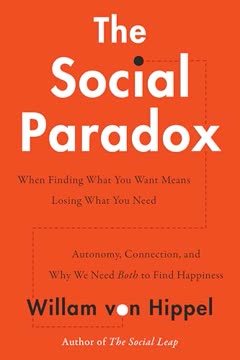
There’s more than one answer to this question, but I believe an important part of the story lies in the inherent tension between our two most basic needs: autonomy and connection.
Unprecedented comfort, stagnant happiness. Despite living longer, healthier, and more interesting lives than 99.9% of our ancestors, modern humans are no happier than hunter-gatherers who faced constant danger, hunger, and disease. This "social paradox" highlights a fundamental disconnect between our material well-being and our emotional fulfillment. We are like multimillionaires compared to our ancestors, yet often distracted by trivial problems, failing to appreciate our extraordinary quality of life.
Beyond adaptation. The common explanation that we simply adapt to our circumstances, focusing only on short-term gains and losses, doesn't fully explain this paradox. If adaptation were the whole story, a millionaire losing money would be sadder than a homeless person finding it, which intuition suggests is a fleeting effect. Something deeper is at play, suggesting a loss of a crucial element our ancestors possessed.
A fundamental imbalance. The core issue is an imbalance between our two most basic psychological needs: autonomy and connection. Our hunter-gatherer ancestors struck a balance that worked well, but modern society has increasingly prioritized autonomy over connection. This shift explains why so many people feel an emptiness despite their achievements, leading to "sad success stories" where accomplishments feel hollow without a strong social network to share them with.
2. Our Core Conflict: Autonomy vs. Connection
Unfortunately, when we pursue either of these needs, we must sacrifice the other.
Two fundamental needs. Humans are driven by two primary, often conflicting, psychological needs: connection and autonomy. Connection is our desire to cooperate, form social bonds, make friends, establish romantic relationships, and attach to a group. Autonomy is our need for self-governance, choosing our own path, and making independent decisions based on personal preferences and skills.
An inherent trade-off. While psychologists like Deci and Ryan's Self-Determination Theory often view autonomy and connection as mutually reinforcing, the reality is a constant tension. Forming social bonds (connection) inherently constrains individual choices (autonomy), as we must consider others. Conversely, prioritizing personal goals (autonomy) can make us less appealing as relationship partners. This trade-off is a fundamental aspect of human experience.
Redefining autonomy. The book argues for a definition of autonomy focused on independence and self-governance, distinct from merely feeling volition. If a decision is made to prioritize a relationship over a personal preference, it's a sacrifice of autonomy for connection, not an autonomous act in itself. This distinction is crucial for understanding how modern society's emphasis on individual choice has inadvertently eroded our social ties.
3. Evolution's Mandate: Why We Need Both
Our evolutionary trajectory put us on this path to sociality millions of years ago, but it also instilled in us a competing need for autonomy.
Connection for survival. For millions of years, human survival depended on strong social connections. Our ancestors, vulnerable alone, banded together for safety, cooperative hunting, and defense against predators and other human groups. This deep interdependence led to cultural rules like mandatory sharing, ensuring collective survival and etching the need for connection into our psychology.
- Safety: More eyes, ears, and noses for predator detection.
- Effectiveness: Planning and division of labor in groups (e.g., hunting).
- Secondhand Learning: Teaching and storytelling for cumulative knowledge.
- Protection from Each Other: Strong social networks offered safety within groups.
Autonomy for value. While connection was paramount, autonomy also evolved to make individuals valuable to the group and attractive to mates. It motivated individuals to develop unique skills and competencies, whether as hunters, gatherers, healers, or storytellers. This drive for self-development, guided by personal preferences, allowed humans to adapt and contribute in diverse ways, making groups more effective than the sum of their parts.
The balance of competence and warmth. Our evaluations of others revolve around competence (autonomy's output) and warmth (connection's output). While both are important, warmth often matters more for survival in a social species. However, pursuing one often jeopardizes the other: the more time spent honing skills (competence/autonomy), the less time spent connecting (warmth/connection). Finding the right balance is crucial for both individual well-being and social perception.
4. Identity's Influence: How We Prioritize Needs
Whether autonomy or connection emerges as the winner of that struggle varies with different aspects of the self.
Sex differences in prioritization. Men and women, on average, prioritize autonomy and connection differently due to evolutionary pressures. Women tend to be more connected, driven by the need for alloparenting and support in child-rearing. Men tend to be more autonomous, fueled by mate competition and the need to demonstrate competence.
- Women: Smaller, tighter friendship circles; expect more emotional support; more prone to depression.
- Men: Larger, looser friendship circles; more tolerant of competition; less likely to seek emotional support; higher suicide completion rates.
Cultural variations. Societies also lean towards collectivism (prioritizing connection) or individualism (prioritizing autonomy). Western cultures are individualist outliers, rooted in factors like wheat farming (less communal labor), Catholic Church policies (weakening clan ties), and the Industrial Revolution (individual wages). Collectivist cultures, often shaped by rice farming or high threat environments, emphasize conformity and group harmony.
Religious and political divides. Religion and politics further shape this balance. Moralizing Abrahamic religions broadened connection beyond kin but also deepened autonomy (e.g., Protestant emphasis on individual salvation and thought control). Politically, the Left prioritizes connection (fairness, harm, empathy), while the Right emphasizes autonomy (individual rights, self-reliance) and group loyalty. Libertarians represent an extreme of autonomy, valuing individual freedom above almost all other concerns.
5. The Urban Shift: Cities Drive Autonomy, Erode Connection
The increase in autonomy that cities gave us came with costs, the most notable of which is the inevitable price that had to be paid in connection.
From no choice to many. Cities, starting with ancient Uruk, introduced specialized occupations beyond hunting, gathering, or farming. Initially clan-based, these roles gradually allowed for individual career choice, marking humanity's first major leap in autonomy. This freedom to choose a livelihood was a profound shift from ancestral life, where options were virtually nonexistent.
Anonymity and isolation. While cities offer diverse opportunities, they pull individuals out of tight-knit family and friend networks. The constant presence of strangers, a seismic shift from ancestral norms, led to a loss of deep connection. Urbanization, accelerating dramatically since the 19th century, has transformed society from predominantly rural to urban, with profound psychological consequences.
Rural connection, urban autonomy. Global data from the World Values Survey confirm that urban living and industrialized societies emphasize independence, while rural living and traditional societies prioritize obedience and connection. City dwellers report less satisfaction with friendships and are less likely to trust neighbors than their rural counterparts. Despite the opportunities, people in cities are, on average, less happy than those in the countryside, suggesting a cost to this increased autonomy.
6. Education & Wealth: Supercharging Individualism
Education gave me the power of genuine choice, which is the essence of autonomy.
Education's autonomy dividend. Formal education, particularly liberal arts degrees, expands autonomy by exposing individuals to diverse ideas and career paths, enabling informed choices about one's future. Early, high-quality education fosters initiative and self-discipline, leading to more fulfilling jobs and greater life options. Literacy, in particular, liberates individuals from blindly following local norms, offering awareness of alternatives and the power to decide for oneself.
Delayed gratification and connection costs. Modern education, especially for the knowledge economy, is a prolonged exercise in delayed gratification, prioritizing future success over present social engagement. This constant focus on "tomorrow" trains individuals to sacrifice connection for competence, subtly reshaping thought patterns. While school offers social opportunities, its formal demands often undermine the natural inclination to connect, leading to a default prioritization of autonomy.
Wealth's double-edged sword. Affluence further enhances autonomy by reducing the pragmatic need for connection. Rich individuals can buy tools, hire help, and solve problems with money, rather than relying on neighbors or friends. Studies show that wealthier and more educated people spend less time with neighbors and are less communally oriented. While wealth offers freedom, it can inadvertently lead to social isolation, as the necessity that once forged strong bonds diminishes.
7. Marriage Under Strain: Autonomy's Impact on Our Deepest Bonds
The fact that people are increasingly opting out of long-term romantic bonds shows us that the conflict between connection and autonomy has shifted relentlessly in favor of autonomy, as connection has become less vital to our survival.
Marriage redefined. Historically, marriage evolved from a fluid, often parent-arranged union in hunter-gatherer societies to an economic bond between families in agricultural societies, making divorce difficult. With urbanization and increased independence, marriage in Western societies transformed into a relationship ideally based on affection and personal choice, leading to the advent of no-fault divorce.
Disengagement and rising expectations. As individuals gained autonomy and withdrew from broader community ties (friends, neighbors), marriage was increasingly expected to fill the void, becoming a primary source of social support. However, this increased expectation has not been met with commensurate investment; couples spend less quality time together, leading to declining marital satisfaction. This reflects a broader trend where autonomy leads to disengagement from various social networks, including the marital one.
The rise of single living. Marriage rates have steadily declined, particularly in North America and Northern Europe, with more people living alone than ever before. This shift is largely attributed to women's increased economic independence and broader gender equality, freeing both sexes from the necessity of marriage for survival or comfort. While long-term relationships may be more rewarding than ever due to greater choice, the increasing preference for single living highlights autonomy's ascendance over connection, even in our most intimate relationships.
8. The Digital Divide: E-Connection's Promise and Peril
As the importance and ubiquity of the phone has shown us, e-connection is way better than no connection, but it’s nowhere near as good as the real thing.
A pale replica of reality. E-connection, from telegraphs to social media, offers convenience but lacks the depth of face-to-face interaction. Brains respond differently to screens than to real people, disrupting interpersonal synchrony (body movements, eye contact, neural activation). Slight lags in online communication hinder the rapid, unconscious responses that signal rapport, making it harder to "click" with others.
Vices of social media. Social media platforms often exacerbate negative psychological tendencies:
- Social comparison: Curated posts lead to feelings that others' lives are better, fostering envy and dissatisfaction.
- Casual cruelty: Social distance shields users from the immediate consequences of their aggression, leading to nastiness and reduced empathy.
- Social laziness (SMILSH): The ease of online interaction discourages in-person socializing, potentially leading to missed opportunities for meaningful connections. This is evidenced by declining sexual activity among young adults, even as porn consumption rises.
Leveraging digital strengths. Despite its downsides, e-connection has significant strengths that can be leveraged for rebalancing:
- Asynchronous communication: Allows time to formulate thoughtful responses, reducing awkwardness and improving clarity.
- Finding like-minded others: Connects individuals with rare hobbies or identities, combating isolation.
- Facilitating self-disclosure: Reduces embarrassment, fostering intimacy faster than in-person interactions.
- Maintaining distant ties: Enables regular, easy, and cheap contact with geographically separated friends and family.
- Enhanced group interaction: Offers features like private messaging and information display (e.g., names, interests) that can improve virtual gatherings.
9. Evolutionary Mismatch: Why We Over-Prioritize Autonomy
In our modern world, opportunities for autonomy are like salt, fat, and sugar—they’re everywhere.
Ancient drives, modern pitfalls. Our evolutionary history, marked by constant struggle for survival, instilled a strong, unquestioning drive for connection, as it was an obvious necessity. Autonomy, however, was a rare luxury. When genuinely available, our ancestors likely seized it, as their connection needs were typically met by daily life. This default tendency to "grab autonomy whenever possible" was adaptive in a resource-scarce, highly interdependent world.
The abundance of choice. Today, opportunities for autonomy are ubiquitous, akin to the endless availability of salt, fat, and sugar in modern diets. Our evolved preference for autonomy, once a beneficial trait, now leads to "miswanting"—choosing things that aren't ultimately good for us. This mismatch between our ancient programming and our new reality results in an overconsumption of autonomy, disrupting the delicate balance with connection.
The cost of too much freedom. This relentless favoring of autonomy, while offering comfort and safety, leaves us "out of shape and autonomous" but often unhappy. We may get what we want (autonomy), but not what we need (connection). The demands of modern life no longer force connection upon us, yet our mental and physical health still depend on it, as argued by US Surgeon General Vivek Murthy.
10. Rebalancing for Well-being: Restoring Lost Connection
If I’m right, and we have shifted to a world that overemphasizes autonomy at a cost to connection, then all the micro-fixes offered by the numerous approaches to happiness are really just Band-Aids.
The need for rebalancing. The pervasive unhappiness in modern industrialized societies, particularly among wealthy, educated urbanites, stems from an overemphasis on autonomy at the expense of connection. This imbalance is a fundamental injury, and superficial "happiness hacks" are mere Band-Aids if the underlying cause isn't addressed. Restoring connection is crucial for regaining well-being.
Genes and self-change. While genetics influence about 50% of human traits, change is possible. Just as individuals with a genetic predisposition to obesity can achieve a normal weight through determination, we can rebalance our autonomy and connection. The key is to work with our predispositions, choosing strategies that align with our nature rather than fighting against it.
Connection as a necessity. Our ancestors' lives mandated connection, making it our most fundamental psychological need. While modern life has removed this necessity, it hasn't removed the need itself. The costs of tight connections (criticism, social comparison, limited autonomy) led to a natural shift towards autonomy when possible, but this shift has gone too far, leaving us unfulfilled.
11. Practical Steps: Easy Ways to Reintegrate Connection
Change and maintenance must be easy.
Integrate, don't add. The most effective way to restore connection is to weave it into existing routines, making it easy and low-friction. Instead of adding new social obligations, transform solitary activities into shared ones.
- Joint activities: Do crossword puzzles, Wordle, or other hobbies with friends/family virtually or in person.
- Mindless tasks: Use commute time, laundry, or tidying up as opportunities for phone calls with loved ones.
- Text groups: Create casual group chats for sharing thoughts and musings, allowing for flexible, low-pressure interaction.
Habit formation is key. To make these changes stick, establish new habits through "implementation intentions." Link a desired social action to an existing environmental trigger (e.g., "When my morning coffee is ready, I'll call my sister"). This automates the behavior, reducing the need for constant decision-making and willpower.
Leverage lifestyle goals. Combine connection goals with other lifestyle aspirations like exercise or self-improvement. Running with a friend, lifting weights together, or joining a painting studio can strengthen both social ties and personal development. Connect at work by carpooling, having lunch with colleagues, or integrating social elements into remote meetings. The goal is to make connection a natural, effortless part of daily life.
12. A Lifelong Journey: Continuous Rebalancing
Rebalancing is a long-term strategy that involves continual assessment and small tweaks as needed.
Dynamic needs. Our balance between autonomy and connection is not static; it shifts throughout life. Younger years often prioritize autonomy for skill development and career establishment, while middle adulthood sees connection (family, career security) re-emerge. Later in life, connection often takes center stage as individuals seek meaning and companionship.
Proactive adjustments. Continuous assessment is crucial to prevent severe imbalances. Small, regular course corrections are easier than drastic overhauls. If friendships are waning, reconnect before ties are completely severed. Flexibility is key, as life circumstances and personal preferences evolve.
Embrace the bespoke. There's no one-size-fits-all solution. Tailor suggestions to your unique personality and circumstances. Start with easy, enjoyable strategies that align with your proclivities. Be mindful of future decisions, both big and small, to avoid repeatedly prioritizing autonomy at connection's expense. Breaking old habits requires attention, but integrating connection will become automatic and profoundly rewarding.
Last updated:
Similar Books