

Key Takeaways
Smart people can keep an organization running while making it dangerously blind
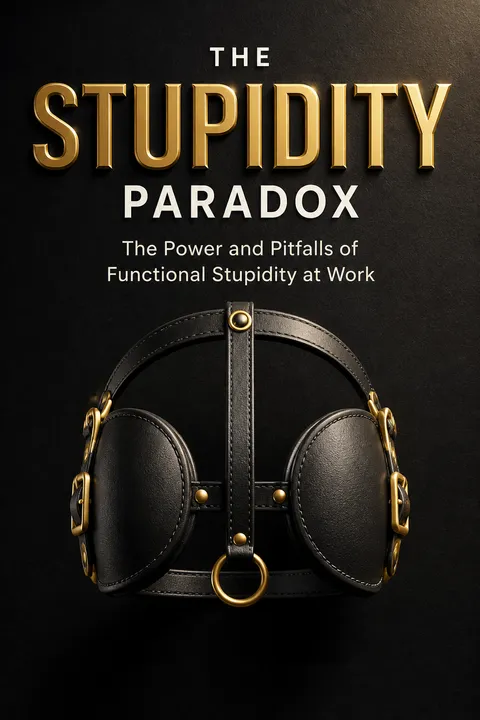
The central paradox. Functional stupidity is the narrowing of thought at work: people can perform tasks capably while avoiding questions about assumptions, reasons, or consequences. This often helps in the moment. Employees get on with the job, avoid conflict, and appear decisive. But ignored problems accumulate. In the financial crisis of 2008, banks relied on complex models that many senior managers did not understand. Even some model-makers were unsure how well their equations represented actual markets. While conditions were favorable, the models seemed to work. When markets turned, their hidden weaknesses helped bring the financial system to a halt.
Convenience has a bill. The same habits that smooth daily work can make organizations unable to detect danger. The risk is not simply that one person makes a foolish choice. It is that many people learn not to question the same assumptions.
The useful distinction here is between individual competence and collective understanding. A team can contain excellent specialists and still lack anyone able to connect their work to the whole system. Safety engineering faces a similar challenge: a component may meet its local specification while the overall design remains unsafe. The book’s argument is strongest when it shows how incentives make this blindness practical, not merely a failure of intelligence. Its caution is that crises are easier to explain in retrospect. Not every mistake signals a culture of thoughtlessness, so diagnosis should look for repeated silencing of questions, not just bad outcomes.
Spot workplace stupidity by the questions people learn not to ask
Three missing habits. The authors identify functional stupidity through three absences: reflexivity, justification, and substantive reasoning. Reflexivity means examining assumptions instead of treating familiar beliefs as facts. Justification means asking for reasons behind decisions, rather than accepting rank or custom as sufficient. Substantive reasoning means considering wider consequences and purpose, not only the mechanics of execution.
A costly silence. Ford employee Dennis Gioia reviewed reports of car fires and saw a burned-out vehicle, but colleagues dismissed the evidence as too thin to justify action. He set aside his concern and followed the workplace norm against making decisions on emotion. The case illustrates how people can notice a warning and still learn to discount it. A practical diagnostic is to ask: What are we assuming? Why are we doing this? What might follow from it?
These questions turn an abstract label into a usable diagnostic. They also resemble the separation between technical correctness and ethical judgment: a process can be executed properly while its purpose or effects remain indefensible. The framework is especially helpful because it does not equate stupidity with low ability. However, questioning has costs. A team cannot reopen every premise during every routine task. The important distinction is whether reflection is available when stakes, evidence, or conditions change. A mature organization makes room for scrutiny at consequential moments without turning every ordinary decision into a seminar.
Test knowledge-economy promises against what employees actually do
A polished story. The book challenges the belief that modern economies mainly employ highly skilled people doing intellectually demanding work. Its examples point instead to routine service jobs, repetitive information handling, and educated employees doing work that may not use their training. A US labor estimate cited in the book found that only 20 percent of jobs required a bachelor’s degree, while many required high-school education or less.
Smart labels, ordinary work. A consultancy may advertise deep expertise while assigning junior staff to produce a report or slide deck. An internal IT team renamed itself an integrated-services consultancy, even though its daily work changed little. The new label nevertheless gave staff a more ambitious identity. Such language can motivate people and reassure clients, but it is not proof that an organization is producing valuable knowledge.
The critique usefully separates credentials, job titles, and actual capability, which are often treated as interchangeable. In labor economics, this resembles the distinction between education as skill-building and education as a signal used to sort applicants. A grand title can help workers claim dignity in routine work, so image-making is not automatically fraudulent or useless. The sharper question is whether the story is paired with learning, discretion, and demonstrable value. Where it is not, inflated language can conceal a mismatch between what workers were promised and what their jobs permit them to do.
Do not assume expertise, data, or confidence will correct human bias
Shortcuts survive intelligence. Herbert Simon’s bounded rationality describes how people decide with limited time, attention, and information. Rather than find the perfect answer, they often settle for one that seems adequate. More information does not always solve the problem: an overload can push people back toward shortcuts. The book also reviews common judgment errors. Anchoring makes an initial number shape later estimates. Availability makes vivid or memorable events seem more common. Overconfidence leads people to overrate their skill and underestimate how long work will take.
Experience can mislead, too. In an experiment, experienced managers began proposing solutions before they had seen all the facts. Expertise helps people act quickly, as with firefighters recognizing familiar danger patterns, but can also make them commit too early to a familiar interpretation.
This section resists the comforting idea that smarter people simply make better decisions. A useful extension is to treat expertise as a pattern-recognition tool whose reliability depends on how stable the environment is. Familiar patterns can guide rapid action in well-practiced situations; they can mislead when conditions have changed or the case is unusual. Decision quality therefore depends not only on who is in the room, but on whether the process makes assumptions visible and allows new evidence to interrupt the first confident answer.
Check whether a team needs leadership before prescribing more of it
The leadership promise. The book questions the popular image of leaders as unusually wise people who transform followers. Many managers spend their days on meetings, emails, budgets, and administration, while employees may prefer autonomy and technical support to inspiration. In one studied software firm, a manager imagined himself as a coach, but spent his days directing staff. Another manager’s attempts at leadership were welcomed most when he arranged breakfast or social events.
Belief can still be useful. Leadership stories can give managers status and help a group rally around a goal. But they can also make followers seem dependent and encourage managers to overstate their influence. The authors recommend noticing when ordinary coordination, clear responsibilities, or professional expertise would serve better than a grand theory of leadership.
Leadership is not a single activity, and the book is right to distinguish symbolic leadership from the practical work of coordination. Research on teams often finds that expertise is distributed: the person best placed to guide a decision may vary by task. That complicates the assumption that authority should always flow from one inspirational figure. Still, leadership can matter when people must coordinate across boundaries or act under uncertainty. The useful test is not whether leadership is fashionable, but whether a specific person has relevant knowledge, earns trust, and improves the group’s ability to act.
Measure rules by what they accomplish, not by their paperwork
Compliance can replace purpose. The authors describe a society of superficial scrutiny, where organizations are inspected for plans, procedures, and records more readily than for the quality of their core work. In one municipality, a social-services director faced about twenty-five regulatory comments. The next year, inspectors raised none, although the agency had changed no substantive practice. It had simply written down twenty-five new routines.
Structure has two faces. Rules can create consistency and protect people from arbitrary decisions. Yet elaborate processes can also divide work into narrow roles, leaving nobody with a clear view of the whole. At a school, a principal’s intensive accountability systems frustrated teachers and contributed to departures, even while senior officials initially praised her control. Ask whether a procedure changes practice or merely documents compliance.
The tension resembles Goodhart’s law: once a measure becomes a target, people may optimize the measure rather than the underlying goal. Documentation can be essential in medicine, aviation, and public administration, especially where memory and consistency matter. The danger is not measurement itself but a weak link between indicators and lived outcomes. A useful safeguard is to pair process audits with direct observation and feedback from the people receiving the service. Paperwork should support judgment, not become its substitute.
Copy a successful practice only after understanding its local conditions
Imitation buys safety. Organizations often adopt fashionable practices because peers, consultants, or investors expect them to. The authors describe hospitals that adopted total quality management. Early adopters adjusted the approach to local needs; many later hospitals copied the label with less adaptation, partly because their peers had done so. Following a trend can win legitimacy and spread blame if it fails, even when it does not improve results.
Winners are a biased sample. Companies often study celebrated successes and overlook the many firms that tried similar strategies and failed. A practice that works in one organization may depend on its skills, culture, or market, and may not transfer intact. Before copying, ask what problem the practice solved in its original setting, what assumptions it depends on, and whether those conditions exist here.
Imitation is not always irrational. Under uncertainty, copying a peer can conserve scarce attention, and shared standards can make coordination easier. The problem is confusing legitimacy with effectiveness. Institutional sociology explains how organizations often adopt visible structures to appear proper, even when their daily operations remain unchanged. A disciplined imitation process would examine both successes and failures, then run a small local test. That approach keeps the social benefit of learning from others while reducing the risk of importing a ritual detached from its original purpose.
Treat branding as a promise that operations must be able to keep
Image can outrun substance. The Swedish military considered replacing its historic insignia with a new identity, despite budget problems and strong attachment to the old symbol. Public criticism helped end the project. British Airways faced a similar backlash after repainting aircraft to present a more global image, and eventually restored its previous look. In both cases, the image strategy collided with the organization’s history and stakeholders’ expectations.
Meaning can inflate a mundane product. Toothpaste brand managers spoke of deep emotional value, while customers often chose products based on price and promotions. Branding can help people distinguish similar products and can give employees pride, but it can also turn minor differences into grand promises. A brand is useful only when the experience beneath it supports the story being sold.
Brands function as shortcuts in crowded markets, but shortcuts transfer trust rather than eliminate the need for evidence. The same is true inside organizations: a prestigious consultancy name or a celebrated university identity can make claims seem credible before their substance is examined. This can reduce the cost of choice, yet also insulate weak performance from scrutiny. The important question is whether the brand helps audiences recognize a real difference or merely makes an ordinary offering feel exceptional. Credibility depends on the gap between promise and delivery staying small.
Protect bad news from cultures that reward only optimism and belonging
Culture coordinates, then constrains. Shared beliefs help employees understand how to work together, but they can also make alternatives hard to imagine. At Nokia, middle managers hesitated to deliver bad news because criticism could be mistaken for disloyalty. Senior leaders favored confident promises, despite limited technical understanding of some projects. Optimism protected careers and morale in the short run, but unrealistic timelines and weak products damaged the company’s position.
Harmony has a blind spot. A newspaper’s editors repeatedly explained sales through their shared belief that strong headlines sold papers, despite mixed evidence. The meetings built community, but did little to test the assumption. Ask how a team handles dissent, failure, and uncertainty. If criticism is treated as a personality flaw, the culture may be protecting group comfort at the expense of learning.
Psychological safety, the belief that people can raise concerns without humiliation or retaliation, offers a useful counterpoint to the book’s examples. It does not mean constant agreement or unfiltered complaint. It means that disagreement can be specific, evidence-based, and separated from judgments about loyalty. A strong culture can make that easier by providing shared standards for debate. Optimism itself is not the enemy; optimism becomes dangerous when it edits the evidence. Teams need both confidence to act and permission to revise their confidence.
Build regular dissent into decisions before silence becomes expensive
Make reflection routine. The authors argue for negative capability: the ability to stay with uncertainty and contradiction instead of rushing to a reassuring answer. Their practical suggestions include observing a problem before prescribing a solution, hearing how different groups interpret it, and then questioning the assumptions, reasons, and consequences involved.
Use structured challenges. Teams can appoint a rotating devil’s advocate, conduct post-mortems after failures, or hold a pre-mortem before a project by imagining how it could go wrong. Newcomers and outside critics can expose what insiders have stopped noticing. In a Swedish hospital clinic, a leader resisted spending the entire budget simply to protect future allocations. She argued that unused resources could support patient care elsewhere. Reflection mattered because it changed a practical decision, not because questioning was an end in itself.
The proposed practices work best when dissent is built into the process rather than left to individual courage. A pre-mortem, for example, gives people permission to name risks before commitment makes criticism feel disloyal. But rituals can themselves become box-ticking exercises. Their value depends on whether someone has authority to change the plan when objections are persuasive. The aim is not maximal skepticism. It is calibrated scrutiny: routine work can proceed efficiently, while consequential choices receive enough challenge to expose assumptions and adjust course.
Analysis
The book’s central contribution is a shift in how organizational stupidity is understood. It is not primarily a defect in individual intelligence. It is a pattern of narrowed attention that can be rewarded by institutions because it reduces friction, strengthens belonging, and makes decisions easier to execute. This explains why smart employees can produce brittle systems: each person may perform a local task well while nobody examines the assumptions connecting the tasks or the purpose of the whole.
The argument is especially persuasive when it connects incentives to thought. Employees learn which questions bring status, which threaten it, and which are best left unspoken. Leadership myths, branding, fashionable practices, and compliance systems then supply ready-made explanations. These devices are not always empty. They can coordinate activity, reassure stakeholders, and make uncertain work manageable. Their danger appears when symbolic success substitutes for evidence about actual outcomes.
A useful refinement is to distinguish three conditions: routine, where established procedures are efficient; adaptive, where new evidence calls for reconsideration; and high-stakes, where errors can propagate beyond the immediate team. Not every task needs deep debate. The central organizational challenge is to preserve reliable routines while ensuring that warning signs can trigger genuine review. This makes reflection a designed capacity rather than a personal virtue demanded from the least powerful.
The authors’ examples are vivid, but the concept risks becoming too elastic. If any conformity, optimism, or disappointing result counts as functional stupidity, the label explains everything and therefore distinguishes little. A careful application should identify the specific assumption left unexamined, the incentives that silence challenge, and the consequences of doing so. Under that standard, the book offers a strong practical test: organizations should ask not simply whether people are smart, but whether their systems let intelligence question the work it is helping to perform.
Review Summary
People Also Read









Glossary
Functional stupidity
Narrow thinking at workA workplace pattern in which people can carry out tasks capably while limiting reflection on assumptions, reasons, and wider consequences. It is not simply low intelligence. It can help people coordinate and avoid conflict in the short term, while allowing errors, weak practices, or harmful consequences to go unnoticed.
Stupidity management
Organized limits on questioningFormal or informal efforts that encourage employees to stay within accepted ways of thinking and acting. Managers may use authority, appealing stories, familiar norms, or personal incentives to discourage difficult questions. The approach can make decisions and coordination easier, but may also suppress useful criticism and learning.
Self-stupidification
Self-censorship at workThe process by which employees learn to limit their own questioning, often without being directly ordered to do so. They set aside doubts, avoid uncomfortable evidence, and adjust their interpretation of events to fit the organization’s preferred story. This can protect belonging and career prospects while deepening the gap between official claims and lived experience.
Negative capability
Tolerance for unresolved uncertaintyThe capacity to remain open to doubt, ambiguity, and contradiction without rushing to a simple explanation or comforting conclusion. In the book, it supports critical reflection: people can examine assumptions and consider new interpretations before acting. It does not mean indecision, but a willingness to delay certainty when evidence is incomplete.
Bounded rationality
Reasoning under real limitsHerbert Simon’s account of decision-making under limited time, information, and cognitive capacity. People may try to make rational choices, but cannot examine every option or consequence. They often settle for an adequate answer rather than an ideal one, especially when information is abundant or decisions must be made quickly.
Satisficing
Choosing an adequate solutionA decision strategy associated with bounded rationality. Instead of searching indefinitely for the best possible option, a person selects one that meets an acceptable threshold. Satisficing can be sensible when time and attention are limited, but it may also preserve weak decisions if people stop searching before important alternatives or risks are considered.
Society of superficial scrutiny
Oversight focused on appearancesA condition in which organizations are repeatedly checked for visible plans, procedures, records, and compliance, while the quality of their substantive work receives less attention. It can produce detailed documentation and formal reassurance without improving outcomes. The concept extends the book’s account of auditing and surface-level organizational control.
Fachidioten
Experts trapped in narrow fieldsA German term the book uses for specialists who know a great deal about a limited domain but struggle to see beyond it. Deep expertise can improve technical work, yet excessive specialization may encourage tunnel vision, weaken coordination, and make wider organizational problems harder to recognize.
Download PDF
Download EPUB
.epub digital book format is ideal for reading ebooks on phones, tablets, and e-readers.








