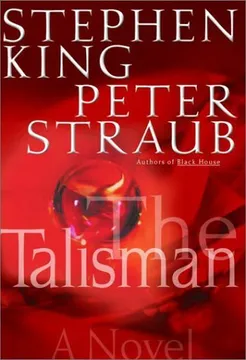


Summary Unavailable
This book is not suitable for a summary (it may be a textbook, workbook, cookbook, reference book, or collection). However, you can still explore the FAQs, about author, and other metadata below!
Plot Summary
Prologue
Before Jack Sawyer1 begins his journey, the book shows him standing alone after Speedy Parker5 has sent him toward California and the Talisman. Speedy’s5 warning makes the quest sound like a burden with consequences beyond one boy’s life: Jack1 must enter a dangerous place, retrieve a mysterious object, and bring it back safely.
The brief glimpse offers no explanation of how Jack1 got there or what the Talisman can do. Instead, it plants the destination and the cost before the story returns to the grief and confusion that set Jack1 moving.
The opening works as a promise rather than a map. By showing Jack after Speedy has given him his charge, it places the reader ahead of the boy’s understanding while preserving the mystery of the other world. The burden is framed as intimate and cosmic at once: Jack is being asked to save someone he loves, but failure could damage far more than his family. His loneliness in the teaser also anticipates the emotional price of the quest. The story will repeatedly make Jack act before he understands, turning trust in a few people into his only substitute for certainty.
Arcadia After Summer
Twelve-year-old Jack Sawyer1 arrives with his mother,2 Lily,2 at the empty Alhambra Inn on the New Hampshire coast. Lily,2 a former film star, has fled Los Angeles and the pressure of Morgan Sloat,4 her late husband’s8 business partner. Jack1 is already grieving his father,8 and a phone call brings worse news: Uncle Tommy Woodbine21 has died in a hit-and-run.
Lily2 grows thinner, smokes again, and refuses to explain what is wrong, leaving Jack1 alone with the fear that she may be dying too. He drifts through the deserted resort until he meets Lester Speedy Parker,5 the amusement park’s caretaker. Speedy’s5 kindness cuts through Jack’s1 numbness and gives him someone he can trust.
The move to Arcadia Beach does not restore safety; it makes the family’s instability visible. Lily tries to manage fear through flight and performance, but her silence forces Jack to interpret every physical change as a possible farewell. Tommy’s death removes a guardian just as Jack is beginning to suspect that the adults around him cannot protect one another. Speedy matters first as a human presence, not as a guide to magic. His practical kindness gives Jack enough emotional ground to notice that the world is behaving strangely.
The Sand Funnel
On the beach, a gull’s feeding turns Jack’s1 grief into a vision of his mother’s2 mortality. Then the sand spins into a funnel and seems to speak in Morgan’s4 voice, insisting Lily2 is dying. Jack1 runs to the hotel and finds her safe, but his fear no longer feels imagined. At Funworld, Speedy5 explains that Jack’s1 so-called daydreams are glimpses of a real place called the Territories.
Its sick ruler, Queen Laura DeLoessian,7 is Lily’s2 counterpart in that world, and both women may be saved by the same object. Jack1 recalls that strange men once tried to abduct him in California and Speedy5 drove them off. Speedy5 gives him a rotten-tasting drink that will help him cross between worlds.
The sand funnel turns Jack’s private dread into evidence he cannot dismiss, while Speedy gives that evidence a structure without making it less frightening. The idea of Twinners links personal resemblance to political consequence: Lily’s illness is not isolated, and Jack’s family history may intersect with a whole kingdom’s fate. The remembered abduction also revises an old childhood terror. Jack was not merely frightened by strangers; someone had wanted him badly enough to seize him. His choice to believe Speedy begins when he accepts that the ordinary explanation no longer accounts for what he has seen.
The Queen’s Pavilion
The drink carries Jack1 into the Territories, where ordinary people speak a language he somehow understands and his clothes change with him. At the Queen’s7 summer pavilion, Captain Farren9 recognizes Speedy’s5 gift, a guitar pick that becomes an ornate tooth.
Farren9 smuggles Jack1 inside and lets him glimpse the helpless Queen Laura,7 whose face resembles Lily’s.2 Jack1 learns that Morgan’s4 counterpart, Morgan of Orris, is coming west and that Osmond,10 his cruel lieutenant, commands the court.
The Queen’s7 infant son died under suspicious circumstances, and Farren’s9 account echoes Jack’s1 own near-death as a baby. Osmond10 recognizes Jack1 as a threat and whips him, but an ale-wagon accident distracts the court. Farren9 sends Jack1 west with a coin bearing the Queen’s face.
The pavilion gives Jack his first view of power as a system of bodies, gates, and access. Farren can help only by risking his position, while Osmond’s violence makes the cost of being noticed immediate. The near-parallel deaths of the two infants deepen the mystery around Jack without resolving it. The Queen’s likeness to Lily converts the quest from abstract duty into a direct encounter with the person Jack hopes to save. Farren’s coin and Speedy’s transformed pick are small objects that carry authority across worlds, preparing Jack to rely on signs when explanations fail.
Morgan’s Black Coach
Farren9 points Jack1 toward the western road and gives him a coin bearing the Queen’s portrait. Jack1 hides from Morgan of Orris’s4 immense black diligence as it races past, but the forest itself becomes a predator: roots coil around his limbs and a tree tries to choke him. He escapes by drinking from Speedy’s5 bottle and flips back into America, miles from where he entered the Territories.
Near a river, he doubts what happened until he finds the bruises and throat wound left by the living roots. Alone and hungry, he follows roads west, hitchhikes under an invented story, and reaches Oatley, New York. Its empty shops, hostile residents, and decaying streets make it feel like another trap.
The first journey west teaches Jack that movement between worlds is not a convenient shortcut. Distance changes unevenly, and danger can cross the boundary through physical wounds. The living forest externalizes the sense that the world is watching him, but the lasting consequence is practical: Jack emerges far from safety with little money and no reliable plan. Oatley’s human bleakness then mirrors the Territories’ supernatural threat. The contrast matters because Jack cannot divide danger neatly into magical and ordinary categories; both worlds contain people and places that exploit the vulnerable.
Oatley’s Pitcher Plant
Jack1 accepts a job at the Oatley Tap, where Smokey Updike15 underpays him, hits him, and uses the town’s police chief to threaten him into staying. Jack1 learns that the friendly-looking bar has become a prison. A phone call from a dead-sounding voice warns him to return home, while a millhand whose eyes turn yellow stalks him through the back halls.
The man transforms into Elroy,22 a killing creature, and attacks. Jack1 grabs Speedy’s5 remaining drink and flips away as Elroy22 closes in. During the crossing, a childhood memory resurfaces: Jerry Bledsoe, the Sawyers’ handyman, died when an electrical panel exploded after Jack’s father8 and Morgan4 had visited another world. Jack1 begins to suspect that actions there can cause deaths here.
Oatley strips Jack of the confidence he had gained by surviving the road. Smokey’s wage tricks and threats show how coercion can wear the face of employment, while Elroy makes the danger physical and unmistakably supernatural. Jack’s escape depends on a tool he dislikes and barely understands. The memory of Jerry Bledsoe changes the moral terms of travel: crossing worlds may not be harmless, and Jack may have caused deaths without intending to. His guilt begins to compete with his duty to save Lily, forcing him to ask not only what he can do but what his actions cost.
The Market’s Wonders
Back in the Territories, Jack1 finds that he understands the local language and can spend the jointed wooden money he carried from America. A market vendor gives him a small mirror that changes his face, and Jack1 watches men launch from a tower and fly with powerful wings. The beauty of the spectacle briefly lifts him out of homesickness.
Then Morgan’s4 approach forces him to return to America. Jack1 emerges near Angola, New York, where a newspaper reports that an earthquake collapsed the Rainbird Towers and killed five workers. The timing matches Jack’s1 crossing into that world. Remembering Jerry Bledsoe’s death, he fears that his arrival caused both disasters. The quest now carries a burden of unintended consequences.
The market makes the Territories attractive through its sensory abundance and its unfamiliar social rules, but the flying men offer a more complex wonder: their flight costs effort, yet their exertion produces visible joy. Jack’s brief relief is broken by the Angola report. The possibility that his crossing caused the earthquake transforms wonder into culpability. The story refuses to make magic morally clean; even a boy acting to save lives may trigger harm elsewhere. Jack’s challenge is no longer simply courage against danger. He must decide whether responsibility means stopping or continuing when every available choice carries risk.
Snowball’s Advice
A farmer named Buddy Parkins16 gives Jack1 a ride and invites him home, sensing that the boy’s cover story hides a deeper ordeal. Jack1 turns down the refuge and stops at a mall, where a news report confirms the Angola deaths. He recognizes that his crossing may have caused the collapse, then finds a blind street musician called Snowball,17 whose blues playing recalls Speedy.5
Jack1 admits his guilt and fear of continuing. Snowball17 refuses to absolve him but helps him distinguish consequence from deliberate murder: refusing to act can also leave people in danger. Jack1 chooses to keep going west rather than return to New Hampshire. At a roadside stop, Morgan’s4 car appears, and Jack1 uses his last drink to escape into the Territories.
Buddy offers ordinary care without demanding that Jack explain himself, a form of rescue Jack cannot accept while the mission remains unfinished. Snowball’s counsel is more difficult: he does not erase the deaths or tell Jack that guilt is meaningless. Instead, he challenges Jack’s tendency to claim total responsibility for events he could not foresee. This distinction lets Jack continue without pretending he is innocent. His decision to go west is therefore neither pure heroism nor reckless denial. It is an acceptance that ethical action under uncertainty cannot guarantee a clean outcome.
Wolf Joins the Road
At an Ohio rest stop, Jack1 escapes Morgan Sloat4 by crossing into the Territories, where he meets Wolf,6 a huge, gentle werewolf who recognizes Jack’s father8 by scent. Wolf6 explains that Morgan of Orris4 once stole members of his family and corrupted some of their people. When Morgan4 rips open a passage between worlds and attacks with a lightning-rod, his bolts stampede Wolf’s6 herd into a stream.
Jack1 abandons his escape to pull Wolf6 from drowning and brings him back to America. The rescue leaves Wolf6 terrified of cars, noise, and pollution, while Jack’s1 journey slows. He could leave Wolf6 behind, but Wolf’s6 loyalty to his herd makes Jack1 feel responsible for him.
Wolf’s introduction changes the quest from a solitary ordeal into a relationship with obligations on both sides. His strength is obvious, but his sensitivity to smells and machines makes the modern world painful to him. Jack’s rescue of Wolf repeats the moral problem raised by the Angola disaster: helping one person may endanger others, yet refusing to help would betray a bond Jack has chosen to accept. Morgan’s attack also shows that he can force entry across worlds and weaponize the consequences. Jack is no longer simply fleeing his enemy; his choices now determine who else is pulled into the conflict.
The Moon Takes Wolf
As the full moon approaches, Wolf6 begins changing earlier than expected and warns Jack1 that he may kill anything he catches. Jack1 buys a padlock and finds a shed where Wolf6 can be contained. Wolf6 tries to leave before the change, but waits for Jack1 to return and reminds him that the herd must be locked away to keep it safe.
Jack1 spends three days trapped inside while Wolf6 hunts through the surrounding countryside. Wolf6 brings him scraps of meat and water, then returns alive, having killed animals but no people. The ordeal changes their bond: Jack1 survives through Wolf’s6 care, while Wolf’s6 willingness to restrain himself protects human lives. They leave the shed together, weakened but still moving west.
The shed reverses the familiar pattern of rescue. Jack becomes the one confined, while Wolf becomes the creature whose freedom carries danger. Their roles are not reducible to human and monster: Wolf’s inherited rules protect the herd, and Jack trusts him enough to accept dependence. The three days also expose how care can involve restraint rather than comfort. Wolf’s decision not to harm people is meaningful because it is made while his instincts are strongest. Their friendship deepens through reciprocal vulnerability, not through sameness or easy understanding.
The Sunlight Home
Jack1 and Wolf6 hitch toward Illinois, but Wolf6 cannot endure the smells inside a car and refuses a ride. A police officer arrests them for hitchhiking and brings them before Judge Fairchild, who sends them to the Sunlight Gardener Scripture Home for Wayward Boys. The Home’s barred windows, forced labor, and strict schedules reveal a prison disguised as religious rescue.
Reverend Sunlight Gardener11 welcomes them with polished warmth, while Sonny Singer19 and Heck Bast18 enforce his rules. Jack1 recognizes a disturbing familiarity in Gardener’s11 gaze but cannot place it. The Home confiscates their possessions and separates them from the road, leaving Jack1 desperate to escape before Morgan4 or Gardener11 can uncover what he knows.
The Home translates the violence of the Territories into an institution that claims to save the boys it controls. Its power lies in making coercion appear voluntary, moral, and therapeutic. Jack sees through the performance, but he is still a child without legal standing, money, or allies. Wolf’s difficulties with cars have helped bring them here, showing how adaptation to one world can create vulnerability in another. The institution’s rhetoric also prepares the later conflict between genuine confession and forced confession: Gardener wants not simply obedience, but control over what the boys believe about themselves.
Ferd Runs for Freedom
At the Home, Jack1 befriends Ferd Janklow,12 a sharp, skeptical boy who explains that Gardener’s11 religious broadcasts conceal abuse and that boys who spoke to an investigative television crew disappeared. Ferd12 runs across the rock-strewn field, but the Home later announces that he has converted. Jack1 believes the claim hides his murder.
When Heck Bast18 attacks him, Wolf6 crushes Heck’s18 hand, and Gardener11 confines Wolf6 in an iron box. Gardener11 offers to release Wolf6 if Jack1 explains where they met, but Jack1 refuses, unaware that Gardener11 is probing their connection to the Territories. Gardener11 burns Jack’s1 hand to force answers. Jack1 and Wolf6 remain trapped, one under physical restraint and the other under threats against his friend.
Ferd’s escape reveals that the Home’s system depends on erasing dissent rather than answering it. His fate is obscured by a conversion story, turning religious language into a tool for making a person disappear twice: first physically, then narratively. Wolf’s violence is reactive and protective, but it gives Gardener a pretext to intensify control. Jack’s refusal to identify the Territories preserves a secret at the cost of immediate suffering. The scene exposes confession as a contested act: truthful self-disclosure can create intimacy, but under coercion it becomes another instrument of domination.
Wolf Breaks the Box
Jack1 and Wolf6 try to flip from a bathroom stall, but they land beside a deadly pit in the Territories and return to the same bathroom, where guards beat them. Gardener11 drugs them and puts Jack1 in a straitjacket, then tortures him with a lighter to learn about his ability to cross worlds. Wolf,6 locked in the iron box, finally changes and tears his way out.
He kills several of Gardener’s11 enforcers, reaches Jack,1 and shields him when Sonny Singer19 fires. Wolf6 is mortally wounded. As he fades, he tells Jack1 he kept his herd safe, then returns to the Territories. Jack1 escapes the Home alone, carrying grief and the knowledge that Gardener’s11 cruelty is tied to Morgan’s4 larger pursuit.
The failed crossing makes clear that Jack’s new ability is not a dependable escape hatch. Wolf’s breakout is both rescue and catastrophe: he saves Jack, but his transformation brings lethal force into a world already shaped by institutional violence. His final concern is not his own survival but the herd he was charged to protect. Jack’s grief is sharpened by the recognition that Wolf’s loyalty has repeatedly exceeded his own patience. The Home’s collapse does not erase its harm; it leaves Jack carrying a debt he cannot repay, which becomes part of his resolve to finish the mission.
Richard at Thayer
After escaping the Home, Jack1 travels east to Thayer School in Illinois and finds Richard3 at his dormitory. Richard3 is shocked by Jack’s1 appearance and initially refuses to believe his account of the Territories.
He does believe Jack1 was imprisoned at the Sunlight Home, and reveals that Sunlight Gardener’s11 son,20 Reuel,20 had lived next door and behaved cruelly. Reuel20 has been ordered to leave after the Home’s crimes became public. Jack1 recognizes the danger in the connection but tells Richard3 he is trying to save Lily.2
Richard3 listens as Jack1 recounts the road, Wolf,6 and the Home, accepting that Jack1 is truthful even while resisting the supernatural explanation. Their reunion gives Jack1 an ally, though Richard3 remains deeply invested in rational order.
Richard’s skepticism is not simple obtuseness. It is a defense built around his need for a world that behaves predictably, while Jack has learned to survive by treating impossible evidence as actionable. Their friendship holds because Richard can doubt Jack’s interpretation without dismissing his honesty. Reuel’s presence at Thayer also shows that the Home’s influence extends beyond its walls. The reunion is a pause in the journey, but not a return to childhood ease: Jack has changed, and Richard must decide whether loyalty can survive the collapse of his assumptions.
Thayer Slips Away
Thayer’s familiar routines unravel: students vanish, halls grow strange, and damaged figures gather outside Nelson House demanding Jack.1 Richard3 tries to explain the chaos as illness or drugs until he remembers entering his father’s4 closet as a child and finding a monstrous hand in another world. That memory explains why he rejected fantasy so fiercely.
When the campus begins to rot and white larvae emerge from the walls, Jack1 leads Richard3 to an old railway depot. Richard3 remembers his father’s4 private train and the route west. They flip into the Territories together, arriving at the Outpost Depot, where an old keeper14 mistakes Jack1 for the dead Prince Jason. The train waiting there offers a route through the Blasted Lands.
Richard’s childhood memory gives his skepticism an emotional origin: he did not merely dislike fantasy, he once encountered something that left him terrified and without an explanation he could bear. His damaged glasses had already symbolized a refusal to see; his decision to follow Jack makes that refusal less absolute. Thayer’s collapse is both external attack and psychological pressure, stripping away the school’s rituals that had promised order. The depot then converts Richard’s family history into a practical route forward, making his inherited memories useful even as they become painful.
The Train Through Hell
Jack1 and Richard3 take Morgan’s4 battery-powered train west through the Blasted Lands, carrying guns and explosives hidden beneath a tarp. They pass poisoned pools, deformed animals, and fireballs that leave burning trails across the soil.
Richard3 grows feverish and weak, while Jack1 keeps the train moving and watches the ridges for pursuers. At a guarded stockade, they crash through the gate and attack Morgan’s4 force before it can use the weapons on the train.
Jack1 recognizes Reuel Gardener20 among the attackers and drives the Queen’s coin into his forehead, banishing the creature. Osmond10 and Morgan4 arrive as the battle turns chaotic. Jack1 gets Richard3 away and continues toward Point Venuti, carrying the coin and the Talisman’s summons closer to the black hotel.
The Blasted Lands make the cost of Morgan’s ambitions visible in the environment itself. The fireballs, sickened creatures, and poisoned water suggest a landscape altered by technologies and powers that their users no longer control. Jack’s raid reverses Morgan’s plan to arm the corrupted Wolfs, but it does not make Jack a triumphant soldier. He acts under fear, with limited training, and relies on the Queen’s coin as much as on the weapons. Richard’s illness keeps the victory uneasy: survival is not the same as safety, and the mission still leads into the place Morgan fears.
The Hotel’s Iron Guardians
At the Agincourt, Jack1 carries Richard3 through a flooded route beneath the hotel and enters the dining room. The building tries to repel him with false heat, voices, and an ancient armored knight. Jack1 refuses to run; Speedy’s5 ivory pick becomes a weapon of light and destroys the guardian, though the pick cracks.
In the ballroom, Jack1 finds the Talisman hovering in radiant form and accepts it as the object that links worlds. He leaves with Richard3 and the Talisman, but Sloat4 and Sunlight Gardener11 wait outside. Gardener11 aims at Jack,1 and the Talisman turns the attack back on them. Sloat4 is driven through a rupture between worlds, while Jack1 keeps hold of the fragile object and survives the final confrontation.
The hotel is more than an enemy fortress: it tests whether Jack will accept the role of thief the building assigns him. He insists that he has come for something that is his responsibility, not for private gain. The guardian’s defeat depends on a humble object given earlier by Speedy, showing that the quest’s tools are relational as well as magical. The Talisman’s arrival does not end danger; it makes Jack responsible for a power whose effects reach beyond his own world. His refusal to surrender it to Sloat is a moral decision as much as a physical victory.
The Beach Gives Way
Outside the Agincourt, Jack1 finds Richard3 badly hurt and Speedy5 collapsed on the beach. Sloat4 threatens them with the lightning key, using snow and shifting appearances to disorient Jack.1 Jack1 realizes Sloat4 is crossing between his American and Territories selves, then holds his ground rather than being baited into dropping the Talisman.
When Sloat4 fires at him, the Talisman absorbs and magnifies the attack. Its returned force drives Sloat4 through the worlds, ending his pursuit. Jack1 then uses the Talisman to heal Richard3 and Speedy.5 Speedy5 tells him to remain in the Territories briefly before returning home, and Jack1 and Richard3 begin their final journey east with the Talisman still in Jack’s1 keeping.
Sloat’s last attack turns the conflict into a contest over ownership. He wants the Talisman as an instrument of dominion, while Jack has learned that its power cannot be separated from the choices made around it. The crucial shift is Jack’s refusal to treat the artifact as a weapon he can simply wield. Its response to Sloat’s lightning returns the aggression to its source. Healing Richard and Speedy then demonstrates a different use of power: not control, but restoration. Jack’s victory remains emotionally costly because it cannot return Wolf or undo earlier deaths.
Home Across the Country
Wolf’s6 litter-brother drives Jack1 and Richard3 across the country in a Cadillac, while Jack’s1 time aboard the ride blurs into a long, suspended journey. Richard3 gradually accepts that he cannot return to the boy he was before learning what his father4 did. On December 21, they reach the Alhambra. Lily2 is barely alive, and Jack1 carries the Talisman to her bedside.
Its light and substance pour into her, removing the cancer and restoring her strength; then the object’s shell crumbles away. Jack1 and Lily2 embrace, while Richard3 waits nearby. Far away, Queen Laura7 opens her eyes in the Territories. Jack’s1 quest has saved both mothers, but the story ends with him still a boy, at the threshold of an adult life.
The return is not a simple restoration of the old family. Lily survives, but Jack has crossed a moral and emotional distance that cannot be undone; Richard has also lost the security of his former worldview. The Talisman’s disappearance suggests that its power is not a possession Jack can keep for future convenience. It is spent in the act of healing. The parallel awakening of Laura confirms that Jack’s private rescue has altered the other world as well. Ending at boyhood’s threshold preserves the story’s central tension: Jack has completed an adult task without ceasing to be a child.
Epilogue
In the Territories, Queen Laura7 opens her eyes in a room crowded with attendants. Her awakening confirms that the Talisman’s restoration has reached beyond Lily2 and into the world whose queen7 she is.
The book then closes with a note about the limits of this account: Jack’s1 story has reached the point where he stands at the edge of growing up, but the future remains unwritten. The ending offers recovery and possibility without showing what adult life will make of the boy1 who has carried the Talisman across the country.
Laura’s awakening makes the resolution reciprocal: Jack has not simply rescued his mother, but repaired a bond between two worlds whose rulers share a life-pattern. Yet the closing frame refuses to turn that success into a complete biography. Jack’s achievement belongs to childhood precisely because it precedes the adult explanations that might flatten it into ambition, inheritance, or legend. The book ends with the future still open, preserving the uncertainty that drove the journey. Its final emphasis is not on mastery of the worlds but on a boy who has done what he could and must now return to ordinary time.
Analysis
The Talisman makes childhood a condition of action, not innocence. Jack1 is young enough to move through the Territories without demanding that every wonder be reduced to a stable theory, yet old enough to recognize hunger, coercion, grief, and the cost of choices. Richard3 supplies the opposing temperament: his insistence on evidence protects him until it becomes a prison, while Jack’s1 openness makes him vulnerable to error and guilt. Their friendship works because neither position is sufficient alone. The novel also refuses to divide evil cleanly between supernatural monsters and ordinary institutions. Smokey’s15 bar, Gardener’s11 religious home, and Morgan’s4 business empire use different languages to make exploitation look normal; the Territories makes that logic visible in its corrupted court and poisoned landscape. Jack’s1 journey repeatedly tests whether responsibility means controlling outcomes or acting with care despite uncertainty. He cannot prevent every death, and the book does not excuse him from feeling their weight. What changes him is the gradual distinction between guilt that recognizes harm and guilt that falsely claims omnipotence. The Talisman’s power becomes meaningful only when Jack1 can give it up, use it to heal, and refuse to turn it into private possession. Its final effect restores Lily2 and Laura,7 but it does not restore Jack’s1 former life untouched. The ending preserves the ache of loss, especially Wolf’s6 absence, while allowing Jack1 to return to ordinary human attachment. The largest victory is therefore not conquest of a world. It is the recovery of a shared life after a child has been forced to carry more than any child should.
Last updated:
Report IssueReview Summary
The Talisman is widely praised as an epic dark fantasy collaboration between King and Peter Straub, following 12-year-old Jack Sawyer on a cross-country quest to save his dying mother. Readers consistently highlight Wolf as a beloved standout character and appreciate the rich world-building and coming-of-age themes. Common criticisms include pacing issues, an overly slow start, and excessive length. Many draw connections to King's Dark Tower series. Opinions range from "favorite book of all time" to disappointment, with most landing around 3.5–4.5 stars.
People Also Read

Characters
Jack Sawyer
The reluctant world-crosserJack is a twelve-year-old California boy whose father8 is dead and whose mother2 is gravely ill. He is observant, funny, proud of his parents, and more emotionally perceptive than he knows; he reads small shifts in adult behavior long before he can name their causes. His childhood has already been unsettled by grief, sudden moves, and an earlier attempted abduction. When Speedy5 gives him a mission, Jack acts from love rather than certainty. He is brave, but not serenely so: he tires, panics, resents the burden, and repeatedly wants to turn back. His capacity to accept responsibility grows through friendship, especially when he must care for someone whose needs frustrate his own.
Lily Cavanaugh Sawyer
The guarded actress motherLily is Jack’s1 mother, a former film star known for playing tough, self-possessed women. Her wit and theatrical instincts help her meet the world on her own terms, but her illness and financial entanglements with Morgan Sloat4 strip away much of that control. She protects Jack1 by withholding information, even when that silence intensifies his fear. Her old affection is visible in teasing exchanges and remembered tenderness, though she often hides vulnerability behind cigarettes, jokes, and impatience. Lily’s central conflict is between wanting to spare her son1 and needing to trust him with the truth. She is fiercely attached to Jack1, yet initially finds it difficult to show how frightened she has become.
Richard Sloat
The friend who needs proofRichard is Jack’s1 oldest friend and the son of Morgan Sloat4. Precise, intelligent, and attached to scientific order, he is uncomfortable with fantasy because he needs the world to remain explainable. This is not mere smugness; his skepticism protects a childhood wound he has never fully faced. Richard cares deeply for Jack1, but loyalty does not immediately overcome his fear of uncertainty. His education, memory, and attention to detail prove useful, even when he resists Jack’s1 account of events. Richard is not simply converted by spectacle. He has to confront the experience he buried and decide that friendship matters more than preserving an airtight theory of reality.
Morgan Sloat
The ambitious business partnerMorgan is Jack’s1 late father’s8 business partner and Richard’s3 father. He is a shrewd investor who sees relationships, institutions, and other worlds in terms of leverage. His ambition grows from an old sense of having been underestimated, and he justifies his appetite for power as fairness owed to him. Morgan is capable of charm and paternal warmth, which makes his possessiveness harder for Richard3 to recognize. He dislikes limits, whether they come from business rivals, moral obligations, or the rules separating worlds. His outwardly practical mind conceals a deep hunger to enlarge his influence, and his attachment to his son3 is tangled with his wish to shape the boy’s future.
Lester Speedy Parker
The blues-playing guideSpeedy is the elderly caretaker at Arcadia Funworld and a former traveling blues musician. He meets Jack1 when the boy is emotionally adrift, offers companionship without demanding a full explanation, and teaches him to trust what he has experienced. His speech is playful and indirect, but his practical gifts and warnings are carefully chosen. Speedy knows that Jack’s1 journey will be dangerous and still refuses to pretend otherwise. He offers help without taking over the mission, leaving Jack1 to make the decisive choices himself. His kindness is not soft reassurance; it is a form of respect that treats a frightened child as someone capable of carrying a difficult responsibility.
Wolf
The loyal herdsman friendWolf is a large, gentle member of a people who can change into wolves. He tends the Queen’s7 cattle and organizes his life around his family, his herd, and his loyalty to the crown. His intelligence is uneven, his emotions direct, and his senses far more acute than Jack’s1. Cars, crowds, and polluted air overwhelm him, yet he repeatedly endures them to stay with Jack1. Wolf is both powerful and vulnerable: his strength can protect others, while the moon’s pull creates a danger he cannot simply reason away. His instinctive attachment to Jack1 grows from their shared care for vulnerable beings, not from an easy fit between their worlds.
Queen Laura DeLoessian
The ailing Territories rulerLaura is the Queen of the Territories and Lily’s2 counterpart in another world. She is seen mostly through the fear and loyalty she inspires in others, rather than through direct action. Her illness threatens the fragile order of her kingdom and gives Morgan of Orris4 room to gather influence. The portrait and coin bearing her likeness suggest authority tempered by kindness, and her resemblance to Lily2 makes her feel intimately connected to Jack1 before he knows her personally. Laura’s importance is not simply political: her fate is bound to Jack’s mother2 and to the balance between worlds. She represents a form of leadership that others serve because they believe her life matters.
Philip Sawyer
Jack’s absent, principled fatherPhilip Sawyer is Jack’s1 deceased father and Morgan’s4 former business partner. Jack1 remembers him as warm, witty, and generous, a man who noticed music, explained the world without diminishing its mystery, and loved his son1 openly. Philip’s caution about exploiting the Territories contrasts with Morgan’s4 appetite for expansion. His ideas about consequences continue to guide Jack1, even after his death. The gap between Jack’s1 loving memories and the unresolved circumstances of Philip’s death gives the boy’s journey an undercurrent of suspicion and grief.
Captain Farren
The Queen’s scarred guardCaptain Farren is a disciplined officer of the Queen’s7 Outer Guards. His scar and military bearing make him seem severe, but he is willing to improvise when Jack1 needs access to the Queen7. Farren values duty and public order, yet his help is personal as well as official. He understands that the court is vulnerable to men who exploit the Queen’s7 illness, and he acts within the limits of his position to aid Jack1. His coin gives the boy a tangible connection to the Queen’s7 cause.
Osmond
Morgan’s cruel courtierOsmond is a thin, unnerving court figure who carries a whip and serves Morgan of Orris4. His elaborate dress and perfumed scent conceal a taste for domination. He is alert to weakness and uses humiliation as readily as physical force. Jack1 encounters him as a threat in the Territories, while his exact reach remains difficult to understand. Osmond’s conduct makes the court’s political danger immediate: cruelty is not merely a policy but a personal pleasure.
Reverend Sunlight Gardener
The preacher who controls boysGardener runs the Scripture Home for Wayward Boys and presents himself as a charismatic religious rescuer. He is skilled at shaping an audience, using confession, prayer, and broadcast spectacle to make boys seek his approval. Beneath the polished performance is a man who treats fear as a tool and obedience as proof of moral worth. His need to control the boys is both institutional and personal. Jack1 senses danger in him before he can explain why, while the Home’s routines make it difficult for vulnerable residents to resist him.
Ferd Janklow
The Home’s defiant skepticFerd is a clever, wounded teenager who sees through Gardener’s11 public image and describes the Home’s hidden abuses to Jack1. His humor is sharp enough to puncture the institution’s pious language, but it also protects a deep sense of betrayal by his parents. Ferd understands the danger of speaking openly and chooses to escape anyway. He gives Jack1 crucial knowledge about the Home’s surveillance, punishments, and false appearances.
Lester Parkus
The Territories lawmanIn the Territories, Parkus is a respected figure with authority and an old history of conflict with Morgan4. Jack1 knows him through his connection to Speedy5, who serves as his counterpart in America. Parkus understands the danger surrounding the Talisman and the cost of Morgan’s4 ambitions. He offers Jack1 direction without removing the boy’s responsibility for acting. His role links private mentorship to the broader struggle over the Territories’ future.
Anders
The frightened depot keeperAnders runs the Outpost Depot, where he is responsible for the small electric train Morgan’s4 agents have left behind. He has lived through the rise of Morgan’s4 influence and fears the Blasted Lands enough to dread his assigned journey. His first response to Jack1 is terror, but recognition of the Queen’s7 sign changes his posture and gives him a reason to help. Anders’s practical knowledge of the train makes the westward route possible, while his stories reveal what the frontier has become.
Smokey Updike
The predatory bar ownerSmokey owns the Oatley Tap and hires Jack1 as underpaid labor. He controls workers through withheld wages, threats, and casual violence, while presenting himself as the only protection available in town. His bar is one of Jack’s1 first demonstrations that exploitation can be ordinary and local, not supernatural.
Buddy Parkins
The farmer who offers shelterBuddy is a kind, observant farmer who picks Jack1 up while the boy is traveling under a false identity. He recognizes that Jack’s1 story does not quite add up and offers him a place at his family’s table anyway. Jack1 declines, but Buddy’s gesture shows the possibility of care outside the quest.
Snowball
The blind blues singerSnowball is a blind street musician Jack1 meets outside a mall. His guitar playing and practical perspective help Jack1 reconsider the guilt he feels over deaths linked to his crossings. He neither absolves Jack1 nor tells him to quit; instead, he challenges the boy’s belief that every bad consequence makes him a murderer.
Hector Bast
The Home’s brutal enforcerBast is a massive student enforcer at the Sunlight Home. He relies on size and intimidation, carrying out Gardener’s11 discipline and targeting boys who resist. His physical presence makes the Home’s hierarchy visible even before its worst punishments are revealed.
Sonny Singer
The preacher’s ambitious aideSinger is a sharp, angry student who helps manage the Home and enforces its rules. He imitates Gardener’s11 authority, using threats and humiliation to make himself seem important. His desire for status makes him both a bully and a vulnerable instrument of the institution.
Reuel Gardener
Gardener’s volatile sonReuel is Sunlight Gardener’s11 son and Richard’s3 unpleasant neighbor at Thayer School. Richard3 remembers him as cruel and unsettling, and Jack1 recognizes a link between him and the dangers surrounding the Home. Reuel’s presence connects the respectable school environment to the violence gathering around Jack1.
Thomas Woodbine
Jack’s dependable uncleTommy Woodbine is Jack’s1 uncle and a trusted adult who offered practical guidance and affection. A lawyer by training, he is remembered for his steadiness, his humor, and his willingness to treat Jack1 as a person rather than a child to be managed. His loss deepens Jack’s1 sense that the adults who might protect him are disappearing.
Elroy
The Oatley predatorElroy is a monstrous pursuer associated with the man whose eyes change color at the Oatley Tap. He embodies the danger Jack1 has trouble distinguishing from the violence of ordinary men. His presence follows Jack’s1 fear from a dark tunnel into the bar and makes Oatley feel like a trap with teeth.
Plot Devices
The Territories
A parallel world with consequencesThe Territories are a kingdom of farms, courts, strange creatures, and vast open landscapes that corresponds imperfectly to America. Jack1 reaches it by crossing worlds, and distance does not match the distance traveled on the American side. People and objects can have counterparts there, while events in one world can echo dangerously into another. This device gives the quest its geography and its moral uncertainty: a crossing may help Jack1 reach his goal, but it can also alter conditions elsewhere. The Territories are not a fantasy refuge. They contain courts, exploitation, poisoned regions, and people whose lives matter as much as those in Jack’s1 own world.
Twinners and crossings
Lives linked across worldsSome people have counterparts in the Territories, known as Twinners, and events in one life can resonate with the other. Jack1 is exceptional because he has no living counterpart in the same way. Crossing begins with Speedy’s5 strange drink, but Jack1 later learns to do it through concentration and will. The mechanism allows the plot to move between America and the Territories while tying personal relationships to political events. It also creates uncertainty: a person’s counterpart may be separated by distance, unaware of the connection, or shaped by a different history. The device ultimately turns Jack1 and Richard’s3 family histories into part of the larger struggle.
The Talisman
The healing axis of worldsThe Talisman is a powerful object Jack1 must reach at the black hotel in Point Venuti. It appears as a clear, luminous globe and is connected to the health of more than one world. Its presence draws Jack1 forward, while lesser objects, including the Queen’s coin and Speedy’s pick, help him survive barriers along the way. The Talisman can resist destructive force and restore what is damaged, but it is fragile and cannot be treated as an ordinary weapon or possession. Jack’s1 relationship to it changes from wanting an unknown cure for his mother2 to recognizing that its power carries obligations beyond his own family.
The cross-world train
A route through poisoned territoryThe battery-powered train at Outpost Depot follows rails through the Blasted Lands toward Point Venuti. Morgan4 intends to use it to transport weapons and explosives to his forces. Jack1 takes the train and its cargo, turning Morgan’s4 logistics into a risky means of reaching the coast. The train is slow, exposed, and vulnerable to the damaged landscape, so travel becomes a sustained ordeal rather than a convenient ride. Its route also connects Richard’s3 childhood memories of Camp Readiness to the Territories’ political struggle. The train makes the journey possible while carrying the means for a confrontation Jack1 would rather avoid.
The Territories objects
Small tokens carry authoritySpeedy’s5 ivory guitar pick, Captain Farren’s9 coin, and the mirror-like marble change form when Jack1 crosses worlds. Their transformations show that ordinary objects can carry different meanings in each reality. They are not interchangeable magic weapons: each helps Jack1 at a particular point, by opening a path, marking allegiance, or reminding him of a bond. The coin becomes especially important when Jack1 faces a creature tied to the Queen’s7 enemies, while the pick helps him confront the hotel’s guardians. These objects give the story a concrete way to express trust across worlds, and they reward Jack1 for preserving gifts rather than discarding what he does not yet understand.
About the Author
Stephen Edwin King was born in Portland, Maine, and raised by his mother after his father abandoned the family. He spent portions of his childhood in Indiana and Connecticut before settling in Durham, Maine. King graduated from the University of Maine in 1970 with a B.A. in English, where he also met his future wife, Tabitha Spruce. After struggling financially through teaching and laundry work, his writing career took off following his first professional short story sale in 1967, with his novels and collections eventually establishing him as one of the most celebrated authors in American literary history.
Download PDF
Download EPUB
.epub digital book format is ideal for reading ebooks on phones, tablets, and e-readers.








