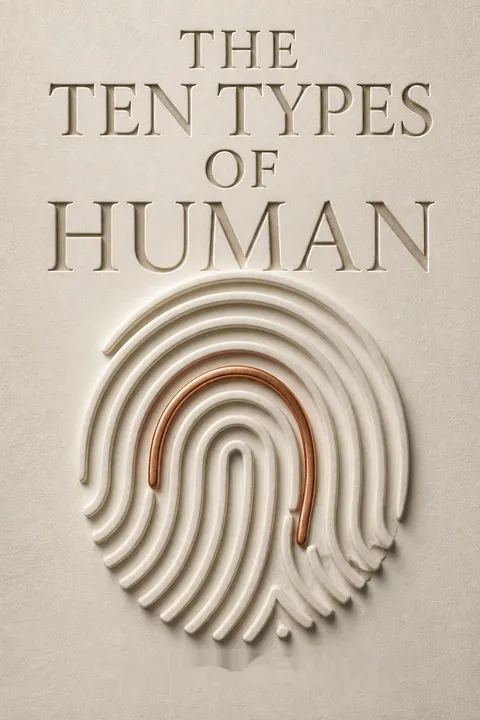


Key Takeaways
Treat human nature as evolved tendencies, not a fixed verdict on character.
A map, not a machine. Dias argues that the mind contains specialized systems shaped by recurring survival problems. These mental modules are networks, not neat brain compartments, and they influence behavior without dictating it. Genes, experience, culture, and circumstance all matter. The ten Types are a way to think about these overlapping influences, not ten literal people inside the head.
The opening dilemma asks a parent to save their child or 24 other children from a gunman. The Kinsman names the powerful pull toward protecting one’s own offspring. The book begins with a lawyer’s unanswered question about Gareth Myatt, a boy who died in custody, and follows the author’s search for what human beings are capable of, including harm and rescue.
The model is most useful when treated as a set of tendencies to investigate, not a biological excuse or a personality test. Cognitive science often explains behavior through specialized processes, while systems theory emphasizes that those processes interact and can produce outcomes no single part predicts. Dias’s emphasis on both inheritance and learning helps prevent a false choice between biology and society. The caution is important: evolutionary stories can sound more certain than the evidence permits, especially when a behavior’s current function is inferred from its possible ancestral value.
Train compassion to reach distant sufferers without drowning in their numbers.
Pain can register unseen. The Perceiver of Pain is the proposed system for noticing another person’s distress. In one striking case, a physician blinded by strokes could not identify shapes but recognized emotional expressions above chance. The researchers linked this response to the amygdala, a brain structure involved in emotion. Other scans showed overlapping brain responses when people felt their own pain and watched a loved one suffer.
Yet empathy has limits. Large-scale suffering can produce psychic numbing, as when millions of victims become an abstract statistic. The book contrasts that with Anthony and Michael, boys forced to fish on Lake Volta, where hazardous child labor affects an estimated 21,000 children. Compassion can also be approached as a positive wish to help, rather than simply absorbing another person’s distress.
The distinction between feeling another person’s pain and choosing to help is valuable. Emotional resonance can motivate action, but it can also exhaust attention and encourage avoidance. Public health communication faces the same problem: vivid individual cases attract concern, while enormous totals can overwhelm it. A practical response is to pair human stories with specific, achievable action. The limit is that compassion is not a complete theory of moral obligation. Fair institutions still matter because people cannot depend on feeling moved each time an unseen person needs help.
Challenge harmful group norms, even when belonging makes silence feel safer.
Exclusion enforces the rules. The Ostraciser is the impulse to exclude people who seem to threaten a group. Social rejection can hurt even in a virtual game: in psychologist Kip Williams’s Cyberball experiment, participants felt diminished when computer-controlled players stopped passing them the ball. Coral gobies offer a sharper example. Subordinate fish restrain their growth to avoid eviction from the protective coral; for this species, researchers identified a size threshold near 0.93 of the dominant fish.
Human exclusion can preserve a healthy group, but it can also protect a corrupt one. In Bosnia, police officer Kathy Bolkovac exposed colleagues involved in trafficking women and was isolated, removed from her work, and fired. Her experience shows why a group’s punishment of dissent does not prove the dissenter is wrong.
This account connects an ancient social threat to modern institutions, from school cliques to workplaces and international agencies. Research on conformity shows that people often adjust their judgments when a group appears unanimous, even when the group is mistaken. That makes belonging a potent lever of both cooperation and control. The goby analogy is illuminating but limited: human groups negotiate norms through law, power, and history, not body size alone. The useful question is not simply who is excluded, but whose interests the exclusion protects.
Build meaning through action when mortality or disability narrows your world.
Terror demands management. Terror Management Theory proposes that awareness of death can threaten a person’s sense of meaning and provoke defensive responses. In one experiment, judges asked to consider their own deaths set much higher bail for a hypothetical sex worker: about $455 rather than the roughly $50 set by unprimed judges. The result suggests that mortality reminders can alter judgment without conscious awareness.
The story of Dawn Faizey Webster offers a different response to terror. A stroke left her almost entirely paralyzed, but she learned to communicate by blinking, completed a degree, and pursued postgraduate study. Her example does not make suffering beneficial or require others to find meaning in it. It shows that a life changed by illness can still contain choices, relationships, and projects that matter.
The research helps explain why death reminders can make people more punitive or defensive, but it does not reduce every response to fear of mortality. Decisions also reflect law, social norms, and personal history. Dawn’s story is powerful because it resists treating disability as either tragedy alone or inspirational spectacle. Meaning is not a prize that every person must extract from hardship. The stronger insight is that agency can persist in forms outsiders may underestimate, and that policy should support those forms rather than assume what a worthwhile life looks like.
Question face-based judgments that quietly distribute opportunity, sympathy, and safety.
Faces shape first impressions. The Beholder is the proposed system that evaluates faces and uses them to guide social responses. Studies described in the book found that even newborns spent more time looking at faces adults rated as attractive. In adult life, appearance can influence hiring, promotion, and judgments of defendants. Research on capital sentencing found that Black defendants with more stereotypically Black features were more than twice as likely to receive a death sentence in a particular comparison.
The harm can become literal. Rana and Hanifa survived acid attacks aimed at their faces, and both had to confront the way others responded to their changed appearance. Their stories expose a cruel reversal: people who are visibly harmed may be treated as if they themselves are the problem.
Appearance is not merely a private preference when it shapes who receives credibility, employment, or protection. The book usefully links everyday attractiveness bias with more consequential racialized judgments. Still, face perception is not one simple instinct. Cultural learning, institutional rules, and repeated media images influence what people notice and how they interpret it. The practical implication is not to deny that impressions arise, but to prevent them from deciding outcomes unchecked. Structured hiring, sentencing, and service procedures can reduce the power of an unexamined first glance.
Interrupt violence before repetition makes cruelty feel rewarding.
Harm can change its appeal. Action aversion is the discomfort people may feel at the act of hurting someone, even when they know no injury will occur. In laboratory simulations, participants hesitated to strike a fake hand or cut toward a research assistant with a rubber knife. A contemporary report after Gettysburg counted 28,000 muskets, many loaded or reloaded, raising the possibility that soldiers sometimes could not bring themselves to fire.
The Aggressor names systems that support defensive or reward-seeking violence. Research with former combatants suggests that repeated exposure can turn violence from frightening into exciting or compelling, a pattern called appetitive aggression. Some studies found lower post-traumatic stress among more cruel combatants, but that does not make the violence harmless or every combatant alike. It shows why prevention and rehabilitation must address learned rewards as well as fear.
The idea that repeated harm can become reinforcing connects individual behavior to institutional routines. In organizations, violence can be normalized when rewards, peer approval, and distance from victims outweigh immediate discomfort. That framework is valuable for prevention because it shifts attention from a few supposedly monstrous individuals to the conditions that train behavior. At the same time, laboratory simulations and combatant interviews cannot establish a single pathway for all violence. Explanation must remain distinct from excuse, and victims’ safety must remain the first priority.
Change the cues that define outsiders; group boundaries are not fixed.
Coalitions are easy to redraw. The Tribalist is the tendency to divide people into an in-group and an out-group. In experiments, participants sorted basketball players more by race when team membership was unclear. When players wore different team uniforms, team affiliation became more salient and racial categorization declined. In a replication, just a few minutes of exposure to another system of group membership reduced the use of race as a sorting cue.
The book connects this finding to post-earthquake Haiti, where new groups formed quickly around access to food, safety, and shelter. It also describes women who organized protection and mutual aid when formal systems failed. Group identity can sharpen hostility, but it can also organize solidarity. The relevant boundary is shaped partly by the situation people share.
This is one of the book’s most hopeful findings: a salient shared identity can reduce the weight assigned to race. Social identity research supports the broader point that group categories can be created rapidly, even around arbitrary distinctions. But changing a cue is not the same as eliminating discrimination. Material inequality and political power can keep old boundaries consequential after people adopt new labels. Effective interventions therefore need both contact and structural change, so a new sense of common membership is backed by fair access to resources and protection.
Protect children without pretending parental care is limitless or perfectly equal.
Care has constraints. The Nurturer names the systems that promote feeding, protecting, and investing in children. Dias complicates the ideal of perfectly equal parental love with research on mothers of preterm twins: under intense strain, they responded more readily to the healthier twin. The pattern does not imply that the other child mattered less. It shows how limited time and energy can shape care.
Anna’s story is more wrenching. As a teenager, she was abused by her uncle, became pregnant, and later relinquished her son through a paid agency for $1,000. She believed he might have a safer life with adoptive parents than in an institution or with her. Research cited in the book links prolonged institutional care with changes in children’s stress systems, but Anna’s decision remained tragic, constrained, and morally complex.
This section replaces sentimental accounts of parenting with a more useful view of care as embodied work under pressure. Developmental science supports the importance of stable caregiving, while also showing how poverty, trauma, and institutional conditions shape what parents can provide. The danger is interpreting unequal investment as biological destiny or treating adoption as a simple solution. A humane response asks what support would make caring for a child feasible, while respecting that parents facing impossible choices may still act out of concern.
Read generosity as a possible signal, not proof of pure selflessness.
Giving can communicate status. The Romancer describes mating-related motives that may shape courtship, spending, and public generosity. In an experiment at the University of Kent, male participants donated about 35 percent of their earnings when unobserved, around 30 percent when watched by another man, and roughly 60 percent when an attractive woman watched. Meriam turtle hunters in the Torres Strait also gained prestige and greater mating success by sharing costly catches at public feasts.
These findings do not mean generosity is fake. They show that giving can benefit others while also advertising resources, commitment, or social value. François’s choice to stay with Marielle as violence approached may have carried several motives, including love and the wish to be trusted. Human motives are often mixed, not neatly selfless or selfish.
Signaling theory explains why costly public gifts can be attractive: they provide evidence of resources or commitment that cheap claims cannot. This adds depth to generosity without reducing every generous act to calculation. The Kent result comes from a specific experimental setting, and the Torres Strait findings come from a particular community, so neither should be treated as a universal law about men. The broader lesson is to examine what a gesture does socially, while leaving room for genuine care to coexist with reputational or romantic motives.
Rescue can be costly, sincere, and still shaped by reciprocal expectations.
Helping has several motives. The Rescuer is the proposed system that makes aid to others possible, including people outside one’s family. In psychologist Daniel Batson’s experiments, many participants were willing to take the place of a woman they believed was receiving shocks, even when they could easily leave. Other researchers argued that helpers might be relieving their own distress. Later brain studies found reward-related activity when people cooperated with another person, but not in the same way when cooperating with a computer.
Vasily’s story gives the question a human cost. He risked his safety to help Lena escape trafficking in Siberia; she was injured during their flight and died in the snow. Reciprocal altruism offers one explanation for helping: assistance today can support cooperation and aid in a future crisis. It need not erase compassion or turn rescue into a bargain.
The debate between altruism and self-interest is less useful when treated as an all-or-nothing contest. A person can care about another’s suffering, feel personal distress, and hope for reciprocal trust at the same time. Brain activity associated with reward supports the idea that helping can feel good, but it cannot by itself identify a person’s motive. Vasily’s story resists tidy classification. The ethical value of rescue does not depend on proving that the rescuer acted from a perfectly pure inner state.
Analysis
Dias’s central achievement is to put laboratory findings beside lives that refuse to behave like tidy experiments. The result is a moral psychology with texture: a parent chooses one child, a whistleblower is expelled, a survivor turns pain into advocacy, and a young man risks himself for a stranger. The Types help readers notice recurring pressures without claiming that people are machines. That restraint matters because evolutionary explanations can easily slide from describing a tendency to excusing an injustice. A practice may have social or reproductive functions and still be indefensible.
The evidence also has different strengths. Brain imaging identifies activity correlated with a task, not a single moral motive. Laboratory games isolate variables but simplify the stakes of real relationships. Personal narratives reveal context, shame, and ambiguity, yet cannot establish how common a behavior is. The book’s own account of composite and protected stories makes this distinction especially important. These forms of evidence work best together when each answers a different question.
The most productive extension is institutional. If exclusion, violence, and care are shaped by both mental tendencies and social rewards, changing individual attitudes is insufficient. Laws, incentives, professional norms, and material support influence which tendencies gain traction. A nurse who listens, a court that protects dissent, or a community that supports parents can alter the setting in which decisions are made. That perspective preserves human agency without pretending choice occurs in a vacuum.
The book’s optimism is therefore strongest as a practical claim, not a promise that compassion always wins. People possess capacities for cruelty and care, but their expression depends partly on cues, relationships, and institutions. Recognizing a tendency is not the same as obeying it. The Types become useful when they sharpen attention to those conditions and suggest where intervention can change the outcome.
Review Summary
The Ten Types of Human is a thought-provoking exploration of human behavior, blending personal stories with scientific research. Readers praise its engaging narrative and insightful analysis of human nature, comparing it favorably to "Sapiens." Some find the writing style and structure challenging, with interweaving storylines and a lengthy format. The book covers difficult topics like human rights abuses, prompting reflection on morality and human potential. While some criticize its organization and length, many readers find it deeply impactful and enlightening.
People Also Read




Glossary
Ten Types of Human
Evolved behavior patternsDias’s interpretive model for ten recurring human tendencies associated with major survival and social problems. The Types are not literal characters or fixed personality categories. They represent interacting mental systems shaped by evolution, learning, and culture, which influence behavior without determining it.
Kinsman
Kin-protective driveThe proposed tendency to prioritize close relatives, especially one’s own children. The book uses life-and-death dilemmas to reveal how powerful this pull can be, even when many strangers could be saved instead. It describes an influence on judgment, not an absolute rule for behavior.
Perceiver of Pain
System for noticing sufferingThe proposed mental system that detects and responds to pain in other people. It draws on mechanisms involved in perceiving one’s own emotional states, allowing another person’s distress to matter psychologically. Its reach is limited by attention, social distance, and the strain of sustained exposure.
Principle of Emotional Blindsight
Emotion detected without sightThe book’s label for evidence that some people with severe cortical blindness can still respond to emotional expressions on human faces. In the case discussed, a patient recognized facial emotion above chance despite failing to identify ordinary shapes. Researchers linked the response to an alternate pathway involving the amygdala.
Rule of Effective Invisibility
Visible suffering ignoredDias’s label for the way people can act as if others do not exist, even when they know those people are present and suffering. The idea is illustrated through hemispatial neglect, where stroke patients fail to attend to one side of space, and through social indifference to distant victims.
Cognitive Cost of Compassion
Mental strain of caringThe effort and emotional strain involved in attending to other people’s suffering. The book argues that attention and empathic capacity are limited, so overwhelming numbers can cause withdrawal or numbness. A compassionate wish to help may feel more sustaining than repeatedly absorbing another person’s distress.
Ostraciser
Exclusion enforcing group normsThe proposed tendency to distance, ignore, or expel people perceived as violating group expectations. Exclusion can reduce conflict or protect a group, but it can also preserve abusive or corrupt norms by silencing those who challenge them. Its threat is powerful because belonging matters deeply to social beings.
Cyberball
Virtual social exclusion testA computerized ball-tossing game developed to study ostracism. Participants believe they are playing with other people, then find themselves excluded from the passing. Studies report that even this brief, virtual rejection can lower feelings of belonging, self-worth, control, and meaning.
Tamer of Terror
Managing existential fearThe proposed tendency to manage the fear and disruption associated with death, vulnerability, or profound loss. It can appear through efforts to find meaning, defend a worldview, or keep acting in the face of suffering. The book presents this as an influence, not a uniform response to hardship.
Terror Management Theory
Defenses against death anxietyA psychological theory that awareness of death can threaten a person’s sense of meaning and security. It proposes that people defend cultural beliefs and self-esteem to manage this anxiety. Experiments described in the book found that reminders of death sometimes altered judgments and attention.
Beholder
System evaluating facesThe proposed tendency to use facial appearance as information about other people. Attractiveness can shape attention and social judgments, while perceived racial features can affect outcomes such as sentencing. The book emphasizes that these responses combine possible evolved preferences with culture and institutional bias.
Aggressor
Capacity for harmful actionThe proposed system associated with defensive or instrumental aggression. It can help protect a person or group, but it can also support violence used for status, resources, or power. The book argues that aggression is one human capacity among several, not a complete definition of human nature.
Action aversion
Resistance to harming othersA discomfort with performing an act that resembles harm, even when the person knows no real injury will result. In laboratory simulations, participants hesitated to strike a fake hand or use a harmless prop weapon. The concept distinguishes aversion to an action from concern only about its consequences.
Appetitive aggression
Violence experienced as rewardingA pattern observed in some combatants in which repeated exposure to violence makes it compelling or exciting rather than only frightening. Researchers studying former fighters developed measures to examine this tendency. It may help explain continued violence in conflict settings, but does not apply to every combatant.
Tribalist
Tendency to form groupsThe proposed tendency to create in-groups and out-groups, then favor members of one’s own group. Group membership can provide cooperation and protection, but it can also support hostility and unequal treatment. The book argues that the boundaries are historically changeable rather than biologically fixed.
Race-erased effect
Other cues reduce racial sortingA finding from experiments in which participants categorized people less by race when another group identity, such as team uniform, was made salient. The effect suggests race can function as one cue among several for coalition membership. It does not show that racial bias disappears in real social settings.
Nurturer
Care and investment in offspringThe proposed system that supports feeding, protecting, and caring for children. It can produce sustained devotion, but parental resources are finite and care may be unevenly distributed under severe stress. The book uses research and personal stories to show that nurturing can involve painful trade-offs.
Romancer
Mating and courtship strategiesThe proposed system associated with attracting and choosing mates. It may shape courtship, spending, generosity, and public displays of resources or commitment. The book presents signaling as one possible motive for conspicuous giving, while allowing that genuine affection and other motives can coexist.
Rescuer
Tendency to help othersThe proposed system that supports aid to others, including people who are not close relatives. The book examines evidence that helping can be emotionally rewarding and may be sustained by reciprocal cooperation. A rescue can involve real sacrifice without having only one simple motive.
Reciprocal altruism
Helping with future return possibleAn evolutionary explanation for cooperation in which one individual helps another who is not a close relative, with the possibility that help may be returned in a future situation. The theory depends on repeated social interaction and mechanisms that limit cheating. It does not require every act of help to be consciously transactional.
FAQ
What's The Ten Types of Human about?
- Exploration of Human Nature: The book examines the complexities of human behavior, focusing on how we act in extreme situations and moral dilemmas.
- Ten Distinct Types: Dexter Dias introduces ten psychological types that emerge in response to critical life problems, each representing different aspects of our behavior.
- Research-Based Insights: The narrative is grounded in extensive research from neuroscience, social psychology, and human rights, combining personal stories with scientific findings.
Why should I read The Ten Types of Human?
- Deep Understanding of Self: The book offers insights into the hidden parts of ourselves that influence our decisions, encouraging self-reflection on moral choices.
- Engaging Narratives: Dias shares compelling stories from his experiences as a human rights lawyer, making the book both informative and engaging.
- Relevance to Current Issues: The exploration of human rights and moral dilemmas is highly relevant today, with lessons applicable to contemporary social issues.
What are the key takeaways of The Ten Types of Human?
- Understanding the Types: The book identifies ten types of human behavior, each linked to specific life challenges, explaining our actions in critical situations.
- Nature and Nurture: Dias emphasizes the interplay between biological evolution and social learning in shaping human behavior.
- Compassion and Pain: The book discusses the cognitive costs of compassion and the importance of protecting our capacity for empathy.
What are the best quotes from The Ten Types of Human and what do they mean?
- “We want to believe there are some things we would never do.”: This quote challenges the notion of moral certainty by exploring darker aspects of human nature.
- “The worst in our nature coexists with the best.”: It highlights the duality of human behavior, suggesting our capacity for both good and evil.
- “We are not entirely alone.”: This emphasizes the interconnectedness of human experiences and shared psychological mechanisms.
Who are the Ten Types of Human in The Ten Types of Human?
- The Kinsman: Represents the instinct to protect one's own kin, highlighting the biological drive to prioritize family.
- The Perceiver of Pain: Embodies our ability to empathize with others' suffering, exploring how we process and respond to pain.
- The Ostraciser: Reflects the tendency to exclude individuals who violate social norms, examining the psychological mechanisms behind ostracism.
How does The Ten Types of Human address moral dilemmas?
- Real-Life Scenarios: Dias uses real-life moral dilemmas to illustrate the complexities of human decision-making, challenging readers to reflect on their values.
- Psychological Mechanisms: The book delves into the psychological processes that inform our moral decisions, including fear, empathy, and social norms.
- Evolutionary Perspective: Dias connects moral dilemmas to evolutionary psychology, suggesting responses are shaped by biological heritage and social learning.
How does The Ten Types of Human explore the concept of aggression?
- Aggression and Environment: The book emphasizes that aggression is influenced by environmental factors and social conditioning, not inherently part of human nature.
- Impact of Trauma: It discusses how trauma affects individuals, particularly children, shaping their responses to violence and conflict.
- Role of Empathy: Empathy plays a crucial role in our aversion to violence, though it can be overridden in certain circumstances.
What is the significance of the Perceiver of Pain in The Ten Types of Human?
- Empathy Mechanism: Represents our capacity to empathize with others' suffering, playing a vital role in social bonding and moral decision-making.
- Cognitive Costs: Discusses the emotional toll empathy can take, particularly in high-stress situations, essential for maintaining our ability to care.
- Connection to Human Rights: Relevant in human rights advocacy, underscoring the importance of recognizing and responding to suffering.
How does The Ten Types of Human relate to contemporary social issues?
- Human Rights Advocacy: Draws connections between psychological insights and current human rights challenges, emphasizing empathy and action.
- Moral Responsibility: Encourages reflection on moral responsibilities towards marginalized or suffering individuals, relevant in today's interconnected world.
- Understanding Human Behavior: Provides insights for creating positive social change, underscoring the importance of understanding ourselves to help others.
How does The Ten Types of Human address the concept of altruism?
- Altruism vs. Self-Interest: Examines the tension between altruistic behavior and self-interest, suggesting acts of kindness often have underlying motivations.
- Reciprocal Altruism: Discusses helping others with the expectation of future assistance, highlighting the strategic nature of such behavior.
- Cultural Variations: Notes that expressions of altruism vary across cultures, influenced by social norms and expectations.
How can understanding the ten types in The Ten Types of Human improve personal relationships?
- Enhanced Empathy: Recognizing different types of behavior can develop greater empathy and understanding, improving interpersonal dynamics.
- Conflict Resolution: Understanding motivations behind actions aids in resolving conflicts, helping navigate differences effectively.
- Personal Growth: Encourages self-reflection and personal growth, helping identify behaviors and motivations in relationships.
What research methods does Dexter Dias use in The Ten Types of Human?
- Case Studies: Employs a variety of case studies, drawing from real-life examples to illustrate the ten types and their implications.
- Psychological Research: References numerous psychological studies and theories, grounding arguments in empirical evidence.
- Narrative Approach: Combines storytelling with academic analysis, making complex concepts relatable and engaging.
Download PDF
Download EPUB
.epub digital book format is ideal for reading ebooks on phones, tablets, and e-readers.








