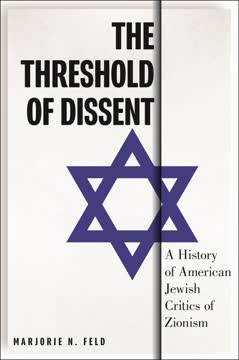
Key Takeaways
1. A "Forced Consensus" on Zionism Suppressed Diverse Jewish Voices in America
What appeared as a consensus based on shared ideas was, in fact, a manufactured consensus, as Jewish leaders increasingly discounted and marginalized dissent on this issue.
Manufactured unity. From the mid-20th century onward, mainstream American Jewish leaders actively created and enforced a "consensus" on Israel and American Zionism, portraying it as essential for Jewish survival, especially after the Holocaust. This unity, however, was often an illusion, masking a complex reality where diverse perspectives were systematically suppressed. Critics of Israel, Israeli policies, or American support for Israel, or those who rejected Zionism entirely, faced significant marginalization.
Lowering the threshold. Jewish leaders deliberately lowered the "threshold of tolerance" for dissenting views. Any questioning of American Jews' loyalty to Israel was seen as crossing this symbolic line, triggering powerful negative responses. Critics were frequently accused of disloyalty, Jewish self-hatred, or even antisemitism, leading to denial of funding and support for their communal work. This low threshold cultivated the image, and eventually the reality, of a forced consensus.
Historical invisibility. For decades, American Jewish historians largely reinforced this imposed consensus, presenting unconditional American Zionism as a natural and uncomplicated response to modernity and antisemitism. They often ignored or dismissed Israel's critics as misguided or assimilationist, contributing to a historical narrative that largely disregarded the plurality of perspectives on Zionism and Israel within the American Jewish community. This lack of rigorous scholarship on dissent had far-reaching implications, making the development of a certain brand of American Zionism appear uncontested.
2. Early Jewish Anti-Zionism Rooted in American Integration and Religious Identity
We consider ourselves no longer a nation, but a religious community, and therefore expect neither a return to Palestine, nor a sacrificial worship under the sons of Aaron, nor the restoration of any of the laws concerning the Jewish state.
Reform's anti-nationalism. In the late 19th and early 20th centuries, leaders of American Reform Judaism, influenced by the European Enlightenment, sought to adapt Judaism to modern American life. Their 1885 Pittsburgh Platform explicitly rejected Jewish nationalism, viewing the return to Zion as a spiritual, not literal, journey. They believed that identifying solely as a religious community, rather than a nation, was crucial for safe integration into the United States and protection against accusations of dual loyalty.
Fears of dual loyalty. This early anti-Zionism stemmed from a deep concern about antisemitism in Europe and the U.S., where Jews faced exclusion and hostility. Reform leaders feared that Jewish nationalism would present Jews as a "race apart," jeopardizing their integration and potentially questioning their "whiteness" in an era of racial segregation. They saw rejecting Zionism as upholding a "moral contract" of good citizenship, emphasizing Judaism's universal ethical teachings over political state-building.
The American Council for Judaism. This tradition of Reform anti-Zionism was later championed by the American Council for Judaism (ACJ), founded in 1942. ACJ members, like Lessing Rosenwald and Rabbi Elmer Berger, condemned Zionism as a form of Jewish separatism that threatened integration, diverted resources from American Jewish life, and contradicted Judaism's universalist mission. They also raised early concerns about the impact of Jewish statehood on the native Palestinian population, advocating for a democratic, non-sectarian state in Palestine.
3. Left-Wing Jewish Critics Linked Zionism to Colonialism and Warned of Palestinian Dispossession
The Zionists had a wonderful chance then to gain even the political goodwill of the Arabs by cultivating ordinary social relationship[s] based on human equality and friendship, which incidentally would also be more in accord with the Jewish character and tradition.
Yiddish Left's critique. William Zukerman, a prominent Yiddish and English-language journalist, emerged from the Jewish radical tradition, deeply influenced by Marxism and socialism. He criticized Zionism as bourgeois nationalism and an arm of British imperialism, arguing it reproduced capitalist inequality and victimized Palestinian laborers. Zukerman mourned the decline of Yiddish culture and saw Zionism as a distraction from working for justice in one's own country.
Prescient warnings. In his 1937 book, The Jew in Revolt, Zukerman praised early Labor Zionists but warned that capitalism and narrow nationalism were corrupting the socialist vision in Palestine. He highlighted the dehumanization and forced removal of Palestinians, quoting philosopher Chaim Zhitlowsky on the moral right of Arabs to their land. Zukerman predicted that without full recognition of Arab rights, conflicts would become more frequent and brutal, leading to "eternal guerrilla warfare."
Challenging the consensus. Through his Jewish Newsletter, founded in 1948, Zukerman consistently drew attention to the denial of justice and human rights for Palestinians, the "trend towards theocracy" in Israel, and the diminishing freedom of expression within the American Jewish world. He blasted American Jewry for its "sheepish adoration" of Israel and its "flagrant act of double morality" in protesting discrimination at home while remaining silent on similar issues in Israel. Zukerman's critiques, though often met with accusations of antisemitism, provided a crucial platform for independent voices.
4. Post-1967 Wars Intensified Zionist Consensus and Anticolonialist Critiques
This present Israel is not what we dreamed and hoped for and worked for—we who followed Herzl or Ahad Ha-am, Brandeis or Weizmann.
The 1967 watershed. The Six-Day War in 1967 profoundly impacted American Jewish support for Israel. Despite Israeli intelligence indicating readiness, media narratives portrayed an existential threat, leading to immense relief and euphoria when Israel emerged victorious. This victory, coupled with the occupation of the West Bank and Gaza, solidified an unquestioning loyalty to Israel among many American Jews, who increasingly saw Zionism as a liberating and unifying force.
Anticolonialist parallels. Simultaneously, global anticolonialist movements, including civil rights and Black Power in the U.S., began to draw direct parallels between Vietnam and Israel. Activists argued that both represented Western colonialism destroying indigenous lives and creating military conflicts. Figures like Noam Chomsky and I.F. Stone criticized American support for Israel as analogous to U.S. involvement in Vietnam, arguing that it perpetuated injustice and militarism.
"Israel Is Not Vietnam." In response, prominent liberal Zionists like Michael Walzer and Martin Peretz published articles arguing that "Israel Is Not Vietnam," seeking to carve out a space for American Jews to oppose the Vietnam War while maintaining unconditional loyalty to Israel. They dismissed anticolonialist analyses of Israel as misguided, asserting Israel's unique status as a site of Jewish national liberation. This narrative allowed many American Jews to avoid applying their progressive values universally, creating a blind spot for Israel's actions.
5. The "New Antisemitism" Narrative Delegitimized Criticism of Israel as Jew-Hatred
Anyone associated with the peace movement or the American left who has opposed expansionist or exclusivist tendencies within Israel has been reviled, without documentary evidence, as a supporter of terrorism and reactionary Arab states, An opponent of democracy, an anti-Semite, or, if Jewish, a traitor afflicted with self-hatred.
ADL's role. As anticolonialist critiques of Israel gained traction, Jewish organizational leaders, particularly the Anti-Defamation League (ADL), intensified their surveillance of Jewish and non-Jewish critics. The ADL, with its history of anti-communism, began to categorize criticism of Israel as a "new antisemitism," originating from the left and from "Arab propaganda." This narrative served to delegitimize dissent and insulate American Jews from fully engaging with progressive movements.
Conflating criticism with hatred. In their 1974 book, The New Anti-Semitism, ADL leaders Arnold Forster and Benjamin R. Epstein argued that indifference to Israel's necessity for Jewish safety and survival constituted this new form of Jew-hatred. They dismissed left-wing criticism as rooted in Soviet and Chinese anti-Israel stances, and controversially linked Black solidarity with Palestinians to "Black antisemitism," a concept that further distanced white Jews from Black liberation struggles.
Silencing dissent. This strategy effectively raised the threshold of dissent, making it extremely difficult for American Jews to criticize Israel without facing accusations of antisemitism or disloyalty. It reinforced the idea that Jewish unity on Israel was paramount for safety, aligning mainstream Jewish communal interests with American Cold War militarism and conservative political structures. This stance allowed Jewish leaders to demonize movements that offered critical perspectives on Israel and other colonial powers.
6. Progressive Jewish Organizations Navigated a Narrow Path of Dissent Amidst Rising Conservatism
This attitude of “my country right or wrong” was reflected in all areas of American Jewish life because Israel is the ‘glue’ that holds the disparate elements of the community together, as well as the “cause” which unites separate and faltering fundraising efforts into an effective campaign.
Breira's emergence. In the 1970s, Breira ("alternative" in Hebrew) emerged as a response to the stifling of dissent, advocating for mutual recognition between Israelis and Palestinians and challenging the "my country right or wrong" mentality applied to Israel. Though not anti-Zionist, Breira's members, many from civil rights and anti-war movements, deplored the pressures that made open discussion of vital issues "virtually synonymous with heresy" in American Jewish life.
New Jewish Agenda's multi-issue approach. Founded in 1980, New Jewish Agenda (NJA) learned from Breira's challenges. It adopted a broad, multi-issue progressive agenda, encompassing nuclear disarmament, economic justice, feminism, and LGBTQIA+ rights, intentionally not centering Israel/Palestine to avoid immediate attacks. NJA members cautiously criticized Israeli policies, such as the occupation and settlement building, while consistently affirming their love for Israel and commitment to Jewish life.
Navigating a fraught landscape. NJA sought to bridge the gap between the Jewish community and progressive movements, explicitly acknowledging the interrelatedness of antisemitism and white supremacy. They challenged the notion that unconditional support for Israel was the sole measure of Jewish identity, creating a space for Jews to ally with people of color in coalitions for change. However, their association with the left and any criticism of Israel, no matter how nuanced, still drew suspicion and attacks from mainstream Zionist leaders, highlighting the enduring power of the forced consensus.
7. The Cost of the Forced Consensus: Alienation from Justice Movements and Internal Division
It is probable that it is the Jewish community—or more accurately, perhaps, its remnants—that in America has paid the highest and most extraordinary price for becoming white.
The "price of whiteness." James Baldwin's 1984 essay, "On Being 'White' . . . and Other Lies," profoundly critiqued American Jews' choice to become "white," linking it to Zionism and Israel. He argued that this choice, made possible by justifying Black subjugation and denying indigenous history, meant withdrawing from the struggle against white supremacy and supporting colonialism. For Baldwin, supporting Israel meant supporting dispossession and colonialism, thereby choosing not to support anticolonialism and Black freedom.
Fractured alliances. The forced consensus on Zionism exacted a heavy toll on American Jewish engagement with broader justice movements. The 1983 March on Washington for Jobs, Peace, and Freedom, for instance, saw many mainstream Jewish groups abstain due to criticisms of Israel among march organizers. This demonstrated how the demand for unquestioning loyalty to Israel often trumped alliances with civil rights, anti-apartheid, and other progressive causes, leading to a "splendid isolation" for some Jewish organizations.
Diminished relevance. Critics like William Zukerman and Rabbi Alexander Schindler warned that unqualified support for Zionism would ultimately undermine American Jewish liberalism and diminish the community's capacity for participation in struggles for justice. The stifling of dissent chilled the Jewish community's capacity for critical self-reflection, leading to a narrow focus on Israel that alienated many, especially younger Jews, who sought communal connections to broader struggles for justice. This ultimately weakened Jewish communal life and its prospects for belonging.
8. Contemporary Dissent Challenges the Consensus, Signaling a Potential Shift in American Jewish Identity
I’m less nervous than other people are, because from the perspective of Jewish history there was never a time in Jewish life of ideological consensus.
A new chapter of dissent. The 2022 Israeli election, bringing the most right-wing government in the nation's history, and the subsequent Israel-Hamas war, sparked renewed and intensified dissent within the American Jewish community. While mainstream Zionist organizations reaffirmed support for Israel's democratic process, many also voiced strong concerns about the new government's racism, homophobia, and threats to judicial independence, challenging the long-held narrative of Israel as a liberal democracy.
Pushing the boundaries. Organizations like Jewish Voice for Peace (JVP) and IfNotNow, building on decades of earlier dissent, have become increasingly vocal. JVP, which unequivocally opposes Zionism as "damaging to Jewish identity and spiritual life," actively allies with movements like Black Lives Matter, directly linking Black and Palestinian oppression. These groups represent a growing segment of American Jews, particularly younger generations, who are willing to cross the traditional threshold of dissent, often facing accusations of antisemitism but asserting their actions as rooted in Jewish values of justice.
Reckoning with history. The current moment reveals a potential "reckoning" for American Jews, as the costs of the forced consensus become more apparent. The willingness of some mainstream Jewish leaders to criticize Israeli policies, even while reaffirming Zionist commitments, suggests a possible, albeit slow, shift in the threshold of acceptable dissent. This ongoing struggle reflects a deeper effort to reconcile Jewish identity with universalist commitments to social justice, democracy, and pluralism, potentially leading to new, more inclusive models of American Jewish life.
Last updated:
Similar Books