

Plot Summary
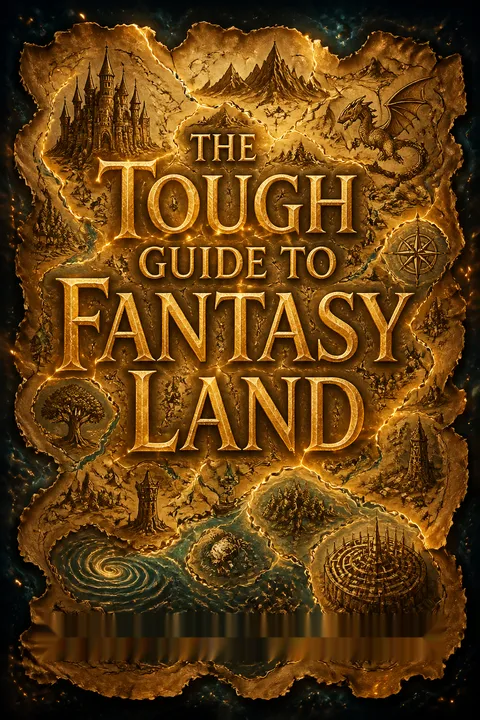
The Map Is No Map
The guide opens by handing the prospective Tourist1 a map that names distant regions but omits roads, distances, and useful stops. The starting point is usually an isolated coastal town, where the newcomer1 must find an inn, acquire companions,4 eat stew, survive the expected tavern brawl, and buy a cloak, weapons, a horse, and provisions.
A merchant caravan seems the safest way inland, though the guide warns that prices will be unfair and the sword may need a magician’s7 inspection. There is no freedom to skip ahead: every marked place must be visited, and the final confrontation is unavailable until a later brochure. The journey begins as a managed itinerary disguised as an adventure.
The map’s uselessness establishes the book’s central comic tension: a supposedly heroic journey is both wildly unpredictable and tightly administered. The Tourist is told to prepare, but nearly every practical safeguard is unavailable or inadequate. This is not merely a joke about fantasy maps. It punctures the genre’s promise of agency by making the world’s apparent openness a route imposed by unseen rules. Even the tavern brawl, a familiar sign of lively adventure, arrives as scheduled programming. The guide’s deadpan authority invites readers to enjoy the conventions while noticing how thoroughly convention can dictate a hero’s choices.
The Caravan Gets Betrayed
Once the caravan leaves town, the guide’s first major hazard arrives in a narrow defile or forested stretch of road. A guard planted among the hired protectors9 leads the wagons into a prepared bandit ambush. The guards and merchant8 are likely to be killed, while the Tourist1 is left for dead; a companion4 may be carried off, creating an immediate rescue mission.
The survivors take the bandits’ horses and continue without the caravan that was meant to protect them. This supposedly disastrous opening attack frees the party from the slow, vulnerable wagons and forces its members to rely on one another. The guide treats betrayal not as a rare shock but as a scheduled early test of whether the Tour can keep moving.
The ambush converts a staple adventure betrayal into an onboarding procedure. The Tourist loses security, transport, and the ordinary protections of paid service in one blow, but the loss also creates the conditions for a more active party. The caravan’s failure is therefore structurally useful: it strips away the commercial world and pushes the travelers into the landscape where the genre’s trials can begin. The guide’s brisk treatment of the dead exposes a larger convention, too. Unnamed people absorb the cost of making a hero’s journey exciting, while the protagonist survives because the story requires continued participation.
Night Wings Smell Evil
Traveling alone brings the party into its first direct encounter with the Dark Lord’s5 forces. Leathery-winged creatures attack at night, usually on exposed ground; their foul odor gives warning, and the group beats them back, though a wound may quickly fester.
The travelers then face the ordinary attrition of the Tour: cold camps, inadequate meals, bad roads, river crossings, and hills that force them off their horses. A weaponry school may teach the Tourist1 to fight through bruising sparring, knowledge that later proves useful in a forced arena contest.
The Tour Mentor3 offers instruction and cryptic guidance, but remains maddeningly secretive. The early journey turns helpless newcomers into practiced survivors, though the guide makes clear that competence only earns them harder tests.
The first fight gives danger a legible signal: evil has a smell, and even a horse can sense it. This comic shortcut turns moral discernment into a sensory skill, making a morally simplified world feel navigable. Yet survival still requires bodily cost. The party is cold, hungry, injured, and tired, while the Mentor’s knowledge arrives in fragments rather than reassurance. Training, then, is less a triumphant acquisition of mastery than a forced adaptation to recurring violence. The escalation mocks the heroic assumption that skill brings security. In Fantasyland, becoming capable simply qualifies the Tourist for a more demanding spectacle.
The City Closes Its Gates
The route eventually brings the party to a town or city, often just as danger is rising outside its walls. Inside, the travelers may seek a ruler,6 a guild, a temple, or a source of information, only to find spies, corrupt officials, and suspicious courtiers. A seemingly helpful court can imprison the party, while an adviser may be serving the Dark Lord.5
The Mentor’s3 guidance becomes less available around the middle of the Tour, leaving the companions4 to interpret clues and make decisions themselves. If the city comes under siege, its defenders fight until the walls fail; the Tour party4 escapes by a secret passage, usually leaving the citizens behind. The city provides knowledge and temporary shelter, but never a safe resolution.
The city makes social complexity another form of hostile terrain. Its walls promise protection, but court access exposes the travelers to surveillance, manipulation, and imprisonment. The guide’s political world is not a civic system so much as a sequence of tests in which trust must be inferred from conduct and appearance. When the Mentor recedes, the party loses its interpretive authority just as the stakes rise. Escape through a secret passage preserves the travelers while abandoning the besieged city, an uneasy bargain the guide treats as routine. That mismatch between heroic self-image and selective rescue gives the satire a sharper edge.
The Inland Sea Takes Them
A voyage across the Inland Sea rarely offers a shortcut. Storms, pirates, or pursuit usually end with shipwreck or capture, and the captured travelers are separated according to the guide’s harshly gendered conventions.
A male Tourist1 may be chained to a galley bench, where a strong fellow prisoner10 helps him cut free, overpower the crew, and escape toward an island or another continent. A female Tourist1 may be sold into domestic service; a raid on the household later creates an opening to flee.
Either route brings new allies, but freedom depends on timing, endurance, and help from people the traveler1 has only just met. The sea crossing enlarges the map while stripping the party of control, making survival depend on the labor and risks imposed by others.
The sea is a threshold that expands the Tour geographically by reducing its travelers to property. The guide presents captivity as a recurring plot mechanism, but its differing fates for men and women expose the genre’s unequal assumptions with particular bluntness. Escape depends less on individual prowess than on cooperation: the galley prisoner needs a powerful ally, while the enslaved traveler waits for upheaval in the household. The adventure’s forward motion is purchased through coercion. By cataloguing this as a travel hazard, the guide makes readers confront how easily fantasy conventions convert exploitation into a convenient bridge between destinations.
The Quest Has More Layers
Beyond the sea, the party’s original mission often proves incomplete. A missing heir may need to be returned to a kingdom, or the travelers may have to recover a royal sword, sceptre, ring, orb, cup, or other object whose powers recognize its rightful owner.
Clues emerge in legends, songs, inscriptions, and scrolls, which the guide treats as more dependable than official history. Ruins, caves, temples, and hidden kingdoms supply knowledge, but discovering the needed object or place only reveals what must happen next.
Magical tools can warn, protect, deceive, or endanger their holders, so the party must learn their conditions as well as their uses. The quest keeps changing shape, turning recovery into responsibility and making self-knowledge a rarer prize than treasure.
The quest’s objects promise a clear solution, yet each discovery creates further obligations. A royal artifact is not simply useful equipment; it authenticates inheritance, exposes a political disorder, and binds its holder to a public role. The guide’s preference for legends and songs over written history also suggests that a society’s truths survive in communal memory, even when its institutions conceal or distort them. But this knowledge is never enough on its own. The travelers must interpret it and act. The book’s comic inventory of magical conditions therefore carries a serious insight: power is not possession alone, but an ongoing negotiation with history, identity, and consequence.
Good Kingdoms Finally Gather
As the threat grows, the party seeks support from rulers6 and peoples encountered along the way. Councils of war bring together good kings,6 clans, mercenaries, dwarfs, elves, and other allies, though agreement arrives slowly and the enemy’s5 army keeps advancing.
A siege may devastate a city, while an ambush against the Dark Lord’s5 troops gives the travelers one of their first victories. The Tour’s earlier lessons now matter: scouts track the enemy, companions4 fight beside one another, and knowledge gathered from distant places helps the allies choose where to strike.
The good army is often outnumbered, but it finally takes the field. The personal journey has become a continental conflict, and the party must carry its private quest into a war that threatens everyone.
The gathering of allies reverses the isolation imposed by the early Tour, but it does not erase the costs of delay. Councils and coalitions are necessary precisely because no single hero can repair the political fractures that let the Dark Lord gain ground. The guide’s emphasis on a smaller good army facing a larger enemy punctures military arithmetic while preserving the fantasy of moral advantage. Earlier encounters become useful not as decorative episodes but as relationships and forms of knowledge that can be mobilized. The shift from survival to coalition-building marks a change in the Tourist’s role: the traveler now connects communities rather than merely passing through them.
The Dark Lord’s Last Stand
The final confrontation takes the party to the Dark Lord’s5 stronghold, where the remaining companions4 face its guards, spells, and supernatural defenses. The Tourist1 and allies exploit knowledge and magical protections acquired during the journey, then overcome the Dark Lord5 and bring down the enemy’s base, often by fire or a destructive magical event.
Victory does not leave the land untouched: battles have killed people, ruined cities, and created fresh waste areas. The guide also warns that the conclusion may require a third, or even fifth, brochure, so defeating the immediate enemy need not finish every obligation.
Afterward, powerful magicians7 restore the damaged landscape for future Tours. The world is saved, but the machinery of another adventure is already being prepared.
The climax offers the expected defeat of absolute evil, then refuses to let victory stand as a clean restoration. The stronghold falls, but the war’s material losses remain, and the promise of repair is assigned to magicians rather than to the victorious party. The need for more brochures makes closure a managed commodity: the Tour’s completion can be deferred whenever the itinerary demands it. Yet the final reset also exposes the premise behind the whole guide. Fantasyland must be made whole because it is a reusable stage. Its inhabitants endure recurring catastrophe so that the next set of travelers can experience a fresh, apparently singular quest.
Analysis
The Tough Guide to Fantasyland is structured as a travel manual for a journey that never quite becomes one fixed story. Its direct address asks readers to imagine themselves as Tourists,1 then turns the expected incidents of heroic fantasy into a system of procedures: buy a sword, meet companions,4 survive an ambush, collect clues, and confront the Dark Lord.5 The joke depends on recognition. Familiar conventions become funnier when treated as administrative rules, from the map that cannot guide anyone to the prophecy that is guaranteed to come true.
That comic framing also sharpens the book’s critique. Fantasyland advertises choice and wonder, but the Management2 controls equipment, danger, pacing, and even the number of Tours required for closure. The Tourist’s1 apparent agency exists inside a prewritten itinerary. Yet the guide does not merely dismiss the conventions it catalogs. It shows why readers return to them: a scattered set of allies, clues, and ordeals can make a large world feel coherent, and the journey’s repeated tests can turn an unprepared traveler1 into someone capable of acting.
The book’s treatment of power is especially revealing. Magical artifacts arrive with conditions, political authority is usually concentrated in rulers,6 and moral alignment is often made visible through appearance. These devices offer quick ways to read an unfamiliar world, but they also expose the simplifications on which that world depends. The guide’s matter-of-fact treatment of casualties, captivity, gendered expectations, and devastated landscapes lets the comedy register discomfort rather than conceal it. Even defeating the Dark Lord5 does not restore what war has destroyed; the Management2 simply prepares the scenery for the next Tour.
The result is both affectionate parody and a reading lesson. By naming the rules, the book helps readers see how genre conventions guide expectation, distribute attention, and make some kinds of suffering seem routine. Its most enduring invitation is to enjoy the familiar adventure while remaining alert to the machinery that makes it feel inevitable.
Review Summary
The Tough Guide to Fantasyland is a satirical A-to-Z encyclopedia of fantasy tropes, presented as a mock travel guide for "Tourists" visiting a generic fantasy world. Readers praise its hilarious and accurate observations about clichés like omnipresent stew, color-coded morality, and cross-pollinating horses. While clever and entertaining, most reviewers warn against reading it straight through, recommending instead to dip in occasionally. The book is considered essential reading for fantasy writers to avoid overused tropes, and is compared to Terry Pratchett's humor and TV Tropes website. Jones doesn't mock maliciously but affectionately skewers the genre she clearly knows well.
People Also Read


Characters
The Tourist
Reluctant questing travelerThe Tourist is the reader’s stand-in, sent into Fantasyland with little equipment, little reliable information, and no right to ignore the map. The guide gives this figure no fixed name, gender, history, or temperament, allowing the role to absorb many familiar fantasy protagonists. The Tourist begins as a customer of the Management2, expected to follow its itinerary, then learns to fight, read signs of danger, and depend on companions4. The journey’s recurring lesson is practical rather than triumphant: preparation rarely prevents hardship, but attention and cooperation make continued movement possible. The Tourist’s most important trait is adaptability, though the guide keeps reminding readers that even competent travelers remain subject to the rules of the Tour.
The Management
Author of the itineraryThe Management is the unseen organizer of Fantasyland’s Tours and the source of their rules, hazards, and carefully timed revelations. It controls what equipment travelers may carry, where the map sends them, and when they are allowed to reach a conclusion. The guide addresses it with a customer-service politeness that makes its authority feel both absurd and absolute. Psychologically, the Management resembles a system that calls restriction convenience: it plans danger in advance, then presents survival as part of the experience. Its insistence on repeat Tours turns the world into a product and its disasters into scheduled attractions.
The Tour Mentor
Cryptic guide and tutorThe Mentor is usually an experienced magic user assigned to guide the party through unfamiliar customs, hazards, and forms of magic. The guide portrays this figure as useful but exasperating, inclined to offer hints instead of plain answers and to keep important knowledge back. The Mentor’s temporary absence forces the travelers to make judgments without an expert interpreting events for them. This role embodies the tension between instruction and dependence: the travelers need help, but cannot grow capable if every decision is made on their behalf. The Mentor may return when the party most wants to feel self-sufficient.
The Companions
Uneasy traveling fellowshipThe companions are a modular party assembled from recognizable fantasy roles, such as a bard7, a mercenary, a talented young magic user7, a serious soldier, or a suspicious stranger. They bring different skills and temperaments, and their friction supplies both danger and comedy. The guide’s archetypes are not a single fixed cast, so the composition of a Tour changes from one imagined journey to another. As a group, the companions turn individual survival into interdependence: one can read lore, another fight, and another recognize a political or magical trap. Their usefulness is inseparable from their eccentricities, which the Tourist1 must learn to tolerate.
The Dark Lord
Distant source of perilThe Dark Lord is the Tour’s ultimate enemy, usually remaining in the background while minions, spies, armies, and magical threats do the immediate work. The guide casts him as unmistakably evil, a figure whose presence can make travelers feel cold or diminished and whose plans threaten the whole continent. His distance gives the party time to encounter a succession of smaller dangers before the final confrontation. He is less a psychologically detailed person than the organizing principle of the Tour’s escalating menace. The guide’s satire makes his apparent omnipotence strangely procedural: he has forces everywhere, yet his defeat remains an expected final service.
The Good Rulers
Reluctant wartime alliesGood kings, queens, and other rulers can offer counsel, resources, or troops when the Tour reaches the wider conflict. The guide presents them as conscientious but burdened, often slow to mobilize until the danger is nearly upon them. Their willingness to help does not make them interchangeable with the Tourist1: each governs a place and must weigh its survival. They show how personal courage and political responsibility overlap, even in a world that treats moral allegiance as easy to read.
The Magical Helpers
Keepers of risky knowledgeWizards, witches, healers, bards, and other magic users offer knowledge or practical power, but their abilities operate under different rules and may bring costs. A healer may close a wound, a bard may unlock information through music, and a wizard may provide protection or cryptic advice. The guide resists treating magic as a simple tool: it can backfire, deceive, exhaust its user, or carry hidden conditions. These helpers make knowledge indispensable while reminding the Tourist1 that expertise does not guarantee safety.
The Caravan Merchant
Unwitting early sponsorThe merchant provides the Tour’s initial means of travel by carrying passengers and goods along a prescribed route. The arrangement seems practical, but the caravan is vulnerable to the bandits who attack early in the journey. The merchant represents the fragile commercial order the Tourist1 leaves behind when the road turns dangerous.
The Bandit Spy
Betrayal inside the guardThe disguised guard helps the bandits direct the caravan into an ambush. The role turns apparent protection into a trap and makes distrust one of the Tourist’s1 first survival skills. The guide treats this betrayal as a standard danger rather than an exceptional twist.
The Galley Ally
Strength beside the oarA powerful fellow prisoner may help a captured Tourist1 break free from the galley and overpower the crew. The ally’s strength matters, but so does cooperation and timing. This role turns an episode of forced labor into a chance for escape and renewed movement.
Plot Devices
The Map and the Tour
Enforces the journeyThe map supplies a continent of named places while withholding the practical details a traveler would need, such as scale, roads, inns, and distances. The Tour’s rules compensate by requiring the party to visit every location and by controlling which stages can be reached. This device creates the book’s central frame: a reader is not following one fixed hero so much as being instructed in the standard machinery of a fantasy itinerary. The gap between the map’s promise and its usefulness makes exploration feel both expansive and managed.
Official Management Terms
Turns danger into shorthandThe guide identifies recurring descriptive formulas as the Management’s2 standard language for people, places, and sensations. These terms cue the reader to expect a particular kind of scene, such as an ominous landscape, a suspicious stranger, or a sudden ambush. They operate like a soundtrack translated into prose, signaling emotional meaning before the event fully unfolds. By cataloguing the formulas, the book makes familiar fantasy language visible as a technique and invites readers to notice how description can pre-program their response.
Quest Objects and Birthright
Turns travel into obligationThe Tourist1 may be sent to recover an object, find a hidden place, learn vital knowledge, or restore a missing heir. Swords, rings, orbs, cups, and sceptres often carry powers or prove royal identity, while legends and inscriptions point toward their location or meaning. Finding the apparent prize rarely ends the journey. Instead, it exposes another duty, such as returning an heir, resisting the Dark Lord5, or saving the world. The device keeps the itinerary moving while connecting physical discoveries to political identity and responsibility.
Prophecy and Lore
Hints without simplifyingDreams, visions, songs, legends, runes, and predictions provide information that travelers need but may struggle to interpret. The guide treats legends and songs as unusually reliable, while many prophecies arrive in obscure forms that only become clear after events have begun to fulfil them. These devices narrow the party’s options without removing the need to choose and act. They also keep the Mentor’s3 role alive: an expert may offer a clue, but not necessarily a complete explanation. Knowledge advances the Tour by creating further decisions.
Colour Coding
Makes morality visibleClothing, hair, eyes, and complexion are presented as clues to a character’s moral alignment, magical ability, or royal status. The system encourages the Tourist1 to read people quickly, sometimes accurately and sometimes with caution. It satirizes the fantasy convention that virtue and villainy can be recognized through appearance, while also giving the traveler a practical tool for navigating courts and encounters. Because deception and betrayal still occur, colour coding never replaces judgment; it simply makes the world’s moral shorthand explicit.
About the Author
Other books by Diana Wynne Jones


Download PDF
Download EPUB
.epub digital book format is ideal for reading ebooks on phones, tablets, and e-readers.








