

Plot Summary
The Eldest's Narrow Road
In Ingary, eldest children are expected to fail first, and Sophie Hatter has arranged her life around that belief. After her father dies, she stays in the family hat shop while her sisters, Lettie and Martha, leave for apprenticeships. On May Day, Martha reveals that she and Lettie secretly exchanged places: Martha wants a family, while Lettie wants to study magic.
The discovery makes Sophie question whether her dutiful work is a future or merely a habit. Soon a wealthy customer identifies herself as the Witch of the Waste, who believes Sophie's hats have interfered with her plans. With a spell, she turns Sophie into an old woman and prevents her from explaining what happened. Sophie closes the shop and sets out alone.
The eldest-child rule gives Sophie a story about herself before she has had a chance to test it. Her sisters resist the futures assigned to them, but Sophie treats her own assignment as proof that ambition would be foolish. The Witch's spell makes that inward resignation visible on her body, yet it also loosens the social expectations attached to youth and attractiveness. Sophie's departure is therefore both an escape from exploitation and a first experiment in agency. She does not yet imagine herself as powerful; she simply acts once staying still becomes harder than leaving.
A Bargain by Firelight
On the road, Sophie props an abandoned scarecrow upright, frees a dog trapped by a rope, and accepts a shepherd's wary directions toward Upper Folding. Exhausted on the hills, she spots Wizard Howl's moving black castle and orders it to stop.
She forces her way through a small door, where Howl's apprentice, Michael, lets her sit by the fire. The castle moves across the moor, but its interior remains steady. When Sophie speaks to the flames, they answer: Calcifer is a fire demon bound to Howl by a contract.
He offers to break Sophie's spell if she frees him, but the contract prevents him from revealing its terms. Sophie agrees to stay long enough to investigate. Her search for shelter has become a bargain with a creature whose freedom may depend on her.
Sophie treats each encounter as a practical problem: she helps the scarecrow and dog without expecting reward, then stops the castle because she needs a fire. That instinctive care, paired with her willingness to command, gives her an influence she has not recognized in herself. Calcifer's proposal mirrors Sophie's own experience of being bound by obligation, but the resemblance is not simple: both have accepted arrangements that conceal their real cost. The bargain establishes the novel's central ethical puzzle. Freedom cannot be won by wishing, and a rescue may expose both parties to danger.
Four Doors, One Workshop
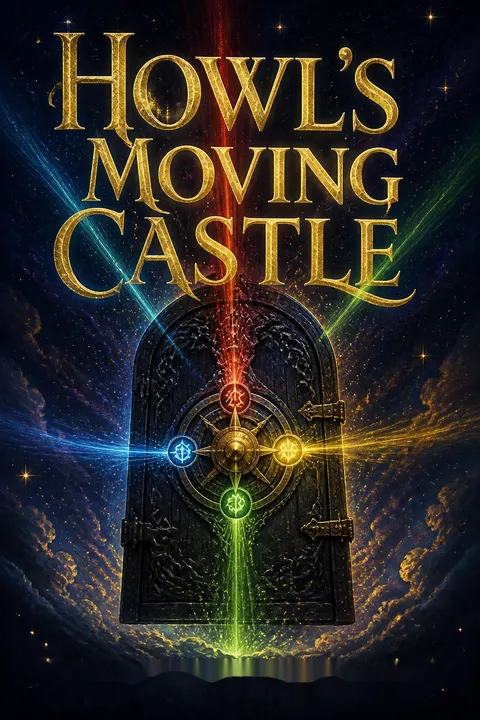
Morning reveals a filthy workshop, an equally neglected bathroom, two upstairs bedrooms, and a backyard piled with scrap. A square knob above the main door changes the destination among the hills, Porthaven, Kingsbury, and a mysterious black setting.
Michael explains that the castle's interior is really Howl's modest house in Porthaven, made mobile by Calcifer's magic. Sophie declares herself the new cleaning woman and begins scrubbing, despite Michael's warnings that Howl will throw her out.
Visitors soon arrive through the colored doors for spells, and Sophie adopts the local reputation of a witch to make herself useful. She learns that Michael saves money because Howl spends it freely, and that both he and Calcifer are burdened with work. Sophie recognizes an old pattern in the wizard's household.
The castle's grand menace is revealed as an elaborate construction around an ordinary home. This reversal fits Sophie's emerging skill: she looks past appearances and asks what actually needs doing. Cleaning is not merely comic defiance. It is how she makes herself indispensable, gathers information, and converts a strange household into a place where she can act. Yet her care can become intrusive; she assumes that everyone needs the order she would impose. The magic doors also make the home porous, linking private life to different communities and obligations. The castle is less a fortress than a workplace with too many entrances.
Slime and a Suitor
Sophie damages the spells on Howl's hair products while cleaning, and the wizard erupts into a spectacular tantrum that fills the room with green slime and drives people from the Porthaven house. Sophie and Michael wash him and the room, then discover that his despair is about a young woman who may love someone else.
When Howl names Lettie Hatter as the woman he is pursuing, Sophie assumes he means Martha, who is posing as Lettie at Cesari's pastry shop. Michael explains that Howl repeatedly charms women, loses interest when they love him, and leaves Michael and Calcifer to manage the fallout.
Sophie grows alarmed for her sister and decides she must reach Upper Folding. She also begins to understand that Howl's reputation for devouring girls grew from Michael's deliberate lies.
Howl's theatrical distress makes his vanity look ridiculous, but the harm around him is real: women are drawn into an unequal game, while Michael handles the consequences. Sophie's anger initially comes from believing Martha is at risk, but it also reflects her new refusal to accept Howl's self-presentation at face value. The false rumor that he eats hearts is itself instructive. A frightening story can protect young women from a charming man, yet it obscures the more ordinary pattern of manipulation that deserves scrutiny. Sophie's moral judgment is becoming sharper, even as mistaken identities complicate what she thinks she knows.
Two Letties in the Valley
Michael lends Sophie one of Howl's prototype seven-league boots, and their first attempts send them bouncing across the valley before they land at Mrs. Fairfax's home. There Sophie sees Howl courting the real Lettie Hatter, who is not Martha in disguise. Mrs. Fairfax knows about the sisters' exchange and has chosen to teach the clever, ambitious Lettie rather than keep Martha against her wishes.
Michael, meanwhile, is relieved to learn that his beloved Lettie at Cesari's, actually Martha, has never met Howl. The sisters' arrangement has allowed each to pursue a chosen future, but it has also tangled two romances around one name. Sophie returns to the castle carrying a more urgent worry: the real Lettie may be trusting Howl.
The boot's comic inability to stop turns travel into a lesson in control: speed is not the same as direction. Sophie reaches the right place only after several accidental landings, much as she has reached this crisis through other people's assumptions. The two sisters' swap is more than a disguise. It is a quiet refusal of a family plan that treated marriage and career as outcomes to be assigned. Yet the deception creates collateral confusion, especially for Michael and Sophie. The scene asks whether self-determination can survive without honesty, and shows Sophie beginning to separate what she fears from what she has actually witnessed.
A Star Refuses Rescue
Michael struggles with a strange sheet of writing he mistakes for an advanced spell. Sophie helps him parse its instructions, and together they use the seven-league boots to chase a falling star across Porthaven Marshes. When Michael reaches it, the small living light begs not to be caught; it chooses to fall into a pool and die rather than be saved.
Their failure leaves Michael shaken. Howl later recognizes the writing as part of a poem by John Donne, not a spell, and explains that the Witch of the Waste has used its verses to curse him. Several conditions have already come true, and the remaining ones point toward Midsummer. Howl now expects the curse to draw him back to the Witch, and Calcifer admits the danger threatens him too.
The star scene overturns Michael's assumption that help is always welcome. The star's fear makes rescue morally complicated: survival imposed on another being can be another form of capture. That question echoes the contract binding Calcifer and the spell binding Sophie. The poem becomes a mechanism that turns language into a timetable, but its riddling form also exposes the limits of clever interpretation. Sophie and Michael try to solve its images literally because that is what they have been taught to do. Howl's recognition shifts the problem from puzzle-solving to responsibility: a curse can be understood and still demand action.
The King Hears Wrong
Howl sends Sophie, dressed as his mother, to visit his former tutor, Mrs. Pentstemmon, before she meets the King. The old magician detects a charm in Howl's suit and warns that he is losing his way; Sophie tells her about the contract with Calcifer.
At the Palace, Sophie forgets Howl's carefully planned speech and describes him as vain, unreliable, and unexpectedly kind. The King takes this as evidence that Howl is exactly the clever, unscrupulous wizard he needs, then appoints him Royal Wizard and orders him to find Prince Justin.
Sophie gets lost afterward and encounters the Witch, who admits killing Mrs. Pentstemmon and sends Sophie back to the Palace. Sophie invents another message from Howl, but the King understands it as further proof of his resolve.
Sophie repeatedly fails at the performance Howl designed for her, yet her unscripted account proves more revealing than his strategy. The King reads contradiction as evidence of complexity: Howl's faults do not cancel his capacity to act. Sophie has not meant to make him Royal Wizard, but she cannot control how institutions interpret her words. Her meeting with the Witch sharpens the stakes by showing that sophisticated magic carries immediate human costs. Mrs. Pentstemmon's death also removes a source of guidance, leaving Sophie to decide whether her developing power is merely a gift or an obligation.
The Curse Crosses Worlds
Howl takes Sophie and Michael through the black door into Wales, where his modern home is a yellow-brick house shared by his sister Megan and her children. The foreign setting explains the strange machines and unfamiliar clothes, but Howl is focused on recovering the missing continuation of the poem. His nephew Neil identifies the writing as schoolwork assigned by his teacher, Miss Angorian.
At her flat, she returns the second verse and reveals that she is engaged to a missing man named Ben Sullivan. As she reads, Howl recognizes the lines as the rest of the Witch's curse: its final conditions will converge when he reaches ten thousand days old, at Midsummer. He calculates that only weeks remain before the Witch can claim him.
Wales widens the novel's world without making it feel like an escape from Ingary's problems. Howl's ordinary family life exposes another version of him, one shaped by Megan's disapproval and his habit of evading demands. The poem binds these worlds together: homework from a child becomes evidence of a curse, and an absent fiancé links Miss Angorian to a history Howl does not yet understand. The deadline adds pressure, but its deeper force is psychological. Howl's evasions have kept danger at a distance; now a sequence of written conditions insists that time and consequence cannot be charmed away.
A Dog Comes Seeking Sophie
Howl returns from Wales with a cold and admits that he has already searched for Prince Justin. The missing prince had followed finding spells from Kingsbury to Mrs. Fairfax, then to Howl's castle, without realizing that his trail was leading toward the Witch.
During Howl's illness, a dog arrives from Upper Folding and struggles to become a man long enough to explain that Lettie sent him to find Sophie. Sophie keeps him close, though he cannot remember who he is.
Howl buys an empty hat shop in Market Chipping, planning to move the castle there, and prepares to attend Mrs. Pentstemmon's funeral in disguise. Sophie cuts up the charmed gray-and-scarlet suit that attracts women, but Michael's enlargement spell makes Howl's other suit enormous instead.
The dog brings the consequences of Howl's courtship into Sophie's home in a form that cannot be dismissed as gossip. He is both a vulnerable guest and a mystery, and Sophie responds to his need before she understands his identity. Howl's account of Prince Justin shows that his apparent avoidance has concealed some real investigative work, although he still resists explaining himself. Meanwhile, Sophie's alterations to the suits show her using practical skills as a form of intervention. Her intentions are protective, but the results are chaotic. Care in this household often arrives as an improvised act whose consequences are not yet visible.
Mermaids in the Harbor
Howl reaches Mrs. Pentstemmon's funeral in the shape of a red setter, keeping his illness and the Witch's attention at bay. Soon afterward, the Witch finds him in Porthaven.
Sophie and Michael watch a magical battle spill over the harbor: mermaids scramble from the waves, a storm traps a ship, and pairs of monstrous creatures race through town into the marshes. The spectacle is partly made of illusions, but the danger to Calcifer is real; the demon is left nearly extinguished after helping Howl fight.
Howl returns exhausted and orders an immediate move. He carries Calcifer on a silver shovel through a spell that transfers the castle's hearth to the purchased shop in Market Chipping, with its other doors leading to a mansion and a flowering place near the Waste.
The harbor fight makes private magic public. Porthaven's residents see the consequences of a conflict they did not choose, while Sophie sees how much of Howl's power depends on Calcifer's labor. The Witch's advantage is not simply strength; she can make appearances and dangers difficult to distinguish. Howl's decision to move the castle is therefore both a tactical retreat and an act of care for those caught in the fight. Carrying Calcifer out of the hearth makes their bond physically precarious. The relocation also turns the household into a new kind of place, connected to Sophie's past and the Witch's territory at once.
Flowers, Fire, and a Scarecrow
The castle settles into a flower garden begun by the missing Wizard Suliman, and Howl opens a flower shop in Sophie's old hat shop. Sophie finds she can keep blossoms alive by speaking to them, then experiments with roots and grows a mandrake flower, fulfilling another part of Howl's curse.
The scarecrow she once propped in a hedge hops back through Market Chipping, but Sophie's words send it away. Miss Angorian later enters through the black door, looking for Howl and claiming that her missing fiancé's guitar may be in the castle.
Sophie wrests the instrument from her and sends her out. These encounters leave Sophie uneasy: the curse is advancing, the scarecrow keeps returning, and the teacher's interest in Howl's guitar feels more dangerous than she admits.
Sophie discovers that her gift does not announce itself through formal spells. It appears in the way she addresses hats, flowers, and a walking stick, as if attention itself can awaken possibility. The garden makes that talent productive, but the mandrake also proves that Sophie can unknowingly help a curse advance. The scarecrow's return complicates her sense of responsibility: she gave it life without understanding what it was, and her words can still affect its movement. Miss Angorian's visit adds an intimacy that Sophie misreads as simple romantic rivalry. Her protectiveness is growing, but jealousy and guilt sometimes steer it.
Percival Remembers the Witch
After Sophie nearly destroys the mansion's weeds with a powerful mixture, Percival explains that the Witch used him to learn about Howl and Sophie, then transformed him into a dog. His account helps Howl understand the visitor Sophie has been sheltering.
Howl, with Calcifer's help, removes the dog's spell and calls the confused man Percival. He recognizes Percival as incomplete and made from parts belonging to more than one person, but cannot yet restore his memories.
Sophie also learns that Howl has known about her age spell all along and tried unsuccessfully to lift it. He assumed she preferred the disguise. Feeling exposed and patronized, Sophie throws the weed-killer at him, then retreats into a sulk as Midsummer approaches and Howl prepares the castle's defenses.
Percival's partial memory turns the dog from a companion into evidence of the Witch's method: she gathers information by disassembling people and remaking them for her purposes. Howl's confession that he recognized Sophie's spell unsettles the intimacy between them. He has tried to help, but withholding what he knew deprived Sophie of the chance to decide what she wanted. Her anger is therefore about more than a mistaken assumption; it is a response to being treated as a problem already interpreted by someone else. The scene also makes Sophie's temper consequential. Her magic can protect, but it can also wound when she acts before thinking.
The Scarecrow Names Its Purpose
On Midsummer, Sophie tries to leave the castle, but Fanny arrives at the mansion and recognizes her. Their emotional reunion brings Martha, Lettie, Mrs. Fairfax, and Percival into the house as well. Miss Angorian arrives and waits while Howl sleeps.
Calcifer suddenly warns that the Witch has found Howl's family in Wales, and Howl rushes out to protect his sister and her children. While the others gather, the scarecrow enters the castle and absorbs the skull from the workbench, gaining a face and the ability to speak.
It explains that it is searching for missing parts. Then the Witch speaks through it, revealing that she has captured Miss Angorian and will release her only if Howl comes to the Waste. Sophie takes the seven-league boots and sets off before Howl can stop her.
The reunion gives Sophie what she had been avoiding: her family sees her altered, and they respond with affection rather than rejection. That acceptance arrives just as the Witch uses another family as leverage against Howl. The scarecrow's transformation shifts it from a frightening pursuer into a messenger with its own unfinished purpose, linking Sophie's seemingly casual kindness to the larger conflict. Yet the Witch exploits that opening to create a trap. Sophie does not wait for permission or certainty. Her decision to go after Miss Angorian comes from guilt, compassion, and an increasingly active sense that her choices matter.
A Heart Returned to Howl
Inside the Witch's fortress, Sophie finds the Witch guarding a headless body built from Prince Justin and Wizard Suliman, awaiting Howl's head to complete a new ruler. The scarecrow bursts in, and Howl follows, using a word of power to end the Witch's attack.
He explains that Miss Angorian is the Witch's fire demon, hidden in the guitar, and that she has invaded the castle. Back home, Angorian seizes Calcifer; Howl collapses because his heart is inside the demon.
Sophie knocks Angorian's hand with her living stick, frees Calcifer, and returns Howl's heart to his chest. Howl destroys the Witch's heart, and Angorian vanishes. The scarecrow and Percival resolve into Suliman and Justin. Sophie's spell lifts, and Calcifer returns freely to the hearth.
The ending resolves the novel's bargains through acts of recognition rather than superior force alone. Sophie understands that Calcifer's apparent heart is also Howl's, and that freeing the demon requires separating their lives without destroying either. Her spoken instructions to the stick and her hands-on restoration of Howl's heart bring together skills she once dismissed as ordinary. The Witch's attempt to manufacture a perfect ruler through stolen body parts contrasts with the recovered, imperfect people around Sophie. Howl remains vain and evasive, but his vulnerability is no longer hidden behind a performance. Freedom here means restoring the possibility of choice, not making everyone flawless.
Analysis
Howl's Moving Castle turns ordinary acts of care into a form of magic, then asks what care costs when it becomes control. Sophie begins by making hats that seem to influence their wearers, but she cannot imagine herself as the source of that influence. Her belief in the eldest child's doomed future is less an imposed curse than an internal rule, one that keeps her talents in service to other people. The Witch's spell makes that self-neglect visible, while life in the castle gradually gives Sophie room to act without the protections of youth, beauty, or social approval.
The story's magical systems repeatedly blur the boundary between help and coercion. Calcifer's bargain offers Sophie a way out, but neither party can explain the whole contract. Howl's romantic pursuits promise delight while leaving women and household companions to manage the damage. The falling star refuses rescue because continued life feels like another form of capture. The Witch's curses and reconstructed bodies are the starkest version of this logic: she treats people as materials to be arranged for her purposes. Against that, Sophie's magic works through attention, conversation, and repair. Her way of speaking to objects does not guarantee good outcomes, but it makes relationships possible where the Witch sees only instruments.
Howl's courage is also presented as a problem of self-knowledge. He acts against the Witch while telling himself he is a coward, and his habits of evasion both delay responsibility and make frightening action possible. Sophie, in turn, does not become powerful by acquiring a clean, heroic identity. She misreads people, damages things, and acts out of jealousy as well as compassion. The resolution depends on her noticing what others are bound to, separating Calcifer from Howl without destroying either, and returning the heart that made their partnership dangerous. The novel's happy ending is therefore not an escape from dependence. It is a movement toward relationships in which obligation can be chosen, revised, and lived with openly.
Review Summary
Howl's Moving Castle is a beloved fantasy novel praised for its whimsical world-building, charming characters, and clever plot. Readers appreciate the witty dialogue, imaginative magic system, and character development, particularly Sophie's growth. Many find it superior to the film adaptation, though both are enjoyable. The book's humor, romance, and themes of self-discovery resonate with readers of all ages. While some found the plot confusing at times, most consider it a delightful and memorable read that stands alongside other classic children's fantasy novels.
People Also Read






Characters
Sophie Hatter
The reluctant eldestThe eldest of three sisters, Sophie is dutiful, observant, and convinced that her birth order has already narrowed her future. She works in the family hat shop, where her skill with needle and trim is matched by a habit of speaking to the things she makes. Sophie often mistakes modesty for a lack of ability and service for the only kind of worth she can claim. Yet she is also blunt, resourceful, and unexpectedly commanding when someone needs help. Her relationships with her sisters are loving but complicated by assumptions she has made about their choices. As the story begins, she is more comfortable solving other people's problems than naming her own desires.
Howl
The evasive wizardHowl is a powerful wizard who maintains several identities and a moving castle, yet avoids commitments with the agility of a professional trickster. He is vain about his appearance, quick to dramatize disappointment, and capable of real generosity toward people who cannot pay him. This mixture makes him difficult to judge: his charm can manipulate, but his care is not wholly counterfeit. Howl depends on his apprentice and fire demon while behaving as if dependence were an inconvenience. His attraction to beautiful women is habitual, and he often pursues the excitement of winning more than the responsibilities that follow. Beneath his evasions is a man who fears what he may become if he faces danger directly.
Calcifer
The captive fire demonCalcifer is the sharp-tongued fire demon who keeps Howl's castle moving and performs much of its magic. He complains about work, food, weather, and Howl's choices, but his grumbling does not make his dependence less real. Bound by a contract, he has limited freedom and an intimate connection to the wizard whose household he powers. He is neither simply villainous nor safely benevolent: he bargains strategically, guards secrets, and shows fear when his life is threatened. Calcifer's relationship with Sophie begins in mutual self-interest, then grows through daily negotiations over cooking, logs, and the castle. He makes magical obligation feel domestic and immediate.
Michael
The steady apprenticeMichael is Howl's young apprentice, a conscientious boy who tries to keep the household solvent and its work moving. Orphaned and rejected after his parents die, he found shelter with Howl and made himself useful before anyone formally offered him a place. He is patient, earnest, and sometimes so focused on doing things correctly that he overlooks what is in front of him. His affection for Lettie gives him a private hope that is more dependable than Howl's romantic pursuits. Michael respects Howl and wants to become a capable wizard, but he can also see the costs of Howl's selfishness. Sophie becomes a disruptive, sometimes exasperating presence who eventually earns his trust.
The Witch of the Waste
The pursuing enchantressThe Witch of the Waste is a formidable sorceress whose long reach extends from the royal court to remote villages and other worlds. She uses beauty, fear, curses, and carefully gathered information to control people around her. Her threats to the King and her pursuit of Howl make her a public danger, but her methods are also intimate: she targets bodies, names, and vulnerabilities. The Witch's power depends on making other people serve a plan they cannot see. She treats resistance as an inconvenience and mistakes control for security. Sophie encounters her first as a customer in the hat shop, where the Witch's interest in Sophie's work reveals how easily ordinary life can attract dangerous attention.
Martha Hatter
The future-minded sisterThe youngest Hatter sister, Martha is clever, affectionate, and clear about wanting a home and a large family rather than the grand fortune others imagine for her. She conspires with Lettie to exchange identities, giving herself time to meet people as herself. Martha's confidence in reading other people's motives helps Sophie see that dutifulness can be exploited. Her relationship with Michael grows through the life she chooses in the pastry shop.
Lettie Hatter
The ambitious sisterSophie and Martha's middle sister, Lettie is strong-minded and interested in learning, particularly magic. The family expects her to follow a conventional path, but she refuses to let her position determine what she can become. She exchanges identities with Martha so each sister can pursue a more fitting apprenticeship. Lettie is perceptive about people and prepared to challenge Sophie when she sees her accepting too little for herself.
Fanny
The practical stepmotherFanny is the Hatter sisters' stepmother and a capable shopkeeper who tries to secure each girl's future after Mr. Hatter dies. Her plans are practical, but the sisters interpret them differently, and Sophie is especially vulnerable to the work she leaves in her hands. Fanny's ambition for a more comfortable life sits alongside genuine affection for the girls. She is neither the ideal guardian Sophie imagines nor the calculating exploiter Martha suspects.
Mrs. Fairfax
The generous magic tutorMrs. Fairfax is a warm, talkative witch with a busy household and a generous approach to teaching. She recognizes Lettie's intelligence and respects a student's right to choose where she belongs. Her fondness for honey finds its way into her spells, making her work as practical and personal as her hospitality. She offers Sophie a glimpse of magic that is neither frightening nor domineering.
Mrs. Pentstemmon
Howl's exacting mentorMrs. Pentstemmon is Howl's formidable former tutor, a renowned magician who values discipline and moral responsibility alongside talent. Her physical frailty does not soften her keen judgment. She sees potential in Howl but worries about the direction of his choices, and she treats Sophie as a person with magical ability rather than a mere messenger. Her high standards challenge both characters to look beyond appearance.
Miss Angorian
The searching schoolteacherMiss Angorian is a young English teacher in Wales, intelligent, self-possessed, and still committed to an absent fiancé. Her composure unsettles Howl's usual confidence, while her interest in his strange appearances and belongings draws her toward the castle. She is not easily charmed into accepting someone else's account of events. Her search for the missing man gives her a motive independent of Howl's attention.
Percival
The troubled strangerPercival is a confused, anxious stranger whose memories and sense of identity have been badly disrupted. He arrives seeking Sophie and Lettie, but cannot give a stable account of his past. His unease makes him wary of Howl, while his attachment to Lettie suggests a history he cannot yet explain. Percival's presence draws Sophie into helping someone who has little power to help himself.
Wizard Suliman
The missing royal wizardWizard Suliman is the King's former magician, sent to confront the Witch of the Waste before the story begins. His disappearance leaves the court without a trusted wizard and helps set the search for Prince Justin in motion. He is remembered as a capable magician and as a friend to the prince. His influence persists through the unfinished magical work he left behind.
Prince Justin
The vanished generalPrince Justin is the King's brother, a brilliant general who leaves the court after a serious disagreement. His disappearance matters to the kingdom as military danger grows, and it matters personally to a king who regrets their quarrel. Justin is closely connected to Wizard Suliman and willing to pursue him when he believes the court has abandoned him.
The King
The calculating monarchThe King of Ingary is practical, politically alert, and more perceptive than Sophie initially expects. He needs his brother's military skill and understands that finding him may require a wizard with an appetite for risk. His authority shapes Howl's choices, though he must read the people around him rather than rely on command alone. He is also a father concerned about threats to his young daughter.
Megan Parry
Howl's disapproving sisterMegan is Howl's older sister in Wales, a respectable, anxious parent who disapproves of his clothes, work, and unconventional life. Her criticism helps explain why Howl prefers to evade confrontation rather than defend himself.
Mari
Howl's young nieceMari is Howl's lively young niece, openly delighted by his visits. Her trust in him reveals a tender, playful side that his reputation in Ingary conceals.
Neil Parry
Howl's distracted nephewNeil is Howl's teenage nephew, absorbed in computer games and wary of interruptions. His missing English assignment provides a crucial link between Howl's two worlds.
Princess Valeria
The threatened royal childValeria is the King's infant daughter, curious and affectionate. The Witch's threat to her helps motivate the King's decisions before Sophie understands how close the danger is.
Jane Farrier
The runaway hat customerJane Farrier is a local customer whose life changes after buying one of Sophie's hats. Her unexpected romantic success gives Sophie early evidence that her work may carry a power she does not understand.
The Count of Catterack
The grateful suitorThe Count of Catterack is a courtier whose reunion with Jane Farrier follows a spell Sophie supplies. He later helps Sophie navigate the Palace when she becomes lost.
Mr. Hatter
The absent fatherSophie's father owns the hat shop and sends his daughters to school, but leaves the family with debts when he dies. His decisions establish the financial pressures that shape their apprenticeships.
Plot Devices
The Eldest-Child Rule
A self-limiting prophecyIn Ingary, birth order carries a familiar story about who is likely to succeed. Sophie accepts the eldest child's supposed failure as a reason not to seek more for herself, even when her sisters reject the futures chosen for them. The belief gives emotional shape to her early timidity and becomes a standard against which she measures each unexpected success. It is not a literal spell, but it behaves like one because Sophie lets it govern what she considers possible. The device makes her growth concrete: she must learn that inherited expectations are not evidence of her actual abilities.
The Castle's Four Doors
A house between worldsA square knob changes the destination of the castle's main door. Its colored settings connect the hills around Market Chipping, Porthaven, Kingsbury, and a mysterious black passage to another world. The castle itself is a small house made mobile through Calcifer's magic, rather than the vast fortress people imagine. The doors let Howl work across several communities and let the story move between fantasy and modern Wales. They also turn privacy into a fragile thing: a visitor may arrive from almost anywhere, and a choice about which door to open can expose the household to danger.
The Witch's Poem
A curse with a deadlineThe Witch hides a curse inside the lines of a familiar poem. Michael mistakes part of it for a spell and tries to complete its images literally, while Howl recognizes the writing as a prophecy whose conditions are already unfolding. Each fulfilled detail narrows the time before Midsummer, when the Witch expects to claim him. The poem binds language, memory, and magical consequence: knowing what it means does not automatically make Howl free of it. Its clues also bring the characters from Ingary into Wales, where the missing lines reveal the deadline and connect the curse to Howl's past.
Calcifer's Contract
A shared life in a hearthCalcifer is bound to Howl by a contract whose essential term neither can state. The demon powers the castle and performs much of its magic, while the arrangement connects his existence to Howl's. Sophie agrees to discover how to break it in exchange for help with her own spell. The contract serves as both a mystery and a test of trust: Calcifer and Howl conceal information, yet their dependence creates genuine vulnerability. Its final stakes are foreshadowed through Calcifer's complaints, Howl's unusual exhaustion when the demon is threatened, and the demon's fear of being separated from the hearth.
Sophie's Living Words
Speech that awakens thingsSophie habitually talks to hats, her walking stick, flowers, and other objects. At first the habit seems like a response to isolation, but the things she addresses begin to display magic. Mrs. Pentstemmon recognizes that Sophie can give life to objects, and the power later affects the scarecrow and the stick. The device connects Sophie's craft as a hat-maker to her emerging magical ability: she notices what a thing might become and speaks to it as if that future is possible. Because her words have force, casual encouragement and angry instructions can both carry consequences she does not expect.
FAQ
Synopsis & Basic Details
What is Howl's Moving Castle about?
- Eldest daughter's journey: Sophie Hatter, the eldest of three sisters in a land where being the eldest is a misfortune, is cursed by the Witch of the Waste and transformed into an old woman.
- Seeking a cure: To break the curse, Sophie seeks refuge in the moving castle of the infamous Wizard Howl, where she becomes his cleaning lady.
- Magical bargains and self-discovery: Inside the castle, Sophie makes a bargain with a fire demon, Calcifer, and becomes entangled in Howl's life, discovering her own magical abilities and the true nature of the curses that bind them.
Why should I read Howl's Moving Castle?
- Unique magical world: Diana Wynne Jones creates a whimsical and enchanting world filled with quirky characters, moving castles, and unpredictable magic.
- Complex character development: The story delves into the complexities of its characters, exploring their motivations, fears, and desires, leading to significant personal growth.
- Themes of self-acceptance and love: The novel explores themes of self-acceptance, inner beauty, and the transformative power of love, making it a heartwarming and thought-provoking read.
What is the background of Howl's Moving Castle?
- Fantasy setting: The story is set in the fictional land of Ingary, a place where magic is commonplace and coexists with everyday life, creating a unique blend of the mundane and the fantastical.
- No specific historical period: The novel does not adhere to a specific historical period, but rather draws inspiration from various cultural and literary traditions, creating a timeless feel.
- Focus on character and magic: The background serves primarily as a backdrop for the characters' personal journeys and the exploration of magical themes, rather than a detailed historical or political context.
What are the most memorable quotes in Howl's Moving Castle?
- Sophie's self-acceptance: "Don't worry, old thing. You look quite healthy. Besides, this is much more like you really are." This quote highlights Sophie's initial acceptance of her old age, revealing her inner strength.
- Calcifer's contract: "I'll break your spell if you agree to break this contract I'm under." This quote introduces the central bargain of the story, setting the stage for Sophie's quest and the exploration of Calcifer's predicament.
- Howl's self-awareness: "I've reached that stage in my career when I need to impress everyone with my power and wickedness. I can't have the King thinking well of me." This quote reveals Howl's performative nature and his desire to maintain a specific image, hinting at his underlying insecurities.
What writing style, narrative choices, and literary techniques does Diana Wynne Jones use?
- Whimsical and humorous tone: Jones employs a lighthearted and often humorous tone, using witty dialogue and absurd situations to create an engaging and entertaining reading experience.
- Third-person limited perspective: The story is primarily told from Sophie's perspective, allowing readers to experience the world through her eyes and understand her thoughts and feelings, while maintaining some narrative distance.
- Subversion of tropes: Jones subverts traditional fantasy tropes, creating characters who are flawed and complex, and plots that are unpredictable and often defy expectations, adding depth and originality to the story.
Hidden Details & Subtle Connections
What are some minor details that add significant meaning?
- The color green: The recurring motif of the color green, particularly in the caterpillar-green hat and Howl's green slime, symbolizes change, growth, and Howl's emotional state, adding a layer of visual symbolism.
- The human skull: The presence of the human skull on the workbench, initially a seemingly random object, later becomes a symbol of Wizard Suliman and his connection to the Witch of the Waste, revealing a deeper layer of the story's history.
- The seven-league boots: The seven-league boots, initially presented as a magical item, become a symbol of Sophie's journey and her ability to overcome obstacles, highlighting her inner strength and determination.
What are some subtle foreshadowing and callbacks?
- Sophie's hat conversations: Sophie's habit of talking to hats foreshadows her ability to talk to and influence magical beings, hinting at her hidden magical potential.
- The scarecrow's appearance: The scarecrow's initial appearance as a discarded object foreshadows its later significance as a key ally, highlighting the interconnectedness of seemingly random events.
- The mention of Wales: The seemingly throwaway mention of Wales early in the story foreshadows Howl's connection to that place and the eventual reveal of his family and the source of the Witch's curse.
What are some unexpected character connections?
- Howl and Mrs. Pentstemmon: The connection between Howl and Mrs. Pentstemmon, his former tutor, reveals a hidden layer of his past and his potential for good, challenging his reputation as a heartless wizard.
- Percival and Prince Justin: The revelation that Percival is a combination of Prince Justin and Wizard Suliman highlights the Witch's manipulative power and the interconnectedness of the characters' fates.
- Sophie and the Witch: The subtle connection between Sophie and the Witch, both being powerful women with a history of being underestimated, adds a layer of complexity to their conflict and reveals a hidden parallel between them.
Who are the most significant supporting characters?
- Calcifer: As the fire demon bound to Howl, Calcifer is a key figure in the plot, driving much of the action and providing a unique perspective on the events, while also being a source of humor and warmth.
- Michael: As Howl's apprentice, Michael serves as a foil to Howl's chaotic nature, providing a sense of stability and loyalty, and also acting as a bridge between the magical and mundane worlds.
- Mrs. Fairfax: As a wise and kind witch, Mrs. Fairfax provides guidance and support to Sophie and Lettie, and her knowledge of magic and her connection to the past add depth to the story's world.
Psychological, Emotional, & Relational Analysis
What are some unspoken motivations of the characters?
- Howl's fear of commitment: Howl's constant pursuit of new love interests masks his deep-seated fear of commitment and vulnerability, stemming from his past experiences and the Witch's curse.
- Sophie's desire for purpose: Sophie's initial resignation to a dull life hides her deep desire for purpose and meaning, which she finds through her journey and her relationships with Howl and Calcifer.
- Calcifer's longing for freedom: Calcifer's sarcastic and often grumpy demeanor hides his deep longing for freedom from his contract with Howl, revealing his desire for autonomy and self-determination.
What psychological complexities do the characters exhibit?
- Howl's performative nature: Howl's constant need to maintain a specific image of power and wickedness reveals his underlying insecurities and his struggle with his own identity.
- Sophie's low self-esteem: Sophie's initial belief that she is destined for a dull life and her acceptance of her old age reveal her low self-esteem and her struggle to see her own worth.
- The Witch's loneliness: The Witch's desire for power and control masks her deep-seated loneliness and her longing for connection, revealing her vulnerability and her tragic past.
What are the major emotional turning points?
- Sophie's transformation: Sophie's transformation into an old woman is a major emotional turning point, forcing her to confront her fears and embark on a journey of self-discovery.
- Howl's green slime tantrum: Howl's dramatic reaction to his hair color reveals his deep-seated insecurities and his emotional immaturity, highlighting his vulnerability and his need for validation.
- Sophie's realization of Howl's heart: Sophie's discovery that Howl gave his heart to Calcifer is a major emotional turning point, revealing his capacity for selflessness and his hidden depths of kindness.
How do relationship dynamics evolve?
- Sophie and Howl's evolving relationship: Sophie and Howl's relationship evolves from initial fear and suspicion to a deep and complex love, as they learn to see each other's true selves and accept each other's flaws.
- Sophie and Calcifer's bond: Sophie and Calcifer's relationship evolves from a transactional bargain to a genuine friendship, as they learn to trust and rely on each other, highlighting the importance of connection and understanding.
- Michael's growing affection for Sophie: Michael's initial view of Sophie as a natural disaster evolves into a deep affection and respect, as he comes to appreciate her kindness, strength, and wisdom.
Interpretation & Debate
Which parts of the story remain ambiguous or open-ended?
- The nature of the Witch's power: The exact nature of the Witch's power and her motivations remain somewhat ambiguous, leaving room for interpretation and debate about her true intentions and her tragic past.
- The origins of the curse: The origins of the curse on Howl and Sophie are not fully explained, leaving room for speculation about the nature of magic and its impact on the characters' lives.
- The future of the characters: The ending leaves some aspects of the characters' futures open-ended, allowing readers to imagine their lives beyond the confines of the story and to consider the long-term implications of their choices.
What are some debatable, controversial scenes or moments in Howl's Moving Castle?
- Howl's treatment of women: Howl's initial pattern of wooing women only to lose interest once they fall for him is a controversial aspect of his character, raising questions about his morality and his capacity for genuine love.
- Sophie's initial acceptance of her old age: Sophie's initial acceptance of her old age and her lack of resistance to the curse can be interpreted as both a sign of her inner strength and a reflection of her low self-esteem, sparking debate about her agency and her motivations.
- The nature of the contract: The nature of the contract between Howl and Calcifer is open to interpretation, raising questions about the ethics of magical bargains and the consequences of sacrificing one's heart.
Howl's Moving Castle Ending Explained: How It Ends & What It Means
- The breaking of the contract: Sophie's decision to break Calcifer's contract, despite the potential consequences, highlights her selflessness and her willingness to sacrifice her own happiness for the sake of others.
- The defeat of the Witch: The defeat of the Witch represents the triumph of love and self-acceptance over fear and control, emphasizing the importance of embracing one's true identity and rejecting the influence of external forces.
- The new beginning: The ending, with Sophie and Howl together and the castle moving to a new location, symbolizes a new beginning and the promise of a future filled with love, adventure, and the acceptance of their true selves.
Howl's Moving Castle Series


About the Author
Other books by Diana Wynne Jones

Download PDF
Download EPUB
.epub digital book format is ideal for reading ebooks on phones, tablets, and e-readers.








