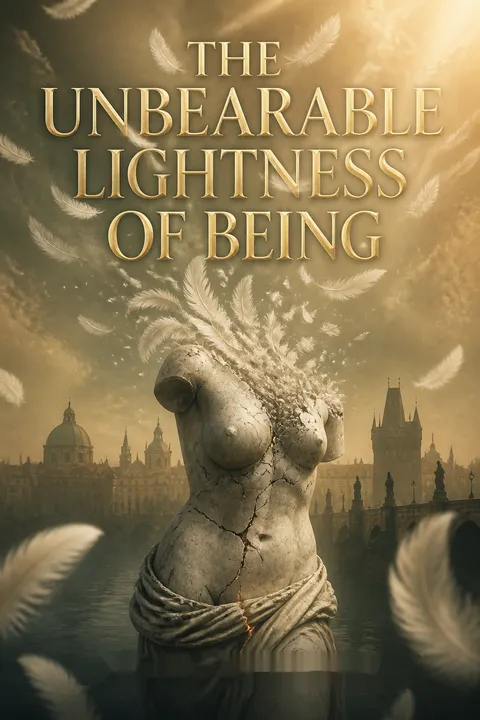


Plot Summary
A Suitcase at the Station
Years after divorcing his wife and abandoning contact with his son, Tomas, a Prague surgeon, has built his life around brief affairs and strict emotional distance. Then he meets Tereza, a waitress in a provincial hotel, when a chance work trip brings him to her town. She later appears at his Prague flat with a fever, a book, and nowhere else to go.
Tomas cannot decide whether his tenderness is love or a passing impulse, but when she returns with a heavy suitcase, he takes it from the station and lets her stay. He breaks his own rules before he can settle whether he wants to. Tereza’s arrival turns his bachelor life into a choice with consequences.
Tomas wants a life without obligations, yet his first meaningful decision is not made through certainty. Tereza’s suitcase makes his abstract hesitation physical: letting her stay means accepting that another person may depend on him. The novel refuses to certify this as destiny. Their meeting requires a chain of coincidences, and Tomas cannot test whether another choice would have been better. Love begins here less as a settled feeling than as an interpretation he gives to an unrepeatable event.
The Bed Becomes a Bond
Tomas arranges a job for Tereza through Sabina, his longtime lover, and tries to keep his new attachment separate from his affairs. But Tereza’s recurring nightmares turn his infidelities into scenes of public humiliation, while she searches his papers and finds proof of his intimacy with Sabina. Tomas, who denies and then rationalizes his betrayals, discovers his own jealousy when Tereza dances with a colleague.
He marries her and gives her a puppy, Karenin, but marriage does not end the unequal bargain: Tereza longs to be irreplaceable, while Tomas still seeks novelty in other women. Her childhood under a mother who mocked privacy and exposed her body helps explain why fidelity means safety, not merely sexual exclusivity.
The couple want different forms of reassurance. Tomas treats sex as an activity that can remain detached from attachment, but his jealousy shows that he demands from Tereza the exclusivity he will not offer her. For Tereza, the body is never neutral: her mother taught her that privacy and personal distinction could be taken away. The nightmares make that history visible without resolving it. Karenin brings tenderness and routine into their home, but neither marriage nor affection can erase the power imbalance that has formed between them.
Prague Under the Tanks
In August 1968, Soviet tanks invade Czechoslovakia and interrupt the brief exhilaration of political freedom. Tereza spends the first week photographing soldiers, damaged streets, and Czech resistance, then passes her undeveloped film to foreign journalists.
Russian troops arrest and threaten her, but she returns to the streets with her camera after being released. When the occupation settles into compromise and humiliation, she agrees to Tomas’s offer of exile in Switzerland. The couple move to Zurich, while Sabina settles in Geneva.
Tereza finds that her photographs cannot secure meaningful work abroad, and she grows lonely while Tomas builds a new medical career. The invasion gives Tereza a rare sense of courage, but exile strips away the public purpose that sustained it.
Tereza’s camera lets her act when political power has made ordinary speech useless. Her images preserve evidence, but they cannot preserve the solidarity of the first days of resistance or guarantee that anyone abroad will care. The move to Switzerland is both escape from occupation and loss of the conditions in which Tereza briefly felt strong. For Tomas, emigration is a practical new beginning; for Tereza, it exposes how much her sense of self has depended on place, work, and collective danger.
The Zurich Goodbye
After six or seven months in Zurich, Tereza leaves Tomas a letter and returns to Prague with Karenin. She believes she has failed to become stronger abroad and that her dependence is burdening him. At first Tomas feels liberated: the pressure of her jealousy and his lies seems to have lifted, and his old bachelor life appears available again.
Then he imagines Tereza alone in their Prague flat, and compassion overwhelms his relief. He abandons his promising Swiss post and drives back through Russian military checkpoints. The reunion does not restore their earlier certainty. Tomas realizes that the chance events that brought them together might just as easily have led elsewhere, yet he has returned because he cannot bear to leave her alone.
Tomas’s freedom is not false, but it is incomplete. He can enjoy Tereza’s absence only while he keeps her suffering out of view; imagining her alone changes the moral weight of his decision. Compassion functions as an involuntary form of intimacy, making another person’s vulnerability impossible for him to treat as irrelevant. His return does not prove that their love was fated. It shows instead that a choice can become binding through the consequences one is unwilling to abandon.
A Hat Between Worlds
In Geneva, Sabina, a Czech painter, becomes the secret lover of Franz, a married university professor. Sabina’s black bowler hat carries memories of her grandfather, her father, and her erotic history with Tomas. When she wears it in front of Franz, he reads the gesture as a playful invitation and removes the hat, missing the meanings she is trying to share.
Their differences run deeper than this one misreading. Franz treasures fidelity, public causes, and the emotional grandeur of political marches; Sabina prizes privacy, artistic ambiguity, and the freedom to leave. He imagines their love as a shared story, while she fears that naming it publicly will turn it into a role she must perform.
The hat is not a code with one correct translation. It accumulates meanings through Sabina’s past, while Franz sees only the immediate scene between them. Their intimacy therefore contains a structural mismatch: they can understand each other’s words and still inhabit different emotional histories. Franz wants love to make him vulnerable in a legible, shared way. Sabina protects herself by keeping meanings provisional and private. Neither position is simply a failure of feeling, but the gap between them steadily shapes what each can ask of the other.
Truth Opens the Door
After Franz’s wife, Marie-Claude, publicly belittles one of Sabina’s handmade pendants, Franz decides he can no longer hide their affair. He confesses and expects his honesty to begin a life with Sabina. She feels instead that their private relationship has been exposed to an audience and made heavier by other people’s expectations.
They travel to Rome, but Sabina’s passionate farewell leaves Franz believing she has accepted his choice. When he returns to Geneva and tries to find her, he learns she has already given up her studio and left without an address. Franz moves into a small flat, begins a new relationship with a student, and discovers that Sabina’s absence has given him a freedom he had never managed to claim for himself.
Franz mistakes disclosure for intimacy. To him, telling Marie-Claude is an ethical release from deception; to Sabina, it destroys the privacy that made the affair bearable. Their opposing ideas of truth have concrete consequences: his declaration opens a door she chooses not to enter. Yet her departure also changes his life in ways he did not anticipate. He can build a home on his own terms, although he continues to preserve Sabina as an ideal, safer than the actual woman whose meanings he could not read.
The March to Cambodia
Years later, Franz joins Western doctors and intellectuals traveling to the Cambodian border to demand entry for medical aid. The event becomes a contest over microphones, celebrity, and who leads the procession.
A photographer steps on a mine and dies, but the American actress and a German singer continue marching beneath a bloodstained flag. At the border, the group receives only silence from the Vietnamese forces. Franz returns to Bangkok, where three men try to rob him.
Remembering Sabina’s admiration for strength, he fights back and is struck down. He wakes in a Geneva hospital unable to speak, with Marie-Claude beside him. After his death, she recasts his life as a return to the marriage he had left, while his student lover grieves away from the public ceremony.
Franz’s march begins as an attempt to make political concern visible, but its spectacle repeatedly competes with its humanitarian purpose. The cameras make symbolic action legible while the actual border remains closed. Franz’s private need for Sabina’s imagined approval also shapes his participation, though he does not fully recognize this motive. His final act of resistance to the robbers cannot undo his habitual vulnerability or restore the relationship he idealized. Afterward, Marie-Claude’s public account of his life demonstrates how easily an individual is simplified into a story that serves the living.
The Engineer's False Room
Back in occupied Prague, Tereza loses her photography job and works behind a hotel bar. She tries to understand Tomas’s distinction between sex and love by accepting the advances of a tall man who presents himself as an engineer.
In his bare, book-filled flat, she experiences desire and revulsion at once, then leaves without forming an attachment. A government official later explains that secret police stage compromising encounters to recruit informers. Tereza begins to suspect that the supposed engineer had filmed her for blackmail, though she cannot prove it.
Soon afterward, she finds a crow buried alive by children and carries its injured body home. Its helplessness sharpens her fear that Prague has become a place where privacy and kindness are both under threat.
Tereza’s experiment does not teach her that casual sex is liberating or meaningless. Instead, it makes her newly conscious of her own body as both vulnerable and distinct, while the possible surveillance turns private experience into political evidence. Her suspicion remains unresolved, which is itself important: the state’s power works partly by making citizens imagine the hidden listener in every room. Rescuing the crow gives her a concrete object for her compassion, but it also clarifies how unsafe she feels among people who can harm the powerless without consequence.
Oedipus Costs a Career
Before the invasion, Tomas writes an essay using the story of Oedipus to challenge Communist officials who claim innocence because they did not know about political crimes. The newspaper cuts much of his argument, but the regime still treats its surviving point as an attack.
After Tomas returns to Prague, hospital leaders ask him to retract it so he can keep operating. He refuses, despite knowing his colleagues expect him to comply, and is removed from surgery.
A later Ministry official tries to coax him into signing a broader statement that would praise the regime and implicate the newspaper’s editors. Tomas withholds the editor’s identity, resigns from his clinic, and becomes a window washer rather than lend his name to a false confession.
Tomas’s refusal is not a clean victory. The article was altered without his permission, its public meaning exceeds his intention, and neither truth nor silence offers a safe route through the regime’s demands. His professional loss forces him to distinguish medicine, the work he chose from within, from the political identity imposed on him. At the same time, his resistance is partly defensive: he wants to escape the police’s leverage. The novel keeps conviction and self-protection intertwined rather than presenting courage as a pure, consequence-free act.
A Son's Petition
While washing windows, Tomas is summoned to meet Simon, the son he has not seen since childhood, and a former newspaper editor. Simon has become involved with dissidents and asks Tomas to sign a petition seeking amnesty for political prisoners.
Tomas recognizes that the petition may help identify its signatories to the authorities, and he also fears renewed scrutiny of Tereza. He refuses, despite feeling drawn to the editor’s courage and wanting some connection with Simon.
The petition appears in the state-controlled press as an anti-government provocation, and its signers face public smears. Simon continues his own path, eventually becoming a farmer and a religious man. Tomas and his son remain connected more by resemblance and letters than by any settled understanding.
The petition compresses Tomas’s competing obligations into a choice that offers no reliable measure of good. Signing might affirm solidarity, but the authorities can turn that act into a pretext for further repression. Refusing protects Tereza from added exposure, while deepening the distance from Simon. Tomas is not simply choosing private love over public courage; he doubts the petition’s likely effect and resists being forced into a symbolic role. Simon, meanwhile, seeks his father’s recognition as much as political agreement, a motive neither man can openly resolve.
The Village's Narrow Peace
After years of surveillance, lost work, and strain, Tomas and Tereza leave Prague for a village where Tomas drives a farm truck and Tereza tends cattle. They sell most of what they own to buy a small cottage and garden, and Karenin becomes the clock of their shared routine.
Tereza also grows close to the animals she tends, whose lives seem less governed by performance and shame than human life. A dream in which a gunman shoots Tomas and he becomes a rabbit exposes her fear of losing him and her longing for a safe, childlike refuge. Then Tomas discovers a cancerous lump on Karenin’s leg. Surgery cannot stop the disease, and the dog’s condition worsens.
The village offers neither an ideal pastoral world nor a return to the past. Its inhabitants are isolated and often wish to leave, but its distance from political scrutiny gives Tomas and Tereza room to live without constant judgment. Tereza’s care for animals lets her imagine goodness outside human bargaining, while Karenin’s illness makes that care painfully finite. The rabbit dream condenses her dependency into an image of Tomas stripped of strength. Their rural refuge can shelter them from public life, but it cannot protect them from loss.
Karenin's Last Roll
As Karenin weakens, Tomas and Tereza keep up the small rituals that have ordered their days: the morning roll, walks, and games that once made the dog yelp with pleasure. For a brief moment, Tomas crawls toward him with a roll in his mouth, and Karenin answers with the play sounds they take as a smile. The cancer soon leaves him unable to walk without pain.
Rather than make him suffer longer, Tomas prepares an injection, while Tereza holds Karenin’s head and comforts him. They carry him to the garden and bury him beneath the apple trees, adding his collar, leash, and uneaten chocolate. Their grief does not divide them; they share the burial even when they cannot share every other fear.
Karenin’s death makes care an action rather than a sentiment. Tomas and Tereza must decide when continued life has become continued suffering, then accept responsibility for ending it. The familiar roll briefly restores their old routine, but it cannot reverse the illness. Their shared burial gives grief a physical place in the garden they have made together. The scene also contrasts human love, burdened by demands and interpretation, with the unguarded bond Tereza experiences with her dog. That bond is not exempt from pain; it makes the pain more intimate.
Dancing Without a Mission
After Karenin’s death, Tereza watches Tomas struggle with a broken farm truck and recognizes how much his old career has cost him. She blames herself for his return from Switzerland and for the compromises that brought them to the village. Tomas insists that he has been happy there and that no profession or destiny has an absolute claim on him.
A young farm worker invites them to a nearby hotel, where an elderly pianist and violinist play for a handful of dancers. Tomas and Tereza take turns dancing with the others, then dance together. Their sadness comes from knowing their life is limited; their happiness comes from being beside each other without needing to justify the life they chose.
The final dance revises the meaning of Tomas’s lost career. Tereza has treated surgery as the central measure of what he sacrificed, but Tomas refuses to equate vocation with the whole value of a life. His contentment does not erase the cost of their choices; it changes the standard by which they judge them. The modest dance hall offers no political spectacle, intellectual triumph, or promise of permanence. Its smallness matters. For once, the couple can inhabit the present without converting it into evidence for or against their love.
The Last Letter
After Tomas and Tereza’s years in the village, their pickup truck crashes on a hill road because its brakes are in disastrous condition. They die together. Simon, now a farmer, writes to Sabina in Paris because she had been close to his father. The news breaks the last living link to her Czech past.
Sabina takes refuge in a cemetery, where she reflects on the difference between a grave covered with earth and one sealed by stone. She imagines Tomas and Tereza’s shared life as a quiet happiness rather than a tragic mistake. With no place she can call home, she moves farther west and asks for her own body to be cremated and scattered.
The accident gives no final moral verdict on Tomas and Tereza’s choices. Their deaths are sudden and ordinary, the consequence of a badly maintained vehicle rather than a grand design. Sabina receives their story only through Simon’s letter, and must interpret a life she did not witness in its final years. Her cemetery reflections turn mourning into a question of whether the dead can remain part of the living imagination. Her decision to keep moving preserves her freedom, but also reveals its cost: escape has left her with no durable home.
Analysis
The novel treats a human life as something that cannot be rehearsed. Tomas and Tereza must choose without access to a second version of themselves who could test the alternative. That condition makes coincidence feel powerful, but the story resists turning coincidence into proof of destiny. Tomas’s return to Tereza is neither a triumphant confirmation of fate nor an error he can cleanly undo. He chooses with incomplete knowledge, then discovers what the choice has made possible and what it has cost. The political history of Czechoslovakia intensifies this uncertainty. Under occupation, speech, photographs, petitions, and professional decisions all become vulnerable to appropriation. Tomas’s essay is cut; Tereza’s photographs are useful to journalists but politically dangerous; the petition for prisoners may expose those it hopes to help. Resistance is necessary, yet its results cannot be guaranteed. The novel’s moral attention rests on that uncomfortable interval between acting responsibly and knowing what responsibility will produce.
Its treatment of bodies makes the private life equally political. Tereza’s mother denies her privacy, while the regime turns private conversation into broadcast material. Tereza seeks a unique self through her body and photographs; Tomas often approaches other bodies as mysteries to be examined. Their conflicts show that intimacy depends not only on desire but on whether another person is recognized as singular and entitled to boundaries.
Finally, Karenin offers a counterpoint to human life organized around interpretation, status, and competing ideals. The dog’s rituals do not solve the couple’s problems, but they give their days a shared rhythm and make care unmistakably concrete. When Tomas and Tereza choose village life and later mourn Karenin, they do not escape history or mortality. They arrive instead at a modest happiness that does not require a grand explanation. The novel’s deepest claim is not that lightness is better than weight, but that no abstract principle can decide the value of a life lived only once.
Review Summary
The Unbearable Lightness of Being is a philosophical novel that explores themes of love, fate, and human existence. Readers praise Kundera's intellectual prose and thought-provoking ideas, though some find the characters unsympathetic. The book's blend of philosophy and narrative polarizes opinions, with many lauding its profound insights while others criticize its pretentiousness. Despite mixed reactions, most agree on the novel's significance in modern literature. The recurring motifs of lightness and weight, along with Kundera's unique storytelling style, leave a lasting impression on many readers.
People Also Read








Characters
Tomas
A restless Prague surgeonTomas is an accomplished surgeon who has arranged his intimate life around sexual freedom and emotional distance. His divorce and estrangement from his son have taught him to distrust obligations that others call natural or necessary. He is curious about people, professionally precise, and often more compassionate than his theories about love allow. Tereza unsettles his carefully divided existence because he cannot treat her vulnerability as incidental. His attraction to women and his commitment to medicine both begin as forms of inquiry, but political pressure forces him to confront what he is willing to lose. Tomas’s central tension is not simply between freedom and commitment; it is between chosen principles and the unchosen feelings that keep undoing them.
Tereza
A searching photographerTereza is a perceptive, self-conscious woman who longs to experience her body as uniquely hers rather than as one body among many. Her mother’s contempt for privacy and modesty leaves her hungry for a life organized around dignity, books, and emotional fidelity. She arrives in Prague with little security but considerable courage, first as a photographer and later as someone trying to understand the limits of dependence. Tomas’s infidelities intensify her fear that love cannot protect what matters most to her. Her tenderness toward Karenin and other animals reveals a capacity for attachment that does not depend on reciprocity or control. Tereza’s vulnerability is real, but it is not the same as passivity.
Sabina
A painter of hidden worldsSabina is a Czech painter who resists political conformity and personal possession alike. She distrusts public narratives that turn complicated lives into simple emblems, and her canvases place polished surfaces beside fractures that reveal what lies beneath. Her relationships are shaped by a desire to leave before anyone can make her into a fixed role. She values privacy not because she feels nothing, but because intimate meanings become distorted when exposed to an audience. The bowler hat she carries gathers memories that no one else can fully share. Sabina’s independence gives her room to move, but it also makes permanence difficult to imagine.
Franz
A professor seeking the marchFranz is a Swiss academic whose confidence in public life contrasts with his emotional uncertainty in private. He loves music, enjoys demonstrations, and is drawn to the idea that collective action can make history meaningful. His kindness often prevents him from imposing himself, yet he mistakes restraint for moral virtue and struggles to see when others experience his ideals as pressure. Sabina fascinates him because her history seems to contain the danger and drama absent from his settled life. He wants love to be shared openly, while she sees exposure as a threat. Franz’s longing to join a cause and his need to be loved often overlap without his recognizing the difference.
Karenin
The household's steady companionKarenin is the dog Tomas gives Tereza, a companion whose daily habits organize the couple’s mornings, walks, and nights. He dislikes change and responds to affection through ritual rather than explanation. His attachment to Tereza is particularly strong, but he becomes a source of shared tenderness for both partners. Karenin’s place in the household offers a form of intimacy without the jealousy, negotiation, or self-consciousness that complicate human love. The dog is not a decorative symbol: his needs shape where Tomas and Tereza live and how they spend their time. Through him, the novel asks what people owe to a vulnerable creature who cannot bargain for its care.
Simon
A son seeking recognitionSimon is Tomas’s estranged son, raised largely outside his father’s life. He grows interested in the people and causes that place him at odds with the political order, and he seeks a connection to Tomas through shared convictions. Simon’s political commitment is personal as well as public: he wants his father to see the adult he has become. His religious belief offers a way to live ethically without waiting for the regime to change. He is not simply Tomas’s moral opposite; both men are trying to act responsibly with limited certainty, though they imagine responsibility differently.
Marie-Claude
Franz's forceful wifeMarie-Claude is Franz’s socially assured wife and the mother of their daughter. She knows how to command attention in galleries and gatherings, and she treats public life as a stage on which she can set the terms. Her confidence contrasts with Franz’s gentler manner, while her understanding of marriage is more combative than his. She values recognition and appearances, but she is also capable of responding to disruption without the collapse Franz expects. Her presence helps expose how differently spouses can imagine loyalty, dignity, and the right to define a shared life.
Tereza's mother
A mother who invades privacyTereza’s mother treats modesty and privacy as pretensions, exposing her daughter’s body and private writing to ridicule. She presents motherhood as sacrifice and makes Tereza feel indebted for her existence. Her behavior is not merely coarse; it enforces a world in which individual boundaries carry little authority. Tereza continues to love her, which makes separation emotionally difficult even when it is necessary. The mother shapes Tereza’s longing to distinguish her own identity from the body and family history imposed on her.
The collective farm chairman
A village allyThe chairman is a local farmer who becomes Tomas and Tereza’s friend after they settle in the countryside. He helps Tomas find work and treats the couple as neighbors rather than as disgraced political figures. His family and his unusually beloved pig, Mefisto, anchor him in the village’s modest routines. He is practical about rural life and does not mistake it for an idyllic escape, yet his welcome gives Tomas and Tereza a place outside the scrutiny of Prague.
The former editor
A dissident editorThe former editor is a courageous intellectual whose newspaper was suppressed after the invasion. He helps organize a petition for political prisoners and asks Tomas to sign it. His willingness to act despite likely failure gives Simon a model of public commitment. At the same time, he understands that a petition may function as a visible statement of resistance even when it cannot secure immediate release. He represents the difficult choice to act under conditions where political power can distort both action and silence.
The student mistress
Franz's younger companionFranz’s student lover is a young woman with large glasses who admires him and shares his enjoyment of music, conversation, and public life. She asks little of him beyond his presence, but her dependence makes his choices consequential. Her quieter relationship with Franz contrasts with the idealized place he continues to give Sabina.
The chief surgeon
Tomas's hospital mentorTomas’s chief surgeon respects his medical ability and wants to keep him at the hospital. He urges Tomas to make a private retraction that would satisfy the authorities without public humiliation. His pragmatism reflects the compromises demanded of professionals under political pressure, even when he believes the demand itself is degrading.
Plot Devices
Lightness and weight
Measures choices against fateThe novel repeatedly tests whether freedom from obligation makes life more vivid or merely less substantial. Tomas first experiences Tereza’s departure as liberation, then feels the weight of her imagined loneliness and returns to Prague. His career losses later appear both devastating and unexpectedly freeing. These reversals prevent lightness and weight from becoming simple moral categories. A choice may feel light because it leaves no visible mark, yet still carry lasting consequences; a burden may be painful and also give a life its shape. The device organizes the characters’ decisions without providing a final formula for judging them.
The bowler hat
Stores shifting private meaningsSabina’s bowler hat links her to family history, artistic independence, and erotic play. Each appearance changes its significance, while earlier associations continue to linger. Tomas understands some of its intimate meanings because he has shared its history with her. Franz sees the same object but cannot read the private context it carries. The hat therefore makes the difference between shared experience and shared interpretation tangible. It also resists the idea that an object, a gesture, or a person can be reduced to one stable meaning.
The camera
Records power and exposureTereza’s camera first gives her a way to document the Soviet invasion when public resistance is being crushed. Her images reach foreign journalists, but they do not guarantee lasting attention or change. Later, photography is bound to questions of intimacy and vulnerability, as Tereza uses the camera in Sabina’s studio and fears that police may have recorded her private encounter with the supposed engineer. The camera can preserve evidence, create art, or become an instrument of surveillance. Its meaning depends on who controls the image and who gets to see it.
Oedipus
Tests innocence after harmTomas’s essay uses the Oedipus story to challenge officials who claim that ignorance absolves them of responsibility for political crimes. Oedipus does not know the truth about his family, yet punishes himself once he understands the consequences. The analogy costs Tomas his medical position and later draws him into a second confrontation over political speech. It also remains morally unsettled: Tomas questions whether punishment is just when wrongdoing was committed unknowingly. Oedipus is therefore not a tidy lesson but a device for exposing the gap between innocence of intention and responsibility for consequences.
The Grand March
Turns ideals into spectacleFranz imagines political demonstrations as a collective movement toward justice and shared purpose. His trip toward Cambodia reveals how easily that ideal becomes a performance shaped by cameras, celebrity, national rivalries, and competing slogans. The marchers want to help people, but the border remains closed and the group cannot compel an answer. The device also echoes public rituals in Communist Czechoslovakia, where displays of unity conceal coercion and dissent. By placing aspiration beside spectacle, the novel asks when symbolic action bears witness and when it merely stages the participants’ preferred image of themselves.
FAQ
Synopsis & Basic Details
What is The Unbearable Lightness of Being about?
- Philosophical love story: The novel explores the lives of several characters, primarily Tomas and Tereza, as they navigate love, commitment, and the weight of existence against the backdrop of political turmoil in Czechoslovakia.
- Dichotomy of lightness and weight: It examines the philosophical concepts of lightness and weight, questioning whether a life of freedom and detachment is preferable to one of responsibility and commitment.
- Complex relationships: The story delves into the intricacies of human relationships, exploring themes of love, infidelity, jealousy, and the search for meaning in a world marked by both personal and political upheaval.
Why should I read The Unbearable Lightness of Being?
- Profound philosophical questions: The novel grapples with fundamental questions about life, love, and the nature of existence, prompting readers to reflect on their own values and choices.
- Intricate character studies: Kundera creates complex, flawed characters whose internal struggles and relationships offer a deep exploration of human psychology and emotion.
- Unique narrative style: The novel's blend of philosophical discourse, personal narratives, and historical context creates a thought-provoking and engaging reading experience.
What is the background of The Unbearable Lightness of Being?
- Post-Prague Spring Czechoslovakia: The novel is set against the backdrop of the 1968 Soviet invasion of Czechoslovakia, which serves as a catalyst for the characters' personal and political struggles.
- Communist era oppression: The political climate of the Communist era, with its restrictions on freedom and individual expression, shapes the characters' lives and choices.
- Cultural and intellectual context: The novel draws on philosophical ideas from Nietzsche and Parmenides, as well as references to art, music, and literature, reflecting the intellectual milieu of the time.
What are the most memorable quotes in The Unbearable Lightness of Being?
- "Einmal ist keinmal": This German saying, meaning "what happens but once might as well not have happened at all," encapsulates the novel's exploration of the significance of single events and the weight of choices.
- "The heaviest of burdens crushes us, we sink beneath it, it pins us to the ground. But in the love poetry of every age, the woman longs to be weighed down by the man's body.": This quote highlights the paradoxical nature of weight and lightness, suggesting that burdens can also be a source of fulfillment.
- "Making love with a woman and sleeping with a woman are two separate passions, not merely different but opposite.": This quote reveals Tomas's complex understanding of love and desire, distinguishing between physical intimacy and the longing for shared sleep.
What writing style, narrative choices, and literary techniques does Milan Kundera use?
- Philosophical digressions: Kundera frequently interrupts the narrative with philosophical essays, exploring themes of lightness, weight, and the nature of being, inviting readers to engage with the story on an intellectual level.
- Non-linear storytelling: The narrative shifts between different characters' perspectives and time periods, creating a fragmented and multi-layered reading experience that mirrors the complexities of human life.
- Irony and humor: Kundera employs irony and dark humor to explore the absurdities of human existence and the contradictions inherent in love, politics, and personal relationships.
Hidden Details & Subtle Connections
What are some minor details that add significant meaning?
- The red number six: The number six, appearing on Tomas's hotel key and Tereza's childhood home, symbolizes the role of chance and coincidence in their relationship, highlighting the fragility of fate.
- The bowler hat: The bowler hat, a recurring object associated with Sabina, represents her complex identity, her rebellion against societal norms, and the shifting meanings of objects over time.
- The recurring motif of mirrors: Mirrors, frequently used by Tereza and Sabina, symbolize their search for identity and the duality of body and soul, reflecting their internal struggles and self-perceptions.
What are some subtle foreshadowing and callbacks?
- Tereza's dream of cats: Tereza's recurring dream of cats attacking her foreshadows her jealousy and fear of other women, highlighting her insecurities and the threat she perceives from Tomas's mistresses.
- The image of the bulrush basket: The metaphor of Tereza as a child in a bulrush basket, used by Tomas, foreshadows her vulnerability and his desire to protect her, while also highlighting the power dynamics in their relationship.
- The motif of the railway station: The railway station, where Anna Karenina meets Vronsky and later dies, foreshadows the tragic end of Tereza and Tomas, emphasizing the role of fate and coincidence in their lives.
What are some unexpected character connections?
- Tomas and Sabina's shared understanding: Despite their different approaches to love and life, Tomas and Sabina share a deep understanding of each other, particularly their aversion to kitsch, which forms a unique bond between them.
- Tereza and Sabina's complex friendship: Tereza's initial jealousy of Sabina evolves into a complex friendship, as they explore their shared experiences as women in a patriarchal society, blurring the lines between rivals and allies.
- Franz's admiration for Sabina's homeland: Franz's fascination with Sabina's homeland and its struggles reveals his longing for a life of meaning and purpose, highlighting his desire to escape the confines of his own privileged existence.
Who are the most significant supporting characters?
- The chief surgeon: The chief surgeon, Tomas's former boss, represents the conflict between personal integrity and political compromise, highlighting the moral dilemmas faced by individuals in oppressive regimes.
- Marie-Claude: Franz's wife, Marie-Claude, embodies the complexities of love and betrayal, as she navigates her husband's infidelity with a mix of vulnerability and resilience.
- Simon (Tomas's son): Tomas's son, Simon, represents the search for meaning and redemption, offering a contrasting perspective on faith and personal responsibility, and highlighting the enduring impact of family relationships.
Psychological, Emotional, & Relational Analysis
What are some unspoken motivations of the characters?
- Tomas's fear of commitment: Tomas's womanizing stems from a deep-seated fear of commitment and the loss of personal freedom, which he tries to reconcile with his love for Tereza.
- Tereza's need for validation: Tereza's jealousy and insecurities are driven by a need for validation and a desire to be seen as unique and irreplaceable in Tomas's eyes.
- Sabina's fear of sentimentality: Sabina's constant betrayals and rejection of kitsch are motivated by a fear of sentimentality and a desire to maintain her independence and freedom.
What psychological complexities do the characters exhibit?
- Tomas's internal conflict: Tomas struggles with the dichotomy between his desire for freedom and his capacity for love, leading to a complex and often contradictory behavior pattern.
- Tereza's self-destructive tendencies: Tereza's insecurities and jealousy manifest in self-destructive behaviors, such as her obsessive need for control and her tendency to sabotage her own happiness.
- Franz's romantic idealism: Franz's romantic idealism and his desire for a life of meaning often lead him to make impulsive decisions, highlighting his vulnerability and his search for authenticity.
What are the major emotional turning points?
- Tereza's discovery of Tomas's infidelity: Tereza's discovery of Tomas's letters to Sabina marks a major turning point, triggering her jealousy and insecurities and leading to a breakdown in their relationship.
- Tomas's return to Prague: Tomas's decision to return to Prague for Tereza, despite his desire for freedom, highlights the power of compassion and the weight of his commitment to her.
- Karenin's death: Karenin's death serves as a catalyst for Tereza and Tomas's reconciliation, prompting them to confront their mortality and the fragility of life, and leading them to seek solace in each other's company.
How do relationship dynamics evolve?
- Tomas and Tereza's power imbalance: The power dynamics in Tomas and Tereza's relationship shift throughout the novel, as they struggle to balance their individual needs with their shared love and commitment.
- Sabina and Franz's shifting power dynamics: Sabina and Franz's relationship is marked by shifting power dynamics, as they navigate their conflicting desires for freedom and connection, ultimately leading to their separation.
- The influence of secondary characters: Secondary characters, such as the chief surgeon and Marie-Claude, play a significant role in shaping the main characters' relationships, highlighting the impact of external forces on personal lives.
Interpretation & Debate
Which parts of the story remain ambiguous or open-ended?
- The meaning of lightness and weight: The novel's central philosophical concepts of lightness and weight remain open to interpretation, prompting readers to consider their own values and choices.
- The nature of love and fidelity: The novel does not offer a definitive answer to the question of what constitutes true love and fidelity, leaving readers to grapple with the complexities of human relationships.
- The characters' ultimate fates: The characters' ultimate fates, particularly Sabina's, remain somewhat ambiguous, leaving readers to ponder the meaning of their lives and the impact of their choices.
What are some debatable, controversial scenes or moments in The Unbearable Lightness of Being?
- Tomas's infidelity: Tomas's numerous affairs and his attempts to justify them are a source of debate, prompting readers to question the nature of love and commitment.
- Tereza's jealousy and possessiveness: Tereza's jealousy and possessiveness are controversial, raising questions about the nature of love and the boundaries of personal freedom.
- Sabina's constant betrayals: Sabina's constant betrayals and her rejection of sentimentality are debatable, prompting readers to consider the value of loyalty and the meaning of personal freedom.
The Unbearable Lightness of Being Ending Explained: How It Ends & What It Means
- Tomas and Tereza's death: The novel ends with the tragic death of Tomas and Tereza in a car accident, highlighting the fragility of life and the inevitability of fate.
- The cyclical nature of life: The ending emphasizes the cyclical nature of life, as the characters' stories come to an end, but the themes of love, loss, and the search for meaning continue to resonate.
- The enduring power of memory: Despite their deaths, the characters' lives and experiences continue to exist in the memories of those who knew them, suggesting that even in the face of oblivion, human connections endure.
About the Author

Download PDF
Download EPUB
.epub digital book format is ideal for reading ebooks on phones, tablets, and e-readers.








