

Key Takeaways
Treat the economy as a repairable system, not a household budget
A machine worth understanding. Tim Harford opens with Bill Phillips, an adventurous New Zealander who built the MONIAC, a working hydraulic model of the British economy. Pink water flowed through tanks representing income, spending, investment, and other flows. The device solved nine equations at once, with reported accuracy within about 2 percent. Its central lesson is not that economies are literally plumbing, but that flows interact and policy can redirect them in surprising ways.
Look beyond the visible. A household budget is a poor guide to national policy because economies contain feedback loops and effects that are easy to miss. A public project may employ workers but also pull them from private firms, raise wages, or require taxes. Good economic reasoning tracks both the immediate change and the alternatives displaced.
The MONIAC is memorable because it makes an abstract system visible without pretending to make it simple. Systems thinking uses a similar move: map stocks, flows, delays, and feedback before intervening. Yet every model omits something. Phillips's machine depended on calibrated assumptions, and modern models do too. The practical lesson is not to trust a vivid model blindly, but to ask what it represents, what it leaves out, and how its predictions change when people respond.
A slump can persist because everyone waits for everyone else to spend
The babysitting recession. In a Washington babysitting cooperative, families traded evenings using paper tokens. Members worried they had too few tokens for future outings, so they stayed home and tried to earn more by babysitting. But if nobody went out, nobody needed a sitter, and nobody could earn tokens. The co-op had willing sitters and willing customers, yet too little exchange. Issuing more tokens helped, though the committee eventually issued too many and recreated the problem in reverse.
Why money can matter. The tokens did not create more parents or free evenings. They helped people trade resources already available. Harford calls prices and wages sticky when they do not adjust quickly to changed conditions. Fairness concerns, the cost of changing prices, coordination problems, and money illusion can all slow adjustment, turning a shortage of spending into a wider slump.
The co-op captures a coordination failure: each household's cautious choice makes sense alone, but collectively produces an outcome nobody wants. This resembles problems in traffic, bank runs, and other systems where expectations reinforce behavior. The story also shows why more money is not a universal cure. It works here because idle capacity exists and prices are slow to change. In an economy already producing at its limits, extra spending can raise prices instead of output.
Money works through trust and shared accounting, not paper's intrinsic worth
Three jobs for money. Money can serve as a medium of exchange, a store of value, and a unit of account, the shared yardstick used to state prices and debts. These roles can come apart. Yap islanders tracked ownership of enormous stone wheels without moving them; modern societies use electronic records in much the same way.
Brazil's ghost currency. During hyperinflation, when prices in Brazil were rising around 80 percent a month, repeated currency replacements failed to restore confidence. Economists introduced the URV, a stable unit used to list prices and salaries, while people still paid in cruzeiros. The URV existed only as an accounting measure, but it gave people a reliable reference point. In 1994 it became the real. Money can organize exchange, but printing it cannot manufacture food, labor, or machinery.
The URV illustrates that shared conventions are economic infrastructure. A measuring system works when people coordinate around it, not because the unit has physical substance. This insight applies beyond currency to accounting standards and contract rules. But confidence alone cannot rescue a currency if governments keep financing spending by creating money faster than the economy can supply goods. Trust is necessary, not magical; monetary reform must be supported by credible policy.
Keep inflation low, but leave room to escape deflation
Why zero is risky. A little inflation can help wages adjust when workers resist nominal pay cuts. If prices rise modestly, an employer can offer a smaller raise than inflation, reducing the worker's real wage without cutting the number on the paycheck. Deflation creates the opposite trap: wages and prices fall, but fixed debts do not, so borrowers face heavier repayments and may cut spending further.
A policy buffer. Harford argues that central banks need some inflation rather than a zero target, partly because interest rates cannot fall much below zero. When people hoard cash instead of spending, money creation may fail to revive demand, a situation called a liquidity trap. The book favors a target of roughly 3 to 4 percent rather than 2 percent, while stressing that higher inflation also distorts prices and can weaken confidence.
This is a problem of asymmetric risk. Moderate inflation has real costs, but deflation can amplify debt distress and make conventional rate cuts ineffective. The case for a buffer is strongest when nominal wages are rigid and interest rates are already low. The choice is not costless, though: a higher target redistributes between borrowers and savers, and can make planning harder. The argument is best read as a policy tradeoff, not a timeless magic number.
Choose stimulus only after diagnosing whether demand or supply is broken
Two kinds of downturn. In a German prisoner-of-war camp, Red Cross food parcels dwindled near the war's end. Trade contracted because there was less to trade, even as prices adjusted. This supply shock differs from the babysitting co-op, where unused capacity remained but demand collapsed. The distinction matters: spending can help a demand slump, while it cannot replace missing resources.
Spend conditionally. The spending multiplier measures how much total output changes after government spending changes. It can be high when workers and equipment sit idle, but small or negative when spending pushes up interest rates, displaces private activity, or leaks into imports. Harford recommends preparing useful projects during good times, trying monetary policy first, and using fast, temporary fiscal investment when a slump is deep and borrowing remains credible. Estimates are uncertain, and the 2008 crisis made past averages unreliable.
The prison-camp comparison is a compact diagnostic tool: ask whether the economy lacks buyers or productive capacity before prescribing demand support. In practice, the two can interact, and no single indicator settles the question. The multiplier is also context-dependent, not a fixed property of a project. That uncertainty argues for preapproved investments with lasting value, careful evaluation, and a clear exit plan, rather than treating any spending as stimulus by definition.
Unemployment reflects bad matches and costly job design, not laziness alone
Ford's expensive workers. In 1914, Henry Ford more than doubled many workers' daily pay, even though applicants were already crowding his factory gates. The higher wage reduced turnover and improved productivity, making commercial sense for Ford. But it also left qualified outsiders unemployed because firms had reason to keep a smaller, better-paid workforce. Economists call such above-market pay efficiency wages.
Improve matching. Unemployment also reflects the time and effort required to connect a worker with a suitable vacancy. The Beveridge curve tracks vacancies against unemployment; a shift outward can signal deeper structural problems, not just a recession. Job-search help, training, and mobility can improve matching. A British program subsidizing six-month jobs for young people was associated with an 11 percentage-point increase in later unsubsidized employment, though a French trial found that counseling mostly helped recipients compete against other job seekers.
Ford's story complicates the textbook picture of wages simply clearing a labor market. Firms care about reliability, effort, and training costs, so the wage that maximizes profit need not produce a job for everyone who wants one. The policy challenge is to reduce barriers to matching without pretending that every vacancy is suitable. Subsidies can create lasting gains, but programs that only reshuffle who gets hired may improve individual outcomes without improving the labor market overall.
Raise productivity by exposing poor management to competition
Management is measurable. Researchers Nick Bloom and John Van Reenen conducted thousands of interviews with managers to assess practices such as performance monitoring, inventory control, and promotion by merit. Better-managed firms tended to be more productive. In Indian textile factories, a randomized study of consulting advice found that improved procedures raised profits by nearly a fifth and cut defects substantially, although those factories had unusually basic operational problems.
Let weak firms face pressure. Harford argues that competition helps spread better management by forcing inefficient companies to improve or make way for more capable rivals. Research comparing major employers across countries found that economies grew faster where large firms were more likely to be replaced. This is not a case for celebrating every bankruptcy. It is a warning that protecting incumbents can preserve weak practices and block more productive entrants.
Management connects the small scale of workplace routines to national productivity. Inventory records, clear accountability, and sensible promotion rules can compound across thousands of firms. Competition can expose waste, but it does not guarantee fair or socially beneficial outcomes; dominant firms may also suppress rivals, and workers bear real costs when companies fail. The useful policy distinction is between protecting people through transition and protecting particular firms from the pressure to improve.
Use GDP as a gauge, never as a verdict on national welfare
What the number counts. Gross domestic product measures the market value of production within a country's borders. It helps track economic activity, but it is not a direct measure of health, fairness, happiness, or environmental quality. It can miss unpaid care work and count spending to replace a damaged asset without fully registering the loss. Simon Kuznets, a pioneer of national income accounting, warned against treating more output as a complete definition of progress.
Happiness needs careful measurement. Life-satisfaction surveys find that richer people within a society tend to report greater satisfaction, but comparisons between richer and poorer societies are disputed. A dime found on a photocopier has even been shown to lift survey responses temporarily. Harford's point is not to abandon GDP or happiness data, but to use separate measures for separate questions instead of compressing every public goal into one ranking.
GDP's strength is also its limitation: market prices offer a common, observable measure, while human welfare is plural and harder to compare. Replacing GDP with a single happiness index risks hiding value judgments inside its formula. Better public reasoning keeps a dashboard of measures, including health, inequality, and environmental damage, then asks which policy changes which outcome. Measurement informs choices; it cannot decide what a society should value.
Fight poverty with opportunity while measuring inequality at several scales
Poverty changes with society. A fixed subsistence line can miss what people need to participate in modern life, while defining poverty as a share of median income can make the poverty rate stay constant even when everyone becomes richer. Harford favors absolute measures that are updated to reflect changing social necessities. Inequality also looks different across countries and within them: falling gaps between national averages can coexist with widening gaps inside individual countries.
Invest early, test carefully. The Perry Preschool Project offered intensive preschool to a small group of disadvantaged children in the 1960s. By middle age, participants had higher earnings, more education, and less contact with prison than the comparison group. Such results support testing early-childhood programs, not assuming every intervention works. Cash support may relieve hardship, while education, safety, and access to jobs can address its roots.
The key distinction is between measuring deprivation and explaining it. Income thresholds are useful signals, but they cannot capture whether people can participate in ordinary social life. Inequality statistics likewise depend on whose incomes are compared and whether populations are weighted fairly. The preschool evidence is unusually compelling because it follows outcomes over decades, yet one successful program cannot automatically be copied everywhere. Replication and context-sensitive evaluation remain essential.
Decouple prosperity from resource damage instead of declaring growth impossible
Growth is not energy use. Physicists warn that exponential growth in energy consumption cannot continue indefinitely on a finite planet. Harford accepts the physical constraint but argues that economic growth and resource use are not identical. From 1986 to 2011, U.S. energy use per person fell slightly, while GDP per person grew by more than 2.5 percent a year on average. Efficiency, digital goods, and services can add economic value without proportionate increases in energy.
Target the harm directly. The book does not claim environmental limits are imaginary. It argues for policies aimed at specific costs, such as carbon emissions, rather than treating economic growth itself as the culprit. In a no-growth future, governments would also need to rethink debt and benefit systems that assume rising incomes. The immediate task is to price environmental damage and reduce resource intensity.
This distinction is analytically important: a physical limit on emissions or energy does not automatically imply a limit on every form of valued activity. But historical decoupling in rich economies does not prove that global growth can become fully sustainable, especially when production shifts across borders. The strongest version of the argument is practical rather than complacent: measure material footprints, price pollution, and test whether efficiency gains outrun rising consumption.
Build credible rules, but never confuse commitment with inflexibility
Expectations change policy effects. The Lucas critique says people adjust their decisions when policy changes, so a correlation from the past may not survive deliberate use as a policy tool. Governments that promise low inflation must make that promise credible; independent central banks helped establish such credibility. But commitment can become a trap. Greece's adoption of the euro reduced fears of currency devaluation and lowered borrowing costs, yet removed the option to adjust its own currency when crisis struck.
Keep macroeconomics empirical. Harford argues that the field needs models that take banking, psychology, and complex interactions seriously. The lesson from Phillips's hands-on engineering spirit is to use theory, data, and practical observation together. Economic systems are too complex for confident one-size-fits-all prescriptions, but that is a reason to improve diagnosis and revise models, not to abandon the attempt to solve real problems.
Credibility is valuable when it coordinates expectations, but a rule can also prevent adaptation to an unforeseen shock. That tension appears in many institutions: commitments reduce short-term opportunism while limiting discretion when conditions change. The challenge is to design rules with transparent goals and legitimate escape mechanisms. The book's call for macroeconomics to reconnect with banking and observed behavior is especially persuasive because models gain authority from explaining failures, not merely from mathematical elegance.
Analysis
The book's most useful contribution is a disciplined way to think under macroeconomic uncertainty. Its recurring contrast is between demand failures, where idle capacity can be mobilized, and supply failures, where spending cannot recreate lost productive resources. The babysitting cooperative and prisoner-of-war camp make that distinction concrete, but Harford also shows why real economies blur it: a prolonged demand slump can destroy firms, skills, and confidence, turning temporary slack into lasting damage.
That makes the work less a manual of fixed answers than a guide to conditional reasoning. Monetary expansion, fiscal stimulus, inflation targets, and labor-market reforms each depend on circumstances, timing, and expectations. The examples also expose a measurement problem: potential output and policy multipliers cannot be directly observed, while available data may be weak or misread. Harford's account of the Reinhart-Rogoff error is a reminder that public authority and academic prestige do not substitute for replication.
The book's practical optimism is valuable, especially against fatalism about recessions. Yet the repair-machine metaphor has limits. Economies are not designed systems with a known blueprint; people adapt to policy, institutions distribute gains and losses, and political choices shape which harms count. The strongest policy stance therefore combines humility about prediction with firmness about evidence: distinguish the likely mechanism, monitor outcomes, and change course when results contradict the model.
Its wider lesson is that economic aggregates should inform, not monopolize, judgment. GDP, unemployment, inflation, and inequality answer different questions. Treating any one as a proxy for national welfare invites blind spots. A more complete approach keeps the measures separate and makes tradeoffs explicit, including who benefits, who bears risk, and what resources are being depleted. Harford's final call is for economics that is empirically grounded, psychologically alert, and willing to borrow useful methods from engineering and other fields.
Review Summary
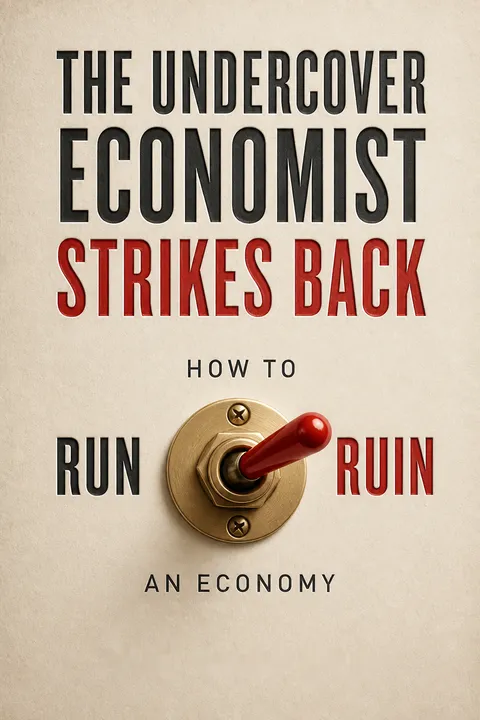
The Undercover Economist Strikes Back is praised for its accessible approach to macroeconomics, using a conversational style and real-world examples. Readers appreciate Harford's balanced perspective and ability to explain complex concepts. The book covers topics like inflation, unemployment, and economic growth. Some reviewers found the Q&A format awkward, while others enjoyed it. Most agree it's a good introduction to macroeconomics for beginners, though some more knowledgeable readers found it too basic. Overall, it's considered an engaging and informative read.
People Also Read




Glossary
MONIAC
hydraulic economy modelThe Monetary National Income Analog Computer, built by Bill Phillips, represented economic flows with dyed water moving through tanks and pipes. Adjustable channels stood for relationships such as consumption, taxation, and investment. It could solve several differential equations simultaneously, making the economy's flows and adjustments visible as a physical system.
sticky prices
slow-adjusting pricesPrices or wages that do not quickly change when supply, demand, or costs change. Harford describes several sources, including social ideas about fairness, the costs of changing posted prices, coordination among firms, and money illusion. When prices stay fixed during a downturn, goods can remain too expensive and employers may cut jobs instead.
money illusion
confusing nominal and real valueThe tendency to respond more strongly to the stated amount of money than to its purchasing power. A worker may accept a nominal raise that is smaller than inflation, even though it reduces real wages, while reacting angrily to an equivalent explicit pay cut. This behavior can make nominal wages resistant to downward adjustment.
URV
Brazilian ghost currencyThe unidade real de valor was a stable unit of account introduced in Brazil during severe inflation. Prices and salaries were stated in URVs, but payments continued in cruzeiros at a changing daily exchange rate. Because the URV offered a stable reference for value without initially replacing cash, it helped prepare the transition to Brazil's real currency.
spending multiplier
output change per spending changeThe spending multiplier measures the change in total economic output associated with a change in government spending. A multiplier above one means output rises by more than the initial spending; a multiplier below zero means the economy contracts. Its size depends on conditions such as idle capacity, interest rates, imports, and how spending is financed.
output gap
actual versus potential outputThe output gap is the difference between an economy's actual production and its estimated potential production. A large gap suggests that unused workers or equipment may allow demand stimulus to raise output. Potential output cannot be directly observed, however, and estimates depend on assumptions about trends, capacity, unemployment, and inflation.
efficiency wages
above-market productivity wagesWages set above the level that would balance labor supply and demand, because employers expect higher pay to improve productivity, loyalty, reliability, or effort. Henry Ford's unusually generous factory pay reduced turnover and helped motivate workers. The same strategy can leave willing applicants unemployed because firms hire fewer workers at the higher wage.
Beveridge curve
vacancies versus unemploymentA relationship between the number of job vacancies and the unemployment rate. In a typical business cycle, vacancies rise as unemployment falls and decline as unemployment rises. If the relationship shifts outward, unemployment may remain high even when vacancies increase, suggesting structural problems such as poor job matching or barriers to worker mobility.
Lucas critique
policy changes alter behaviorThe argument that observed relationships in economic data may change when policymakers deliberately exploit them. People adapt their expectations and decisions to new rules, so a past correlation, such as one between inflation and unemployment, is not necessarily a reliable guide to future policy effects. Economic models must account for those responses.
Easterlin paradox
income and national happiness puzzleThe reported pattern that richer people within a society tend to be happier than poorer people, while richer societies have not consistently reported greater average happiness than poorer societies. The finding is disputed because survey wording, cultural differences, changing expectations, and relative status can affect comparisons across countries and decades.
day reconstruction method
episode-based mood surveyA method for measuring experienced well-being by asking people to reconstruct the previous day as a sequence of activities and report the feelings associated with each episode. Instead of relying only on a general judgment about life satisfaction, it estimates how much time people spend in moods such as stress, boredom, enjoyment, or sadness.
skill-biased technological change
technology favors skilled workersTechnological change that raises the productivity and demand for skilled workers more than for less-skilled workers. As work shifts from routine manual tasks toward operating, maintaining, or designing advanced systems, workers with education and specialized skills may gain while others lose bargaining power or employment opportunities. Harford links this pressure to rising inequality.
Perry Preschool Project
early-childhood intervention studyA 1960s study that provided high-quality preschool education to a selected group of disadvantaged young children and compared their later outcomes with a control group. The participants, followed into adulthood, had more education, higher earnings, and less involvement with prison. Harford presents it as promising evidence for early intervention, while noting the findings concern a specific program and population.
FAQ
What's The Undercover Economist Strikes Back about?
- Explores economic principles: The book delves into macroeconomic concepts, contrasting them with microeconomic perspectives, to explain how economies function and the implications of various economic policies.
- Focus on real-world examples: Tim Harford uses engaging stories, such as the babysitting co-op and a POW camp, to illustrate complex economic ideas, making them accessible and relatable.
- Addresses current economic issues: Harford discusses contemporary challenges like recessions and inflation, offering insights into effective policy responses.
Why should I read The Undercover Economist Strikes Back?
- Accessible economics: Harford presents economic concepts in a relatable and engaging manner, making them understandable for readers without a background in economics.
- Practical insights: The book provides valuable lessons on how economic principles apply to everyday life and current events, enhancing readers' understanding of economic forces.
- Encourages critical thinking: By challenging conventional wisdom, Harford encourages readers to think critically about economic policies and their implications.
What are the key takeaways of The Undercover Economist Strikes Back?
- Understanding macro vs. micro: The book emphasizes the difference between macroeconomics and microeconomics, crucial for grasping economic dynamics.
- Importance of demand: Harford illustrates how demand drives economic activity, highlighting the need for effective demand management in policy.
- Role of inflation: The book discusses maintaining moderate inflation to facilitate economic adjustments and stability.
What are the best quotes from The Undercover Economist Strikes Back and what do they mean?
- Complexities of macroeconomics: “Microeconomics concerns things that economists are specifically wrong about, while macroeconomics concerns things economists are wrong about generally.” This highlights the uncertainties in macroeconomic analysis.
- Government spending potential: “If the Treasury were to fill old bottles with banknotes... there need be no more unemployment.” This illustrates the potential of government spending to stimulate the economy.
- Limitations of GDP: “The welfare of a nation can scarcely be inferred from a measurement of national income as defined by the GDP.” This underscores the need for broader measures of economic health.
What is the difference between Keynesian and classical economics in The Undercover Economist Strikes Back?
- Keynesian focus on demand: Emphasizes aggregate demand's role in driving economic activity, advocating for government intervention during recessions.
- Classical view of supply: Argues that supply creates its own demand, suggesting economies are self-correcting and recessions are due to external shocks.
- Short-run vs. long-run: Keynesian principles apply in the short run, while classical economics is more relevant in the long run.
How does The Undercover Economist Strikes Back explain the role of inflation?
- Moderate inflation is beneficial: Harford argues that a small amount of inflation can help facilitate economic adjustments, such as allowing real wages to decrease without cutting nominal wages.
- Risks of deflation: Highlights the dangers of deflation, which can lead to increased debt burdens and reduced consumer spending.
- Inflation as a policy tool: Discusses how central banks use inflation targets to guide monetary policy, promoting economic stability and growth.
What is the concept of efficiency wages in The Undercover Economist Strikes Back?
- Definition of efficiency wages: Wages set above market equilibrium to increase worker productivity and reduce turnover.
- Ford's five-dollar day: Example of efficiency wages, where higher pay reduced turnover and increased productivity at Ford.
- Impact on unemployment: While improving productivity, efficiency wages can lead to higher unemployment as employers hire fewer workers at higher wages.
How does The Undercover Economist Strikes Back address the issue of unemployment?
- Types of unemployment: Distinguishes between cyclical and structural unemployment, crucial for effective policy-making.
- Beveridge curve: Illustrates the relationship between job vacancies and unemployment rates, indicating structural issues in the labor market.
- Role of incentives: Emphasizes that unemployment is influenced by incentives, both for workers and employers.
What is the significance of the Beveridge curve in The Undercover Economist Strikes Back?
- Understanding labor markets: Illustrates the relationship between job vacancies and unemployment rates, providing insights into labor market efficiency.
- Shifts in the curve: Indicates structural unemployment, where job seekers exceed available positions.
- Policy implications: Helps policymakers design interventions targeting specific labor market issues.
How does The Undercover Economist Strikes Back explain the relationship between inflation and unemployment?
- Phillips curve: Discusses the historical inverse relationship between inflation and unemployment, noting its breakdown during stagflation.
- Expectations and behavior: Emphasizes that inflation expectations influence behavior, complicating the relationship between inflation and unemployment.
- Policy challenges: Highlights the difficulties in managing inflation and unemployment simultaneously.
What role does behavioral economics play in The Undercover Economist Strikes Back?
- Incorporating psychology: Integrates psychological insights into economic models, challenging traditional assumptions about rational decision-making.
- Impact on policy: Informs better policy design, particularly in consumer protection and financial regulation.
- Examples of behavioral insights: Explains phenomena like sticky prices and efficiency wages, enhancing understanding of human behavior in economic contexts.
What are the implications of rising inequality discussed in The Undercover Economist Strikes Back?
- Global versus local inequality: Highlights the distinction between inequality between countries and within countries, noting rising inequality within rich countries.
- Factors contributing to inequality: Discusses technological change and educational disparities as drivers of rising inequality.
- Policy responses: Suggests targeted interventions, such as improving education access and progressive taxation, to address inequality.
The Undercover Economist Series
About the Author
Other books by Tim Harford



Download PDF
Download EPUB
.epub digital book format is ideal for reading ebooks on phones, tablets, and e-readers.








