

Key Takeaways
Use mathematics to expose relationships, not to declare numbers infallible.
Math is a way of seeing. Cole presents mathematics not merely as calculation, but as a lens for finding patterns hidden beneath messy facts. Equations can reveal connections that ordinary perception misses, from electricity and magnetism forming a unified account of light to statistical patterns linking smoking and lung cancer. In this sense, mathematics is a tool for asking better questions about nature and society.
The tool has limits. Numbers do not interpret themselves. A statistic can mislead if its assumptions or qualifications are concealed, as Cole argues happened in debates surrounding The Bell Curve. Readers need not become mathematicians to scrutinize numerical claims. Ask what evidence supports them, what they are compared with, and what the calculation leaves out.
What's striking is the book's civic view of mathematical literacy. It is less about mastering formulas than resisting the authority that numbers acquire when printed in charts. This resembles media literacy: readers learn to inspect how a claim is constructed, not merely whether it sounds technical. Mathematics can clarify a question, but its apparent precision can also conceal choices about categories, evidence, and relevance. The useful habit is neither suspicion of every statistic nor reverence for one, but informed curiosity about the model behind it.
Treat doubling as a warning: small growth can fill a finite world.
Growth compounds quietly. Exponential growth occurs when each increase is calculated from an already growing total. In the chessboard story, the number of grains doubles on every square, eventually exceeding the world's historical grain production. In physicist Albert Bartlett's bacteria illustration, a colony doubles each minute and fills its bottle at noon. At 11:58, the bottle is only one-quarter full, so even perceptive bacteria have little time to respond.
A bigger bottle buys little time. Three extra bottles extend the colony's limit by only two minutes. On a finite planet, persistent population or resource growth eventually runs into limits, even when the initial rate seems modest. A growth rate of 1.9 percent, Cole notes, doubles in about 36 years.
The bacteria story captures a cognitive trap that applies well beyond population: linear intuition expects gradual growth, while compounding makes later changes arrive much faster than earlier ones. Finance, epidemics, and environmental pressures all require attention to the changing base, not just the annual increment. The argument is strongest when directed at indefinite growth in finite systems. It does not, by itself, settle which kinds of growth improve human welfare or how resources should be distributed. Those are political and ethical questions as well as mathematical ones.
Rank risks by probability and consequence, not by how frightening they feel.
Fear follows the story. People often dread vivid, unusual, or uncontrollable dangers more than familiar hazards that cause greater harm. A plane crash grips attention; ordinary accidents and disease may not. This bias can pull public resources toward dramatic threats while less visible dangers receive less attention. Risk judgments also depend on personal circumstances, trust, and whether people feel they can control the hazard.
Framing changes choices. Psychologists Amos Tversky and Daniel Kahneman described a study involving a disease expected to kill 600 people. Physicians preferred a sure plan saving 200 when the choice was framed as lives saved. Faced with the same outcomes described as certain deaths, they tended to prefer a risky plan that might save everyone. The probabilities had not changed. The wording had.
Risk decisions combine calculation with values: whose safety counts, which harms are acceptable, and how much weight to give prevention. Behavioral economics helps explain why the same odds feel different when described as losses rather than gains. That insight can improve public communication, but it also creates a responsibility not to manipulate people through framing. A further distinction matters: an individual's voluntary risk is not identical to a risk imposed on others or paid for collectively. Sound policy needs both probability estimates and an explicit account of those consequences.
Before trusting a statistic, inspect its definitions, comparison, and error.
Measurement makes choices. A number describes only what its method defines and captures. Shoe size correlates with children's math scores, for example, largely because older children have both larger feet and more schooling. The relationship does not show that big feet cause mathematical ability. A third factor, age, helps explain both.
Averages can disguise variation. If a company head earns far more than other employees, the mean salary may sound high while the median salary better represents the middle worker. Error bars matter, too: scores of 98 and 101 on a test with an uncertainty of three points do not establish a meaningful difference. Before comparing statistics, check what was measured, which average was used, what other factors could explain the pattern, and how uncertain the result is.
This is a practical lesson in operationalization, the process of deciding how an abstract idea becomes measurable. Intelligence, well-being, and fairness are not self-evident variables waiting to be read off a meter. Their measures can guide decisions, but also narrow attention to whatever is easiest to count. The mean-versus-median example shows why statistical fluency must include distribution, not just arithmetic. Even a carefully controlled correlation remains a clue rather than a causal explanation unless a plausible mechanism and stronger evidence support the link.
Change the scale, and the rules of nature can change with it.
Size changes the physics. As J. B. S. Haldane explained, a giant cannot simply be a human enlarged: weight grows faster than the cross-section of bones and muscles that supports it. Tiny animals face the reverse advantage. A flea can lift many times its weight, while surface forces that barely matter to people can dominate the insect's world.
Many create new properties. The term emergent properties describes features that arise when many parts interact, although no single part possesses them alone. One water molecule cannot freeze; large groups of molecules can form ice. Physicist Philip Anderson's phrase, “more is different,” also applies to social patterns: small shifts in neighborhood composition can, under some conditions, trigger a rapid change in behavior, a phenomenon called a tipping point.
Scale is not just a zoom setting. It determines which forces, patterns, and explanations matter, a principle shared by biology, physics, and social science. The same individual-level rules can yield collective behavior that is difficult to predict from a single person. This cautions against assuming that a microscopic explanation automatically explains a society or organism. Conversely, emergence does not make underlying mechanisms irrelevant. A useful account moves between levels, asking what each scale reveals and what it hides.
Use predictions to test patterns, not to pretend the future is settled.
A scientific prediction often points to something already happening. Einstein's theory implied that starlight passing near the Sun would bend. The effect was not forecast as a future event; it was a pattern that observers could test. Likewise, irregularities in Uranus's orbit suggested an unseen planet, which astronomers later found as Neptune.
Forecasts face different obstacles. The Galileo spacecraft reached Jupiter after a six-year, 2.3-billion-mile journey because its motion followed well-understood patterns. Weather and earthquakes involve many interacting conditions, so small differences can grow into large errors. Extending an observed curve into the future is especially risky when the underlying mechanisms are poorly understood. Predictions are most useful when treated as tests of a model, not as guarantees.
The distinction separates explanatory science from fortune-telling. A theory earns credibility when it identifies a pattern that can be checked, including one not previously noticed. Forecasting, by contrast, depends on whether the system remains stable and whether its important inputs are known. This is relevant in finance and climate policy, where uncertainty does not mean that every scenario is equally plausible. The challenge is to report uncertainty without using it either as false certainty or as an excuse for inaction.
Make a discovery survive attempts to explain it away.
Signals need context. A signal is information that can be recognized as meaningful; noise is information that obstructs the question at hand. Neither label is permanent. In Cole's account of astronomers testing a possible planet, the Hooker telescope seemed to show a star as two stars. A second star also appeared doubled, revealing a flaw in the telescope's optics rather than a new discovery.
Comparison exposes artifacts. Researchers checked the instrument against a known single star and found that the apparent signal came from the equipment. This is why scientists control for contamination, repeat measurements, and try to rule out alternative explanations. The hiss once dismissed as interference in the sky, by contrast, turned out to be radiation left over from the Big Bang. Noise can hide discovery, and discovery can masquerade as noise.
The episode demonstrates a central discipline of science: a result gains credibility not because it looks exciting, but because plausible sources of error have been tested. In experimental design, a control is not a bureaucratic extra; it helps separate a real effect from the apparatus or context. The process also requires imagination about what could go wrong. Yet filtering is never neutral: researchers can discard a rare but genuine signal if their assumptions define it as irrelevant. Reliable inquiry needs both rigorous controls and openness to anomalies.
Remember that voting rules shape which preferences become winners.
The ballot is part of the result. Under plurality voting, the candidate with the most votes wins, even without majority support. Cole illustrates the problem with a family choosing among several movies: a movie favored by a small bloc can win when preferences are split among the alternatives, although most family members would prefer another choice in a direct comparison. Changing the voting procedure can change the winner without changing anyone's preferences.
No system is perfect. Kenneth Arrow's impossibility theorem shows that no democratic voting system can satisfy every desirable fairness condition at once. Approval voting lets people support several candidates; preference voting ranks them; cumulative voting lets voters concentrate votes. Each handles some problems while introducing others. The choice of rules is therefore a choice about which kinds of fairness matter most.
Voting is often treated as a transparent container for public opinion, but the procedure helps construct the outcome it claims to measure. This insight connects democratic design to measurement: change the instrument, and the observed result changes. Arrow's result is not a reason to abandon elections. It is a reason to make trade-offs visible and contestable. Any reform should be judged not only by its mathematical properties, but also by whether voters can understand it and whether it gives affected groups a meaningful voice.
Divide by what people value, not by equal-looking pieces.
Equality and fairness can differ. In the classic cake-cutting method for two people, one person cuts and the other chooses first. The cutter has an incentive to make the pieces seem equally desirable, while the chooser selects the preferred share. Both participate in the result, reducing grounds for envy.
Different priorities can help. In the Adjusted Winner method, each of two parties distributes 100 points among the disputed goods according to personal importance. Items go initially to the person who values them more, then a calculation adjusts the division if one party receives more points overall. The approach can help divide property or responsibilities when parties value items differently. It cannot make every emotional dispute mathematical, but it makes preferences explicit rather than assuming identical values.
The key move is to distinguish equal quantities from equal perceived value. That idea informs negotiation and resource allocation: a good trade can exchange something one party values little for something the other values greatly. The method also makes private preferences consequential, which can reduce strategic posturing. Its limits are important. People may misstate their valuations, lack comparable information, or care about recognition and history as much as material goods. A formula can structure bargaining, but it cannot decide what counts as a just settlement.
In repeated conflicts, start cooperatively and answer defection proportionately.
Cooperation can be strategic. In the prisoner's dilemma, two people acting only to protect their immediate interests may both end up worse off than if they cooperated. Robert Axelrod tested strategies in repeated computer tournaments. The successful program called Tit for Tat began by cooperating, then copied the other player's previous move. It responded to defection, but could return to cooperation when the other side did.
Relationships change the calculation. The strategy worked especially well when players met repeatedly, because today's choice affected future interactions. Axelrod found that overly aggressive approaches could exhaust the cooperative environment they depended on. The lesson is not that kindness always wins in a single encounter. It is that in ongoing relationships, a clear, proportionate response can make cooperation stable without rewarding every betrayal.
This result reframes cooperation as neither naïve altruism nor pure self-interest. Repetition, recognition, and the prospect of future interaction alter incentives, a point relevant to teams, diplomacy, and community life. Reciprocity can make trust sustainable because behavior has consequences. But Tit for Tat depends on clear signals and adequate opportunities to repair mistakes. In real relationships, defection may be misread, power may be unequal, and retaliation can escalate. Forgiveness is strategically useful only when paired with boundaries and a realistic chance of renewed cooperation.
Treat scientific truth as strong evidence under revision, not final certainty.
Evidence has degrees. Scientific claims rely on measurement, probability, logical argument, and expert review, none of which guarantees absolute certainty about the natural world. A particle track may fit the expected pattern, but researchers still ask whether chance, contamination, or an instrument fault could explain it. More repeated evidence can make a claim more credible without making it immune to revision.
Different settings demand different thresholds. A physicist announcing a particle discovery and a court deciding whether to imprison a person face different consequences if wrong. Cole also discusses Gödel's theorem, which shows that some statements in sufficiently powerful formal systems cannot be proved within those systems. Mathematics is extraordinarily rigorous, but even formal proof has limits on what it can establish.
The book's account resists two familiar errors: treating uncertainty as ignorance and treating expert agreement as infallibility. Scientific confidence is better understood as calibrated trust, supported by methods that expose claims to criticism and correction. Legal decisions must close cases on a timetable, while research can remain open to new evidence, so the standards cannot simply be identical. Gödel's result also needs careful scope: it does not mean every truth is unknowable, but it does challenge the fantasy of a complete, self-contained proof system.
Search for what remains unchanged when perspective shifts.
Symmetry means preserved sameness. In mathematics and physics, a symmetry is a change that leaves an important feature unchanged. A circle looks the same after any rotation around its center; a square remains the same after certain rotations. This provides a way to distinguish deep structure from surface appearance, including changes caused by an observer's position or frame of reference.
Invariance reveals physical laws. Emmy Noether showed that symmetries in the laws of nature correspond to conserved quantities, such as energy. Her work helped resolve a problem in Einstein's general theory of relativity and exposed a deep link between mathematical structure and physical law. Cole's larger claim is that the same search for pattern can connect scientific truth with the beauty people find in forms such as snowflakes, music, and galaxies.
Symmetry offers a powerful method for compressing complexity: identify what persists through transformations, then ask why it persists. In physics, this can reveal conservation laws; in perception, it can clarify which features define an object. The connection to beauty is suggestive rather than a proof that beautiful theories must be true. Elegance can guide discovery, but nature is not obliged to satisfy human taste. The best role for mathematical beauty is as a source of hypotheses that still have to survive observation and experiment.
Analysis
Cole's central argument is that mathematics is not a remote technical subject but a public method for disciplined attention. The book moves from limits in human perception to distortions in measurement, from physical complexity to social choice, and finally to probability, proof, and symmetry. Its narrative strength comes from making abstractions tangible: a bottle filling with bacteria turns exponential growth into a political problem; a family choosing a movie exposes the hidden power of voting rules; Noether's career shows how an abstract theorem can alter physics while institutional prejudice obscures the mathematician herself.
The most durable insight is not that mathematics supplies certainty, but that it reveals where certainty is being claimed too cheaply. Averages conceal distributions, correlations invite causal stories, and elegant predictions can fail when a system is complex. Yet mathematical form is not neutral. Choices about what counts, which error matters, and whose welfare is represented are value choices expressed through technical procedures. The book's own examples of fairness make this visible: an envy-free division is a useful property, not a complete theory of justice.
The book also benefits from a distinction between levels of explanation. Fundamental laws can constrain what is possible without fully explaining emergent phenomena such as life, minds, institutions, or beauty. This is not an argument against reduction, but against mistaking a component-level account for a complete account. Moving between scales is essential.
Some examples and statistics reflect the book's 1990s context and should not be treated as current estimates. Its reasoning remains valuable precisely because it teaches readers to question such numbers. The best practical outcome is a habit: ask what the model measures, what it omits, how it might be wrong, and what remains true under a change of viewpoint. Mathematics then becomes less an oracle than a tool for intellectual honesty.
Review Summary
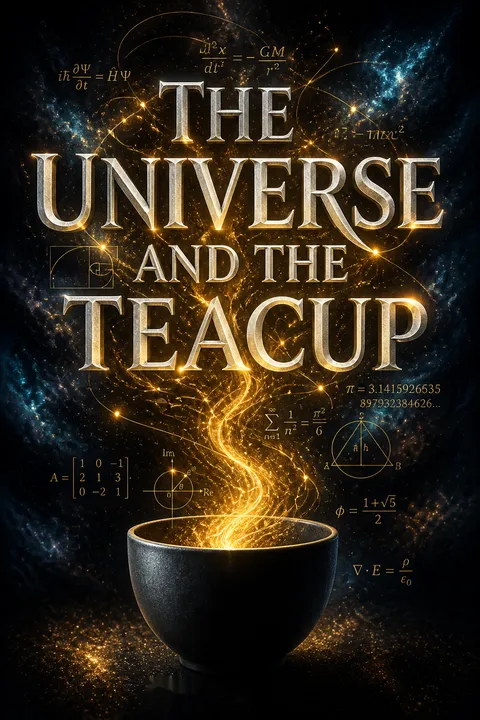
The Universe and the Teacup receives mixed reviews, with an average rating of 3.79 out of 5. Positive reviews praise its accessibility and interesting concepts, particularly regarding scale, probability, and math's role in everyday life. Critics find it superficial, lacking depth, and jumping between topics without thorough exploration. Some readers appreciate the author's effort to make complex ideas understandable, while others feel it's too simplified for those with scientific backgrounds. The book's approach to connecting mathematics to various aspects of life is both lauded and criticized.
People Also Read







Glossary
number numbness
Difficulty sensing numerical scaleA term used by Douglas Hofstadter for the human difficulty of grasping very large or very small quantities. A million and a billion may feel similarly enormous, although one is a thousand times larger. The resulting intuition gap can distort judgments about budgets, population, epidemics, and other quantities that grow or shrink rapidly.
emergent properties
Features arising from interactionsProperties that appear when many components interact in an organized way, even though no single component has those properties alone. A water molecule is not ice, and an individual person is not a crowd capable of mass behavior. The concept cautions against assuming that knowledge of basic ingredients automatically explains larger systems.
tipping point
Threshold triggering rapid changeA critical threshold at which a relatively small additional change can produce a large shift in a system. Cole uses the concept for social patterns, including neighborhood composition and crime, and compares it with a physical phase transition such as liquid water becoming ice. The existence and location of a threshold must be established for each case.
Arrow's impossibility theorem
Limits on fair voting systemsKenneth Arrow's mathematical result showing that no voting system can satisfy every one of a set of desirable fairness conditions simultaneously. It does not show that democracy is pointless or that all voting procedures are equally good. It demonstrates that institutional design involves trade-offs, so the chosen rules determine which properties are prioritized.
Adjusted Winner
Preference-based division methodA two-party method for dividing goods or responsibilities according to how much each party values them. Each party assigns 100 points across the items. Initial allocation follows those valuations, and a mathematical adjustment addresses imbalance. The method aims to produce an envy-free division when parties value items differently, but it does not settle every emotional or ethical dimension of a dispute.
Tit for Tat
Reciprocal cooperation strategyA strategy tested in repeated prisoner's dilemma games. It cooperates on the first move, then responds with the other player's previous move. It can deter exploitation while allowing cooperation to resume after a cooperative move. Its success depends on repeated interaction and sufficiently clear behavior; it is not a universal answer to one-time conflicts or unequal relationships.
wavelet analysis
Multi-scale signal analysisA mathematical technique for breaking a complicated signal into localized components called wavelets. It can help identify patterns at different scales without discarding the larger context. Cole describes applications including fingerprint storage, searching for astronomical structures, and detecting signals amid noise. The method depends on appropriate choices about which features count as meaningful.
Noether's theorem
Symmetry linked to conservationA theorem developed by mathematician Emmy Noether showing that continuous symmetries in the laws of a physical system correspond to conserved quantities. For example, invariance under shifts in time is associated with conservation of energy. The theorem helped clarify conservation laws in general relativity and became a foundational tool in modern physics.
FAQ
What's "The Universe and the Teacup: The Mathematics of Truth and Beauty" about?
- Exploration of Mathematics: The book delves into how mathematics can explain the workings of the universe, from the smallest particles to the largest cosmic structures.
- Interconnection of Concepts: It connects mathematics with philosophical and aesthetic ideas, showing how math influences our understanding of truth and beauty.
- Practical Applications: The book illustrates how mathematical thinking can be applied to solve real-world problems, from social issues to scientific inquiries.
- Author's Perspective: K.C. Cole presents mathematics not just as a tool for calculation but as a way of thinking that can provide clarity and insight into various aspects of life.
Why should I read "The Universe and the Teacup: The Mathematics of Truth and Beauty"?
- Broaden Understanding: It offers a unique perspective on how mathematics is intertwined with everyday life and larger philosophical questions.
- Accessible to All: The book is written in a way that is accessible to those without a strong mathematical background, making complex ideas understandable.
- Interdisciplinary Approach: It bridges the gap between science, philosophy, and art, appealing to readers interested in any of these fields.
- Inspiration and Insight: Readers can gain inspiration from the way mathematics is presented as a tool for understanding the world and solving problems.
What are the key takeaways of "The Universe and the Teacup: The Mathematics of Truth and Beauty"?
- Mathematics as a Lens: Math is a powerful lens through which we can view and understand the world, revealing hidden patterns and truths.
- Interplay of Truth and Beauty: The book explores the deep connection between mathematical truths and aesthetic beauty, suggesting that the two are often intertwined.
- Practical Problem Solving: Mathematical thinking can be applied to a wide range of problems, from social justice issues to scientific discoveries.
- Symmetry and Invariance: The concepts of symmetry and invariance are central to understanding the fundamental laws of nature.
How does K.C. Cole explain the relationship between mathematics and beauty?
- Symmetry and Aesthetics: Cole discusses how symmetry, a mathematical concept, is often associated with beauty in nature and art.
- Mathematical Elegance: The book highlights how elegant mathematical solutions often have a beauty of their own, akin to artistic creations.
- Truth and Beauty Connection: It suggests that the pursuit of mathematical truth often leads to discoveries that are aesthetically pleasing.
- Examples and Illustrations: Cole uses examples from nature, such as snowflakes and galaxies, to illustrate how mathematical principles underpin beauty.
What are the best quotes from "The Universe and the Teacup: The Mathematics of Truth and Beauty" and what do they mean?
- "Mathematics seems to have astonishing power to tell us how things work..." This quote emphasizes the surprising ability of mathematics to explain complex phenomena.
- "The same properties that make a snowflake appealing underlie the laws that control the universe." It highlights the connection between beauty and fundamental natural laws.
- "Science is a long history of learning how not to fool ourselves." This reflects the scientific method's role in uncovering truths and avoiding misconceptions.
- "The Great Architect of the Universe now begins to appear as a pure mathematician." This suggests that the universe's order and structure can be understood through mathematics.
How does K.C. Cole address the concept of probability in the book?
- Probability and Uncertainty: Cole discusses how probability is a way to understand uncertainty and make predictions about the future.
- Role in Science: Probability is presented as a fundamental concept in scientific inquiry, helping to quantify the likelihood of various outcomes.
- Chance and Cause: The book explores the relationship between chance events and causal explanations, showing how probability can bridge the two.
- Practical Examples: Cole uses real-world examples, such as gambling and weather forecasting, to illustrate how probability is applied in everyday life.
What is the significance of symmetry in "The Universe and the Teacup: The Mathematics of Truth and Beauty"?
- Symmetry as a Guide: Symmetry is used as a tool to uncover fundamental truths about the universe, revealing underlying patterns and structures.
- Connection to Conservation Laws: The book explains how symmetry is related to conservation laws, which are central to understanding physical phenomena.
- Aesthetic and Scientific Value: Symmetry is valued both for its aesthetic appeal and its scientific utility in explaining natural laws.
- Examples in Nature: Cole provides examples of symmetry in nature, such as the structure of crystals and the formation of galaxies, to illustrate its pervasive influence.
How does K.C. Cole use real-world examples to illustrate mathematical concepts?
- Everyday Applications: The book uses examples from daily life, such as voting systems and economic models, to show how mathematical thinking can solve practical problems.
- Scientific Discoveries: Cole discusses scientific breakthroughs, like the discovery of quarks and black holes, to demonstrate the power of mathematical predictions.
- Social Issues: The book addresses social justice topics, such as fair division and voting rights, using mathematical principles to propose solutions.
- Engaging Narratives: Real-world stories and anecdotes are woven throughout the book to make abstract mathematical ideas more relatable and engaging.
What role does mathematics play in understanding social justice issues according to K.C. Cole?
- Fair Division: Mathematics is used to develop fair division methods, ensuring equitable distribution of resources in various contexts.
- Voting Systems: The book explores how different voting systems can lead to different outcomes, highlighting the importance of mathematical analysis in democratic processes.
- Game Theory: Cole discusses game theory as a tool for understanding cooperation and competition, offering insights into social and economic interactions.
- Quantitative Arguments: The book argues that quantitative reasoning can enhance the quality of life by providing objective solutions to complex social problems.
How does "The Universe and the Teacup: The Mathematics of Truth and Beauty" address the concept of truth?
- Mathematical Truths: The book explores how mathematical truths are derived through logical reasoning and empirical evidence.
- Truth in Science: Cole discusses the provisional nature of scientific truths, which are always subject to revision based on new evidence.
- Philosophical Implications: The book delves into the philosophical implications of mathematical truths, questioning the nature of reality and knowledge.
- Truth and Perspective: It highlights how different perspectives can lead to different interpretations of truth, emphasizing the importance of context.
What is the relationship between mathematics and scientific discovery in the book?
- Predictive Power: Mathematics is portrayed as a powerful tool for making predictions about scientific phenomena, from the behavior of particles to the fate of the universe.
- Uncovering Patterns: The book emphasizes how mathematical models can reveal hidden patterns in data, leading to new scientific insights.
- Interdisciplinary Approach: Cole illustrates how mathematics intersects with other scientific disciplines, enhancing our understanding of complex systems.
- Historical Examples: The book provides historical examples of scientific discoveries that were made possible through mathematical reasoning, such as the discovery of Neptune and the structure of DNA.
How does K.C. Cole explain the concept of emergent properties in the book?
- More is Different: The book discusses how new properties can emerge when individual components interact in complex systems, leading to unexpected outcomes.
- Examples in Nature: Cole provides examples from nature, such as the behavior of ant colonies and the formation of weather patterns, to illustrate emergent properties.
- Complexity and Simplicity: The book explores the relationship between complexity and simplicity, showing how simple rules can lead to complex behaviors.
- Implications for Science: Emergent properties challenge traditional scientific approaches, requiring new methods of analysis and understanding.
Download PDF
Download EPUB
.epub digital book format is ideal for reading ebooks on phones, tablets, and e-readers.








