

Key Takeaways
Treat success as built through effort and opportunity, not inherited destiny.
Birth is no guarantee. Pablo Picasso’s son Paulo grew up in the shadow of a celebrated, neglectful father and struggled to build an independent life. By contrast, Ursula Burns rose from a low-income New York housing project to lead Xerox, helped by education and opportunities at the company. Family advantage matters, but it does not automatically produce ability, motivation, or well-being. A study of more than 5,000 family businesses found that profitability fell by at least 4 percent after control passed to a family member rather than an outside executive.
Show the steps. When successful parents portray achievement as innate genius, children may see the path as inaccessible. Making effort, practice, support, and luck visible gives them a ladder they can actually climb.
The contrast between Paulo Picasso and Ursula Burns usefully separates inherited status from developed capacity. It also points beyond individual character: access to good schooling, sponsorship, and meaningful work changes which abilities can be expressed. The family-business finding is suggestive, but succession involves more than family membership, including selection and governance. The strongest lesson is not that privilege harms children, but that advantage cannot substitute for the relationships and opportunities through which competence grows.
Teach people to treat failure as information, not a verdict on their ability.
Beliefs change learning. In Carol Dweck and Carol Diener’s experiments, children with similar starting ability faced puzzles with reduced feedback. Some treated mistakes as clues and changed their strategies. Others took failure as proof they were not smart and became less effective. In a later study, students who viewed intelligence as improvable increased their mathematics grades over time, while those who saw it as fixed did not show the same progress.
Praise the process. The book’s entity theory treats ability as a fixed possession; its incremental theory treats ability as something that can develop. A boy praised as exceptionally intelligent became distressed when ordinary school results contradicted that identity. Teaching effort, strategy, and persistence gives setbacks a useful explanation and keeps learning possible.
This is a powerful account of how self-beliefs can shape attention: a learner who interprets an error as evidence of incapacity has less reason to study the correction. The idea aligns with research on metacognition, where noticing and adjusting one’s strategy matters as much as raw ability. Still, effort alone cannot overcome poor instruction, disability, or unequal resources. Growth-oriented feedback works best when it includes concrete guidance, not praise for trying regardless of whether the approach is effective.
Use attainable wins to build momentum, then carry that confidence into harder tests.
Winning can prime winning. The winner effect is the increased likelihood of succeeding again after a previous victory. In animal studies, a win raised the chance of winning a later contest; in one experiment, dominant fish became less aggressive after losing and more aggressive after defeating weaker opponents. The book connects this pattern to Mike Tyson’s carefully chosen early fights after prison, before he faced champion Frank Bruno.
Context matters. Research on California mice found that victories changed brain motivation systems when they happened on home territory, but not in the same way after away contests. Winning is not a permanent upgrade that works everywhere. Familiar settings, expectations, and the meaning attached to the contest can shape whether a prior success helps in the next one.
The winner effect offers a useful model of feedback loops: success can build confidence, change behavior, and improve the odds of another success. That pattern helps explain why early access and manageable first challenges matter. But animal contest results do not establish that every human victory causes a lasting biological advantage. Human performance depends on skill, preparation, and the setting, so confidence should be treated as a resource to cultivate, not as proof that future success is assured.
Remove hidden barriers that let stereotypes shrink people’s performance.
Expectations enter the test. The book describes experiments in which Black students performed worse on an intelligence test when told it measured intelligence, but did better when the same task was framed as eye-hand coordination. Women’s math performance also fell when the task was presented as a measure of mathematical ability. These findings illustrate how stereotypes can become internal obstacles, not only external discrimination.
Change the signals. Context can also lift performance. In Olympic combat sports with competitors of similar ability, athletes wearing red won 62 percent of bouts, compared with 38 percent for those wearing blue. The author also cites research suggesting that Barack Obama’s visible success coincided with a decline in measured implicit racial prejudice. Institutions should examine both explicit rules and subtle cues that signal who is expected to excel.
The key contribution is to show that bias need not be consciously endorsed to affect behavior. Evaluation settings can make a stereotype salient and consume attention that would otherwise support the task. The red-shirt result is a striking illustration of context, though it should not be mistaken for a universal performance rule. Later debates about the reliability and size of some stereotype-threat effects make replication important. That uncertainty strengthens the case for fair testing conditions rather than weakening it.
Treat authority as a cognitive blind spot, not evidence of sound judgment.
Power changes attention. In experiments, even briefly recalling a position of authority made people more likely to focus on their own perspective and overestimate their control of events. The book links power to stronger goal focus and reduced attention to peripheral warnings. Tony Blair’s unusually high measured need for power is used to illuminate his confidence in shaping world events, in contrast with Bill Clinton’s more cautious response to military risks.
Silence is a warning. At Chernobyl, a steep hierarchy discouraged workers from challenging unsafe decisions. The book calls this the mum effect: withholding bad news because speaking up may bring punishment. When authority narrows attention and subordinates stay quiet, leaders lose precisely the information needed to correct a mistaken course.
Power can improve speed and decisiveness, valuable qualities when delay is costly. Its danger is that the same focus can reduce perspective-taking and make weak evidence feel conclusive. Organizational research on psychological safety similarly finds that teams need ways to raise concerns without retaliation. The Blair and Clinton comparison is compelling as an interpretation, but it cannot establish that brain chemistry explains particular foreign-policy choices. Decision quality also depends on institutions, advisers, and the evidence leaders receive.
Give people control and recognition to reduce the bodily cost of chronic stress.
Status has physical stakes. A study cited in the book found that Oscar winners lived about four years longer on average than comparable nominees, while Nobel Prize winners lived one to two years longer than nominees. The author argues that recognition may protect a person’s sense of worth, much as a lasting signal that their work is valued. The effects cannot be explained simply by prize money.
Control buffers stress. In demanding settings, people who feel they can influence their circumstances tend to show lower stress responses than those who feel trapped. The book calls the threat of being judged or rejected for who one is social-evaluative threat. It describes research linking such threat to cortisol and, in one study, poorer health outcomes among HIV-positive men who felt especially vulnerable to rejection.
Recognition and control are not merely workplace perks; they can affect whether people experience demands as manageable or humiliating. This connects with occupational-health research on job control and with social psychology’s account of belonging as a basic human need. The longevity comparisons are intriguing, but observational studies cannot prove that an award itself adds years of life. Health, selection, and social support may also matter. The practical implication is to make respect and genuine autonomy routine, not to chase trophies as medicine.
Keep ambition inside a healthy range before rewards distort judgment.
The reward system has limits. Dopamine helps the brain learn from rewards and pursue goals. The book’s Goldilocks principle describes how performance can suffer when dopamine is either too low or too high. In a computer-game experiment, students caught a target less often when the prize rose from about one dollar to ten dollars. Excessive stakes can create pressure and interfere with skilled performance, as the author illustrates with Tiger Woods missing a short putt in a high-value playoff.
Success can become a craving. Power, money, sex, and gambling can all engage reward systems. Some patients taking dopamine-boosting medication developed compulsive gambling that eased after the medication stopped. The book uses Enron’s escalating bets and its CEO’s risk-taking to show how repeated rewards can encourage dangerous overconfidence.
The account warns against assuming that bigger incentives reliably produce better work. Behavioral economics and performance research both recognize that rewards can change attention, risk appetite, and intrinsic motivation. Yet the dopamine story is not a complete explanation of corporate failure: incentives operate through culture, regulation, and choices, not chemistry alone. The useful distinction is between motivation that sustains good work and reward escalation that makes the next gamble feel necessary.
Balance personal ambition with responsibility for the group affected by your decisions.
Two kinds of power. The book distinguishes p-power, the desire to influence others for personal aims, from s-power, the desire to use influence for a group or institution. Both involve wanting impact, but s-power is more constrained by responsibility and consequences. In experiments described by the author, people with both motives showed a less pronounced testosterone response to competitive wins than those driven mainly by personal power.
Enron’s narrow victory. Jeffrey Skilling and other executives presided over a company that prized individual gains and a rising share price while concealing losses through complex financial arrangements. The author argues that this culture made it easier to ignore employees, shareholders, and the business’s long-term health. Enron’s whistle-blower, Sherron Watkins, warned about accounting problems, but her concerns did not change the course.
The distinction between personal and collective motives helps explain why ambition is not inherently virtuous or corrupt. Institutions need people who want to change things, but they also need norms that make consequences visible to those with authority. The source’s suggestion that women are more likely to have group-oriented power motives should be treated as an average tendency, not a rule about individuals. Organizational safeguards should not depend on gender or presumed virtue; they should reward stewardship and make dissent consequential.
Build channels for dissent before hierarchy turns silence into disaster.
Bad news needs a route. The Chernobyl disaster illustrates the cost of a culture where workers feared contradicting superiors. The book uses the mum effect to describe why people withhold concerns when they anticipate blame or punishment. Similar dynamics can arise in companies, governments, schools, and families, especially when decisions are made by a small inner circle and others have little influence.
Limit unchecked authority. The author argues that democratic checks, independent scrutiny, and accountable procedures help keep power from distorting judgment. A leader who hears only agreement can mistake silence for consent and certainty for evidence. Practical protections include clear reporting routes, independent review, and a culture where raising a safety concern is treated as useful information rather than disloyalty.
This is a strong institutional lesson: dissent is not simply a personality trait but a feature of the environment. A well-designed reporting system lowers the personal cost of speaking and increases the chance that weak signals are noticed early. Yet procedure alone is insufficient if leaders retaliate informally or ignore reports. The relevant measure is not whether an organization has a hotline, but whether people trust that using it can change a decision without ruining their standing.
Audit power in intimate relationships before control becomes contempt.
Small power can reshape behavior. The book’s account of Karen and Chris shows a relationship in which one partner controlled the other’s affection and feared abandonment. As the imbalance grew, Karen’s public humiliation of Chris became a kind of victory, while he grew passive and withdrawn. The author connects this to research showing that power can reduce empathy and make people see others as objects to manage.
The pattern starts early. A study of parents and young children found that harsh, forceful control at ages two to three was associated with more oppositional behavior later. Power is present in parenting, partnerships, and work, not only in government. The question is whether influence protects the other person’s agency or steadily removes it.
The focus on ordinary relationships makes the book’s account of power more concrete than a discussion limited to dictators and CEOs. It also aligns with family research showing that coercive cycles can teach children how to manage conflict. The case narrative cannot establish that every unequal relationship follows the same path, and abuse should not be reduced to a two-sided misunderstanding. Still, checking for fear, dependency, and the freedom to disagree can reveal harmful asymmetries before they become normalized.
Distribute agency so success belongs to the group, not just its leader.
Context creates capacity. The book’s central claim is that people are shaped by the roles and opportunities around them. A subordinate fish can transform when territory becomes available; people can likewise develop abilities when given responsibility and room to act. But the same context can suppress potential through exclusion, stereotypes, or concentrated authority.
Connect contributions. The Polymath project invited people with different levels of mathematical expertise to work on difficult problems online. The resulting collaboration helped solve problems faster and better than isolated work. The book’s closing argument is that organizations and societies can act like a shared problem-solving system when people are empowered to contribute. The goal is not to eliminate leaders, but to keep their power accountable and make room for many minds.
The collective lens corrects the myth that outcomes belong solely to exceptional individuals. Complex work often depends on distributed knowledge, and contribution can come from people outside the highest-status circle. This resembles modern work on collective intelligence, where inclusion and coordination matter as much as individual expertise. Still, group power is not automatically benevolent: majorities can exclude minorities, and collaboration needs clear responsibility. Shared agency works best when participation is broad and accountability remains visible.
Analysis
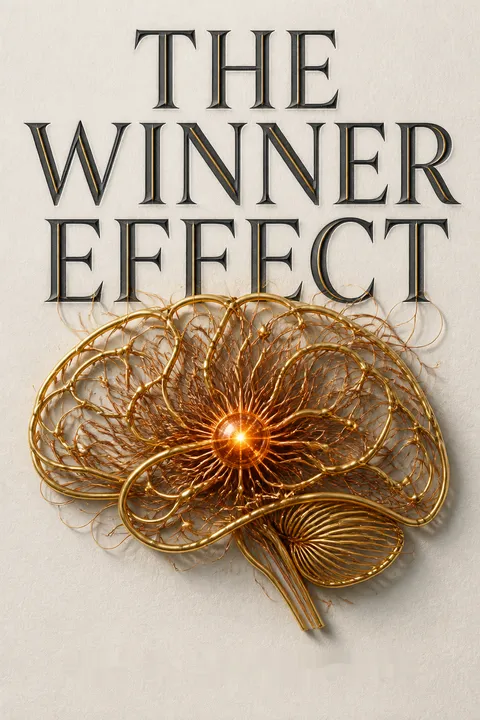
The book’s central argument is that winning is neither a fixed inheritance nor a simple reward for effort. It emerges from an interaction among beliefs, bodily states, social setting, prior success, and access to power. Its strongest contribution is to make success dynamic: winning can alter motivation and confidence, which in turn changes later performance, while the same feedback loop can magnify hubris, silence, and harm. The cichlid fish, the Picasso family, and the executive failures give that abstract claim a memorable human scale.
The book also reframes power as a biological and social condition rather than merely a formal title. Authority can energize goal pursuit, but it can narrow attention, inflate perceived control, weaken empathy, and make dissent costly. This explains why accountability is not an optional ethical ornament. It is a practical safeguard against predictable cognitive distortions. Its distinction between personal power and group-oriented power further clarifies why ambition can support public benefit or become self-serving.
Some of the evidence deserves careful handling. Animal experiments establish mechanisms more cleanly than they predict complex human behavior. Hormonal findings do not prove that testosterone alone causes aggression or political choices. The striking Oscar and Nobel longevity associations do not show that awards themselves extend life, and several social-psychology effects are sensitive to context and replication. The book sometimes moves quickly from experimental results to historical interpretations, especially when explaining particular leaders. Those leaps are best read as hypotheses, not settled causal accounts.
The practical synthesis remains valuable: develop ability through feedback and attainable challenge; offer opportunities without treating identity as destiny; recognize how status and control affect health; and design institutions that allow bad news to reach decision-makers. Above all, evaluate success by who benefits. An individual triumph that leaves a family, company, or society weaker is a poor definition of winning.
Review Summary
The Winner Effect receives mixed reviews, with praise for its insights on power and success but criticism of its disjointed writing style. Readers appreciate the scientific research and real-world examples but find the narrative structure confusing. Some value the book's exploration of neuroscience and psychology in relation to achievement, while others feel it lacks practical application. The book's examination of power dynamics and their effects on behavior is generally well-received, though some readers question the author's political biases and generalizations.
People Also Read








Glossary
Winner effect
Success increases future chancesThe tendency for a previous victory to increase the likelihood of winning a later contest. In animal studies, winning was followed by changes in behavior and brain systems related to motivation and aggression. The book argues that similar feedback loops may operate in humans, although context and the kind of contest matter.
Entity theory
Ability is fixedA belief that traits such as intelligence are relatively fixed qualities that a person possesses or lacks. People who hold this view may interpret failure as proof of limited ability, making it harder to learn from corrective feedback. The book contrasts this with an incremental view of ability.
Incremental theory
Ability can developA belief that abilities can improve through learning, effort, and effective strategies. In the studies discussed in the book, children with this outlook were more likely to adjust their problem-solving after mistakes and to learn from feedback. It does not mean that effort alone guarantees success.
Achievement motivation
Drive to accomplishA person’s drive to meet challenges, improve performance, and achieve valued goals. The book distinguishes inner satisfaction in competence from external rewards such as money, while noting that real-world incentives often carry both meanings. Moderate, attainable challenges are presented as more motivating than goals that are trivial or impossibly distant.
Mum effect
Withholding bad newsThe tendency to stay silent about problems or unwelcome information, especially when speaking to someone more powerful. People may fear blame, punishment, or damage to their standing. In hierarchical organizations, this can prevent leaders from learning about risks until they have become severe.
Power-distance index
Acceptance of unequal authorityA measure associated with Geert Hofstede that describes how readily people in a society or organization accept unequal distributions of power. A high score indicates greater acceptance of hierarchy. The book uses the concept to discuss why subordinates in steep hierarchies may hesitate to challenge those above them.
Social-evaluative threat (SET)
Threat of negative judgmentStress arising from the possibility that other people will judge or reject someone as inadequate. The book presents it as a particularly powerful human stressor because social standing and acceptance matter deeply. Persistent threat of this kind can be associated with bodily stress responses and poorer health.
p-power and s-power
Personal and social influenceThe book’s distinction between power sought for personal impact and power used toward group or institutional aims. P-power centers on individual influence and advantage. S-power directs influence toward a wider group and is more associated with responsibility and restraint. People can have both motives in varying proportions.
Safety signal
Cue of safetyA cue that signals the absence of danger or stress. The book proposes that an award or other durable recognition may function as a safety signal for a person’s sense of worth, reducing the strain of repeated evaluation. The concept also applies to familiar environments that help signal that threat has passed.
FAQ
What's The Winner Effect about?
- Exploration of success and failure: The book examines the neuroscience behind why some people succeed while others fail, focusing on the psychological and biological factors involved.
- Impact of power dynamics: It discusses how power influences behavior and decision-making, often leading to distorted judgment and morality, especially in leaders.
- Real-life examples: The author uses case studies of both successful and unsuccessful figures to illustrate the concepts of winning and losing.
Why should I read The Winner Effect by Ian H. Robertson?
- Understanding motivation: The book offers insights into what drives people to succeed, which can aid in personal and professional development.
- Neuroscience insights: It combines psychology and neuroscience to provide a unique perspective on how our brains respond to success and failure.
- Practical applications: Readers can apply the concepts to improve performance and decision-making in various life aspects, from work to personal relationships.
What are the key takeaways of The Winner Effect?
- Winning breeds winning: The "winner effect" suggests that past victories increase the likelihood of future successes due to hormonal and psychological boosts.
- Power's impact: Power can distort judgment and behavior, leading to overconfidence and risky decisions, as seen in historical figures.
- Belief in control matters: Individuals who believe they have control over their lives tend to perform better and experience less stress.
What is the "winner effect" as defined in The Winner Effect?
- Hormonal influence: Winning increases testosterone levels, enhancing confidence and aggression, making future victories more likely.
- Behavioral changes: This hormonal boost can lead to increased risk-taking and assertiveness, advantageous in competitive situations.
- Long-term effects: The winner effect can create a positive feedback loop, where repeated successes further amplify these traits.
How does power affect decision-making according to The Winner Effect?
- Egocentric thinking: Power can lead to egocentricity, reducing the ability to consider others' perspectives, impacting judgment.
- Illusion of control: Powerful individuals may overestimate their ability to influence outcomes, leading to risky decisions.
- Cognitive changes: Power alters brain function, enhancing motivation and focus but potentially diminishing risk recognition.
How does The Winner Effect explain the relationship between winning and health?
- Cortisol and stress response: Winning can lower cortisol levels, protecting the brain and body from prolonged stress effects.
- Psychological resilience: Winning reinforces a belief in personal control, linked to better coping strategies and resilience.
- Long-term benefits: Success can lead to enhanced longevity due to psychological and physiological benefits.
What role does achievement motivation play in success as discussed in The Winner Effect?
- Intrinsic vs. extrinsic motivation: The book emphasizes the importance of intrinsic motivation for long-term success.
- Self-fulfilling prophecies: High achievement motivation leads individuals to view challenges as opportunities, improving performance.
- Brain activity: High achievement motivation correlates with increased activity in brain areas associated with reward and motivation.
How does The Winner Effect relate to societal structures and discrimination?
- Impact of hierarchy: Societal hierarchies and power dynamics can create barriers to success for marginalized groups.
- Glass ceilings: Implicit biases and stereotypes limit opportunities, affecting chances of winning.
- Cultural influences: The book emphasizes the need for societal change to create equitable environments for success.
What are the best quotes from The Winner Effect and what do they mean?
- "Winning is a drive as powerful as sex." This quote highlights the primal nature of the desire to win.
- "Power corrupts, but it also reveals." It indicates that power can lead to negative behaviors but also exposes true character.
- "Beliefs about winning can act as self-fulfilling prophecies." This emphasizes the importance of mindset in influencing outcomes.
How does The Winner Effect address the issue of bullying in power dynamics?
- Power and aggression: Individuals in power may become bullies, especially if they feel insecure, leading to aggressive behavior.
- Cognitive dissonance in bullies: Bullies rationalize their behavior, convincing themselves their victims deserve mistreatment.
- Cycle of abuse: The power imbalance perpetuates a culture of fear and aggression, harming both victim and perpetrator.
What are the implications of The Winner Effect for leadership and management?
- Need for accountability: The book emphasizes checks and balances in leadership to prevent power's corrupting effects.
- Balancing power motivations: Effective leaders should cultivate both personal and social power for organizational benefit.
- Fostering a positive culture: Organizations should promote empathy and collaboration to mitigate power's negative effects.
How can individuals apply the concepts from The Winner Effect in their own lives?
- Cultivating a sense of control: Develop a belief in your ability to influence circumstances, enhancing resilience and reducing stress.
- Awareness of power dynamics: Understanding power effects in relationships can help navigate interactions more effectively.
- Promoting empathy and collaboration: Prioritize social power to create environments supporting mutual respect and cooperation.
Download PDF
Download EPUB
.epub digital book format is ideal for reading ebooks on phones, tablets, and e-readers.








