

Key Takeaways
Turn your deepest desires into focused experiments, then do the work they reveal.
A life by design. The book’s central wager is that people can reclaim agency by identifying what they genuinely want, rather than mistaking inherited expectations for personal choice. Genesis P-Orridge and collaborators built Thee Temple ov Psychick Youth, or TOPY, as an eleven-year experiment in applying that idea through art, ritual, music, and shared practice. Participants were encouraged to imagine the life they wanted without first shrinking it to what seemed respectable or practical.
Desire needs action. A sigil, a personal symbol or artwork used to focus an intention, was meant to clarify a wish and bring unconscious motives into view. The ritual did not guarantee an outcome: the participant still had to recognize opportunities and act. The book’s most grounded lesson is less about supernatural power than about making a desire concrete enough to guide behavior.
What's striking is the book's insistence that self-direction begins with honest preference, not with a socially approved goal. That emphasis connects naturally to modern goal-setting approaches that distinguish a desired outcome from the specific actions that make it more attainable. The sigil gives an intention a memorable form, while the subsequent effort supplies the causal mechanism. The distinction matters: symbolic practice may sharpen attention and commitment without bending external events by occult force. The book sometimes treats coincidence as confirmation, a weak test of causation. Its more durable contribution is the invitation to examine desire, make a plan, and observe what actually changes.
Use ritual to concentrate attention, but never confuse intensity with proof.
A ritualized focus. TOPY adapted Austin Osman Spare’s approach to sigils into a recurring practice. In its best-known form, adult participants chose an intention, made a personal image or record, and performed a private ritual at a shared monthly time. The original practice included sexual climax and bodily substances, but its underlying idea can be understood without copying those intimate or potentially unsafe details: create a meaningful act that focuses attention on a chosen aim.
Practice, not promise. TOPY members were invited to keep records of intentions, dreams, and apparent results. Repetition was intended to build discipline and make personal patterns easier to notice. The book insists that a sigil cannot guarantee success and that practical action remains necessary. Its own participants sometimes interpreted unexpected events as evidence of magical influence, but the collection does not establish that those events were caused by ritual.
Ritual can work as a technology of attention even when supernatural explanations remain unproven. A repeated, emotionally charged act can help a person pause, articulate a goal, and remember it when ordinary choices arise. That practical reading preserves the method's value while respecting the difference between subjective meaning and evidence of external causation. The book's emphasis on journaling is especially useful because records can expose whether a practice changes behavior or merely changes interpretation. A stronger test would specify the hoped-for outcome in advance and record misses as carefully as apparent successes.
Question inherited reality before treating your habits as an unchangeable self.
Make assumptions visible. TOPY uses demystification to mean examining beliefs and routines that usually operate without attention. The point is not to reject every convention, but to ask where an idea came from, whether it still serves, and what evidence supports it. The book connects this inquiry to ritual, understood broadly as a deliberate way of engaging with experience, and to intention, or acting with clear attention rather than mere reaction.
Identity is not a finished object. P-Orridge argues that people often suppress parts of themselves to fit family, peer, or cultural expectations. The proposed response is ongoing self-observation, including noticing discomfort and doubt rather than automatically dismissing them. A person may discover that a familiar choice reflects habit or fear, not a settled preference. The text also warns that a technique can become superstition if it is followed without critical evaluation.
The useful tension here is between self-inquiry and self-invention. Reflection can loosen automatic behavior, but a person is not a blank slate free to discard every influence at will. Family, material conditions, biology, and social constraints shape the available choices. Treating doubt as information rather than an enemy is a productive middle ground: it invites examination without making every passing feeling authoritative. The book is strongest when it recommends curiosity and accountability. Its sweeping claims that society deliberately programs nearly every aspect of the self are less persuasive than its practical instruction to inspect assumptions one at a time.
Cut up familiar stories to see how editing shapes what feels true.
The edit changes meaning. The Cut-Up is a technique associated in the book with Brion Gysin and William S. Burroughs: text, sound, or images are broken into pieces and rearranged. TOPY extended the idea to television, where channel changes, abrupt edits, and mismatched soundtracks could interrupt passive viewing. The aim was to reveal that a sequence presented as natural or inevitable is often assembled by someone making choices about what appears, what disappears, and what comes first.
From watching to testing. Psychic TV also used video, music, and performance to challenge familiar media forms. Participants were encouraged to treat recordings as material for interpretation rather than transparent windows on reality. The book sometimes describes these experiments as ways to alter reality itself. A more cautious conclusion is that rearrangement can expose framing, provoke new associations, and make a viewer more alert to the construction of a message.
The Cut-Up's enduring value is as a tool for media literacy. Rearranging a familiar sequence makes the normally invisible decisions behind it easier to notice, much as comparing two edits of the same footage can reveal how emphasis guides judgment. The method also has limits: randomness can generate fresh insight, but it can just as easily produce noise that a viewer then overinterprets. In an age of personalized feeds, the question of who selects and orders information is especially timely. A useful practice is to ask what was omitted, what alternative sequence would change the story, and whether the new interpretation has evidence beyond its emotional force.
Treat identity as something you can shape, without denying its constraints.
A self-made symbol. P-Orridge describes an early fascination with androgynous style and later recalls meeting Rolling Stones guitarist Brian Jones as a formative moment. Jones became a personal symbol for an identity that did not fit conventional masculine roles. Years afterward, P-Orridge and Lady Jaye developed Pandrogeny, a collaborative project using appearance, behavior, and body modification to challenge the assumption that identity must be singular and fixed.
A third possibility. The couple described their shared process as creating a Pandrogyne, an imagined third identity formed through collaboration rather than simple opposition between two people. The project makes the book’s larger claim tangible: identity is partly constructed through images, names, habits, and social recognition. It does not follow that everyone can freely remake themselves, or that all people experience gender in the same way. The book offers an artistic experiment, not a universal account of gender.
The project makes identity legible as both personal experience and public performance. Clothing, names, and bodily presentation can change how a person understands themselves and how others respond. This resonates with scholarship that treats gender roles as socially shaped, while leaving room for the fact that identity is not merely costume or choice. The book's language can be liberating when it challenges compulsory binaries, but its ambition to dissolve gender altogether risks flattening the distinct experiences of transgender and nonbinary people. Its strongest implication is more modest: respect self-definition, and do not assume that one inherited category exhausts a person's possibilities.
Build community through shared work, trust, and care for people outside the group.
A network of participation. TOPY organized local groups called Access Points, regional hubs for sharing publications, experiments, and practical help. At its height, the network connected roughly 10,000 people worldwide, though many were not active participants. In Brighton, members shared weekly meals and held life-story sessions in which one person could describe difficult experiences without interruption. The group also supported members' children and organized a campaign against a local dolphinarium.
Care leaves the meeting room. The campaign gathered more than 7,000 petition signatures and helped bring about the facility's closure, after which the dolphins were moved toward rehabilitation. These efforts show TOPY at its most concrete: an alternative community that did more than exchange ideas. The book also describes the risks of intense group intimacy, including pressure, privacy concerns, and uneven participation. Trust can bind people together, but it requires safeguards and respect for individual boundaries.
The mix of inward support and outward civic action is one of the book's most compelling ideas. A group can create belonging through repeated, ordinary labor, then use that trust to sustain a public campaign that no single participant could easily maintain alone. The life-story sessions suggest how attentive listening can replace isolation with context, though disclosure must remain genuinely voluntary. Deep solidarity can become coercive if intimacy is treated as proof of loyalty or if private information is mishandled. The dolphinarium campaign offers a useful counterweight to the book's grander claims: collective effort is most persuasive when its goals, actions, and observable outcomes can be described plainly.
Turn subculture into public experiments, not just private rebellion.
Culture as a working medium. P-Orridge and collaborators treated music, fashion, performance, and publishing as ways to test ideas in public. Psychic TV began after Throbbing Gristle, bringing experimental music into dialogue with TOPY's interest in ritual and self-direction. The book calls this broader crossing of hidden or neglected knowledge with everyday cultural forms occulture. Its aim was not simply to shock, but to make unfamiliar practices visible and give people new possibilities to try.
Influence travels both ways. TOPY members helped shape scenes around body modification and rave culture, while the network drew energy from those scenes in return. Psychic TV's participation in acid house helped connect the group to a wider dance culture. The collection presents this as cultural engineering, but influence is rarely controlled by its initiators. Once an idea spreads, it can be commercialized, simplified, or used in ways its originators did not intend.
What's distinctive is the refusal to keep experimentation inside specialist institutions. Music and style become public invitations, allowing ideas to circulate through participation rather than formal instruction. This resembles cultural diffusion: a practice gains reach when it is memorable, repeatable, and attached to a community. Yet popularity is not proof that the original idea has survived intact. A subculture may open space for expression and still become a marketable look stripped of its politics. The book recognizes that tension, though it sometimes overstates the group's control over trends. Cultural influence is better understood as negotiation among creators, audiences, institutions, and commerce.
Let mortality sharpen your priorities without pretending certainty removes fear.
Time as a responsibility. In essays such as Faith Is Fear, the book argues that awareness of death can motivate a more deliberate life. It criticizes systems that use fear of death to encourage submission, and asks readers to spend their limited time on choices they can stand behind. Zero Regret is the name given to an ideal of facing mortality without hiding from it, then using that awareness to guide future action.
Urgency, not magic. This is not presented as proof that fear can be eliminated. The more practical invitation is to notice where fear, guilt, or the promise of later reward keeps a person from acting on a considered value. The book sometimes treats religion and political authority as if they operate through one simple mechanism. Still, its central question remains useful: if time is uncertain, which postponed choices matter enough to address now?
Mortality can clarify priorities, but it does not reliably make people fearless or wise. Some respond to death awareness by deepening relationships and service; others become anxious or cling more tightly to familiar beliefs. That variation is important because the book sometimes casts faith itself as a control mechanism. A more balanced reading distinguishes private sources of meaning from institutions that demand obedience. The practical value of Zero Regret lies in review rather than bravado: identify neglected commitments, decide what can still be changed, and make room for uncertainty. Facing finitude is not a guarantee of liberation, but it can make avoidance harder to justify.
Make anti-authoritarian movements answerable for their labor, money, and symbols.
The hierarchy problem. TOPY described itself as a network of individuals rather than a church with followers. Yet it developed levels of participation, depended heavily on unpaid work, and relied on P-Orridge's public visibility and creative output. When a proposed communal house required deeper financial commitment, members disputed who had given enough and who held influence. After the project ended, conflict over the group's name, symbol, and publications intensified. Some former participants viewed these as shared cultural inheritances; P-Orridge asserted ownership and sought to protect his trademarks and family livelihood.
Principles need procedures. The disputes reveal a gap between rejecting hierarchy in theory and deciding who controls resources in practice. TOPY's formal dissolution and the later accusations, counterclaims, and legal threats make its ending part of the book's central story, not an afterthought. A movement that values autonomy still needs clear agreements about labor, money, privacy, credit, and what happens when people leave.
The book's most revealing contradiction is that an experiment designed to resist control still depended on a charismatic founder, informal status, and contested ownership. That does not make the experiment worthless; it makes its governance consequential. Volunteer labor can feel generous while a project is inspiring, then become a source of resentment when costs and recognition are unevenly distributed. Intellectual property can protect a creator's income, while collective practice can make participants feel they helped create the work. Transparent accounting, shared decision rules, and explicit exit agreements cannot eliminate conflict, but they make it less likely that anti-authoritarian language will conceal unexamined power.
Analysis
The Psychick Bible is best read as a collage of manifesto, practical manual, movement archive, memoir, and speculative metaphysics. Its organizing story begins with P-Orridge's artistic experiments, moves through Psychic TV and TOPY's attempt to make those experiments communal, and ends in conflict over public scandal, authority, and the ownership of a movement's symbols. That uneven form is not merely editorial clutter. It reflects the book's belief that experience arrives in fragments and that editing, juxtaposition, and ritual can change how those fragments are understood.
Its lasting value lies less in claims about telepathy, paranormal influence, or time travel than in its experiments with agency. TOPY asked participants to examine desire, use symbolic acts to focus attention, challenge media conventions, and build practical networks of mutual aid. The dolphinarium campaign and the shared life-story sessions show two different versions of that project, one civic and outward-facing, the other intimate and inward-facing. Both depend on sustained participation, not simply belief.
The book also contains tensions it cannot settle. It rejects dogma while making sweeping claims about religion, science, and social control. It promotes individual freedom while describing intense group disciplines. It questions fixed identity while presenting a highly programmatic theory of gender transformation. Most consequentially, its opposition to hierarchy coexists with a founder's central authority and later legal claims over the movement's name and emblem. These tensions make the book more valuable as a record of an experiment than as a consistent doctrine.
Its occult claims need careful framing. Ritual may structure attention, emotion, and behavior, but reported coincidence does not establish supernatural causation. The book's strongest methods remain useful when treated as creative prompts and testable practices: state an intention, record what follows, distinguish observation from interpretation, and preserve the freedom to revise a belief. Its most important warning is implicit in its history: a movement built to free people can reproduce control unless it examines its own power, boundaries, and obligations.
Review Summary
Thee Psychick Bible receives mixed reviews, with an overall positive rating. Readers appreciate its exploration of occult concepts, magick, and self-transformation. Many find it insightful and inspiring, praising Genesis P-Orridge's unique perspective and writing style. Critics note the book's repetitive nature, affected spelling, and lack of originality. Some view it as essential for understanding TOPY and Psychic TV, while others dismiss it as psychobabble. The book's historical significance and impact on chaos magick are recognized, though its controversial aspects are also acknowledged.
People Also Read

Glossary
Occulture
Occult ideas in cultureA term used for the exchange between occult or hidden knowledge and ordinary cultural forms. In TOPY's setting, books, music, performance, video, and shared events could carry spiritual or experimental ideas without needing to look like conventional religious practice. The concept emphasizes that culture can be a setting for inquiry, transmission, and change.
Sigil
Symbol focused on intentionA personally created sign, image, or artwork used to focus attention on an intention. In TOPY's practice, a sigil was both a record of a desire and part of a ritual intended to connect deliberate thought with less conscious motives. The book treats it as a tool for self-examination and action, while also attributing magical effects to it.
Sigil ov Three Liquids
TOPY's sexual sigil ritualTOPY's name for a ritual in which an adult participant focused on a chosen desire while creating a personal sigil. The historical procedure incorporated saliva, blood, and sexual fluids, and was associated with a shared monthly time. The book presents the practice as a way to intensify attention and discipline, but does not demonstrate that it causes external events.
Cut-Up
Rearranged media fragmentsA technique associated with Brion Gysin and William S. Burroughs in which text, sound, or images are divided into pieces and rearranged. TOPY applied the method to writing, recorded sound, and television. It was intended to disrupt familiar sequences, reveal the role of editing, and generate new associations that ordinary linear presentation might conceal.
Third Mind
Emergent collaborative perspectiveA concept describing a new creative perspective that can emerge when two collaborators combine material and relinquish some control over individual authorship. Burroughs and Gysin used cut-up methods in their collaboration, and P-Orridge extended the idea to collaborative identity. The term treats shared creation as potentially producing something distinct from either contributor alone.
Pandrogeny
Collaborative gender transformationThe term used by Genesis and Lady Jaye Breyer P-Orridge for their shared artistic and personal project of making their appearances and identities more alike. They framed the process as a challenge to fixed gender binaries and as an attempt to create a third, collaborative identity called the Pandrogyne. It describes their particular experiment, not a universal account of gender.
Zero Regret
Mortality-guided actionTOPY's term for an ideal of accepting that life is finite and using that awareness to guide action. The idea is to avoid letting fear of death or postponed hopes consume one's available time. It does not mean that grief, anxiety, or uncertainty disappear, but that mortality can prompt a more deliberate assessment of priorities.
Access Point
Regional TOPY hubA local or regional group within TOPY's international network. Access Points shared publications, correspondence, events, and information, and helped participants connect with others in their area. They were intended to make the network decentralized and participatory rather than dependent on one central office, though larger Stations still handled broader administration.
Control
Socially imposed behavior patternsIn TOPY's specialized usage, control is the diffuse influence of institutions, media, family expectations, and inherited beliefs over behavior and self-understanding. The term does not refer only to a single authority or conspiracy. It describes patterns that can make people accept limited roles or surrender responsibility, although the book sometimes treats the concept more broadly than its evidence supports.
FAQ
1. What is Thee Psychick Bible by Genesis Breyer P-Orridge about?
- Comprehensive occult manual: Thee Psychick Bible is a collection of scriptures, essays, rituals, and messages documenting the philosophy and practices of Thee Temple ov Psychick Youth (TOPY), blending magick, art, and countercultural thought.
- Focus on self-transformation: The book emphasizes reclaiming personal power and identity through magickal techniques, especially sigil work and sexual magick, as tools for self-exploration and resistance to societal control.
- Historical and cultural context: It situates TOPY within the broader history of occultism, counterculture, and avant-garde art, referencing figures like Aleister Crowley, William S. Burroughs, and Brion Gysin.
- Living philosophy: The text serves as both a historical document and a living guide for personal and communal transformation, challenging readers to break free from conditioning.
2. Why should I read Thee Psychick Bible by Genesis Breyer P-Orridge?
- Unique blend of occult and art: The book offers a rare integration of magickal philosophy, practical ritual, and avant-garde art, making it essential for those interested in alternative spirituality and cultural rebellion.
- Practical magickal methods: Readers gain access to accessible, demystified instructions for rituals, sigil creation, and sexual magick, empowering personal experimentation and self-discipline.
- Insight into control and resistance: The text provides deep analysis of societal control mechanisms and offers strategies for reclaiming autonomy and creative agency.
- Historical and cultural insight: It documents the evolution and impact of TOPY and related movements, providing valuable context for late 20th-century esoteric and underground cultures.
3. What are the key takeaways from Thee Psychick Bible by Genesis Breyer P-Orridge?
- Magick as self-integration: Magick is presented as a practical, non-mystical process of integrating will, imagination, and love to manifest change and reclaim individuality.
- Sexuality as liberation: Sexual energy and orgasm are central to the book’s magickal system, used to break repression and focus will through ritualized practices.
- Resistance to control: The book critiques societal, religious, and media-based control, advocating for ritual, cut-ups, and magick as tools to short-circuit conditioning.
- Art and media as magick: Art, music, and media manipulation are embraced as powerful magickal tools for personal and collective transformation.
4. What is the Sigil ov Three Liquids ritual in Thee Psychick Bible and how is it performed?
- Core monthly ritual: The Sigil ov Three Liquids is performed on the 23rd day at 23:00, involving writing a deep sexual desire on paper and anointing it with spit, blood, and sexual fluids.
- Personalization and symbolism: The sigil is further personalized with head and pubic hair, symbolizing a magical link to the self via the Law of Contagion.
- Submission and initiation: The dried sigil is sent anonymously to the Temple for archiving; completing 23 consecutive sigils qualifies one as a full initiate.
- Purpose and effect: The ritual is designed to unite conscious and unconscious will, break conditioning, and focus energy on manifesting true desires.
5. How does Thee Psychick Bible by Genesis Breyer P-Orridge define and approach magick?
- Integration over superstition: Magick is described as the integration of conscious and unconscious mind to manifest change, not as superstition or dogma.
- Cut-up and behavioral magick: Inspired by Burroughs and Gysin, the book uses cut-up techniques to disrupt linear thinking and societal control, applying them to ritual and behavior.
- Accessible and modern: Magick is demystified and made accessible, encouraging the use of contemporary tools like computers, video, and media for personal experimentation.
- Focus on will and imagination: The process centers on focusing will and imagination, with belief and love as key components for effective magickal work.
6. What role does sexuality and sexual magick play in Thee Psychick Bible and TOPY’s philosophy?
- Sex as magickal power: Sexual energy and orgasm are harnessed as potent sources of magickal power, used to charge sigils and focus intent.
- Breaking repression: The book critiques sexual repression as a tool of societal control and advocates guiltless exploration of true desires for personal liberation.
- Ritualized sexuality: Sexual acts, fluids, and fantasies are ritualized and symbolically charged to create magickal effects and challenge cultural taboos.
- Accessible altered states: Sexual magick is presented as a natural, drug-free method for achieving altered states and manifesting change.
7. What is the significance of the number 23 in Thee Psychick Bible and TOPY practices?
- Symbolic resonance: The number 23 is a recurring symbol representing synchronicity, mystery, and a focus for collective magickal work, inherited from Burroughs and Gysin.
- Ritual discipline: The 23rd hour of the 23rd day is the designated time for sigil rituals, and sending 23 consecutive sigils marks full initiation.
- Unity and amplification: The practice creates a communal bond among initiates, amplifying magickal effects through collective focus and discipline.
- Cultural and mystical context: The number 23 appears in various mystical and historical traditions, symbolizing cycles, trinity, and transformation.
8. How does Thee Psychick Bible by Genesis Breyer P-Orridge view societal control and propose resistance?
- Control as a virus: Societal control is likened to a parasitic virus manipulating behavior, language, and consciousness through institutions and media.
- Short-circuiting control: The book advocates breaking linear time and language through cut-ups, ritual, and magick to reclaim self-determination.
- Cultural engineering: TOPY is presented as a laboratory for alternative systems, promoting individual choice and creative collaboration.
- Empowerment through magick: Magick is positioned as a survival strategy, integrating and empowering individuals to resist and transcend control.
9. What are the key magickal skills and practical exercises taught in Thee Psychick Bible by Genesis Breyer P-Orridge?
- Centering and meditation: Foundational skills include deep breathing, mental balance, and meditation to calm the mind and strengthen willpower.
- Visualization: Visualization is emphasized as the most important skill, involving the creation and manipulation of mental images to direct magickal energy.
- Physical and sexual exercises: The book recommends stress positions, breath observation, orgasm reflex imitation, and mirror gazing to release tension and access unconscious material.
- Sigil creation and use: Instructions are given for formulating, abstracting, and activating sigils, including the use of modern media and sexual energy.
10. What is the Law of Three and the Tree of Psychick Integration in Thee Psychick Bible?
- Law of Three: All creation arises from the interplay of positive, negative, and neutral (reconciling) forces, governing evolution and consciousness.
- Tree of Psychick Integration: A reimagined Qabalistic Tree of Life, the TOPI-tree maps stages of consciousness integration and elevates the Solar-Lunar axis as mediators.
- Process Church symbolism: The four archetypes—Satan, Christ, Lucifer, Jehovah—are mapped onto the Qabalistic Worlds and elements, revealing psychological polarities.
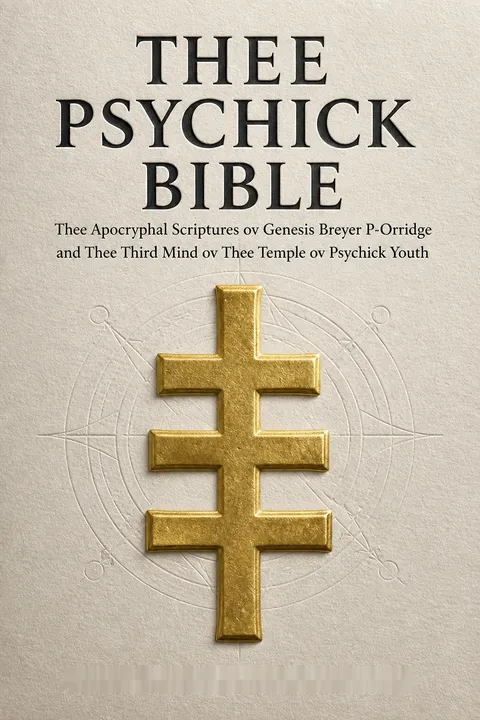
- Psychick Cross: The Psychick Cross symbolizes the integration of these forces, serving as a unifying emblem for TOPY’s philosophy.
11. How does Thee Psychick Bible by Genesis Breyer P-Orridge address Pandrogeny and gender identity?
- Pandrogeny defined: Pandrogeny is the creation of a third, gender-neutral being through the fusion of binary gender identities, challenging societal and biological binaries.
- Personal embodiment: Genesis and Lady Jaye Breyer P-Orridge underwent medical and ritual transformations to physically resemble each other, embodying Pandrogeny.
- Cultural critique: The book critiques dualistic societies as sources of conflict and oppression, advocating for the destruction of gender as a control mechanism.
- Spiritual and political message: Pandrogeny is presented as essential for species survival and cultural evolution, promoting total freedom of identity and sexuality.
12. What are the best quotes from Thee Psychick Bible by Genesis Breyer P-Orridge and what do they mean?
- “Thee product is thee process.” Creation and transformation are ongoing acts; the journey itself is the outcome, emphasizing continuous evolution.
- “Change the way to perceive and change all memory.” Perception shapes reality and personal history; altering consciousness can rewrite experience and identity.
- “Conscious faith is freedom. Emotional faith is slavery. Mechanical faith is foolishness.” Advocates for intentional, aware belief rather than blind or emotional adherence.
- “He who fights with monsters should see to it that he himself does not become a monster.” A warning to maintain self-awareness and integrity when opposing destructive forces.
- “WE ARE BUT ONE…” A call for unity beyond gender and identity divisions, encapsulating the Pandrogeny ideal of collective liberation.
Download PDF
Download EPUB
.epub digital book format is ideal for reading ebooks on phones, tablets, and e-readers.








