

Plot Summary
Three Swords on the Road
On a lonely road in Warric, Hadrian Blackwater and Royce Melborn, the partners known as Riyria, are surrounded by five would-be robbers. Hadrian bluffs and Royce diagnoses their poor ambush, then the pair let the thieves clear their barricade and ride on. When their name frightens the gang into retreat, Hadrian decides they should visit the local earl, Archibald Ballentyne.
The encounter introduces their contrasting habits: Hadrian tries to leave people better than he found them, while Royce treats kindness as an unnecessary risk. Their confidence rests on real skill, but their work is entangled with the wealthy people who hire them. Their next stop is not a job site but the political trouble surrounding a set of stolen letters.
The roadside robbery establishes Riyria as both professionals and reluctant moral instructors. Hadrian’s ease with people and Royce’s exacting suspicion are not merely comic contrasts; each is a different method of managing vulnerability. Hadrian tries to change a threat through rapport, while Royce makes danger legible by identifying its errors. Their reputation protects them here, but it also hints at the unequal world in which a name can frighten the poor more effectively than justice can.
The Letters Turn Blank
Earl Ballentyne intends to force Marquis Victor Lanaklin to marry his daughter Alenda by using letters that appear to prove she loves the Nationalist leader Degan Gaunt. The letters are a lie, but Ballentyne believes their political implications will frighten Victor into surrendering Alenda and the valuable Rilan Valley.
When Victor arrives, Ballentyne opens his safe and presents blank pages. The originals have been replaced by Riyria, who intercepted them for Alenda and then arranged to return them for a second fee.
Victor leaves, while Ballentyne discovers his carriage has vanished too. At a poor Medford tavern, Alenda receives her letters from Hadrian and Royce. Royce warns her that her father may now watch her closely, leaving her romance with Gaunt more dangerous than before.
The letter scheme makes information itself a form of property. Ballentyne expects to control Alenda by controlling what her father believes, while Riyria turns the same vulnerability into profit for both sides. Their double dealing is clever, but Hadrian’s unease exposes its cost: when politics becomes a game played by people with money, even a sincere romance can be reduced to leverage. The blank papers defeat one coercive plan without making the underlying danger disappear.
A Duel's Missing Sword
At the Rose and Thorn, Baron Delano DeWitt asks Hadrian to recover Count Pickering’s prized rapier before a noon duel. DeWitt had stolen it after offending the count’s wife, then panicked and dropped it in Essendon Castle’s chapel. Hadrian accepts despite Riyria’s rule against rushed jobs, persuaded that DeWitt will die if the count gets his sword back.
Royce spots the risks but agrees when the enormous payment promises a safe winter. They scale the castle, cross to the empty room, and enter the chapel, where the sword is missing and a man lies dead in a pool of blood. A gold crown has rolled beside a pillar. The thieves understand that their theft has collided with a murder, and they leave the chapel straight into an accusation.
Hadrian’s decision marks the point where professional caution yields to his desire for a job that might save someone. Yet his compassion operates inside a business arrangement, and the money is part of the persuasion. The chapel reverses the assignment’s meaning: Riyria entered as hired thieves and emerge as apparent killers. In this story, innocence alone offers little protection. The people who control evidence, guards, and public interpretation can decide what an event means before the accused can speak.
The King in the Chapel
A dwarf named Magnus raises the alarm, claiming the two intruders killed King Amrath. Soldiers seize Hadrian and Royce before they can explain that they were after Pickering’s sword. The dead king’s son, Alric, wakes in a servant’s room and learns that he has inherited the throne.
Grief quickly hardens into a demand for revenge, and he orders the prisoners tortured and executed. His sister Arista, however, visits them in the dungeon and believes their account.
She reveals that the murder was arranged to destroy the Essendon line, though she cannot prove who ordered it. Since Alric will not listen to her, she offers the condemned thieves a route out of the castle and asks them to take her brother with them, despite the danger of trusting strangers.
The false accusation turns political violence into a crisis of interpretation. Alric’s grief is real, but his first royal act is to convert grief into punishment, accepting the simplest account because it promises control. Arista’s position is less powerful: she recognizes the trap yet expects to be dismissed as an emotional young woman. Her decision to free the accused men is therefore both strategic and psychologically costly, a wager on their capacity for judgment rather than loyalty.
A King Through Sewers
Disguised as monks, Hadrian and Royce escape the dungeon and knock Alric unconscious in the kitchens. They carry him through the sewers to the Galewyr River, where a stolen fishing boat lets them leave Medford before the castle discovers his absence. When Alric wakes, he suspects Arista arranged the king’s murder and plans to eliminate him too.
Royce sees enough sense in the prince’s argument to abandon the obvious river route. At Wicend Ford, hidden archers shoot the boat and the decoy clothes stuffed with brush. Royce steals the attackers’ horses, and the three flee across the fields. Alric agrees to travel with them to the Winds Abbey, still unsure whether his sister is trying to save him or deliver him to another trap.
The flight forces Alric to experience kingship without its protective scenery. Bound, soaked, and hunted, he cannot rely on rank to make others obey, and his suspicions are partly reasonable because the facts have been arranged to implicate Arista. Royce’s willingness to revise the plan when the prince identifies a real risk contrasts with Alric’s earlier certainty. Trust here is not emotional surrender; it is a provisional decision tested by evidence.
Myron's Ruined Abbey
At the Winds Abbey, the travelers meet Brother Myron Lanaklin, who has never left its grounds and has spent his life memorizing its library. Royce discovers that the abbey is a burned ruin and Myron has buried the monks who died there. The young king learns that armored men accused the monks of treason, locked them in their church, and set it alight.
Myron survived because he was trapped beneath a stone lectern. His memory supplies a fragment about Gutaria, a secret prison built for a man named Esrahaddon, reportedly an ancient wizard blamed for destroying the empire. Since the abbey is no longer safe and Myron has nowhere else to go, the travelers bring him along toward the hidden prison.
Myron’s memory is at once his gift and his wound. He can preserve an entire library because he has spent years turning reading into a private world, yet no perfect recollection can restore the people burned around him. His survival also complicates the idea that silence is neutral: he kept an oath while others died, and now he must confront the difference between honoring a promise and accepting responsibility for its consequences.
The Prison Opens
The party finds a hidden entrance in the mountain near Lake Windermere, but the carved wall will not open. Myron recalls that the prison’s builders used gemlocks, and Royce realizes the blue stone in Alric’s royal ring may be the key. Joined together, the travelers pass through the rock and discover a vast, ancient prison.
Its clerk warns them not to obey the prisoner, but the bridge to the exit disappears after they enter. Esrahaddon, who looks far younger than his age, says the prison has suspended time and blocked magic. He identifies the true danger: church agents killed Amrath because they suspected the king was linked to Novron’s bloodline. To escape, Alric must invoke an old royal decree, freeing Esrahaddon and everyone with him.
The ring changes from a symbol of inherited authority into a working key. Alric’s title matters because the prison’s ancient law recognizes him, not because the men around him defer to it. The timeless chamber sharpens the story’s concern with institutions that outlive their purposes: the wardens still enforce rules whose original meaning they have forgotten. Esrahaddon’s account destabilizes received history, but the group must trust him before they can verify it.
Magnus Behind the Murder
After escaping Gutaria, Esrahaddon reconstructs Amrath’s murder from the room’s layout. The king was kneeling at prayer, and the altar cabinet could have hidden someone small enough to stab him from behind. Magnus, the dwarf who first accused Riyria, had both access and the right size. The wizard concludes that another person hired him, but does not yet know who.
At the Silver Pitcher Inn, Alric encounters Baron Trumbul, who claims to be escorting him home. Trumbul instead admits that Archduke Percy Braga wants Alric dead and prepares to behead him. Hadrian and Royce arrive in time to kill Trumbul’s men and save the prince. Alric finally accepts that Braga is the traitor and rides to Count Pickering’s fortress to raise support.
The murder mystery advances through physical inference rather than confession. Esrahaddon notices what the witnesses overlooked: the king’s posture, the locked room, and the altar cabinet. At the same time, Alric’s political world becomes personal when an uncle’s soldiers try to kill him. His recognition of Braga’s betrayal is not simply a revelation about an antagonist; it destroys a relationship that had shaped his understanding of family and safety.
Pickering Raises the Banner
At Drondil Fields, Alric tells Count Pickering and the count’s sons that Amrath is dead and Braga is trying to seize Melengar. Pickering begins mustering an army, while Alric struggles to accept that childhood plans and easy friendships have ended with his father’s death.
Before the forces are ready, a messenger brings word that Braga intends to try Arista for treason and witchcraft. Alric understands that delay will leave his sister at the archduke’s mercy, but a full assault could fail.
He asks Hadrian and Royce to reach her first. The thieves agree, partly because Arista once saved them from execution. Alric sends them toward Essendon Castle while the nobles continue gathering troops, leaving his sister’s survival dependent on the men he once ordered killed.
Alric’s maturation is measured by the difference between imagining power and carrying its costs. At Drondil, the king cannot simply order events into a favorable shape; he must weigh military readiness against his sister’s immediate danger. His request to Riyria also reverses the earlier hierarchy. The young monarch must ask help from men he once treated as disposable criminals, and the friendship that grows from that dependence is more credible than any sudden conversion to wisdom.
Arista's Tower Falls
Braga builds a public case against Arista from her release of the prisoners and her apparent lack of grief, while Bishop Saldur backs the accusation. Hadrian and Royce slip into the castle disguised as guards. Royce reaches Arista’s tower, where Magnus has hollowed the stone stairs into a death trap.
He and Arista descend by jumping over each missing step, then escape the collapsing tower on a rope. Hadrian delays Braga in the chapel until Alric and Pickering arrive.
Braga attacks Alric, but Pickering intercepts him and kills him in a duel, while the loyal castle guards put down the hired mercenaries. Alric embraces Arista and publicly names her innocent. He takes the throne at his coronation a month later, while Myron receives support to rebuild the abbey and its library.
The rescue resolves the immediate struggle for Melengar, but it does not restore what political violence has already taken. Arista survives because several people act outside the roles assigned to them: a thief enters the tower, a king trusts former prisoners, and Pickering risks a duel. The collapsing staircase gives architectural form to Braga’s rule, a structure designed to look secure while depending on hidden weaknesses. Political legitimacy is recovered through cooperation, not inherited ceremony alone.
Two Years, One Old Debt
Two years later, Hadrian and Royce track DeWitt to Colnora to settle the debt left by the chapel job. Royce holds a blade to the former baron’s throat while Hadrian questions him. DeWitt admits he sold his ship to buy Allie from the slaver Ambrose Moor, and that the false identity and dangerous contract paid for her freedom.
When Allie appears in the alley, Royce lowers his dagger. The two thieves leave DeWitt alive but insist he still owes them money. On their way across the city, members of Royce’s former guild, the Black Diamond, confront them and demand they leave Colnora. They also mention a desperate young woman who has been asking for Riyria by name, giving the partners a new reason to stay.
The confrontation turns revenge into a moral test. DeWitt did endanger Riyria, but his deception was bound to a desperate attempt to rescue a child, not to simple greed. Royce’s choice does not erase the harm or make him gentle; it shows that his harsh code can register context when someone else’s survival is at stake. The encounter also reconnects the story’s earlier job to its new one, making consequences travel farther than the original contract.
Thrace Hires Riyria
The woman seeking Riyria is Thrace Wood, a poor girl from remote Dahlgren. She has spent her dowry searching for the thieves because a crippled stranger named Mr. Haddon told her they could open an abandoned tower. A beast has killed villagers and livestock, including Thrace’s mother, brother, sister-in-law, and young nephew.
Her father, Theron, refuses to leave the ruined farm and plans to fight it with a scythe. Hadrian wants to accept the job, while Royce sees the cost and danger; he finally agrees for a fraction of Thrace’s savings. On the journey east, she marvels at the wealth around Colnora, then reaches Dahlgren and finds the village’s surviving families living under the threat that destroyed hers.
Thrace’s small purse measures the distance between her village and the wealthy cities she crosses. She has saved what she can, but money cannot buy the certainty she wants: that her father will survive. Her request gives the professional thieves a job with a plainly human purpose, while Royce’s low fee quietly signals a shift in his priorities. The adventure begins not with treasure but with a daughter trying to interrupt the repetition of loss.
Theron Refuses the Future
Theron sits among the ruins of his home, imagining the prosperous life his murdered son might have built as a cooper. He blames Thrace for leaving the house door open on the night the beast killed their family, then sends her away while he sharpens his scythe.
Hadrian finds claw marks in the wreckage and understands the creature is enormous. That night it tears apart Mae Drundel’s house and kills her. Royce glimpses a long, winged shape in the darkness.
At Mae’s funeral, Hadrian persuades the villagers to move into the margrave’s fortified manor and shelter their animals together. He tells them the beast hunts isolated prey, then confronts Theron about his self-destructive plans. Theron finally agrees to learn how to fight rather than simply wait to die.
Theron’s grief has narrowed his imagination until death looks like the only action left to him. His fantasies about his son’s future are tender, but they also protect him from confronting the life he actually shared with his family. Hadrian’s blunt challenge is ethically risky: he uses shame to break Theron’s paralysis. The intervention succeeds only when Theron stops treating guilt as proof that he deserves punishment and begins accepting responsibility for the living.
A Citadel Above the Falls
Royce and Esrahaddon inspect Avempartha, a vast elven tower rising from rock above the Nidwalden’s waterfall. Its old bridge has collapsed, leaving the citadel apparently unreachable. Esrahaddon explains that the Gilarabrywn is a magical war creature and that an inscribed sword can dispel it.
He also warns that Dahlgren stands on land covered by an ancient treaty, and that elves across the river may be watching how humans respond. Back in the village, Hadrian pressures Deacon Tomas to open the manor to the people and organizes defenses.
Thrace is injured when the beast attacks again, but survives. Her recovery helps Theron abandon his wish to die; he asks Hadrian to teach him proper combat. Together, the villagers prepare shelters, fires, and a plan to contain the creature.
The tower reframes a local monster as a surviving instrument of a much older conflict. Esrahaddon sees the villagers’ danger in geopolitical terms, but Hadrian acts at the scale where people can actually be protected: doors, fires, shelter, and training. The two kinds of attention are necessary and incomplete on their own. Meanwhile, Theron’s request for instruction marks a concrete turn from grief as fixation to grief as motive for protecting his daughter.
The Church's False Contest
The Nyphron Church arrives with Bishop Saldur, Archbishop Galien, Sentinel Luis Guy, and Lord Rufus, driving Dahlgren’s residents from the manor and taking their livestock. The church announces that volunteers must face the Gilarabrywn; whoever kills it will be recognized as the Heir of Novron.
Esrahaddon realizes the contest is a fraud. The church intends to give Rufus a copied sword, let him claim the empire, and use the victory to force the kingdoms into a new imperial order.
Royce discovers that Magnus, who murdered King Amrath, has been hired to reproduce the elven weapon. Magnus reveals an underwater tunnel leading beneath the river to Avempartha. Royce, Hadrian, and Esrahaddon enter the citadel, but only Royce can see its hidden doors because he has elven blood.
The church converts a genuine crisis into political theater. By presenting the beast as a test of divine blood, it transforms deaths into evidence for a predetermined ruler. Its claim to restore order depends on controlling both the weapon and the story told about its use. Royce’s ability to enter Avempartha introduces a personal inheritance he has kept private, linking his identity to the elven history that human institutions have spent centuries simplifying or suppressing.
The Sword Is Broken
On the first contest night, five challengers die, and the Gilarabrywn flies away before anyone else volunteers. Royce enters Avempartha while the creature is gone and wanders through a preserved elven world of ancient rooms and artifacts. He finds a display of swords, but the weapon associated with the living beast is missing.
Higher in the tower, he discovers the Gilarabrywn asleep amid a heap of its victims and scraps from Dahlgren. A sword glints beneath the remains, but the blade is broken. Royce retrieves only one piece: its etching is incomplete, and the other half lies beneath the monster. He returns to the village with the fragment and Hadrian’s weapons, unwilling to risk waking the creature without a plan.
The tower offers beauty as well as danger, and Royce’s distraction reveals how strongly the place resonates with him. Yet the central discovery is not a usable weapon but a broken one. The monster has anticipated its vulnerability and destroyed the sword’s practical value, turning the apparent solution into another problem. Royce’s restraint is important: skill does not mean acting whenever an opportunity appears. Sometimes survival depends on recognizing that curiosity has carried you too close.
Dahlgren Burns
While Royce and Esrahaddon are away, the Gilarabrywn returns and sets the church’s camp and the fortified settlement ablaze. Hadrian gathers the villagers inside a well, where Magnus adds footholds to make room for everyone.
Royce rescues Pearl before the creature reaches them, and the survivors wait underground as the forest, houses, and manor burn. By morning, Dahlgren is a charred plain. Theron finds that Thrace and Princess Arista are missing; Deacon Tomas says the beast carried them away after demanding the stolen sword.
Hadrian gives Theron the broken fragment, but warns that surrender may not save either woman. As villagers prepare to leave, Hadrian and Royce decide to stay. Their small contract has become a promise they cannot abandon.
The well turns a village’s ordinary infrastructure into collective refuge. Survival comes not from heroic combat but from coordinated labor, trust, and the willingness to shelter together. The destruction still has a devastating cost: the people survive, but their home does not. Theron’s demand for the sword shows how helplessness can disguise itself as a bargain, while Hadrian and Royce’s decision to remain makes their responsibility explicit rather than sentimental.
The Beast Demands Trade
At Avempartha, Arista and Thrace wake on the monster’s pile of victims. Thrace searches the debris and finds the hilt half of the broken sword. Royce enters the tower, but the Gilarabrywn has returned and attacks before he can reach them. Esrahaddon appears and uses a burst of light to draw its attention.
The creature recognizes the wizard and flees with Thrace in its claws, while Royce brings Arista inside the citadel. The princess learns that the sword’s inscription, not its metal, can dispel the magical creature, and that the two fragments must complete its name. The Gilarabrywn is now flying toward Dahlgren with Thrace, while Hadrian and Theron wait below with a counterfeit blade and an uncertain plan.
Arista’s rescue offers relief without resolving the danger, while Thrace’s apparent escape from the heap ends in renewed captivity. The half-sword makes the plot’s central problem tangible: knowledge and courage are insufficient when the crucial object is incomplete. Esrahaddon can still command fear, but his lost hands limit what that fear can accomplish. The characters must now combine scattered resources rather than rely on any one person’s power.
Thrace Names the Beast
The Gilarabrywn lands at the ruins and releases Thrace as a gesture of good faith. Hadrian hands over Magnus’s counterfeit sword, but the creature rejects the bargain and attacks. Hadrian wounds its eye with Royce’s dagger, then Tobis’s catapult drops a weighted net over its wings. Theron drives the genuine broken fragment into the creature, but it survives; the missing half is the part that completes its name.
Thrace returns carrying the hilt half she found in the tower. As the monster turns toward her, she approaches without fear and thrusts the fragment into its body. The complete inscription dissolves the creature in a violent burst of force. Thrace has saved the survivors, but Theron dies from the wounds he received during the fight.
The climax depends on several kinds of courage rather than a single champion. Hadrian buys time, Tobis’s impractical-looking machine becomes useful, Theron intervenes, and Thrace completes the act they cannot. Her lack of fear is not invulnerability; it comes after loss has stripped away the future she was protecting. The victory therefore carries no simple triumph. The village is free of the beast, but Thrace pays for that freedom with her father’s death.
An Empress in the Ashes
After the Gilarabrywn vanishes, Esrahaddon uses Avempartha to search for the hidden imperial heir. He finds the amulets he made for the heir and his guardian, though the search’s full result remains private. On the riverbank, Arista asks whether Esrahaddon caused her father’s death.
He admits that he did, and she rejects him as a trusted teacher. At the church camp, Saldur and Guy decide to present Thrace as the heir, then control her through marriage and political theater.
Royce returns to free Hadrian, the wounded Mauvin, and Hilfred from the church’s guarded tent; Fanen and Theron are buried. He finds Theron’s grave marked as the father of an empress. As the party rides away, Hadrian reveals that his father left him a silver medallion, a clue that may connect him to Esrahaddon’s search.
The ending refuses a clean restoration of order. The monster is gone, but the church immediately tries to turn Thrace’s achievement into a tool of rule. Esrahaddon’s confession also leaves Arista with a new moral crisis: the person who saved her life helped cause her father’s death. Meanwhile, the medallion hints that political identity may be hidden in ordinary family inheritance. The story closes with revelation, grief, and uncertainty still active.
Analysis
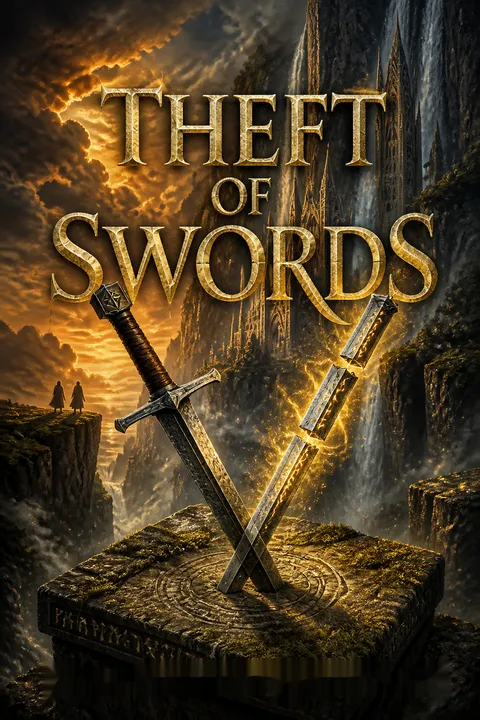
Theft of Swords uses a pair of thieves to test the distance between skill and responsibility. Hadrian’s impulse to intervene and Royce’s instinct to withdraw are not opposing moral absolutes; the plot repeatedly shows each as necessary and each as dangerous on its own. Their partnership works because neither can fully impose his way of seeing the world on the other.
The two linked stories also examine how power makes truth. Ballentyne uses fabricated letters, Braga uses a staged trial, and the Nyphron Church invents a contest designed to manufacture an emperor. Each scheme depends on turning an appearance into public fact. Against this, the book places forms of knowledge that resist easy control: Myron’s memory, Esrahaddon’s historical experience, Royce’s reading of physical spaces, and the villagers’ practical understanding of shelter and danger. None is sufficient alone. The truth emerges through acts of collaboration.
The old empire’s surviving institutions are not presented as inherently wise. Gutaria preserves a law no one remembers, while the church invokes the past selectively to justify a future it already wants. The story’s deepest political question is not whether one ruler is better than another, but who gets to decide what counts as legitimate authority. Alric’s signet, the church’s ritual, and Thrace’s victory all provide competing answers.
The emotional center is the shift from private grief to shared action. Myron must leave the abbey, Theron must stop punishing himself, and Thrace must act after losing nearly everything. Their courage does not restore what was destroyed. It changes what they do with the loss. The ending keeps its victory uneasy: the creature is gone, but the institutions that exploit people remain, and the suspected heir has not yet chosen what his inheritance means.
Review Summary
Theft of Swords receives mostly positive reviews, praised for its engaging characters, particularly the duo of Royce and Hadrian. Readers appreciate the lighthearted tone, humor, and accessible writing style. Some criticize the simplistic plot and familiar fantasy tropes, while others enjoy the traditional elements. The series is noted to improve with each book, encouraging readers to continue. Many reviewers highlight the strong character development and entertaining dialogue. Overall, it's recommended for those seeking a fun, adventurous fantasy read.
People Also Read




Characters
Hadrian Blackwater
The open-hearted swordsmanHadrian is one half of Riyria, a skilled fighter whose warmth distinguishes him from the professional cynicism around him. He jokes easily, notices when people are frightened, and repeatedly accepts risks because he cannot treat suffering as someone else’s problem. That generosity is not uncomplicated: he breaks the partners’ rules and can mistake moral urgency for a workable plan. His bond with Royce depends on trust built through action rather than confession. Hadrian’s past remains guarded, even from his closest friend, and the silver medallion he wears suggests that his origins may matter more than he believes.
Royce Melborn
The shadow-eyed lockpickRoyce is the other half of Riyria, an exceptionally capable thief who reads danger through silence, architecture, and human motives. His suspicion is a form of self-protection shaped by a violent past, but it does not make him incapable of attachment. He often mocks Hadrian’s compassion while continuing to stand beside him when it matters. Royce resists discussing his history and dislikes being treated as a mystery to solve. His relationship with Gwen reveals a softer loyalty he has difficulty accepting, while his fascination with locks and hidden doors mirrors his reluctance to open himself.
Alric Essendon
The untested young kingAlric inherits Melengar’s throne while still thinking of kingship as a distant future. He can be vain, impulsive, and accustomed to other people absorbing the consequences of his choices. His father’s death and his flight from the castle force him to confront vulnerability without the rituals and guards that once insulated him. His connection with Arista is strained by old jealousy and limited familiarity, but the crisis makes their dependence on each other impossible to ignore. Alric is not instantly wise; he learns by suffering, listening, and accepting help from people he once dismissed.
Arista Essendon
The scholar princessArista is a politically observant princess who has studied magic and scholarship in a world that distrusts both in women. Her independence can look like aloofness, and her privacy leaves others free to mistake her motives. She is brave enough to make decisions under pressure but not immune to grief, guilt, or uncertainty about whom to trust. Her bond with Alric is shaped by sibling resentment and affection neither has learned to express well. Arista’s intelligence is practical as well as academic: she recognizes the danger of being reduced to a symbol, even when powerful institutions praise her.
Myron Lanaklin
The living libraryMyron is a monk raised in near-total seclusion, with an extraordinary memory and little experience of the world beyond the abbey. He records knowledge with meticulous care and approaches ordinary experiences, from horses to women, with unguarded wonder. His innocence is not stupidity; he can connect old texts and explain how history has been distorted. Myron is also burdened by the survival of a fire that killed the community he loved. His understanding of duty begins in books and inherited rules, but the journey forces him to test those ideas against grief, guilt, and life outside the library.
Esrahaddon
The imprisoned ancient wizardEsrahaddon is an ancient imperial wizard whose knowledge survives a world that has forgotten much of what he knew. Imprisonment has left him without hands, restricting his magic while sharpening his patience and his habit of withholding information. He can be perceptive, sardonic, and genuinely protective, but he also treats other people as pieces in plans they do not understand. His history with the empire and the Church of Nyphron makes him a source of both insight and danger. Arista’s trust in him is complicated by the gap between the teacher she experienced and the strategist he has been.
Thrace Wood
The determined farmer's daughterThrace is a young woman from the frontier village of Dahlgren whose modest means do not limit her resolve. She crosses the country to find help for her father and spends her savings on a chance to protect him. Her courage coexists with grief and self-blame, especially over the family she lost when the beast attacked. She notices beauty in ordinary things and continues to imagine a future even after hardship has made that future difficult to picture. Thrace’s relationship with Theron is marked by affection that he has not always known how to show.
Theron Wood
The grieving farmerTheron is a strong, stubborn farmer whose identity rests on work, endurance, and the dream of securing a better life for his son. After losing most of his family, he turns grief inward as blame and outward as anger toward Thrace. His refusal to accept help is not mere pride; accepting it would mean admitting that labor and will cannot undo what happened. Hadrian challenges him to replace self-punishment with useful action. Theron’s love for his daughter is deep, though years of emotional silence have made it difficult for him to express.
Percy Braga
The ambitious royal unclePercy Braga is a decorated swordsman and senior royal official whose political competence conceals a dangerous appetite for authority. He presents himself as a protector of the kingdom, and his rank allows him to turn suspicion into official evidence. Braga understands that public fear can be organized, especially when directed toward a young woman accused of magic. His relationship to the Essendon family gives his ambitions a personal intimacy that makes his actions more disturbing. He represents the danger of loyalty to an abstract political cause when it overrides responsibility to actual people.
Maurice Saldur
The church's velvet strategistBishop Saldur, often called Sauly by those close to him, has long occupied a trusted place near the Essendon family. He presents warmth and affectionate concern, but his political judgment is governed by the Church of Nyphron’s ambitions. Saldur believes centralized power can produce order and prosperity, which allows him to rationalize coercion as necessary reform. His paternal manner makes his compromises more effective and more painful to those who trust him. He is not driven by simple cruelty; he is dangerous because he can make manipulation feel like benevolence.
Count Pickering
Melengar's loyal swordmasterCount Pickering is one of Melengar’s most powerful nobles and a trusted friend of King Amrath. He combines political caution with a reputation for exceptional swordsmanship, and he expects responsibility to mean more than titles. His family’s closeness to Alric and Arista gives the royal siblings a rare refuge from court maneuvering. Pickering values restraint, preparedness, and the dignity of keeping one’s word, though his position forces him to weigh personal loyalty against the safety of the kingdom.
Mauvin Pickering
The eldest Pickering sonMauvin is confident, sociable, and proud of the fighting tradition passed down through his family. His teasing manner can conceal real seriousness, especially when Alric’s safety or his siblings are at stake. Mauvin is accustomed to being the capable elder brother and often takes responsibility for Fanen, even when Fanen resents it. His friendship with Alric is rooted in shared childhood, but adulthood makes that bond answer to political and personal danger.
Fanen Pickering
The ambitious younger swordsmanFanen is a talented young swordsman who wants a future of his own, rather than simply living as the middle son of a famous family. He is drawn to public recognition and the promise of the church’s contest, partly because a title or position could spare him an uncertain life. His skill is real, but his ambition can outrun his judgment. Fanen’s relationship with Mauvin combines admiration, rivalry, and the familiar irritation of brothers who care deeply about one another.
Magnus
The dwarf master craftsmanMagnus is a dwarf craftsman who makes a living through stonework, traps, and weapons. He is proud of technical skill and tends to regard human politics as a customer’s problem, a stance that becomes harder to maintain when his work harms people. His interest in Royce’s unusual dagger reveals a more personal devotion to craft and the history of exceptional weapons. Magnus is practical, self-interested, and capable of fear, but he is not defined solely by the jobs he accepts.
Luis Guy
The church's hard-edged sentinelLuis Guy is a sentinel of the Nyphron Church, trained to enforce its authority and pursue its political aims. He is disciplined, observant, and skilled at reading evasions, making even casual conversation feel like interrogation. Guy believes that order requires people to be sorted into categories of loyalty and threat. His immaculate bearing contrasts with the improvised lives of the villagers he encounters. He is not a mindless enforcer; his danger comes from intelligence yoked to an institution that claims the right to define truth.
Deacon Tomas
Dahlgren's uneasy caretakerTomas is the cleric left to manage Dahlgren after its lord and defenders are lost. He is more comfortable with prayer and keeping the manor in order than with making hard decisions for the village. Hadrian’s questions expose how easily Tomas has mistaken the appearance of responsibility for its substance. Still, he is capable of caring for the wounded and standing by people in danger. His nervousness and vanity make him recognizable as a flawed ordinary person rather than a heroic churchman.
Hilfred
Arista's watchful bodyguardHilfred is Arista’s personal bodyguard, a disciplined soldier whose loyalty is shaped by a formative act of courage in the royal family’s past. He is rarely intrusive and gives the princess room to think, even while remaining alert to danger. His relationship with Arista contains unspoken gratitude and old hurt; both have allowed silence to stand in for feelings they cannot easily name. Hilfred’s duty is clear, but his private convictions are harder for Arista to read.
Gwen DeLancy
The Lower Quarter's discreet ownerGwen is a Calian immigrant who has built influence and security by understanding how Medford’s wealthy and poor depend on one another. She runs the Rose and Thorn and Medford House with discretion, intelligence, and a refusal to be treated as merely decorative. Gwen’s warmth toward Royce unsettles him because it asks him to accept affection without turning it into a transaction. She uses practical power, money, and information to protect the people around her.
Albert Winslow
Riyria's noble go-betweenAlbert is a landless viscount who uses his title to move among the nobility and find work for Riyria. Once dependent on appearances, he has learned to survive by adapting them to circumstance. His humor and appetite make him an easy presence, but his role is strategically important: he hears gossip and opens doors the thieves cannot enter openly. Albert’s relationship with Hadrian and Royce is built on a mixture of friendship, employment, and carefully maintained deniability.
Delano DeWitt
The desperate former baronDeWitt is a nobleman whose panic over an impending duel leads him to hire Riyria for a reckless job. He is more frightened than calculating, and his instinct for self-preservation puts others in danger. Beneath his polished clothes and cultivated manners lies a past shaped by loss and desperate choices. DeWitt’s relationship with Allie shows that he is capable of sacrifice, although his attempt to protect her does not erase the harm he caused.
Archibald Ballentyne
The acquisitive border earlBallentyne is a young earl who measures his worth through land, status, and proximity to greater power. His interest in Alenda is entangled with his desire to acquire her family’s territory, and he mistakes social standing for entitlement. He is vain and opportunistic, but also responsive to changing political circumstances. His schemes show how a minor noble can turn private ambition into a threat by exploiting the fears and conventions of people above him.
Plot Devices
Riyria's hired-work code
Jobs become moral testsRiyria’s partnership is built on paid contracts, careful planning, and a rule against impulsive work. Hadrian repeatedly bends that code to help people he believes are in danger, while Royce measures the costs and doubts the stories clients tell. Their work for Alenda and DeWitt introduces the pattern: a job begins as a transaction, then reveals consequences its clients did not disclose. The code gives the partners a practical way to survive, but the people they meet keep challenging whether professional neutrality is possible.
The royal signet ring
Inheritance becomes a keyAlric’s blue signet ring carries the seal of Melengar, but its practical importance reaches further back than the kingdom. At Gutaria, the ring’s gemstone lets the travelers pass through a hidden stone entrance, activating an ancient lock tied to the authority of the land’s ruler. The device connects political succession to physical access: Alric’s claim is not merely ceremonial, since the prison itself recognizes it. The ring also shows how old systems can preserve power long after their creators and original meanings have vanished.
Gutaria's timeless prison
History trapped outside timeGutaria is an ancient prison whose enchantments suspend time, silence magic, and isolate Esrahaddon from the changing world. Its doors and bridges can disappear when their protections shift, trapping visitors as effectively as the prisoner. The prison makes the group confront a past they know only through distorted books and church teaching. Its old legal authority also creates the escape route: Alric’s royal status allows him to invoke a decree the present-day wardens have forgotten how to read.
The named elven sword
A word can unmake a monsterThe sword sought in Avempartha is not powerful because of its metal. Its inscription contains the Gilarabrywn’s name, and the complete name is required to dispel the magical creature. The blade has been broken, splitting the crucial inscription between two pieces. Royce finds one fragment beneath the beast, while Thrace discovers the other among its trophies. Magnus’s accurate-looking copy cannot substitute for the original, making the distinction between appearance and actual knowledge central to the climax.
The heir-making contest
A staged test legitimizes powerThe Church of Nyphron advertises a contest as a chance for anyone to prove descent from Novron by killing the Gilarabrywn. In reality, church leaders plan to give Lord Rufus a copied sword and use a staged victory to justify a new empire. The contest transforms religious belief into political technology: the crowd is meant to witness an apparently divine proof that has been engineered in advance. When the fake sword fails, the church must improvise, first by trying to suppress the truth and then by claiming Thrace as a convenient ruler.
Download PDF
Download EPUB
.epub digital book format is ideal for reading ebooks on phones, tablets, and e-readers.








