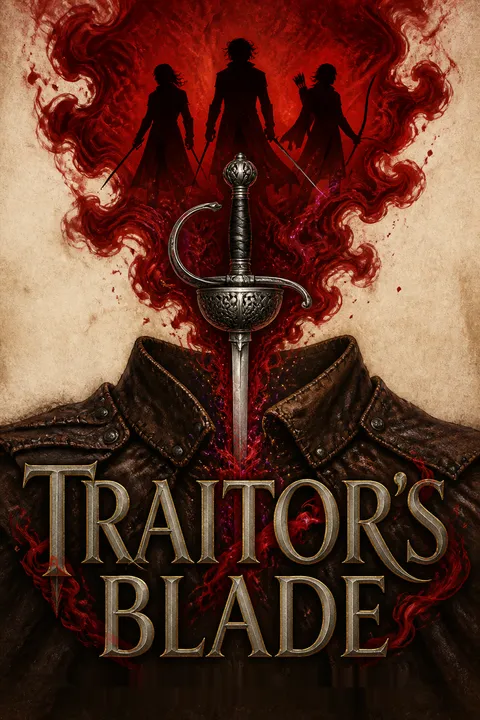


Plot Summary
Tremondi's Bloody Message
Falcio val Mond,1 First Cantor of the disgraced Greatcoats, waits outside Lord Caravaner Tremondi’s room with his friends: Brasti,3 a master archer, and Kest,2 the finest swordsman Falcio1 knows. They hope Tremondi will persuade the trading council to hire the Greatcoats as road wardens, giving the hunted order money and a purpose.
Instead, a masked woman11 emerges from the room, having killed Tremondi with butcher’s scissors. She freezes the three men with costly magic that blurs her identifying features from memory, steals seven caravaner rings, and writes the Greatcoats’ name in blood.
The rings were their chance to rebuild. As city guards approach, the friends escape through a window, leaving Tremondi’s money untouched. Their refusal to steal cannot stop the murder from making them suspects.
The opening makes the Greatcoats’ predicament tangible: their hope for institutional legitimacy is literally taken from a dead man’s hand. The assassin’s memory-altering powder attacks more than their bodies. It deprives them of the evidence they need to defend themselves, turning their reputation into the weapon used against them. Falcio’s refusal to loot Tremondi gives his code a concrete cost. His companions can see that honor has not protected them, yet abandoning it would mean accepting the accusation already made against them.
Pikes at the Window
The three Greatcoats drop into a courtyard where armed constables are already waiting, with crossbowmen above them. The senior officer treats the bloody message as proof and claims Tremondi’s money has vanished, although it remains beside the body.
Kest2 kills a pikeman; Falcio1 uses the awning for cover and draws the crossbowmen’s aim away from Brasti,3 giving the archer time to recover his bow. Brasti3’s arrows and Kest2’s sword clear a path, but a bolt lodges in Falcio1’s thigh.
The friends flee into an alley and remove it before a house-to-house search reaches them. With the city’s ordinary exits sealed and the murder charge impossible to disprove, Falcio1 chooses the caravan market as their best route out of Solat and toward the King5’s mysterious Charoites.
The constables’ conduct mirrors the injustice the Greatcoats were created to oppose: accusation substitutes for investigation, while officials use their authority to conceal their own theft. The fight also clarifies the trio’s distinct survival skills. Kest acts with frightening precision, Brasti needs distance and a bow, and Falcio turns other people’s attention into tactical cover. Yet their escape does not feel like victory. A wound, a stolen reputation, and the loss of their intended sponsor travel with them.
A Boy's Greatcoat Vow
As a poor boy in Pertine, Falcio1 hears the traveling storyteller Bal Armidor17 describe the Greatcoats, royal magistrates who carried justice beyond the reach of local rulers. When an adult dismisses them as fiction, Falcio1 vows to become one.
At the border between villages, he befriends Kest Murrowson,2 whose blacksmith father teaches Falcio1 the sword. Kest2 initially avoids the weapon, then takes it up at twelve and surpasses his teacher and Falcio1 with astonishing speed.
Their friendship survives the imbalance: Falcio1 wants to prove himself, while Kest2 seems drawn to swordsmanship for reasons he keeps private. Years later, Falcio1’s memory of the vow explains why he will not abandon the order, even when the country calls its members traitors.
Falcio’s idealism begins as a response to scarcity. The stories offer a poor child a role in public life that is not assigned by wealth or family. Kest’s early mastery creates a useful contrast: he possesses extraordinary ability without Falcio’s need to turn it into a moral identity. Their friendship is founded on mutual recognition rather than equal talent. The childhood vow is both a source of courage and a psychological trap, because Falcio later treats fidelity to the Greatcoats as a way to measure his own worth.
The King Falcio Almost Killed
At twenty, Falcio1 loses his wife, Aline, after Duke Yered rapes her and his men later kill her. Grief sends Falcio1 on foot to Castle Aramor, intent on killing King Greggor, whom he blames for enabling the Dukes.
He reaches the wrong king: Paelis,5 Greggor’s starving older son, recently freed from a tower after his infant brother dies. Paelis5 persuades Falcio1 to join him in changing the country rather than killing another ruler. They revive the Greatcoats, with Kest2 and Brasti3 among the first recruits, and the Tailor6 supplies their protective coats.
When the Ducal army comes, Paelis5 orders Falcio1 to surrender the castle and save the order through pardons. The King5 also gives Falcio1 a secret mission to find the Charoites, without explaining what they are.
Falcio’s conversion is not a sudden recovery from trauma. Paelis redirects the same moral intensity that made him dangerous, asking him to seek justice for others rather than revenge for himself. The King’s own history of confinement makes that appeal credible, but his decision to surrender leaves Falcio with a wound that never closes: he must obey the order that preserves the Greatcoats while feeling that obedience betrayed their purpose. The unexplained Charoites extend this conflict into the present, making loyalty depend on trust without understanding.
Five Against Falcio
At the caravan market, a captain insults King Paelis,5 and Falcio1 nearly answers with his sword before a noblewoman inside a carriage proposes a test: he must face five guards without killing them. Though injured and exhausted, Falcio1 accepts.
He disables the spearman and breaks another fighter’s knee, then injures two more while trying to spare them. The last man, an armored axeman, triggers a violent fury linked to Falcio1’s buried grief; Falcio1 kills him brutally. Kest2 secures the promised employment, and the woman’s handmaiden,11 Trin,11 files their papers.
The caravan leaves Solat, but not for Baern as Falcio1 expected. Its real destination is Hervor, and its owner has reasons to conceal the route. The Greatcoats have escaped the city only to become bound to a stranger’s plan.
The market challenge makes the gap between principle and survival physical. Falcio can win, but cannot fully control the cost of winning; his effort to avoid killing turns into serious injuries, then the axeman’s armor and threat awaken a more frightening response. The episode also introduces the caravan’s power structure through concealment. The woman’s unseen authority can hire the Greatcoats, redirect them, and keep them dependent, while Trin’s quiet presence gives Falcio a human connection inside an otherwise hostile company.
The Knight Who Laughed
On the northern road, the Greatcoats help the caravan survive two brigand attacks, then train its guards after their poor formation nearly costs a man his life. A Ducal Knight, Captain Lynniac, arrives with soldiers claiming authority to arrest the trio for Tremondi’s murder.
Their employer7 orders the Greatcoats to put down their weapons but threatens their contract if they surrender. Kest2 proposes fighting with the reinforced cuffs of their coats; Falcio1 draws the soldiers into close combat and sings a road song that persuades the caravan guards to join the fight.
Lynniac’s laughter recalls the day the King5 was captured, and Falcio1 nearly kills him in a berserk state before Kest2 knocks him unconscious. Later, Captain Feltock10 admits he was a general at the castle’s surrender. Falcio1 spared him because Feltock10 did not laugh when Paelis5’s body was displayed.
The road fight turns Falcio’s memory into a force that can save him and endanger everyone beside him. His violence is not presented as heroic release; the frightening blankness that follows makes clear he does not control it. The song, by contrast, converts shared labor into collective action, accomplishing what Falcio’s sword alone cannot. Feltock’s confession complicates judgment further. His past is stained by service to the victors, but one withheld laugh gives Falcio a narrow basis for distinguishing complicity from cruelty.
Rijou's Blood Week
The caravan enters Rijou, a city where the Duke permits a week of sanctioned violence called Ganath Kalila. Its hidden mistress finally appears as Valiana,7 who presents rings identifying her as the daughter of the Dukes of Hervor and Rijou, and claims the title of princess.
On the way to the palace, Falcio1 sees men barricading the home of Lady Tiarren, a former ally of Paelis.5 Valiana7 asks her father to protect the family, and he publicly promises to take responsibility for them. By morning, however, the house has been burned with the Tiarrens trapped inside.
A soot-covered girl, Aline Tiarren,4 crawls from a concealed space beneath the building. Shiballe,13 the Duke’s adviser, tries to keep her in Rijou. Falcio1 recognizes that the child remains in danger and refuses to leave her behind.
Valiana’s first exercise of power produces a promise whose wording protects the Duke more than its intended victims. The destruction of the Tiarrens shows how legal language can conceal violence while allowing a ruler to appear generous. Falcio’s response is shaped by a painful repetition: he once watched a woman he loved suffer under a Duke’s power, and now he must decide whether to intervene for a child when intervention may doom them both. Aline’s survival turns that decision into an immediate obligation.
Shiballe at Sunset
Falcio1 orders Kest2 and Brasti3 to leave with the caravan while he stays in Rijou with Aline.4 At sunset, when the Blood Week’s rules begin, Shiballe13 and three guards block their escape. Falcio1 uses the fading light and the guards’ fear to provoke hesitation, then fights them while Aline4 struggles to seize Shiballe13’s pistol.
Shiballe13 catches her, but Falcio1 kills one guard and forces the others to choose between facing him and protecting their employer. Aline4 escapes his grasp and kills a wounded guard with Falcio1’s fallen rapier. She and Falcio1 flee into the city. The child who had once been carried to safety now acts to save herself, but her family’s death and the week’s laws leave them exposed to anyone willing to claim a reward.
Falcio’s choice to remain is both protection and repetition. He has made another person’s survival his burden, but Aline is not simply a passive echo of his lost wife. Her decisive use of the rapier changes the balance of the fight and complicates Falcio’s self-image as sole guardian. The scene’s moral pressure lies in the absence of clean alternatives: refusing violence would leave Aline to Shiballe, while fighting teaches her that survival may require the very acts she will have to live with afterward.
The Copper Tracking Map
Falcio1 hides with Aline4 in a ruined district, but armed bullies surround their shelter. He fights through them in a narrow alley, using his throwing knives and Aline4’s help to break their formation. Aline4 searches the bodies for supplies, finding a copper disc that brightens as she approaches it.
Falcio1 recognizes a magical tracking map: Shiballe13’s men can use matching tokens to locate her. They climb onto rooftops, where a gang of children led by Venger16 corners them.
The children eventually let them go, and Cairn, a young man wearing a homemade Greatcoat, arrives to claim Falcio1 as the First Cantor. He says a new order has formed nearby. Falcio1 accepts the offer of shelter because the tracking discs make staying hidden alone impossible.
The copper token reveals that Rijou’s violence is not confined to noble households or official guards. It can recruit the poor by turning their need for money into surveillance. The children’s gang offers a different kind of power: local knowledge and mutual loyalty, however rough their methods. Falcio’s decision to seek Cairn’s group is pragmatic, but it exposes him to a new danger. The desire to revive the Greatcoats has survived among people who may cherish the costume more than the justice it once represented.
The New Greatcoats
Cairn brings Falcio1 and Aline4 to a lavish headquarters where Lorenzo12 leads a group of wealthy young people calling themselves the New Greatcoats. Their sword fights are choreographed performances, not practical training.
When Lorenzo12 humiliates Cairn in a real bout, Falcio1 steps in, stops the punishment, and defeats Lorenzo12 with rough, unsparing technique. He then orders the group to remove their counterfeit coats and throws them into the fire, rejecting a revival built on spectacle and entitlement.
Aline4 tells Falcio1 that his fights seem driven by anger at everyone who disbelieves in him, not only by her safety. The accusation lands: Falcio1 has mistaken self-destruction for duty. He leaves without the refuge he came seeking, still responsible for Aline4 and with no reliable place to hide.
Lorenzo’s order is a political fantasy made literal: beautiful uniforms and rehearsed violence create the appearance of justice without its discipline. Falcio’s response is necessary but compromised. He protects Cairn from abuse, yet uses his own authority to humiliate the group and destroy their symbols rather than teach them. Aline’s challenge exposes the emotional bargain underneath his heroism. By treating danger as a chance to punish the world, Falcio has made protection and self-harm difficult to tell apart.
The Tailor in the Cellar
After Falcio1 admits that Rijou may kill them, Aline4 asks him to let her choose a quick death rather than face torture. He gives her the soft candy designed for that purpose, but before she can act, apothecaries Radger and Laetha find them and offer shelter.
They drug Falcio1 through a poisoned glass and reveal that Shiballe13 has paid the city to capture Aline.4 Aline4 fights them long enough for Falcio1 to use the King5’s hard candy to overcome the paralysis. In the cellar they find the Tailor,6 bound and gagged.
She explains that the tracking tokens can interfere with one another, gives Aline4 one, and orders Falcio1 to get the girl to the Rock of Rijou so her name will be recorded. The Tailor6’s rescue replaces false safety with a narrow, dangerous purpose.
The betrayal makes trust a material risk: the apothecaries do not need to overpower Falcio, only to exploit his exhaustion and their social welcome. Aline’s willingness to die is an attempt to reclaim agency when every available future seems dictated by others. Falcio’s candy, meanwhile, embodies the King’s disagreement with him about survival. The Tailor’s intervention redirects both characters from escape alone toward a public claim, asking them to risk themselves for a recognition that may matter beyond the immediate crisis.
The Fey Horse's Choice
Two Dashini assassins attack Falcio1 and Aline4 as they near Rijou’s outer wall. Falcio1 resists their fear-inducing poison with a trick prepared by the King,5 but Lorenzo12’s followers capture him soon afterward and deliver him to Duchess Patriana.8
While Patriana8 tortures Falcio1 for information about surviving Greatcoats, she reveals a scarred Fey Horse she has tried to turn into a weapon by killing its foals. She puts Aline4 in the cage with the animal, expecting its rage to finish the girl and break Falcio1’s resistance.
Instead, Falcio1 uses a childhood story’s words to appeal to the horse’s bond with its herd. The animal stops attacking Aline.4 Ugh,15 Falcio1’s torturer, sees this mercy and is shaken by the contrast between the horse’s choice and his own obedience.
Patriana’s experiment exposes her governing logic: she believes a living being becomes useful when enough pain has stripped away its former attachments. The horse’s response is the counterexample she cannot easily dismiss. Falcio reaches it not through command or force, but by naming a relationship the Duchess tried to erase. Ugh’s distress matters because it converts an abstract moral argument into a crisis of self-recognition. He has obeyed cruelty; the animal, despite deliberate conditioning, has not.
A Horse Through Iron
After freeing Falcio1 from his cell, Ugh15 guides him to the stable and leaves him to choose his own route. Aline4 is alive in the cage with the Fey Horse, now called Monster, which guards her from anyone who approaches. Falcio1 opens the cage and persuades Monster to carry them through the palace. She tramples guards, smashes the outer gate, and races into Rijou.
On the final night of the Blood Week, Falcio1 meets Ethalia,9 a healer from the Order of Merciful Light who once received his help as a child. She heals his wounds and offers him a life beyond the Greatcoats. Falcio1 is drawn to her, but refuses to leave Aline4 before the city’s morning ceremony. Ethalia9 lets him go, knowing he is choosing duty again.
The escape depends on choices rather than mastery. Ugh refuses to decide Falcio’s future for him; Monster protects Aline after Falcio recognizes her as part of a herd; Ethalia offers care without coercion. Against these acts of chosen loyalty, the palace’s violence looks less inevitable. Yet Falcio’s refusal of Ethalia’s offer reveals the cost of his identity. He can accept tenderness briefly, but still believes he must finish the dangerous task before he is entitled to a life of his own.
The Rock Takes a Jury
At the Morning of Mercy, Aline4 insists on appearing at the Rock of Rijou, where the City Sage records noble families after the Blood Week. The Sage calls Aline4 by her first name, and she publicly claims her place despite the Duke’s attempt to dismiss her.
Falcio1 challenges the extended Blood Week and reminds the crowd that Rijou’s own founding law rests on collective courage, not the Duke’s permission. He throws the gold buttons from his Greatcoat to the ground and asks for twelve people to serve as a jury preserving his verdict.
No one moves at first. Then Venger16’s dog takes a coin, Venger16 follows, and citizens including Cairn rush forward despite the Duke’s archers. Aline4’s name is recognized, and the Tailor6 arrives to help them leave before the Duke can retaliate.
Falcio’s speech succeeds only after he stops treating the crowd as an audience and gives them a specific, dangerous role. The coins make solidarity measurable: each person who takes one accepts a share of the risk and responsibility. Aline’s claim is likewise more than a bid for status. The ceremony gives her a way to retain a name and future after the Duke has destroyed her household. The people’s response does not overthrow the city’s power, but it prevents the Duke from making fear unanimous.
Cunien's Sword Verdict
Falcio,1 Aline,4 and Monster leave Rijou and race north, pursued by men guided through magical means. Brasti3 finds them on the road and kills four attackers with his bow, then leads Falcio1 back to the caravan. The friends reunite, though Falcio1 returns wounded and emotionally spent.
Farther along the Spear, former Greatcoat Cantor Cunien14 confronts the caravan with a band of brigands. He has become their leader after killing a cruel predecessor, and now keeps his followers fed. Cunien14 distrusts the Greatcoats because he suspects they serve the Duchess,8 but Falcio1 invokes the law of dueling to prevent a wider fight.
Their blades exchange questions and answers until Falcio1 wounds Cunien14’s leg and wins. Cunien14 honors the result and withdraws, confirming that some former Greatcoats survive, though they have adapted to a lawless country in very different ways.
Cunien complicates the idea that the Greatcoats can simply be restored to their former state. He has preserved a recognizable moral practice, the duel, while using violence to govern a band of hungry people. Falcio’s victory therefore brings no easy reunion, only evidence that the order’s scattered members have been reshaped by survival. Brasti’s return offers emotional relief, but the road still carries the larger question: whether a code can remain just when the institutions that once supported it have collapsed.
The Princess Was Trin
Near Orison, Duke Perault blocks the caravan and demands Valiana,7 but Duchess Patriana8 arrives with him. She reveals that the woman long treated as Trin,11 Valiana7’s handmaiden,11 is her true-born daughter.
The apparent princess7 was a peasant child raised to be beautiful, pliable, and convincing enough to secure the Ducal seals. Trin11 is also the masked killer who murdered Tremondi and framed the Greatcoats. Patriana8 orders her soldiers to seize the girls and kill the men.
Feltock,10 who had brought the Greatcoats into the Duchess8’s reach hoping they would resist her, turns against his employer and sacrifices his position to create an opening. Falcio,1 Kest,2 and Brasti3 escape with Aline4 and the false Valiana,7 while Feltock10 and the loyal caravan guards hold off the attack.
The revelation turns the story’s disguises into a system of political manufacture. The false princess was not merely deceived; she was deliberately shaped to embody a harmless ruler, while the real heir learned power from the servant’s position. Trin’s role in Tremondi’s murder makes the opening crime part of the succession plot, not an isolated frame-up. Feltock’s choice is significant precisely because he does not become a spotless hero. He acts within a soldier’s code, but finally directs that code against the power that has used him.
A Coat Without a Past
At Phan, the fugitives find the Tailor6 waiting in a small shop with three new Greatcoats and a fourth, made for Valiana.7 She refuses to assign Valiana7 a purpose, insisting she must choose what she is willing to defend. Valiana7 swears to protect Aline,4 and accepts the coat as the beginning of a new identity. The Tailor6 warns that Kest2’s long-awaited opponent is near.
Duchess Patriana8 soon appears with the Saint of Swords, Caveil, and Kest2 recognizes that the duel belongs to him. He asks Falcio1 to reveal the secret of how he once defeated Kest,2 then faces the Saint alone. Kest2 returns battered but alive, having killed Caveil and taken his place as the new Saint of Swords. His victory cannot stop the army approaching behind the Duchess.8
Valiana’s coat reverses the logic of her manufactured princesshood. Instead of receiving a role chosen by her mother, she accepts a responsibility grounded in a promise she makes herself. The Tailor’s insistence that an oath cannot be supplied from outside connects political identity to consent. Kest’s duel offers the opposite kind of test: a lifetime of technical mastery meets an ideal embodied as a living opponent. His survival transforms him, but not into a solution to the political crisis. Individual excellence still cannot replace collective action.
A Hundred Coats Ride
As Duke Jillard’s force closes in, the Tailor6 arrives and summons a hundred Greatcoats she has secretly trained and assembled while the Dukes searched for the original order. They charge the Duke’s soldiers, breaking a force far larger than their own.
During the battle, the Tailor6 reveals that she is Paelis5’s mother: she taught him through books and stories, then created the Greatcoats as an answer to the violence that had shaped both their lives.
Her triumph is mixed with grief and rage; the King5’s death has turned her into a strategist as well as a maker. With the army beaten, the Tailor6 sends Falcio1 after Patriana,8 who has fled with the lineage papers. Aline4 accompanies him, and Kest2 and Brasti3 remain with the new force to secure the battlefield.
The cavalry’s arrival fulfills the image Falcio has carried since the surrender: Greatcoats riding together against an army. Yet the force exists because the Tailor has been assembling it beyond Falcio’s knowledge, and its origin is personal as well as political. Her grief gives the order a second founder, one whose answer to injustice is more secretive and coercive than Paelis’s public ideal. The victory defeats the Duke’s immediate force, but the Tailor’s revelation warns that a just cause can be carried by a damaged person with dangerous methods.
The Charoite Is Aline
Falcio1 and Aline4 corner Patriana8 in a cave. When the Duchess8 drops explosive poison over the lineage papers, the blast kills her and leaves Falcio1 poisoned. As he drifts toward death, he understands that Aline4 is Paelis5’s hidden daughter, the living Charoite whose royal blood could restore a legitimate line.
The Tailor6 forces Falcio1 to confront the difference between dying and sacrificing: when she raises Kest2’s sword toward Aline,4 Falcio1 catches the blade in his wounded hand, choosing the girl’s life over the peace of death.
The pain pulls him back from the poison’s surrender. He gives the false Valiana7 a new name and a place as his daughter, while Aline4 remains alive and learns the truth of her father. Falcio1 survives, no longer mistaking a death wish for service.
The ending resolves the novel’s central confusion between devotion and self-erasure. Falcio has repeatedly treated death as proof that he remained loyal, but the final test requires him to endure pain and remain available to the living. Aline’s identity makes the King’s secret political plan a person, not a gemstone or weapon. Naming Valiana as family also rejects the bloodline logic that has organized the Dukes’ rule. The resolution offers no repaired country, only a new possibility grounded in chosen obligations and survival.
Analysis
Traitor’s Blade asks what remains of justice after the institutions meant to enforce it have been captured or dismantled. The Greatcoats begin as a practical answer to distance: they carry the King’s law beyond the reach of local courts. Once Paelis5 is dead, however, their uniforms can be imitated, their reputation weaponized, and their members dispersed into banditry or service to the same Dukes they once challenged. The novel therefore refuses to treat the old order’s restoration as sufficient. Falcio1 must distinguish a living ethic from its recognizable costume.
Rijou makes that problem especially sharp. Ganath Kalila turns law into a ceremony that protects the strong while asking the vulnerable to call their exposure freedom. Falcio1 counters it not by claiming a higher personal authority, but by asking citizens to take responsibility for a verdict together. The jury’s formation is fragile and partial, yet it makes justice a shared practice rather than a gift from a ruler.
The book also scrutinizes heroic self-sacrifice. Falcio1’s grief over Aline and Paelis5 makes him brave, but it also makes him treat his own death as proof of loyalty. Aline4 repeatedly resists being reduced to the person he must save; her intelligence and choices force him to see that protection cannot mean deciding everything for her. The final act of holding back the sword is meaningful because it requires him to remain alive and responsible, not because it earns a noble death.
Across the novel, the Fey Horse, Ugh,15 Valiana,7 and the citizens of Rijou offer variations on the same question: can a person act differently from the role imposed upon them? The answers are neither effortless nor pure. A tortured animal can still protect, a soldier can reconsider an order, and a sheltered woman can choose an oath, but each choice carries risk. The novel’s hope is not that good people will simply defeat corrupt systems. It is that justice can begin when people stop confusing obedience, pedigree, and spectacle with moral authority.
Review Summary
People Also Read


Characters
Falcio val Mond
The wounded First CantorFalcio is the First Cantor of the Greatcoats, a disbanded order of traveling judges who enforce the King’s laws. He is a skilled rapier fighter, a quick tactician, and a compulsive talker whose humor often masks grief. His loyalty to the dead King Paelis5 gives him direction, but also binds him to a mission he barely understands. Falcio’s deepest struggle is to distinguish service from self-punishment. He wants to protect people who have little power, yet his rage can turn that desire into reckless violence. His relationships with Kest2 and Brasti3 keep his ideals human rather than ceremonial, while caring for Aline4 forces him to consider what survival, not merely sacrifice, demands.
Kest Murrowson
The unmatched swordsmanKest is Falcio1’s oldest friend and a swordsman of near-impossible skill. He is quiet, disciplined, and bluntly practical, with a dry humor that appears only rarely. As a boy he took up the sword late and surpassed his teachers almost immediately, but his talent has never made him emotionally fluent. He trusts Falcio1’s judgment even when he thinks it mistaken, and his loyalty is expressed through action rather than reassurance. Kest’s desire to test himself against the greatest fighters can look like simple recklessness, but it also reflects his need to discover whether mastery is enough to meet the dangers ahead. His friendship with Falcio1 survives disagreement because neither mistakes affection for obedience.
Brasti
The irreverent master archerBrasti is the Greatcoats’ expert bowman, a charming storyteller and a born improviser. He uses jokes and flirtation to keep fear at a distance, but his humor conceals deep bitterness about the order’s disgrace and the King5’s death. Unlike Falcio1, he doubts that a lost cause deserves every remaining piece of his life; unlike Kest2, he is willing to say so aloud. His loyalty persists beneath his complaints, visible in the way he protects his friends and shares what he knows. Teaching Aline4 to shoot lets Brasti turn his skill into something more generous than survival, while his wit gives the group a way to face grief without pretending it has disappeared.
Aline Tiarren
The determined young survivorAline is a young noble girl whose family and home are caught in Rijou’s political violence. She is intelligent, observant, and more capable of challenging adults than they expect, but she is still a child confronting grief and terror without a stable home. She resists being treated as a burden or a symbol, and her questions often expose the distance between Falcio1’s stated duty and his actual motives. Her bond with him develops through practical dependence, anger, and moments of trust rather than easy sentiment. Aline’s willingness to learn and act for herself gives her a measure of agency even when powerful people try to decide her future.
King Paelis
The idealistic fallen kingPaelis is a thoughtful, bookish ruler whose youth was spent imprisoned by his father. He believes that justice must be made accessible beyond the court, so he revives the Greatcoats as traveling magistrates. His friendship with Falcio1 is frank and affectionate, shaped by shared study, strategy, and a willingness to argue. Paelis can be idealistic to the point of secrecy: he gives the Greatcoats separate missions and leaves Falcio1 with the obscure task of finding the Charoites. His vision is not simply to replace one ruler with a kinder one. He hopes that enforceable law can give ordinary people enough security to make broader change possible.
The Tailor
Maker of the GreatcoatsThe Tailor is an elderly craftswoman who makes the Greatcoats’ protective clothing and understands how their hidden construction works. Abrasive, observant, and difficult to impress, she has a talent for appearing where events are most tangled. She treats practical skill as a form of knowledge, and sees the order’s coats as tools rather than sacred relics. Her affection is usually disguised by scolding, teasing, or a demand that someone stop asking foolish questions. The Tailor carries her own history of loss, which makes her care for the Greatcoats fierce but not uncomplicated. She believes people must choose what to stand for, even when that choice will cost them dearly.
Valiana
The sheltered noblewomanValiana is introduced as a wealthy young woman traveling under the protection of a caravan and claiming a place among the ruling families. She is polished, demanding, and accustomed to receiving attention, but she is not simply vain. Beneath her confidence lies uncertainty about the power she is meant to inherit and the people who shape her decisions. Her conversations with Falcio1 force her to confront the distance between being given authority and knowing how to use it responsibly. She is especially responsive to Aline4’s vulnerability, though she does not initially understand what that care requires. Valiana’s central psychological tension is the difference between performing importance and choosing a responsibility that gives her actions meaning.
Duchess Patriana
The architect of successionPatriana is a powerful Duchess who approaches politics as a project of shaping people and institutions to serve her designs. She is patient, strategic, and skilled at presenting domination as order. Her treatment of the Greatcoats reveals a belief that loyalty can be engineered through pressure and that living beings are valuable chiefly for their usefulness. She has little interest in sentimental claims of justice, which makes her a direct ideological opponent to Paelis5’s vision. Patriana is not impulsive; her cruelty is calculated, and she expects others to mistake composure for legitimacy. Her relationship with the other Dukes is marked by ambition and careful management of their competing interests.
Ethalia
The healer offering refugeEthalia belongs to the Order of Merciful Light and works as a healer, guide, and companion to people in crisis. She is emotionally perceptive and unashamed of the forms of care available to her, including intimacy. Her connection to Falcio1 begins in an earlier moment when he intervened to protect her, though he barely remembers the encounter. She sees his grief clearly and offers him a possible life beyond the Greatcoats. Ethalia’s kindness does not erase the difficulty of Falcio1’s choice; she asks him to imagine happiness rather than merely accept it as payment for suffering.
Captain Feltock
The soldier with a conscienceFeltock is the veteran captain responsible for guarding Valiana7’s caravan. He is practical, blunt, and suspicious of Greatcoat ideals, having served on the side that defeated Paelis5. His military habits make him reliable in danger, but his conscience has never entirely accepted the victory he helped secure. He respects competence even in people he dislikes and gradually comes to trust Falcio1’s judgment. Feltock’s loyalty is shaped by orders, yet he retains the capacity to decide which orders he can no longer obey.
Trin
Valiana's quiet attendantTrin travels as Valiana7’s handmaiden11 and childhood companion, moving between intimacy and service in a relationship shaped by class. She is observant, capable, and more emotionally guarded than her shy manner suggests. Her attention to Valiana7 reflects years of shared routines, while her exchanges with Falcio1 hint at a wish to be regarded as a person rather than an appendage to a noblewoman. Trin’s careful presentation makes it difficult for others to know what she thinks, and the contrast between her public modesty and private confidence gives her an unsettling presence.
Lorenzo
The theatrical reformerLorenzo leads the New Greatcoats, a group of wealthy young people attracted to the order’s image and promise of heroic action. He is handsome, confident, and genuinely skilled with a sword, but his authority depends on spectacle and control. He treats criticism as a challenge to his status and uses public performance to humiliate those who threaten it. Lorenzo’s vision of the Greatcoats is politically convenient because it preserves their appearance while stripping away the independent judgment that once made them dangerous to rulers.
Shiballe
The Duke's calculating adviserShiballe serves Duke Jillard as an adviser and operator, managing threats with a smooth manner that conceals intimidation. He understands how to make Rijou’s laws and customs work for the powerful, and he relies on informants, guards, and magical tracking tokens to control the city. His confidence comes from a system in which nearly everyone can be pressured or bought. Shiballe is less interested in public honor than in keeping the Duke’s plans moving, which makes him dangerous precisely because he rarely needs to claim authority for himself.
Cunien
The brigand CantorCunien is a former Greatcoat Cantor who has become the leader of a band of brigands. He is wary of Falcio1 and distrustful of the caravan’s political loyalties, but he still recognizes the authority of a properly called duel. Cunien represents one possible adaptation to the collapse of lawful rule: he uses force to protect his people and to replace a worse leader, while accepting that survival has narrowed his choices. His encounter with Falcio1 shows that the old order’s members have not all abandoned their principles, though those principles now operate in compromised forms.
Ugh
The conflicted torturerUgh is a palace torturer who initially follows orders without questioning their cruelty. Falcio1’s repeated recitation of the King5’s laws and the Fey Horse’s unexpected restraint unsettle his belief that obedience is enough. He is physically intimidating but emotionally vulnerable to the evidence that even a tortured creature can choose differently.
Venger
The streetwise child leaderVenger leads a gang of children who know Rijou’s alleys and buildings better than its authorities do. He is suspicious, combative, and protective of his group, but his toughness is mixed with childish bravado. He distrusts adults who claim moral authority without proving they will help.
Bal Armidor
The storyteller who inspired FalcioBal is the traveling storyteller who first gives young Falcio1 a vivid account of the Greatcoats. His stories provide the boy with an imagined future, though Bal also teaches him how dangerous it is to speak openly against the Dukes. As an adult, Bal’s presence carries the cost of having told those stories in the wrong court.
Plot Devices
The Greatcoats
Justice made wearableThe Greatcoats are the leather uniforms and protective tools of Paelis5’s traveling magistrates. Reinforced panels help blunt blows, hidden pockets carry weapons and supplies, and the coat identifies its wearer as a servant of the King’s law rather than a Duke. The order’s name becomes an insult after its members surrender at Castle Aramor, making the garment a visible target as well as a source of protection. Falcio1’s refusal to steal, his use of the coat’s cuffs in combat, and the Tailor6’s replacement coats all show that the uniform means nothing without the judgment and choices of its wearer.
The King's Charoites
A hidden royal inheritancePaelis5 gives Falcio1 the task of finding the Charoites but does not explain what they are or how they can change the country. The uncertainty sends the Greatcoats after rumors and keeps Falcio1 committed to a mission that may be more than a search for jewels. The final revelation makes the Charoite a living person rather than a gem: Aline4, whose concealed royal blood gives the Dukes a reason to fear her. The device turns a vague quest into a question of whether political legitimacy can reside in a person who has been denied knowledge of her own identity.
Ganath Kalila
Violence disguised as traditionThe Blood Week suspends ordinary protections in Rijou under the claim that citizens become stronger by defending what they can hold. Its rules give the Duke room to target rival noble families while insisting that the victims have brought danger upon themselves. The Morning of Mercy is meant to restore civic order and record the surviving houses. Falcio1 uses that ceremony to challenge the Duke publicly, invoking Rijou’s older civic identity and asking citizens to serve as a jury. The ritual therefore functions both as a mechanism of oppression and as the stage on which the city can reclaim a law of its own.
The Hard and Soft Candy
Survival and surrender in sugarThe King5’s apothecaries create two potent sweets. The hard candy can temporarily counter paralysis and keep a Greatcoat moving through exhaustion, but overuse risks killing the user. The soft candy is designed to let a person die quickly rather than be captured and tortured. Falcio1’s choice to carry both reveals a disagreement with Paelis5: Falcio1 believes a quick death may be the last protection available, while the King5 insists that survival can preserve a chance to act. The candies return during the Rijou crisis, where the difference between surrendering to death and choosing to stay alive becomes central to Falcio1’s emotional reckoning.
Monster the Fey Horse
Freedom surviving torturePatriana8 tries to turn a rare Fey Horse into a weapon by subjecting it to confinement, poison, and the repeated killing of its foals. The horse emerges scarred and furious, seemingly reduced to violence. Falcio1’s appeal to its instinct for protecting a herd gives it a choice that Patriana8’s conditioning cannot command. Once free, the horse carries Falcio1 and Aline4 out of the palace and becomes a powerful ally on the road. Its role makes the novel’s argument concrete: suffering can distort a being without entirely erasing the possibility of attachment, recognition, and refusal.
Greatcoats Series

About the Author



Download PDF
Download EPUB
.epub digital book format is ideal for reading ebooks on phones, tablets, and e-readers.








