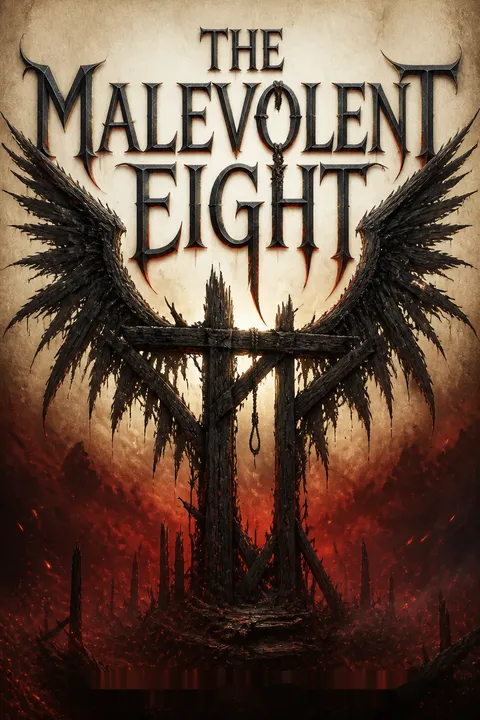


Plot Summary
Pleasance Gets a Warning
Cade Ombra and his six companions arrive at Pleasance to find Infernal soldiers torturing four angelic captives before the townspeople. The supernatural armies are recruiting Mortals for a coming war, and the spectacle is meant to make the town submit. Cade’s crew attacks. Galass, a young blood mage raised as a religious offering, halts a flying, weaponized scarab and delivers the group’s warning before destroying it.
The others tear through the Infernal troops, while Temper, a towering blood-drinking kangaroo, turns the battlefield into a grisly mess. Cade’s powers are more dangerous than he admits: he secretly used a device to attune himself to Pandoral chaos magic, and his experiments accidentally brought Temper into this world.
The rescue begins with a contradiction that defines the crew: they oppose supernatural war by using spectacular violence. Galass’s speech gives their campaign a political rationale, but the battle immediately exposes its moral cost. Cade calls the group a defense for ordinary people while deciding, almost automatically, that he can spend their lives and Galass’s sanity to make the point. His concealed Pandoral attunement adds a second fault line. He believes secrecy protects his friends, but his magic has already changed the world around them in ways they cannot assess.
A Prophecy Takes the Gallows
Cade frees the four Angelic Valiants, expecting gratitude to help secure a message to the Celestines. Instead, their leader immediately claims the town for the Auroral cause. One Valiant speaks with an unfamiliar woman’s voice, burns away a Celestine’s guiding hand, and predicts the futures of those around her.
She makes one prediction happen at once by turning a Valiant’s execution into a grotesque murder, then warns Cade that she and his group will meet again. The remaining angels blame Cade and attack; his companions kill them before they can strike. The townspeople, who had mistaken the crew for heroes, accuse them of destroying their promised city. Cade answers by admitting they are trying to help, though they are poor at it.
The first prophecy does more than threaten the crew. It makes prediction feel like an act of violence: the woman does not merely describe a future, she drags it into the present and forces others to enact it. The Valiants’ unquestioning faith makes them vulnerable to that power, but the townspeople’s disappointment also matters. Cade’s interventions cannot make a community innocent or grateful; he can only expose the price hidden inside its bargain. His admission that he is not a conventional hero is both honesty and a defense against being judged by one.
The Other Eight
For weeks, Cade’s group disrupts Auroral and Infernal recruitment, trying to leave human recruits alive even when they fight back. Galass and Aradeus return from a scouting mission with word of another band, the Apocalypse Eight, which captures spies and leaves them where the rival armies will find them.
Alice and Shame recognize that this may be an attempt to provoke the Great Crusade before either side is ready. Aradeus’s rats locate a hidden Auroral prison, and Cade leads the crew there to learn who the other group serves.
Their breach of the fortress uncovers three tortured Infernal prisoners. One prisoner kills another rather than let him negotiate, then reveals himself as Tenebris, Cade’s former spell broker, now claiming to be a restaurateur.
The campaign shifts from direct resistance to investigation when Cade realizes that someone may be manipulating the timing of the war. His rule against killing human soldiers distinguishes him from the powers he opposes, but it also makes every operation slower and more dangerous. Tenebris’s sudden return unsettles the group’s assumptions about loyalty: he once made his living selling magic, and his new identity as a host and cook seems almost disarmingly ordinary. Cade’s decision to trust him is not simple faith. It is a wager that a known schemer may still be more useful than an unknown one.
The Woman at Dinner
Tenebris serves the group paella and argues that the Infernals should win people through pleasure rather than endless recruitment and bloodshed. Before Cade can get useful information from him, a mysterious mage enters, calls herself a Spellslinger, and acts as if she and Cade share a history.
She warns the crew to stop obstructing the armies, then leaves without explaining who employs her. Her reference to the Glorian Haze, the memory loss that follows Cade’s years as a Celestine-blessed Justiciar, strikes a nerve.
Cade pursues her into the street, where he finds Seduction reduced to ruins and corpses. He attacks with his unfamiliar Pandoral magic, unmaking her body and soul. She reconstructs herself, then brings each companion’s death into the present.
The Spellslinger turns the crew’s usual form of certainty against them. Cade can identify the workings of familiar magic, yet he cannot remember the people he pursued as a Justiciar, and the woman’s knowledge makes that blankness feel like guilt rather than mere impairment. His choice to attack before understanding her is a familiar defense against helplessness. Her return from nonexistence then reveals the limit of his preferred answer to danger: force can destroy a body, but it cannot settle a conflict when the opponent can restore what he has destroyed.
The City Rewinds
The Spellslinger makes Corrigan kill himself with his own lightning, then causes Alice, Aradeus, Shame, Temper, and Galass to die according to their predicted dooms. Cade cannot stop her. She explains that she knew him as Gallantry, a young Justiciar, and blames him for failing to rescue her when they first met. To spare his friends, she demands that he promise to stop interfering in the war.
Cade swears, but she rejects his oath as impossible for him to keep. She reverses the destruction, restoring the town and his companions, then leaves him with the knowledge that their next meeting will be worse. Corrigan admits that dying felt real; Cade can offer no explanation, only a plan to investigate the Spellslinger’s past.
The resurrection does not erase the harm. Corrigan remembers his death, and Cade has watched the people he loves enact futures they could not resist. The Spellslinger’s demand exposes the conflict between private loyalty and public responsibility: she offers to save his friends if he abandons the larger cause, but Cade cannot promise this without betraying a commitment they made together. His uncertainty about the magic becomes inseparable from his uncertainty about himself. The city’s restoration looks like mercy, yet it leaves the group more vulnerable because survival now depends on understanding the past they have avoided.
Gallantry in the Archives
To learn why the Spellslinger knows him, Cade arranges a meeting with the twelve Lords Celestine, rebuilding the ritual cathedral that grants access to the Glorian Archives. His former masters address him by his Justiciar name, Gallantry, while his companions struggle to endure their pomp and judgment.
In the Archives, Cade relives the day he and other Justiciars found a frightened sixteen-year-old mage from the Jan’Tep people. She had accidentally crossed into their world while inventing a spell.
Under the Glorian Haze, Cade first condemned her to execution, then changed his verdict to exile. His superior, Fidelity, took responsibility for carrying out the sentence. The girl later appears to Cade in the Archives and identifies herself as Eliva’ren, revealing that he arrived too late to save her baby.
The Archives promise objective memory, but Cade initially discovers how readily piety can disguise a self-serving story. He remembers himself as a hesitant, compassionate judge; the fuller record shows a frightened young man choosing what his superiors would approve. His shame is therefore not simply about a bad verdict. It concerns the false narrative that allowed him to live with it. Eliva’ren’s appearance makes the past active rather than settled: the person Cade once reduced to a case is now someone with a name, a child, and a history that his order deliberately concealed.
The Celestines Choose War
Cade confronts the Celestines with Eliva’ren’s name and the illegal imprisonment that followed his verdict. They claim Fidelity acted alone at first, but admit they later approved experiments on the captive mage, hoping to acquire new powers against the Infernals.
Eliva’ren was pregnant, and the forced attempt to alter her magic affected her unborn child. The child was taken into the Pandoral realm, while Eliva gained a chaos-based power that can bring possible destinies into the present. The Celestines order Cade’s crew to find and kill her.
Before they can leave, Tenebris arrives with an Infernal army and captures them in custom restraints that suppress their bodies, magic, and resistance. The Lords Devilish want a meeting, and Cade’s appeal to the Celestines has delivered him straight into their hands.
The divine authorities reveal themselves not as neutral custodians but as institutions willing to violate their own laws when a captive might become useful. Their experiments convert Eliva’s misfortune into a strategic asset, then classify the consequences as a threat to be eliminated. Cade’s former loyalty makes his anger especially charged: he sees that the order’s ideals can coexist with secrecy and exploitation. The capture that follows also shows how little control he has gained by exposing the truth. Both pantheons want the same thing from him, and neither recognizes a moral limit that would protect him or his friends.
A Banner for Answers
The Lords Devilish torture Cade’s group while keeping Galass untouched as leverage. Cade refuses to give them a clean victory and forces the conversation toward negotiation. They agree to share what they know about the Spellslinger in exchange for the Glorian Banner, a relic whose value is mostly symbolic.
Cade spots a loophole: the pact requires the crew to secure and deliver the banner, not steal it themselves. Disguised as Glorians, he and Corrigan infiltrate a parade and manipulate an Ardentor named Propriety into believing the Auroral citadel is an Infernal stronghold.
Propriety takes the banner from its vault and delivers it to Tenebris. The crew has technically fulfilled the bargain without touching the relic, but Cade is locked inside the vault as the others escape.
Cade survives the Infernal negotiation by treating language as a weapon, an expertise earned through years of buying spells from Tenebris. The banner heist extends that tactic into social manipulation: rather than overpowering the Auroral guards, Cade feeds Propriety’s suspicions until the Ardentor performs the theft himself. The plan succeeds by exploiting the same vanity and certainty that sustain the supernatural hierarchies. Yet Cade’s confinement at the end punctures his self-image as an infallible strategist. He has outmaneuvered the contract’s wording, but not the people who wrote it.
The Wrong Eight
The Spellslinger appears in the vault and confirms that her powers act on the consequences of choices, not on time itself. Before the fortress collapses around them, she kisses Cade and warns that his decisions are drawing him toward a single doom.
Corrigan rescues him, and the crew meets Tenebris at an abandoned temple to collect the promised intelligence. Tenebris reveals that the Apocalypse Eight are his agents, embedded in the Pandoral’s following.
They have cut up the Glorian Banner to fashion a mask that can track a Mortal wonderist attuned to Pandoral magic, along with restraints able to hold that person. Cade recognizes that the target is himself. He orders Corrigan to kill him, but Tenebris’s agents bind Cade and open a portal beneath him before his friends can act.
The banner’s sacred significance conceals its practical value: its Auroral threads can be repurposed into tools for finding and restraining a Pandoral-attuned mage. Tenebris has engineered an apparent exchange while maintaining a second, hidden agenda. Cade’s concealed attunement now becomes the weakness he created by withholding information from his friends. His order to Corrigan shows that he understands the danger, but friendship makes the necessary act impossible. The capture is not simply another reversal of fortune; it is the consequence of Cade’s belief that he can bear a secret alone.
The Prisoner’s Choice
The Apocalypse Eight torture Cade to force him to become a gate into the Pandoral realm. He feigns madness to frustrate them, then deliberately decides to surrender, hoping the change in his destiny will draw the Spellslinger to him. Eliva’ren arrives but refuses to free him.
She explains that her son, Hamun, was born into the Pandoral realm and that she has spent nine years unable to reach him. She also tries to reshape Cade’s thoughts with Jan’Tep silk magic, but his stubborn commitment to resisting the invasion survives her alterations.
When he offers to become the gate, she realizes his decision has changed her own prospects and helps him escape by pulling the dungeon toward a future in which it becomes a palace. Exhausted, they reach a nearby town and agree to share one night together without discussing what follows.
Eliva’s intervention is neither a rescue nor a simple betrayal. She has her own objective, and Cade’s mind is a means toward it; yet her attempt to control him fails because his commitments are distributed across a lifetime of choices, not housed in a single belief she can replace. Their encounter makes intimacy inseparable from conflict. Each knows the other may be an obstacle, but the date gives them a brief space outside their assigned roles. The child’s absence, disclosed at last, reframes Eliva’s destructive power as a mother’s response to a loss the Celestines helped create.
Tenebris’s New Pantheon
Cade’s friends find him the next morning, just as the sky burns with the approaching Auroral and Infernal armies. During his captivity, Tenebris has offered them power in exchange for support; Corrigan stalled him while Aradeus sent word to both supernatural hierarchies.
At the battlefield, Tenebris explains that he engineered the earlier events that brought the Celestines and Devilish into the Mortal realm. He and a coalition of ambitious figures from both sides now intend to replace the existing rulers.
The Apocalypse Eight have been posing as the Pandoral’s allies while preparing to seize the power released by the collapsing Pandoral realm. Cade recognizes that his own hidden attunement is the key to Tenebris’s plan. He accepts that the old leaders are about to fight, then moves to intervene before their victory becomes a new tyranny.
Tenebris’s long game turns the conflict from a struggle between two pantheons into a contest over who gets to inherit their authority. His argument that the existing rulers are incompetent may be persuasive, but his proposed solution preserves their basic structure: concentrated power, justified by promises of a better order. Cade’s earlier interventions have unintentionally supplied the coup with opportunities, while his secrecy made him the instrument it needs. The battlefield forces him to stop thinking only in terms of exposing villains. The urgent question is whether he can alter the conditions that make any one faction capable of ruling everyone else.
A Son Beyond the Gate
Rather than let Tenebris use him as a conduit for power, Cade sends his consciousness through the Pandoral swarm and into its collapsing home realm. There, scattered across strands of possibility, he finds Hamun, the son Eliva’ren has never been able to hold.
The boy helps Cade gather his divided consciousness into a body and guides him through the realm’s shifting possibilities. They encounter versions of Eliva and Cade who have raised Hamun together, then watch as the Pandoral world begins to disappear.
Hamun’s other father entrusts the boy to Cade, and the constructed Eliva directs them toward a potential gate back to the Mortal realm. Cade follows Hamun through the collapsing strands, carrying him toward the mother waiting on the other side.
The Pandoral realm turns potential into a landscape, making abstract alternatives something Cade must physically navigate. The alternate family he encounters is not a promise he can claim; it is a life formed by choices made in another possibility. Its emotional force comes from showing him what he has missed without letting him mistake that vision for his own. Hamun’s trust reverses the relationship between adult and child: Cade must follow rather than command. The rescue is an act of care that does not guarantee a happy ending, only the chance for mother and son to meet.
Laughter Breaks the Doom
Cade returns to the battlefield barely held together by Galass’s blood magic and Shame’s physical reshaping. Fidick, the boy who once manipulated the Celestines’ entry into the Mortal realm, urges Eliva’ren to kill Cade’s companions so she can take Hamun home.
The boy refuses the choice and appeals to his mother; then Temper’s familiar insult, repeated at the worst possible moment, makes Eliva laugh. The laughter loosens the certainty closing around them. Shame and Alice kill Fidick before he can force the issue.
Eliva’ren unleashes her destiny magic on the surrounding armies, but a Valiant wounds her, leaving Hamun in danger again. Temper, strengthened by all the blood he has consumed, sprouts blood wings and unleashes bloodfire, driving back the Auroral attackers as the supernatural battle reaches its breaking point.
Hamun’s appeal matters because it gives Eliva a choice grounded in a relationship, not an abstract forecast. His mother has spent years trying to force a future that returns him to her, yet the first moment she holds him opens another possibility: staying with him in a damaged world. Temper’s transformation turns his grotesque appetite into a power that can defend rather than merely consume. The crew’s survival depends on such conversions, not on becoming morally pure. Laughter interrupts the machinery of inevitability because it lets the characters respond to one another in a way no prophecy can fully script.
A Draw, Not Salvation
The old rulers fall, and Tenebris’s coalition begins establishing itself as a new pantheon. Shame and Alice negotiate a temporary armistice, not a lasting peace. The Pandoral realm has collapsed, leaving Cade without his magic, but he survives with Eliva’ren and Hamun beside him.
Corrigan insists that the crew remain together, even after their failures, and reveals that he had new uniforms made while Cade was imprisoned because he never doubted Cade would escape. Cade admits that he loves Eliva, though she does not promise marriage.
The group leaves the battlefield facing another set of self-appointed gods and the likelihood of more conflict. Cade’s first proposed response is characteristically direct: he intends to destroy the palace the new rulers are building.
The ending refuses the comfort of a final victory. The crew has stopped the immediate catastrophe, but the replacement pantheon inherits the same temptation to turn other lives into pieces on a board. Cade’s loss of magic strips away the power he treated as his insurance policy, while his companions’ continued loyalty gives him a different kind of capacity: shared responsibility. Eliva and Hamun do not resolve his romantic uncertainty; they make a future imaginable without guaranteeing it. The temporary armistice honors the book’s central skepticism about absolutes. Survival creates another decision, not a permanent escape from conflict.
Analysis
The novel’s central struggle is not simply between good and evil, because both the Celestines and the Devilish turn their preferred moral language into a claim on other people’s lives. The Aurorals invoke virtue and the Infernals celebrate experience, yet both recruit Mortals as expendable instruments. Cade’s response is to resist the whole arrangement, but his methods reproduce some of its logic: he withholds information, manipulates allies, and repeatedly treats his own survival as less important than the plan. His flaws do not make his commitments false; they make them costly to the people who trust him.
Eliva’ren complicates Cade’s mission by embodying the consequences of that institutional violence. The Celestines’ experiments took her child from her and transformed her into a person capable of forcing possible futures into the present. Her desire to recover Hamun is understandable, but it risks making another world pay for what was done to her. Cade’s eventual choice to enter the Pandoral realm and bring Hamun back is not a clean solution. It is an attempt to create a possibility that neither Eliva nor the rival pantheons can dictate alone.
The book treats destiny as a pressure formed by accumulated choices, not a script that absolves people from responsibility. That distinction matters most when characters act against predictions, promises, and institutions: Hamun chooses his mother, Eliva is moved by a moment of laughter, and Cade persists because the act of trying is inseparable from his identity. Yet the ending refuses to confuse a reprieve with a cure. The old gods fall, but another pantheon rises; the war pauses, and the crew’s work begins again. Heroism here is not mastery over history. It is the refusal to let the next powerful faction call its own ambition inevitable.
Review Summary
People Also Read


Characters
Cade Ombra
Reluctant peacekeeperA former Glorian Justiciar turned mercenary mage, Cade is observant, irreverent, and more idealistic than his practiced cynicism allows him to admit. He distrusts institutions that claim moral authority, partly because he once served one and knows how easily faith can blur perception. His habit of concealing important information makes him resourceful but also isolates him from the people whose trust he depends on. Cade meets danger with investigation, deception, or a badly timed joke, often in that order. Beneath his evasions is a persistent attachment to other people’s freedom, including the freedom of those he finds difficult to like.
Corrigan Blight
Explosive loyalistCorrigan is a powerful Tempestoral mage, Cade’s oldest friend, and the loudest critic of Cade’s leadership. He enjoys dramatic violence, crude humor, and being taken seriously, though he often disguises tenderness as bluster. His friendship with Temper gives him a place to express a gentler, more vulnerable side that he rarely offers Cade directly. Corrigan is not merely impulsive: his instincts for strategy and loyalty are sharp, especially when the group is threatened. He pushes against Cade’s self-sacrificing habits while remaining committed to the impossible causes that bring them both trouble.
Galass
Life’s fierce defenderGalass is a young sanguinalist whose magic draws on the life and blood of the Mortal realm. Raised as a Sublime, she was trained to surrender her autonomy in the service of the Auroral order. She resists both that conditioning and the violent impulses her magic can awaken, insisting that power over life should not make her careless with it. Galass challenges Cade when his plans demand too much of others, and her empathy is matched by a stubborn willingness to act. Her determination to use blood magic for healing reflects her refusal to let her history dictate what kind of person she becomes.
Alice
Unlicensed JusticiarAlice is a demoniac trained in the Glorian Justiciar tradition by Hazidan Rosh. Her silver whip-sword, sharp temper, and uncompromising sense of justice make her a formidable opponent and an uneasy ally. She knows that her Infernal origins place her outside the order she longs to join, but refuses to treat that exclusion as proof she is unworthy. Alice’s anger often protects a deeper fear of being denied a meaningful place among others. She challenges Cade’s evasions and hypocrisy, while her commitment to justice remains more durable than her loyalty to either supernatural hierarchy.
Shame
Exiled shapechangerShame is an ancient Angelic Emissary who has abandoned the service of the Celestines. Her ability to reshape bodies makes her adaptable in battle, but her long existence has left her uncertain about ordinary human attachments. She has witnessed cruelty at both divine and Mortal hands, and her dry, detached manner often hides the cost of that knowledge. Freed from the role of reflecting other people’s desires, she experiments with choosing how she appears and how she relates to the crew. Shame’s questions about belonging and affection reveal a being trying to understand humanity rather than merely observe it.
Aradeus Mozen
Gallant rat mageAradeus is a rat totemist whose elegant manners, tactical intelligence, and theatrical courtesy make him seem almost too noble for Cade’s company. He treats his animal allies as sovereign partners and applies the same idealism to his human companions, often praising them at moments when they feel least deserving. His sense of honor is sincere, though it can make him naive about other people’s motives. Aradeus contributes reconnaissance, subtle magic, and a willingness to believe that even a compromised group can act for a worthy purpose. His optimism is not ignorance so much as a deliberate refusal to let cynicism define every relationship.
Temper
Blood-drinking kangarooTemper is a seven-foot-tall creature from another plane, resembling a powerful short-eared kangaroo. He is dangerous, often covered in the blood of his enemies, and apparently communicates through a tiny, emphatic vocabulary. Cade brought him into the Mortal realm by accident while experimenting with Pandoral magic, and Corrigan quickly formed an unusually tender bond with him. Temper’s appetite makes the others wary, but his loyalty and growing ability to communicate make him more than a battlefield weapon. He embodies the unsettling consequences of Cade’s magic and the unexpected attachments that can grow from an error.
Eliva’ren
Destiny-wielding strangerA mage from the Jan’Tep people, Eliva’ren arrives in Cade’s world as a young stranger with unfamiliar magic and an urgent need to survive. She is intelligent, self-possessed, and capable of turning possible futures into immediate events. Her confidence can read as mockery, but beneath it lies a person shaped by loss and years of struggle. Eliva’ren approaches Cade as both adversary and someone who understands more about his past than he does. She is guided by fierce personal loyalties and resists being reduced to a symbol, a threat, or the instrument of someone else’s plan.
Tenebris
Infernal dealmakerTenebris is a Diabolic Contractualist who once supplied Cade with Infernal spells and knows how to turn a conversation into a negotiation. He is vain, funny, opportunistic, and fiercely attached to his people, though his definition of loyalty allows plenty of room for self-interest. His restaurant and enthusiasm for food reveal a worldview that values sensation and experience more than abstract virtue. Tenebris treats bargains as tools for shaping power, and he rarely reveals the whole purpose behind a deal. Cade understands his methods well enough to distrust him, but not always well enough to anticipate him.
Hamun
Boy between worldsHamun is a boy whose life has unfolded in the strange Pandoral realm. He is unusually perceptive about the strands of possibility surrounding him and remains curious, direct, and emotionally brave. His understanding of destiny is not the same as surrender to it; he recognizes that a future can contain several paths and that a personal choice still matters. Hamun’s connection to both Cade and Eliva’ren gives him a perspective neither adult possesses alone. He brings innocence into a world where innocence is often exploited, but he is neither helpless nor naive.
Fidick
Boy with a hidden agendaFidick is a beautiful, apparently innocent boy who understands how easily powerful adults can be steered by faith, fear, and ambition. His calm manner unsettles the people around him, particularly Shame, whose history is entangled with his schemes. He is patient enough to let others believe they are acting freely while he shapes the conditions around them. Fidick’s youth makes his influence harder to recognize, and his polished appearance offers little warning of the will beneath it.
Hazidan Rosh
Rebellious mentorHazidan Rosh was Cade’s Justiciar mentor and the teacher who trained Alice despite her demoniac origins. She treated law as a means of restitution rather than mere punishment and believed that people should not be denied the chance to choose better. Her influence survives in Cade’s investigative instincts and Alice’s determination to claim a place in the Justiciars. Hazidan’s unorthodox methods unsettle the authorities she once served, but her students remember her as a forceful advocate for redemption.
Celestine of Rationality
Strategic divine presenceOne of the twelve Lords Celestine, Rationality is an intelligent and perceptive presence within the Auroral hierarchy. She can see the weaknesses in her fellow rulers’ assumptions, yet remains part of a system that claims authority over Mortal lives. Her history with Cade complicates their formal encounter, bringing personal familiarity into a debate about institutions and war. Rationality is less rigid than some of her peers, but her reasoning does not automatically make her actions just.
Celestine of Justice
Cade’s former divine patronThe Celestine of Justice once blessed Cade’s service as a Glorian Justiciar and gave him the name Gallantry. She sees herself as the guardian of a moral order, yet her judgment is compromised by loyalty to the Auroral project and its military ambitions. Her relationship with Cade carries a mixture of affection, disappointment, and authority. Through her, the book shows how an ideal can be sincere and still become an excuse for institutional harm.
Propriety
Conspiracy-minded ArdentorPropriety is a Glorian Ardentor who longs to uncover a hidden threat within the Auroral ranks. Cade’s suggestions encourage his suspicions, showing how easily his need to matter can be turned into a tool. His devotion to the order is genuine, even when his conclusions are not.
Plot Devices
Esoteric Attunements
Magic with a priceWonderists draw power by briefly opening breaches between the Mortal realm and planes with different physical laws. Their attunement determines what kind of magic they can wield, from Corrigan’s storms to Galass’s blood magic and Alice’s Infernal spells. Magic is never a neutral instrument: it can injure the caster, distort judgment, or become addictive. Cade’s unusual access to Pandoral magic is especially dangerous because it operates through chaos and can reshape reality in unpredictable ways. The system drives the battles while also making every spell a decision about bodily risk, self-control, and responsibility.
Destiny and Dooms
Possible futures made presentEliva’ren’s magic draws a person or place toward one of several possible endings by accelerating the choices and consequences that lead there. It is not ordinary time travel or simple prophecy: a predicted death can occur immediately, while a building can become the ruin it would otherwise become decades later. This power shapes the encounters between Eliva’ren and Cade, makes their decisions feel physically consequential, and creates the central question of whether a person can choose beyond the future another mage sees. Its limits and final implications are revealed through the plot.
The Glorian Archives
Memory beneath the hazeThe Glorian Archives preserve the perceptions and experiences of those who served under Auroral Edicts. Cade seeks them because the Glorian Haze has blurred his memories of his Justiciar work. The Archives do not simply restore an objective past: Cade’s idealized recollections initially distort what he sees, forcing him to distinguish what happened from the righteous story he told himself. The device exposes the gap between religious certainty and personal accountability, while connecting the Spellslinger’s present conflict to Cade’s old verdict.
Infernal Pacts
Contracts hiding leverageThe Lords Devilish use contracts that define obligations with unnerving precision while leaving room for their own advantage. Cade’s familiarity with Tenebris’s tradecraft lets him read the demand for the Glorian Banner narrowly: the crew must secure and deliver it, but need not steal it themselves. That distinction fuels the infiltration and allows Cade to manipulate an Auroral Ardentor into carrying out the theft. The pact makes words and interpretation part of the action, showing that the crew’s survival often depends less on superior force than on noticing what powerful opponents assume nobody will question.
The Glorian Banner
Faith turned into a toolThe banner is a sacred Auroral relic whose symbolic importance makes it more valuable than its appearance suggests. The Lords Devilish demand it as payment for intelligence, but the banner’s threads also contain concentrated Auroral power. Once obtained, the Apocalypse Eight reshape the threads into a tracking mask and restraints designed to find and capture a Pandoral-attuned Mortal. The banner links religious symbolism, political legitimacy, and practical magic: a relic intended to rally believers becomes equipment in a scheme that neither pantheon fully controls.
The Malevolent Seven Series
About the Author



Download PDF
Download EPUB
.epub digital book format is ideal for reading ebooks on phones, tablets, and e-readers.








