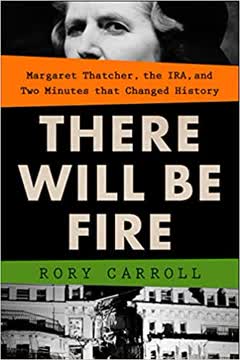
Key Takeaways
1. Mountbatten's Assassination Ignites Thatcher's Resolve
“If we do not defeat the terrorists, then democracy is dead.”
A brutal awakening. In August 1979, the IRA shattered Margaret Thatcher's early premiership with two devastating attacks: the assassination of Lord Mountbatten, a beloved royal figure, and the massacre of eighteen British paratroopers at Narrow Water. These "spectaculars" exposed a humbling truth: Thatcher, just 115 days in office, had no coherent policy for Northern Ireland.
The Iron Lady's response. Thatcher, known for her propulsive energy and unbending will, immediately flew to Belfast. She toured hospital wards filled with victims and visited army bases in "Bandit Country," South Armagh. Despite calls for military escalation, she ultimately sided with Chief Constable Kenneth Newman's "criminalization" strategy, prioritizing policing and courts over army primacy to delegitimize the IRA.
A personal vow. The attacks, particularly the murder of her ally Airey Neave months earlier, solidified Thatcher's resolve. She wrote seventeen personal letters to the families of the fallen soldiers, demonstrating a deep, private grief. Her public stance was clear: the IRA were common criminals, and they would be defeated, a conviction that would define her approach to the Troubles.
2. The Hunger Strikes Fuel IRA's Vengeance and Political Shift
“Mr. Sands was a convicted criminal. He chose to take his own life.”
A new front. In 1981, IRA prisoners in the H-Blocks launched a hunger strike, demanding political status. This was an existential challenge to Thatcher's "criminalization" policy, which sought to portray them as ordinary criminals. Bobby Sands, the prisoners' leader, was elected to the British Parliament, turning the strike into a global media spectacle.
Thatcher's inflexibility. Despite international pressure and the agonizing deaths of ten men, Thatcher remained unyielding, famously declaring, "A crime is a crime is a crime." Her refusal to concede transformed the hunger strikers into martyrs, galvanizing republican support and leading to Sinn Féin's electoral breakthroughs, including Gerry Adams becoming an MP.
"Armalite and ballot box." The hunger strikes, though militarily costly, proved a political boon for the IRA. Gerry Adams, then Sinn Féin's vice president, deftly articulated a new strategy: using both armed struggle and electoral politics to achieve a united Ireland. This dual approach, initially met with skepticism by some IRA hardliners, gained traction, setting the stage for future high-impact operations in England.
3. Patrick Magee: The Meticulous Bomber's Path to Brighton
“The enormity of it. It’s down to you, simple as that. It’s down to you, so you have to just do it to the best of your ability.”
From drifter to dedicated operative. Patrick Magee's journey into the IRA was circuitous. Born in Belfast, he moved to England as a child, feeling like an outsider. After a youth of petty crime and wanderlust, he returned to Belfast in 1971, witnessing the Troubles firsthand. A brutal interrogation by British soldiers in 1973 solidified his commitment, transforming him into a meticulous bomb maker.
The Chancer's tradecraft. Magee quickly became a key operative in the IRA's "England Department," a secret unit tasked with bringing the war to the British mainland. He learned to operate "behind enemy lines," adopting aliases, avoiding surveillance, and meticulously planning attacks. His ability to evade capture earned him the nickname "the Chancer," a testament to his daring and precision.
A personal cost. Magee's dedication came at a high price. His marriage crumbled under the strain of his clandestine life, and he suffered from nightmares and emotional turmoil. Despite a brief attempt to leave the IRA and start a new life in the Netherlands, he was drawn back by the hunger strikes and the perceived need for vengeance, ultimately volunteering for the most audacious mission: to assassinate Margaret Thatcher.
4. The IRA's Audacious Plot: Operation Lochinvar
“We knew she would be doing her speech, she had a habit of writing at nighttime, and we knew that she would have a window open looking out onto the beach.”
A strategic shift. After years of sporadic, often bungled, attacks in England, the IRA's "England Department" conceived Operation Lochinvar: the assassination of Margaret Thatcher. This audacious plot, initially met with skepticism by the Army Council, gained momentum after the hunger strikes and the perceived need for a decisive blow against the British state.
Meticulous planning. The plot involved extensive reconnaissance, including scouting the Conservative Party Conference in Brighton in 1982 and Blackpool in 1983. A construction engineer studied the Grand Hotel's architecture, identifying a critical chimney stack whose collapse could amplify the bomb's destructive force. The goal was to turn the hotel into a "tomb" for Thatcher and her cabinet.
The chosen operative. Magee, despite a previous near-capture in Blackpool and a temporary demotion, was ultimately selected to plant the bomb. His meticulous nature, experience in England, and unwavering commitment made him the ideal choice. The operation was designed to be a one-off, exploiting a perceived vulnerability in conference security that would likely be tightened after the attack.
5. A Near Miss: The Brighton Bomb's Devastating Impact
“Today we were unlucky, but remember we have only to be lucky once, you will have to be lucky always. Give Ireland peace and there will be no war.”
The fateful night. On October 12, 1984, at 2:54 a.m., the bomb planted by Patrick Magee in room 629 of the Grand Hotel detonated. A blinding white light and thunderous roar ripped through the hotel, toppling a five-ton chimney stack that plunged through eight floors, creating a massive V-shaped gash in the facade.
Thatcher's narrow escape. Margaret Thatcher, working on her speech in the Napoleon Suite, had left her bathroom just two minutes before the explosion. The falling debris, guided by a twist of geometry, clipped her suite but did not directly hit it. She emerged unscathed, but five people died, including MP Sir Anthony Berry, and dozens were injured, including Norman Tebbit and his wife, Margaret, who was left permanently paralyzed.
A defiant response. Despite the chaos and personal trauma, Thatcher's resolve was immediate and absolute. She insisted the conference continue as planned, delivering a defiant speech that morning. The IRA's chilling message—"Today we were unlucky, but remember we have only to be lucky once, you will have to be lucky always"—became a stark reminder of the enduring threat.
6. The Forensic Hunt: Unmasking the Invisible Bomber
“We really felt we’d got the man, Roy Walsh was the man, whoever he was. That’s our man, who we’ve got to find.”
A monumental task. Detective Chief Superintendent Jack Reece led the largest manhunt in British history, facing immense pressure and inter-agency rivalries. The investigation involved sifting through 880 tons of rubble, collecting 3,798 bins of evidence, and tracing over a thousand hotel guests from across the globe.
The "Roy Walsh" enigma. The key breakthrough came from the hotel's registration card for room 629, signed "Roy Walsh." Initial inquiries found no such person at the given address, confirming the bomber's use of a false identity. Despite a public appeal on "Crimewatch," the true identity of "Roy Walsh" remained elusive, leading Reece to believe he was chasing a ghost.
The palm print breakthrough. David Tadd, head of Scotland Yard's fingerprinting unit, meticulously processed the registration card. After weeks of painstaking work, a previously undetected palm print from the hypothenar eminence was discovered. On January 17, 1985, analyst Steve Turner identified a match: Patrick Joseph Magee, linking him to a 1967 print from Norwich. The "invisible being" finally had a face and a name.
7. Magee's Capture and the Unveiling of a Wider Campaign
“I have confidence in this team . . . let the guy run, and see where he leads us.”
A high-stakes gamble. Despite identifying Magee, British intelligence made a calculated decision not to arrest him immediately. Fearing that an extradition request would fail and alert Magee, they opted for discreet surveillance by Irish police, hoping he would eventually return to the UK for another operation. This "watch and wait" strategy was a huge gamble.
The Glasgow sting. In June 1985, Magee, now part of a four-person IRA unit, returned to Britain to launch a new "seaside blitz" bombing campaign. He was tracked to Glasgow, where he met Peter Sherry, another IRA operative. A tense surveillance operation, code-named Tricorn, culminated in a raid on their flat at 236 Langside Road.
Unmasking the plot. Magee and his three accomplices—Gerard McDonnell, Martina Anderson, and Ella O’Dwyer—were captured. A money belt found on McDonnell contained a list of sixteen targets and dates, revealing a sophisticated, widespread bombing campaign across England. The discovery of a booby-trapped bomb planted by Magee at the Rubens Hotel in London, set to explode in six weeks, confirmed the scale of the threat.
8. Thatcher's Unbowed Legacy and the Bomb's Unforeseen Ripples
“We got them in the end, didn’t we, my dear?”
Justice and defiance. Patrick Magee was sentenced to eight life terms for the Brighton bomb and the wider conspiracy, serving fourteen years before his early release in 1999 under the Good Friday Agreement. Margaret Thatcher, unbowed, returned to Brighton two years after the attack for the Grand Hotel's reopening, declaring, "The British spirit will once again triumph."
A pivot in history. The Brighton bomb, though failing to kill Thatcher, profoundly impacted her. It solidified her resolve against terrorism and, ironically, contributed to her later willingness to sign the Anglo-Irish Agreement in 1985, a landmark treaty that laid the groundwork for peace in Northern Ireland. Her survival also allowed her to continue her domestic revolution and play a crucial role in ending the Cold War.
Enduring legacy. The attack ushered in a new era of heightened security, transforming public life and political engagement. While Magee expressed regret for the pain inflicted, he continued to defend the bombing as a legitimate act of war. The ultimate irony: Thatcher's post-bomb shift towards Euroscepticism, culminating in Brexit, has inadvertently reopened questions about Northern Ireland's borders and allegiances, potentially paving the way for the united Ireland the IRA fought for.
Last updated:
Review Summary
There Will Be Fire receives mostly positive reviews (4.38/5) for its thriller-like narrative about the 1984 IRA bombing attempt on Margaret Thatcher at Brighton's Grand Hotel. Readers praise Carroll's meticulous research, neutral journalism, and compelling storytelling that reads like fiction. However, critics note the book lacks deeper context about the Troubles, British atrocities, and Catholic oppression in Northern Ireland. Some perceive a pro-Thatcher bias, while others appreciate the balanced approach. The investigation details and forensic work receive particular acclaim. Many compare it favorably to "Say Nothing," though some find it overly detailed or lacking nuance.