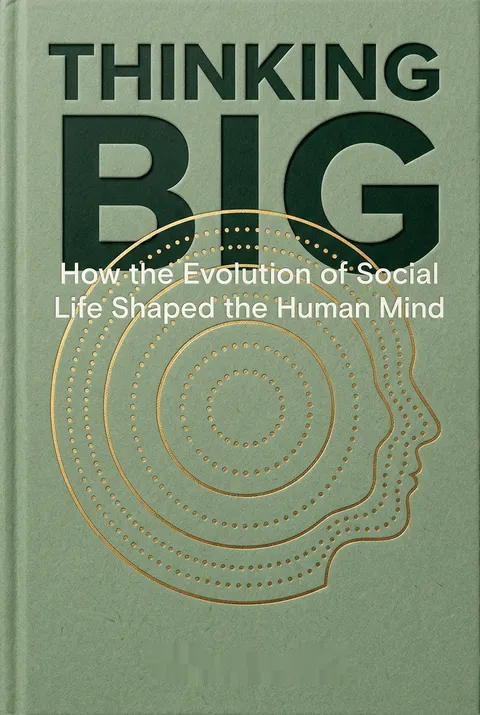


Key Takeaways
Our brains grew to manage relationships, not merely to solve physical puzzles
A social engine. The book’s central proposal, the social brain hypothesis, is that primate brains expanded partly to handle increasingly complicated social lives. Larger groups require remembering who is allied with whom, tracking obligations, and anticipating what others intend. Across primates, group size correlates with the relative size of the neocortex, the brain tissue involved in complex thought. Applying that relationship to humans predicts a social world of about 150 people, a figure also found in studies of personal networks.
A costly adaptation. Brain tissue is energetically expensive, so social complexity must have brought real benefits. The authors point to protection, cooperation, and access to resources. Their argument is not that social life explains every increase in brain size, but that it belongs at the center of any account of human evolution.
The argument’s strength is that it treats social intelligence as a survival problem, not a decorative side effect of general cleverness. Remembering relationships and predicting reactions demand sustained mental work, even when no tool is in sight. Yet a correlation between brain structure and group size cannot by itself establish which caused which. The book makes a plausible evolutionary case by connecting social demands to survival benefits, but the fossil record cannot directly reveal the pressures acting on particular individuals. The hypothesis is most useful as a framework for asking what social problems an anatomical change might have helped solve.
Treat 150 as a relationship budget, not a city limit
Layers of connection. Dunbar’s number refers to the approximate number of people with whom a person can maintain meaningful, reciprocal relationships. It does not limit how many people can live in a city or cooperate through institutions. Human networks tend to form layers of roughly 5, 15, 50, 150, and 500 people, with each layer about three times larger than the one inside it. The closest circles involve more contact and obligation; outer circles contain looser ties.
Groups echo networks. The authors find a similar pattern in small-scale societies: overnight camps may contain about 35 to 50 people, while a wider community averages around 150. Military units also often scale around these numbers. The comparison suggests that organizations can be built from human-sized relationship groups, even when their overall membership is much larger.
This model helps distinguish knowing someone from merely recognizing their name. Large organizations work partly because their internal units preserve the intimacy and coordination possible in smaller groups. The layered view also explains why social life is not a simple count of contacts: a handful of close ties consumes far more attention than a large acquaintance circle. The numbers should be treated as approximate patterns, not fixed rules for every person or culture. Their lasting value is diagnostic: when a group becomes hard to coordinate, its size may exceed the relationship structure holding it together.
Spend time on friendships; familiarity is the fuel that keeps them close
Contact sustains friendship. In a study following 30 students as they left home for university, friendships weakened quickly when regular interaction fell. Within six months, emotional closeness had dropped sharply for many relationships. The authors also found that people were more willing to make sacrifices for closer friends than for distant ones, including in hypothetical kidney-donation choices and a painful exercise that earned money for someone else.
Kinship behaves differently. Family ties, including relationships with more distant relatives, remained comparatively robust during the students’ time away. The book interprets this as a kinship premium: people tend to extend more help to relatives than to friends. Friendships often need active maintenance, while family relationships can draw on a durable sense of shared history and obligation.
The practical implication is not to monitor friendships like appointments, but to notice that affection has a social infrastructure. Shared time gives people fresh knowledge of one another and renews the small acts of trust that make support feel natural. The kinship contrast complicates a simplistic claim that all relationships fade at the same rate. It also reminds readers that emotional closeness is not a perfect measure of care: family members may remain important despite little contact, while neglected friendships can lose their everyday salience. Relationships depend both on repeated interaction and on the stories people share about what binds them.
Read ancient society from bonds and materials, not missing institutions
Look for interaction. Archaeologists cannot excavate a friendship or recover a fossilized intention. The book therefore challenges an approach it calls What You See is What There Was, which treats only directly visible remains as legitimate evidence. Instead, it proposes studying social life through patterns of interaction and bonding, including how people moved, shared resources, and made or used objects.
Objects leave clues. At early sites, stone tools occur with animal remains, and the materials for tools were sometimes carried several kilometres from their source. Repeated work around a carcass or the transport of many stones can support an inference of coordinated activity, though neither proves exactly what people thought. The authors argue that social relationships existed before formal political, religious, or economic institutions, and that archaeology should not mistake a lack of monuments for a lack of society.
This shift makes archaeology more ambitious without making it omniscient. It is reasonable to infer coordination from repeated patterns of transport or shared work, especially when several traces point in the same direction. The key discipline is to separate evidence from interpretation: a tool can suggest learning and cooperation, but it cannot identify a particular bond or belief. The approach also corrects a bias toward societies that left durable buildings and graves. Material remains are not transparent windows into the past, but treated cautiously, they can reveal how people depended on one another.
Bipedalism and dietary shifts opened social possibilities before brains expanded
A small-brained beginning. The earliest hominins differed from other apes in important ways before they had large brains. Ardipithecus, who lived about 4.4 million years ago, had a brain of roughly 325 cc and likely lived in a community of about 50, similar in scale to a chimpanzee group. Yet its body shows a mix of upright walking and climbing adaptations. Its woodland environment and diet also differed from the familiar fruit-rich lives of many living apes.
Adaptation came in bundles. Later hominins increasingly used foods such as roots and tubers, which were patchier and harder to process. Bipedal walking could help with travel and carrying, while changes in teeth helped with chewing. The authors describe these changes as connected responses to environmental pressures, not steps on a smooth ladder toward modern humans. Early social life could change without an immediate leap in brain size.
The story resists the tempting idea that evolution waited for a bigger brain before anything important happened. Bodies, diets, habitats, and social arrangements changed together, with each potentially making other changes more viable. That is a richer account than treating bipedalism as a single-purpose invention. It also cautions against imagining modern apes as perfect stand-ins for ancient ancestors: Ardi appears ape-like, but not simply chimpanzee-like. The book’s reconstruction remains provisional because fossils are sparse, yet the combination of anatomy and environment provides a useful way to reason about change without assuming that every adaptation had one clear cause.
Let tools carry social knowledge across generations
Tools were learned objects. Stone tools are more than solutions to practical problems in this account. Making them required observing other people, learning techniques, and passing on conventions. The earliest widely accepted stone tools, from Gona in Ethiopia, date to about 2.6 million years ago. Later, handaxes appeared by at least 1.75 million years ago and remained in use for roughly 1.5 million years. Their recognizable shape and repeated features point to durable traditions, even as individual examples varied.
Materials mapped relationships. Early toolmakers transported suitable stone, while some later handaxes traveled far from their source. Those movements connect objects to wider landscapes and possible contacts between groups. The authors interpret tools as part of an extended mind: ideas and skills were carried not only in individual brains but also in objects people made, used, and taught others to make.
A tool can preserve a method more reliably than any single learner’s memory. Its shape gives later observers something concrete to inspect, imitate, and modify, making material culture a powerful scaffold for shared knowledge. This does not mean that the object itself contains a mind, or that every repeated design required a formal teaching system. The evidence supports cultural transmission more securely than it identifies the exact route of transmission. The broader insight is still important: technologies do not merely reflect social life. They create new settings in which people can learn together and coordinate their work.
When groups outgrew grooming, laughter, speech, and music scaled bonding
Touch had a limit. Primates build bonds through grooming, which takes time and usually involves one partner at a time. As hominin groups grew, grooming alone would have consumed too much of the day. The authors propose that laughter helped widen bonding: unlike grooming, one person can make several others laugh together. Their observations found laughter groups commonly clustered around three people, still intimate but larger than a grooming pair.
Sound gathered groups. The book also connects active music-making, singing, and dancing with endorphin release, using increases in pain tolerance as an indirect measure. These activities could involve more people at once, especially when performed in synchrony. The authors propose that vocal interaction gradually supplemented touch, helping people maintain larger networks. They do not claim that early vocal bonding was already modern, fully grammatical language.
The useful distinction is between communication that transfers information and activity that makes people feel connected. Laughter and synchronized performance can do both, creating shared attention and a sense of participation without requiring a complicated conversation. The book’s account makes a compelling case that bonding technologies matter, not just words. However, pain tolerance is an indirect indicator of endorphin activity, and the proposed evolutionary sequence from laughter to speech is difficult to test from ancient remains. The framework is strongest when it identifies a problem, too few hours for one-to-one bonding, and shows several plausible ways groups could address it.
Fire changed food, safety, and the hours available for company
Control emerged gradually. The authors resist treating fire as a single sudden invention. Early hominins could have encountered and exploited natural fires before learning to maintain or kindle them. Evidence for early burning at sites such as Chesowanja is suggestive but debated. By around 400,000 years ago, sites such as Beeches Pit in England provide much clearer traces of people working near hearths.
A longer social day. Fire offered warmth and some protection, while cooking could make certain foods easier to digest and safer to eat. It also made evening activity possible after daylight foraging ended. The authors link fireside work, food preparation, and group gathering to a reorganization of daily routines. These benefits likely depended on cooperation, including gathering fuel and keeping a fire available, rather than on a flame acting as a stand-alone technology.
Fire illustrates how one material resource can alter several parts of life at once. It can change what people eat, where they gather, and when they interact, so its social effects cannot be separated neatly from its practical uses. The archaeological record is frustratingly patchy, however, and the earliest traces do not always distinguish human control from naturally occurring fires. The argument is therefore most convincing as a gradual process rather than a precise moment of invention. The broader lesson is methodological: an innovation’s importance may lie as much in the routines it reorganizes as in the object or technique itself.
Turn strangers into kin through shared obligations
Kinship can travel. The authors describe universal kinship as a way of treating people beyond close biological family as relatives, such as addressing strangers through family roles. That language can create expectations of trust, help, and reciprocity where genetic ties are absent. They suggest that such social rules helped people maintain connections across distance and meet unfamiliar groups without treating every outsider as wholly unknown.
Objects extend the link. The spread of modern humans into new regions, including Australia around 50,000 years ago, required social lives that could persist through separation. Long-distance movement of useful or valued materials also connected people who were not in daily contact. The book interprets kinship and material exchange as ways to stretch social bonds beyond face-to-face groups, not as proof that every exchange was trade or every stranger was accepted as family.
Shared categories can make cooperation possible before people have built personal trust. Calling someone kin does not erase risk, but it supplies a social script for how each side is expected to behave. Objects can reinforce the same script by making a relationship visible and portable. This is a powerful account of how humans handle strangers without escaping the limits of intimate social life. Its caution is equally important: networks of exchange may signal contact, but they do not automatically reveal whether the connection was friendly, obligatory, or fleeting. Social reach grows through conventions, not simply through movement.
Scale societies with shared symbols because personal networks remain small
Population outgrew familiarity. At the end of the Ice Age, the world’s population is estimated at about seven million; farming and settled life helped drive enormous later growth. Yet the book argues that people did not acquire a new brain built for knowing everyone. Instead, symbols, material networks, religion, leaders, and eventually writing helped coordinate populations beyond personal circles. The 11,000-year-old stone enclosures at Göbekli Tepe, built before farming, also challenge the idea that agriculture alone made large collective projects possible.
Old limits, new scaffolds. Online platforms do not abolish the constraint: studies discussed in the book found that many users still maintain roughly 100 to 250 social contacts. Large systems work by organizing selective ties and shared representations, not by turning millions of strangers into intimate friends. The familiar small-group mind can therefore support vast societies when institutions and objects help carry information.
The distinction between network size and collective scale is central. A person can participate in a country, religion, or digital platform without personally knowing most participants. Shared symbols and institutions let people coordinate around identities and rules that outlast individual encounters. This is not the same as direct trust, and large systems can fail when their rules lose legitimacy or cooperation becomes unequal. The book’s account explains how human groups scale without assuming that social cognition itself has become limitless. Modernity expands the architecture around relationships more readily than it expands the number of relationships a person can maintain.
Analysis
The book’s central contribution is to make social life a causal question in human evolution. Rather than treating brain growth as an automatic march toward intelligence, it asks what larger communities demanded of their members: more memory for relationships, more attention to intentions, and more ways to coordinate when direct contact was scarce. That reframing links anatomy to archaeology through a useful chain of reasoning. Social pressures create cognitive demands; tools, fire, vocal interaction, and symbols help meet those demands; the resulting practices alter the environments in which people live.
Its most productive conceptual move is to treat objects as part of the social mind’s working environment. A handaxe can encode a learned practice, connect people to a landscape, and help a group act together. This does not require claiming that artifacts literally think. It means that cognition is partly organized through shared things and routines, rather than being sealed inside individual skulls. That account makes technological change social without reducing every invention to social motives.
The book also usefully separates personal networks from population scale. A community of millions does not imply millions of intimate relationships. Symbols and institutions allow coordination beyond the reach of face-to-face familiarity, while the basic limits on close ties remain. This distinction speaks to contemporary digital life without mistaking a list of online contacts for a community of trusted allies.
The main evidentiary challenge is that the book’s strongest questions concern minds and relationships, while archaeology preserves objects, bones, and sites. Group size estimates derived from brain volume, or mental capacities inferred from tool complexity, are models rather than direct observations. Some proposed links, including the origins of language, music, and ritual, are necessarily more speculative than the material evidence for tool transport or hearth use. The authors are most persuasive when they make those inferences explicit and treat them as testable interpretations. The result is not a definitive timeline for when humans became human, but a richer account of why human minds and social worlds evolved together.
Review Summary
Thinking Big receives mixed reviews, with ratings ranging from 2 to 5 stars. Many readers find the book's central thesis on the social brain hypothesis intriguing, though some criticize its speculative nature and lack of concrete evidence. Reviewers appreciate the interdisciplinary approach combining archaeology and psychology but note the writing can be dense and academic. Several highlight the book's exploration of human evolution, social group sizes, and the development of language and culture. Some readers find the content fascinating, while others feel it lacks novelty or convincing arguments.
People Also Read








Glossary
social brain hypothesis
Brains shaped by social demandsThe hypothesis that complex social life helped drive the evolution of large brains in primates. Managing relationships, tracking others’ intentions, and maintaining group cohesion all require cognitive capacity. The book uses the correlation between primate group size and neocortex size to explore how social demands may have contributed to human brain expansion.
Dunbar’s number
Approximate meaningful group sizeThe proposed limit of roughly 150 people with whom an individual can maintain stable, reciprocal relationships. It refers to personal social ties, not the maximum size of a settlement or organization. The book connects this estimate to primate brain comparisons, hunter-gatherer communities, personal networks, and the structure of some human organizations.
rule of 3
Threefold social network layersA pattern in which successive social layers are approximately three times larger than the layer inside them. The book describes personal circles of roughly 5, 15, 50, 150, and 500 people, with larger community groupings extending further. Inner layers involve greater closeness and more frequent contact than outer layers.
mentalizing
Inferring another person’s mindThe ability to understand or infer what another person thinks, believes, or intends. Mentalizing helps people interpret ambiguous words, anticipate reactions, and coordinate actions around others’ interests. The book links this capacity to the cognitive demands of maintaining complex relationships and to brain regions involved in social reasoning.
orders of intentionality
Nested beliefs about mindsA scale for describing how many people’s mental states someone can keep in a chain of reasoning. A basic level concerns one’s own beliefs; higher levels involve beliefs about another person’s beliefs and further layers beyond that. The authors use this framework to discuss differences in social reasoning, language, storytelling, and imagined worlds.
extended mind
Cognition beyond the skullThe idea that thinking is supported by interaction with objects and surroundings, not only by neural activity inside the brain. In the book’s account, tools and other material things can preserve skills, cue memories, and help organize social activity. The term does not mean that objects literally contain brain tissue or thought.
niche construction
Changing the lived environmentThe process by which organisms alter their surroundings in ways that affect how they live and evolve. The book applies the idea to humans who build material and social environments, from tool-using practices to shelters and larger cultural settings. These constructed environments can create new opportunities and pressures for later generations.
social storage
Mutual aid across communitiesA form of ecological insurance in which communities maintain relationships that allow reciprocal access to resources when local conditions become difficult. A group facing scarcity may use another group’s resources and later return the assistance. The arrangement depends on durable social ties and connections beyond the immediate community.
What You See is What There Was (WYSWTW)
Evidence restricted to visible remainsA critical label for an archaeological stance that limits claims about the past to what can be directly observed in surviving material remains. The authors argue that this approach can exclude emotions, intentions, and social relationships from study. They advocate cautious inference from patterns in artifacts, movement, and shared activities instead.
FAQ
What is Thinking Big: How the Evolution of Social Life Shaped the Human Mind by Clive Gamble about?
- Exploration of human evolution: The book investigates how social life, community size, and relationships shaped the evolution of the human brain and mind over millions of years.
- Interdisciplinary approach: It integrates archaeology, psychology, and evolutionary biology to provide a comprehensive understanding of human origins.
- Key themes: Topics include the evolution of the social brain, the development of tools, the control of fire, the emergence of language, and the role of emotions and culture in human evolution.
- Central argument: The authors propose that increasing social complexity, rather than sudden revolutions, drove the gradual development of modern human cognition.
Why should I read Thinking Big by Clive Gamble, John Gowlett, and Robin Dunbar?
- Unique interdisciplinary insight: The book combines expertise from archaeology, anthropology, and evolutionary psychology, offering a holistic view of human evolution.
- Challenges traditional narratives: It moves beyond fossil records to focus on social cognition and gradual change, providing a nuanced perspective on what makes us human.
- Relevance to modern life: The book connects deep evolutionary history to contemporary social behavior, explaining why our brains and social networks function as they do today.
- Practical implications: Readers gain a better understanding of the limits and structure of their own social lives, including the impact of technology and digital networks.
What are the key takeaways from Thinking Big by Clive Gamble?
- Gradual evolution of the mind: Human cognitive and social complexity evolved incrementally over millions of years, not through sudden leaps.
- Social brain as central: The size and structure of the human brain are closely linked to the demands of managing increasingly large and complex social groups.
- Material culture as social amplifier: Tools, language, and rituals served to extend and reinforce social bonds, enabling larger communities and more intricate cooperation.
- Modern mind as adaptation: The human mind is best understood as a set of social skills shaped by evolutionary pressures to manage complex social networks.
What is the social brain hypothesis as explained in Thinking Big by Clive Gamble?
- Brain size and group size: The hypothesis posits a direct correlation between neocortex size and the number of stable social relationships an individual can maintain, known as Dunbar’s number (about 150).
- Cognitive demands of social life: Larger brains evolved to handle the increased complexity of social interactions and relationships in bigger groups.
- Evidence from primates: Studies of monkeys and apes show that species with larger neocortexes maintain larger social groups, a pattern that extends to humans.
- Implications for evolution: The need to manage social relationships was a primary driver of brain enlargement and cognitive sophistication in hominins.
What is Dunbar’s number and why is it significant in Thinking Big by Clive Gamble?
- Definition and origin: Dunbar’s number is the cognitive limit on the number of stable social relationships a human can maintain, estimated at around 150, based on neocortex size.
- Modern relevance: Despite living in large cities, humans typically maintain personal social networks of this size, with layers of intimacy scaling by factors of three.
- Evolutionary puzzle: The book explores how humans evolved to manage larger social groups than other primates and how this limit persists in modern society.
- Supporting evidence: Data from hunter-gatherer societies, personal networks, and even Christmas card lists support the existence of this cognitive constraint.
How does Thinking Big by Clive Gamble explain the evolution of human social cognition and mentalizing?
- Mentalizing defined: Mentalizing, or theory of mind, is the ability to infer others’ thoughts and intentions, enabling complex social interactions like cooperation and deception.
- Orders of intentionality: Humans can handle up to fifth or sixth order intentionality (e.g., "I think that you think that she thinks..."), which is crucial for managing multiple relationships.
- Brain structure link: Brain imaging shows that areas like the orbitofrontal cortex are larger in people with bigger social networks and higher mentalizing abilities.
- Evolutionary significance: The development of advanced mentalizing abilities allowed humans to form and maintain larger, more complex social groups.
What role do emotions, music, and laughter play in human social evolution according to Thinking Big by Clive Gamble?
- Emotions as social glue: Emotions such as guilt, compassion, and pride are essential for maintaining social bonds and regulating group behavior.
- Music and laughter: These activities release endorphins, bonding groups together beyond one-on-one interactions and enabling larger communities.
- Evolutionary function: Emotional closeness and shared experiences foster trust and cooperation, which are vital for the survival of large social groups.
- Beyond grooming: Music and laughter serve as group-level bonding mechanisms, replacing the time-consuming grooming seen in other primates.
How does Thinking Big by Clive Gamble address the evolution of language and its social functions?
- Language as social tool: Language evolved primarily to manage social relationships and facilitate gossip, not just to convey information.
- Gradual development: Anatomical and genetic evidence suggests language capacity developed over hundreds of thousands of years, with early hominins achieving lower orders of intentionality.
- Efficiency over grooming: As group sizes increased, vocal communication became a more efficient way to maintain social bonds than physical grooming.
- Support for complex societies: Language enabled higher orders of mentalizing and the management of larger, more intricate social networks.
What is the concept of the extended mind in Thinking Big by Clive Gamble?
- Beyond the brain: The extended mind includes not only neural processes but also artifacts, environments, and social interactions that shape cognition.
- Distributed cognition: Social cognition is embodied in tools, places, and practices, forming a cognitive niche constructed by humans.
- Material culture’s role: Tools and technology are seen as extensions of the mind, amplifying social signals and enabling cooperation beyond immediate contact.
- Evolutionary advantage: This concept explains how early hominins managed larger social groups and complex behaviors by integrating external resources into their cognitive processes.
How do tools, technology, and material culture relate to the social brain in Thinking Big by Clive Gamble?
- Tools as social products: Toolmaking and use are embedded in social contexts, requiring learning, teaching, and cultural transmission within groups.
- Feedback loop: The appearance of stone tools coincides with increases in brain size and social group size, suggesting a feedback loop between technology and social complexity.
- Amplification of social bonds: Material culture, including ornaments and architecture, serves as external memory and communication tools, reinforcing social ties.
- Gradual amplification: The book argues that technological and cultural complexity increased gradually, building on existing social and cognitive frameworks.
How does Thinking Big by Clive Gamble compare Neanderthals and modern humans in terms of social and cognitive abilities?
- Brain size and structure: Both had large brains, but Neanderthals had larger visual systems, possibly limiting frontal lobe expansion related to social cognition.
- Social group size: Neanderthals likely maintained smaller social groups due to these cognitive constraints, while modern humans managed larger, more complex networks.
- Cultural and symbolic behavior: Neanderthals showed evidence of burial rites and tool use, but their social and linguistic complexity was likely less than that of Homo sapiens.
- Population dispersal: Modern humans developed more complex kinship systems and social networks, enabling global expansion.
What does Thinking Big by Clive Gamble reveal about the transition from small-brained apes to large-brained humans?
- Gradual brain growth: Brain size increased from about 325 cc in early hominins to over 900 cc in early Homo, correlating with larger social group sizes and more complex social lives.
- Social and ecological pressures: Environmental changes, dietary shifts (like increased meat consumption), and social cooperation drove the need for bigger brains.
- Technological and social innovations: The emergence of stone tools, control of fire, and extended social networks both reflected and reinforced brain expansion.
- No single defining moment: The transition to a modern mind was a slow, overlapping process, with no clear-cut fossil or artifact marking its emergence.
Download PDF
Download EPUB
.epub digital book format is ideal for reading ebooks on phones, tablets, and e-readers.








