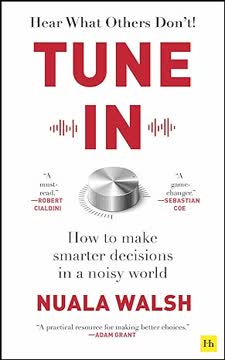
Key Takeaways
1. Human Decision Risk: The Silent Threat in a Noisy World
Despite popular opinion, the most underestimated risk facing modern society is not economic, political, technological or even climate risk. It’s human decision risk, triggered by our tendency to tune out what really matters.
The core problem. In a hyper-connected, digitized world, we are bombarded with information, yet paradoxically, we hear less than ever. This "noisy world" leads to a collective downgrading of our decisions, resulting in persistent human errors. The book argues that our inability to "tune in" to what truly matters is the most significant, yet overlooked, risk.
The irony of information. While countless platforms amplify voices, the sheer volume of conflicting data, distractions, and disinformation overwhelms our capacity to pay attention. We often base decisions on what we see rather than what we hear, failing to consciously filter noise to decode crucial signals. This leads to misjudgment, regret, and tone-deaf leadership.
A cautionary tale. The tragic story of Elvis Presley, who despite immense talent and power, succumbed to a "cocooning inner circle" and delegated critical decisions, serves as a powerful example. His inability to "reinterpret red flags or heed the voice of advice" highlights how even the greatest voices can tune out what truly matters, leading to self-sabotage and a short-circuited life.
2. The Trilogy of Error: Unmasking Blind, Deaf, and Dumb Spots
What you see is not all there is, what you hear is not all there is, and what you say is not all there is.
Internal biases. Our internal mindset significantly compromises judgment, often leading to a "trilogy of error": psychological blind spots, deaf spots, and dumb spots. These phenomena cause us to misjudge what we see, hear, and say, acting as potent sources of misinformation. Recognizing these internal filters is crucial for sound judgment.
Blind spots and deaf spots. Blind spots represent an inability to see a problem, often due to "what-you-see-is-all-there-is" (WYSIATI) thinking or inattentional blindness, where over-focus on one detail makes us miss others (e.g., the "invisible gorilla" experiment). Deaf spots, or "what-you-hear-is-NOT-all-there-is," involve mishearing, tuning out valuable data, or being insensitive to listening. This is exacerbated by:
- Default to truth: Our instinct to believe others, making us vulnerable to deception (e.g., Bernie Madoff's fraud, fake CVs).
- Confirmation bias: Filtering information to justify existing beliefs, rather than seeking disconfirming evidence (e.g., jurors sticking to initial verdicts, Yahoo's missed opportunities).
Dumb spots and their cost. Dumb spots refer to the inability or unwillingness to speak wisely or speak out, leading to self-silencing. This can be driven by fear of retribution, low confidence in remedy, or a desire to avoid censure (e.g., whistleblowers at Enron, the Catholic Church abuse scandal, Boeing's 737 MAX warnings). When individuals or organizations choose silence, critical voices go unheard, perpetuating injustice and leading to catastrophic outcomes.
3. External Forces: How Modern Life Distorts Our Judgment
As psychologists say, “Genes load the gun, the environment pulls the trigger.”
Contextual contamination. Our ability to tune in is severely contaminated by the external environment, which subtly but substantively shapes our judgment. Four key factors diminish our time, attention, and patience, steering us towards binary and short-term thinking:
- A fast-paced, frantic lifestyle: Accelerates short-termism and shreds attention (e.g., Robinhood trader's suicide, quick decisions prioritized over good ones).
- Data overload: Distracts and overwhelms the mind, making it hard to distinguish signal from noise (e.g., Yorkshire Ripper case, FTX founder's distraction, Mars Climate Orbiter's unit error).
Visual dominance and polarization. We rely more on what we see than what we hear, leading to misjudgment. The "7-38-55 rule" suggests visual body language dominates communication impact, while words account for only 7%. This visual bias is reinforced by:
- A visual world: Overstimulation from images on screens, leading to inattentional deafness (e.g., Joshua Bell's unnoticed performance, judging books by covers).
- A polarized world: Systems and structures embed binary perspectives, negating nuance and fueling division (e.g., Liz Truss's "Go big or go home" policy, "us vs. them" mentality).
The cost of speed. The pervasive culture of speed encourages snap judgments and premature conclusions. While intuition can be valuable, a high-speed environment amplifies the risk of being deceived and deluded. This constant pressure makes critical reasoning a luxury, leading to a "reluctance to reflect" and a collective downgrading of decision quality.
4. Power & Ego Traps: When Ambition Silences Reason
When the ego dies, the soul awakens.
The allure of power. The pursuit and retention of power are potent drivers that can severely derail judgment. Leaders often lose perspective, making myopic, self-serving, or reckless decisions when obsessed with hunting or holding power. This preoccupation can lead to a "narrow focus" that blinds them to critical information.
Ego's destructive force. Ego-centric biases make leaders feel invulnerable, overconfident, and immune from error, leading them to tune out contradictory evidence or timely criticism. Examples include:
- Illusion of validity: Excessive confidence in one's judgments (e.g., Thierry de La Villehuchet's belief in Madoff's impossible returns).
- Overconfidence: Unjustified belief in the supremacy of one's ideas (e.g., RBS CEO Fred Goodwin's disastrous ABN Amro acquisition, OJ Simpson's glove fiasco).
- Illusion of invulnerability: Believing bad things won't happen to oneself (e.g., Boris Becker's asset concealment, Steve Jobs's delayed cancer treatment, Veronica Guerin's fatal misjudgment).
Authority and its pitfalls. We tend to conform to the voice of authority, even when it contradicts our intuition or values (authority bias). This is evident in:
- Blind obedience: Nurses administering drugs against practice, soldiers torturing prisoners (e.g., Stanford Prison Experiment, Abu Ghraib).
- Halo effect: Over-admiring successful individuals and assuming their expertise is transferable (e.g., Elvis Presley's reliance on Colonel Parker, Bill Clinton's entourage).
- Champion bias: Allocating monopolistic power to experts, despite their fallibility (e.g., doctors overprescribing, lawyers misjudging trial outcomes).
5. Risk & Identity Traps: Miscalculating Danger, Curating Self
If nature has taught us anything, it is that the impossible is probable.
Risk's deceptive nature. Few decisions are truly risk-free, yet our perception of risk is often distorted, leading to poor choices. Reward-seeking can override rational judgment, increasing unwanted exposure. Key risk-based biases include:
- Sensation-seeking: The thrill of risk attracts some, leading to dangerous choices (e.g., Everest climbers, OceanGate submersible, Ayrton Senna's fatal race).
- Certainty bias: A preference for certainty over ambiguity, leading to missed opportunities (e.g., record companies dismissing music streaming, Microsoft's CEO dismissing iPhone).
- Availability bias: Relying on easily recalled information rather than accurate data (e.g., traders influenced by news headlines, neglecting profit warnings).
- Probability neglect: Underestimating true risk (e.g., Kobe Bryant's helicopter crash, Alexei Navalny's return to Russia).
- Loss aversion: Overweighting potential losses, leading to conservative choices (e.g., "bananagate" at a bank, Blackstone's regret over BlackRock sale).
- Commitment escalation (sunk cost fallacy): Persisting with failing endeavors due to prior investment (e.g., WeWork's board, dull films).
- Anchoring: Fixating on the first piece of information, distorting negotiations and judgments (e.g., ransom negotiation, judicial sentencing).
Identity's double-edged sword. Our self-image and desire to impress profoundly influence our decisions, often leading to "photoshopped lives." This "impression management" can be a trap, as we lose ourselves in narrowly defined identities.
- Consistency bias: Adhering too rigidly to preconceived identities, stifling creativity and evolution (e.g., JK Rowling's pseudonym, fund managers avoiding asset reallocation).
- Social identity theory: Belonging to groups based on shared values, leading to ingroup favoritism and exclusion of "heard-nots" (e.g., Tuskegee syphilis study, Jeffrey Dahmer case, Starbucks incident).
- Representativeness bias: Using stereotypes as lazy mental shortcuts, leading to discrimination (e.g., judging candidates by appearance, "the short guy" labels).
6. Memory & Ethics Traps: The Frailty of Recall, The Fading of Conscience
Memories are thoughts that arise. They’re not realities. Only when you believe they are real, they have power over you.
The unreliability of memory. Memory is a least acknowledged, yet potent, trap. It's not a perfect recording device but a distorted reel, prone to forgetting, misremembering, and manipulation. This frailty impacts judgment significantly:
- Forgetting curve: Rapid loss of new information (e.g., Zeebrugge ferry disaster, Juan Rodriguez's forgotten twins, surgical instruments left in patients). Checklists are a vital countermeasure.
- Misremembering self: Redefining past experiences (e.g., Michael Collins's moon experience, Elizabeth Kendall's reinterpretation of Ted Bundy).
- Power of suggestion/misinformation effect: Memories can be subtly altered by hints or planted data (e.g., eyewitness testimony in Fred Clay's wrongful conviction, false memories of childhood events).
- Serial position effect: Information heard first or last is more easily recalled, influencing perception (e.g., Hans's job description).
- Mere exposure effect: Repeated exposure to a stimulus increases its perceived truth and likability (e.g., Turkish words experiment, fake news).
The fading of conscience. Ethical judgment can be easily compromised by various psychological blind, deaf, and dumb spots, leading individuals and organizations to ignore their moral compass.
- Bounded ethicality: Goal-focus overrides ethical considerations (e.g., Theranos's Elizabeth Holmes, Peanut Corporation of America's Stewart Parnell, Purdue Pharma's opioid crisis).
- Moral dilemma/conflict of interest: Prioritizing self-interest or business over ethics (e.g., McKinsey advising Purdue and FDA, James Comey's FBI decision).
- Ethical fading: Ethical implications fade from mind when focused on other goals (e.g., prison overcrowding, Space Shuttle Challenger disaster).
- Moral licensing: Good deeds justify subsequent bad deeds (e.g., Jimmy Savile's charity work).
- Moral disengagement: Justifying wrongdoing by distancing oneself from its impact (e.g., Josef Mengele's denial, Lance Armstrong's doping).
7. Time & Emotion Traps: The Pull of the Present, The Sway of Feelings
To hear with one’s eyes and see with one’s ears is the key to understanding.
Temporal distortions. Our judgment is unconsciously influenced by whether we orient towards the past, present, or future. This temporal mindset can lead to significant decision damage:
- Present bias: Prioritizing immediate rewards over long-term benefits (e.g., marshmallow test, Liz Truss's short-term policies, workers refusing earplugs, corporate asbestos exposure).
- Status quo bias: Preferring familiarity and avoiding change, even when better alternatives exist (e.g., not changing jobs despite misery, Supreme Court overturning rulings, Dodge's fire escape).
- Hindsight bias: Believing "I knew it all along" after an event, hindering learning from past mistakes (e.g., Yahoo's missed acquisitions, Decca Records rejecting The Beatles).
- Affective forecasting error: Poorly predicting future emotions or scenarios (e.g., overestimating happiness from promotions, underestimating trauma of life-support decisions).
- Planning fallacy: Underestimating time needed for projects (e.g., Sydney Opera House).
- Judgment noise: Inconsistency in expert judgments over time or across groups (e.g., underwriters' risk estimates, software developers' time estimates).
Emotional hijack. Emotions are potent, pervasive drivers of decision-making, often overriding reason in "hot states." While emotions can be beneficial, they frequently trigger deaf ear syndrome and poor judgment:
- Hot/cold states: Impulsive reactions in emotionally charged moments (e.g., Will Smith's Oscar slap, Kevin Keegan's resignation, domestic abuse reports).
- Rage/Envy/Revenge: Destructive emotions that fuel conflict and misjudgment (e.g., Adidas vs. Puma feud, George Floyd's murder, Hunter Moore's revenge porn).
- Regret aversion: Avoiding decisions that might lead to future regret, often leading to inaction (e.g., Stephen Schwarzman's BlackRock sale, Mark Madoff's suicide).
- Ostrich effect: Avoiding uncomfortable or bad news (e.g., Alan Greenspan dismissing warnings, Roger Boisjoly's ignored Challenger warnings).
- Wishful hearing: Believing what one hopes is true, overriding logic (e.g., Fred Goodwin's ABN Amro deal, entrepreneurs' optimism).
- Empathy: While beneficial, can lead to prejudicial decisions (e.g., cheering for the underdog, positive discrimination).
8. Relationship & Story Traps: Crowd Contagion and Compelling Narratives
A misconception remains a misconception even when it is shared by the majority of people.
The power of the crowd. Our decisions are profoundly influenced by collective relationships, often leading us to mimic behavior and lose our individual voice. The crowd can be both wise and foolish:
- Conformity bias: The desire for acceptance, leading to people-pleasing and adherence to group norms (e.g., Post Office scandal, laughing at unfunny bosses, Dr. Feelgood's overprescribing).
- Social comparison: Obsessing about others' status and possessions, leading to dissatisfaction and irrational spending (e.g., Dutch Postcode Lottery winners' neighbors buying cars).
- Bandwagon effect: Following the crowd's assumed wisdom, even if ill-informed (e.g., Fyre Festival, cryptocurrency bubbles, Meta's Threads app).
- Groupthink: Conforming to collective team wisdom, suppressing dissent (e.g., juries, corporate "success theatres").
- Preference falsification: Hiding private views for social or professional survival (e.g., post-Berlin Wall communists, Google searches revealing true concerns).
The seduction of stories. Humans are wired to prefer coherent narratives over scientific data, making us vulnerable to compelling, yet often fabricated, stories.
- Messenger effect: The messenger's likability, similarity, and credibility disproportionately influence what we hear and believe (e.g., Elon Musk's tweets, Jack Ma's charisma, taxi drivers promoting condom use).
- Beauty bias: Attractive individuals are perceived as more credible, intelligent, and trustworthy, influencing hiring, pay, and legal outcomes (e.g., attractive essay writers, Adam Neumann's charisma, lenient sentences for attractive defendants).
- Associative thinking: Compulsively filling knowledge gaps to create congruent explanations, even if spurious (e.g., consumers justifying stocking choices, fund managers explaining underperformance).
- Illusory truth effect: Repeated stories, slogans, or mantras are believed to be true, regardless of veracity (e.g., "Trump of the Tropics" Jair Bolsonaro's hate speech, Richard Jewell's false accusation).
- Outcome bias: Judging decisions solely by their end result, rather than the process (e.g., Wells Fargo, British Post Office, Walter Miller's escape).
- Framing: How a story is presented (gain vs. loss) significantly influences interpretation and persuasion (e.g., "95% live" vs. "5% die," OJ Simpson's defense).
9. The Decision Ninja's Antidote: SONIC Strategies for Just-In-Time Judgment
Everything can be taken from a man but one thing… to choose one’s attitude in any given set of circumstances, to choose one’s own way.
Embracing decision friction. To counteract the PERIMETERS traps and navigate a noisy world, the "Decision Ninja" adopts an "AAA mindset" (Anticipation, Attitude, Acceptance) and intentionally introduces "decision friction." This involves conscious prompts, rules, or mechanisms that interrupt impulsive System-1 thinking, creating valuable seconds for deliberative System-2 reflection.
SONIC strategies for clarity: The book presents 18 science-based strategies, encapsulated in the SONIC mnemonic, to optimize judgment:
- S: Slow Down: Techniques to pause and recalibrate.
- Five Whys: Repeatedly asking "Why?" to uncover root causes and challenge assumptions.
- Argue Against the Argument: Actively seeking disconfirming data and simulating alternative scenarios.
- Time Out Tools: Deliberately scheduling reflection time (e.g., "email-free" Fridays, medical "Time Out" days).
- O: Organize Attention: Strategies to manage distractions and focus the mind.
- Decision Environment Redesign: Structuring physical space to facilitate reflection.
- Digital Distraction Detox: Removing notifications and using tech-based solutions to limit interruptions.
- 4x BIAS Screen: A heuristic checklist (Bias, Intuition, Authenticity, Signal) to filter critical information.
- Pomodoro Method: Structured work intervals with breaks to maintain focus.
Navigating and calibrating. Further SONIC strategies help broaden perspective and refine judgment:
- N: Navigate Novel Perspectives:
- Always Consult Before Deciding (ACBD): Soliciting external advice, reframing "opinion" as "advice."
- de Bono's Six Thinking Hats 2.0: Using conceptual hats (strategic, optimistic, pessimistic, factual, emotional, creative) to explore multiple viewpoints.
- Zoom Out for Independence: Seeking third-party advice and visualizing situations from another's perspective.
- The Janus Option: Simultaneously looking forward and back, considering a broader spectrum of choices beyond binary options.
- I: Interrupt Mindsets:
- Default to Error: Assuming one might be wrong to increase critical scrutiny.
- Decision Diagnostic: Asking clarifying questions about the messenger and message.
- Adopt a Third Ear: Listening with curiosity but not conviction, posing "Really?" to probe deeper.
- Embrace U-turns: Rethinking existing ideas and building a "challenger network" for critical feedback.
- C: Calibrate Situations, Strangers, and Strategies:
- PERIMETERS Bias Checklist: A ready-made reference to identify and counteract specific biases.
- Interpretation Habit: Practicing conscious hesitation, probing, and fact-checking as a routine.
- Implementation Intentions: Creating "if-then" plans to trigger desired behaviors in specific situations.
Last updated:
Similar Books