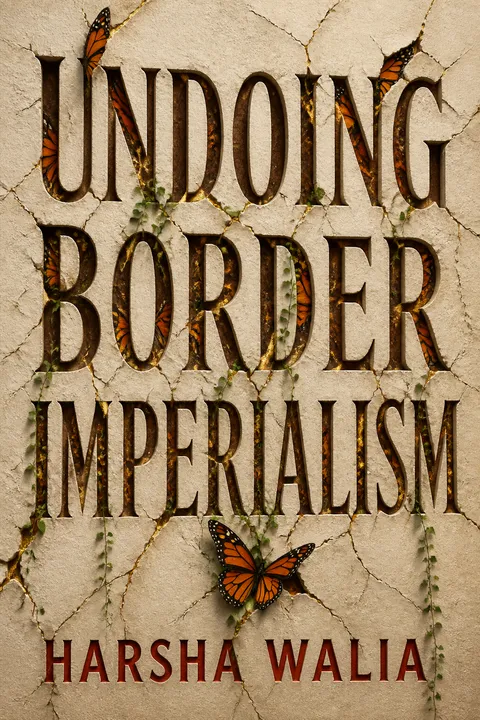


Key Takeaways
Read migration as a system that displaces, polices, and exploits
A connected machine. Harsha Walia calls this system border imperialism: the linked forces that uproot people, restrict their movement, criminalize them, and make their labor exploitable. It has four overlapping parts: economic and colonial displacement alongside fortified borders; criminalization of migration; racialized rules about who belongs; and state-backed exploitation of migrant workers. The result is a border regime, not merely a line on a map. Capital and goods can cross borders with relative ease while displaced people face detention, dangerous journeys, and precarious work.
Follow the causes. The book uses NAFTA as an example: subsidized US corn undercut Mexican farmers, contributing to poverty and migration, while the US-Mexico border was increasingly fortified. Walia cites estimates that more than 15 million Mexicans were pushed into poverty and 1.5 million farmers migrated.
The framework is useful because it connects policies that are often debated separately: trade, military intervention, immigration enforcement, and labor standards. It asks readers to trace feedback loops rather than blame migrants for responding to pressures they did not create. That systems view is powerful, but it can become too totalizing if every migration story is treated as identical. Different people move for different combinations of safety, family, work, and choice. The framework works best as a map of structural pressures, not a substitute for listening to individual accounts.
Ask whose land a border claims, not only whom it keeps out
Territory has a history. Walia argues that borders do more than regulate entry. They assert a state’s authority to own and control territory, often on land taken from Indigenous peoples. Colonial borders also divide Indigenous communities and restrict movement across homelands. The book describes the Tohono O’odham, whose ceremonial and community ties cross the US-Mexico border, while border militarization brings walls, checkpoints, and patrols onto their land.
Question the frame. Indigenous activists challenge the assumption that people naturally belong to one fixed place and become outsiders when they move. The issue, from this perspective, is not simply how generously a state admits migrants. It is also how the state acquired the authority to decide who belongs, and whose relationships to land its borders interrupt.
This shift broadens immigration debates into questions of sovereignty and property. It also prevents a familiar reform from appearing complete: a fairer admissions system can still leave the state’s original claim to Indigenous territory untouched. The distinction matters because movement and settlement are not interchangeable. Migration does not automatically make a person a colonizer, but living within a settler state can involve participation in its structures. A careful account needs to hold both points without turning Indigenous sovereignty into a metaphor for anyone else’s exclusion.
Treat detention as racialized governance, not neutral security enforcement
Punishment by category. Walia describes a carceral network: the institutions and practices that classify, monitor, detain, and deport people deemed dangerous or undesirable. Migrants may be imprisoned for administrative reasons without a criminal conviction, and some face indefinite detention or limited access to challenge it. The book’s example of Canadian security certificates shows how secret evidence and vague allegations could keep noncitizens detained without ordinary criminal charges. Adil Charkaoui, one of the affected men, described living under severe restrictions after release.
Follow the incentives. Detention also creates business for private prison and security contractors. Walia connects immigration enforcement to wider patterns of racialized policing and incarceration, arguing that the label of threat can precede any proven wrongdoing.
The account makes visible how administrative language can hide coercive consequences. A person need not be convicted of a crime to lose liberty, family contact, or a stable life. This is a valuable corrective to debates that treat security measures as technical tools with no distributional effects. At the same time, the term carceral network can blur meaningful differences among detention, imprisonment, and surveillance. Clear analysis should identify each institution’s powers and safeguards while still examining how their combined effects sort people by race, class, and citizenship.
Demand legal status without sorting migrants into deserving and disposable
Rights without a test. No One Is Illegal, or NOII, advocates regularization: granting secure legal status to people without full immigration status. Its demand is deliberately broad. Status should not depend on a person’s income, education, employment, health, disability, family structure, or criminal record. Walia argues that selective programs reproduce the idea that migrants must prove their usefulness or respectability before they deserve safety.
Make access real. NOII-Toronto’s campaigns sought to make schools, shelters, and city services safe for undocumented people. After organizers pressed for a policy that schools should not ask about immigration status, the Toronto District School Board affirmed that undocumented children could attend. In 2013, Toronto declared city services accessible to undocumented residents. These gains reduced immediate barriers, even though they did not dismantle the immigration system.
Universal eligibility rejects a hierarchy in which the educated, employed, or legally impeccable are treated as the only credible claimants. It also makes a strategic point: labor-based regularization leaves unpaid caregivers, disabled people, children, and others exposed. The challenge is that broad demands can meet political resistance, while partial protections may still save lives. The book’s approach suggests refusing that false choice: pursue immediate access without presenting partial access as a just or sufficient endpoint.
Pair urgent case support with collective power and community leadership
Help that builds power. Direct support work means practical, organized help for people facing detention, deportation, or exploitation. It can involve legal paperwork, childcare, court support, food, fundraising, public pressure, and emotional support. The principle is solidarity alongside affected people, not charity on their behalf. Support is strongest when the person facing harm helps set the goals and speak publicly about the system producing it.
A public victory. In 2007, NOII-Vancouver organized against the deportation of Laibar Singh, a paralyzed refugee claimant from India. After months of rallies and community outreach, about 2,000 people, many Punjabi elders and women, blocked the airport terminal on the day of his planned removal. Enforcement backed away. The action joined an urgent individual case to wider community mobilization, though such victories were neither easy nor guaranteed.
This model treats practical help as political work rather than a distraction from politics. It can create trust, reduce isolation, and give affected people room to lead. It also poses a real sustainability problem: volunteer groups may absorb responsibilities that belong to public services, and emergency cases can consume all available capacity. The strongest version therefore pairs immediate help with organizing that changes access and accountability, while recognizing that one dramatic win cannot resolve the conditions that made the case urgent.
Combine practical reforms with a strategy aimed beyond the existing system
Avoid the false choice. Walia distinguishes tactics, the specific actions used in a campaign, from strategy, the broader plan that connects those actions to a goal. She rejects the idea that working with institutions automatically makes a movement reformist, or that confrontation alone guarantees transformation. A campaign can seek a legal change while exposing the deeper system and building community power.
Keep principles visible. The campaign against Canadian security certificates brought families, migrant justice groups, faith communities, legal advocates, and civil-liberties organizations into a loose alliance. Public education and organizing helped build opposition to secret detention. The old regime was struck down by the Supreme Court, but revised rules left some men subject to severe restrictions. The case shows why a partial win should be valued without mistaking it for abolition, and why alliances need room for disagreement.
The distinction between a campaign’s immediate objective and its long-term political horizon is a strong tool for evaluating strategy. It allows organizers to ask whether a reform expands people’s capacity to act or merely makes an unjust system easier to defend. The answer depends on context, not on whether a tactic looks respectable or confrontational. Still, a movement needs ways to judge its own tradeoffs: who benefits, who is excluded, and whether the alliance can speak honestly about the limits of its gains.
Share leadership by redistributing skills, access, and decision-making power
Structure without domination. NOII groups are decentralized and volunteer-run. Walia argues that rejecting formal hierarchy does not erase power: informal leaders can still dominate through experience, confidence, or access to networks. The alternative she describes is antiauthoritarian and group-centered leadership. People most affected by an issue should shape the work, while leadership roles remain transparent and accountable.
Make participation practical. Groups can share public speaking, meeting facilitation, media work, and campaign knowledge so newer members can take meaningful roles. NOII’s antioppression practice also resists ranking people by a simple tally of identities. Instead, organizers examine how power operates in a specific situation and take responsibility for changing it. Representation matters, but it is not enough if decision-making stays elsewhere.
The insight is organizational as much as ethical: distributing skills reduces dependence on a few experienced people and makes a group more resilient to turnover. It also answers a common misconception that horizontal organizing means having no structure. Yet consensus and shared leadership require time, conflict skills, and deliberate attention to who is being heard. Without those supports, the language of equality can conceal informal authority. Clear roles, reflection, and accountability help keep participation from becoming symbolic.
Make Indigenous self-determination foundational to migrant solidarity
Solidarity has obligations. Walia rejects both the claim that migrants and Indigenous peoples face the same history, and the claim that migrant justice can ignore Indigenous sovereignty. Migrants of color may be displaced by colonialism and capitalism, yet become implicated in a settler state and benefit from its control of Indigenous land. The book distinguishes this complicity from the greater privileges that some settlers possess.
Build accountable relations. NOII groups supported Indigenous land defense over years, including Secwepemc struggles against development and Wet’suwet’en resistance to pipelines. The work included learning local histories, supporting campaigns when asked, and building relationships beyond moments of crisis. The aim is not to use Indigenous struggles to strengthen a migrant-rights argument. It is to respect Indigenous leadership and connect freedom of movement with responsibility to the lands and communities where people arrive.
This argument avoids an easy but damaging equation between shared racialization and shared political position. It asks migrants to confront their involvement in settler structures without treating displacement as a moral stain or denying migrants’ need for safety. The practical test is whether solidarity changes who sets priorities and how resources are shared. Relationships built over time can make that accountability more concrete, though no alliance can assume consent or trust simply because its intentions are anticolonial.
Build alternatives now through decolonization, mutual aid, and land care
Practice the future. Walia uses prefiguration to describe organizing whose methods and relationships reflect the society it seeks to create. Decolonization, in this account, is both resistance to colonial, capitalist, and racial hierarchies and the creation of alternatives grounded in self-determination, mutual aid, and collective responsibility. It does not mean inventing an entirely new way of living from scratch. It also means learning from Indigenous knowledge and other traditions of shared care without romanticizing the past.
Change the relationship to land. The book contrasts endless extraction and private ownership with stewardship: taking what is needed, sharing resources, and recognizing human dependence on the living world. Walia argues that environmental reform can be absorbed by markets when it leaves growth and commodification unquestioned. Decolonizing practice therefore links migrant justice to land defense and ecological survival.
Prefiguration gives movements a positive measure of progress: not only what they oppose, but what forms of care, authority, and resource-sharing they practice. This matters because a campaign can win access to an existing institution while reproducing its exclusions internally. The ecological argument also widens the meaning of migration justice by linking displacement to resource extraction and climate harm. A useful caution is that community alternatives cannot replace public provision or erase disagreements about land use; they need accountability to the people whose sovereignty they claim to respect.
Treat care as movement infrastructure, not a private luxury
Care is collective work. Walia questions self-care when it is framed as an individual escape from political conditions and shared responsibilities. Healing justice is a community-centered approach that connects healing with liberation and addresses personal, collective, and systemic trauma. Emotional justice means attending to how power is felt in daily life, not only describing it in abstract political language.
Make the work livable. Community care can include meals, emotional support, shared resources, and attention to illness, disability, grief, and burnout. These practices counter the isolation that makes people seem disposable and help movements sustain relationships through setbacks. The book’s many first-person accounts also carry political knowledge: an asylum hearing, a detention center, or a family’s forced displacement becomes legible through the person who lived it, not only through policy language or statistics.
Care is often treated as a personal virtue, but the book makes a stronger claim: it is part of a movement’s capacity to organize. Shared care can expose hidden labor and make participation possible for people excluded by conventional activist routines. It does not eliminate conflict, exhaustion, or unequal responsibility, and care language can itself become a way to pressure people into doing more. It works best when paired with boundaries, shared workloads, and material resources rather than relying on goodwill alone.
Analysis
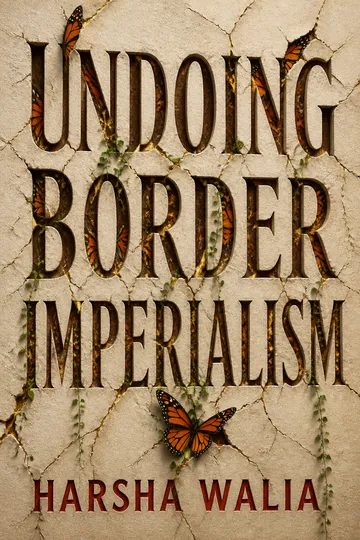
Undoing Border Imperialism is part political theory, part organizing handbook, and part collective testimony. Its central achievement is to change the unit of analysis. Instead of treating migration as a problem at a national boundary, Walia traces a chain: colonial dispossession and capitalist restructuring displace communities; states then fortify borders, criminalize movement, and allocate belonging unequally; precarious legal status makes workers easier to exploit. This frame links immigration enforcement to Indigenous sovereignty, prisons, labor conditions, racism, gender, and ecological damage.
The book’s most practical contribution is its refusal to separate immediate relief from structural change. NOII’s support for people facing deportation, its universal demand for regularization, sanctuary campaigns, and Indigenous solidarity work offer different scales of intervention. The examples show that a movement can negotiate with institutions without treating those institutions as the source of justice. They also reveal the costs: campaigns can depend heavily on volunteer labor, partial policy wins can be reversed, and alliance building demands continuous work over strategy and accountability.
The text’s collective form strengthens its argument. Personal narratives are not decorative illustrations; they show how laws become fear, separation, and constrained choices. The roundtable likewise resists the fiction that a movement speaks with one voice. This approach makes the analysis vivid, although the book’s cases are illustrative rather than a systematic comparison across countries or migration pathways. Its broad structural theory should therefore guide questions, not predetermine answers for every case.
The deepest challenge is constructive: movements must make their internal relationships answer to their political visions. Decolonization is not only a future legal arrangement but a present practice involving land, leadership, care, and resource-sharing. That standard is demanding, particularly where groups face urgent needs and scarce capacity. Yet it gives readers a way to assess more than slogans: who leads, who is protected, what relations are being built, and whether a victory makes the next act of collective self-determination more possible.
Review Summary
Undoing Border Imperialism is praised as a powerful, revolutionary work that combines theory and practice to challenge border imperialism and advocate for migrant justice. Reviewers appreciate Walia's comprehensive analysis, grassroots organizing insights, and decolonization framework. The book's inclusion of diverse voices, personal narratives, and practical organizing strategies is highlighted. Many readers find it inspiring, thought-provoking, and relevant to current social justice movements. Some note its academic language may be challenging for casual readers, but overall it's considered an important contribution to migrant rights discourse.
People Also Read






Glossary
Border imperialism
Borders organizing displacement and controlWalia’s framework for the connected processes through which colonialism and capitalism displace people, states restrict and criminalize their movement, citizenship is racialized, and migrant labor is kept precarious. It treats borders as systems of governance and economic power, not simply geographic lines.
No One Is Illegal (NOII)
Grassroots migrant justice networkA decentralized Canadian migrant justice movement that provides practical support to refugees, undocumented migrants, and migrant workers while challenging the systems that produce displacement and border controls. Its organizing connects migrant justice to Indigenous self-determination, anticapitalism, antiracism, and other movements.
prefiguration
Practicing the society soughtAn organizing principle in which a movement’s methods, relationships, and institutions reflect the values of the society it wants to build. In Walia’s account, this includes developing mutual aid, shared decision-making, and alternatives to state or market control while struggling against existing systems.
direct support work
Practical solidarity in urgent casesOrganized, hands-on assistance for people facing detention, deportation, or other forms of state control. It can include legal advocacy, childcare, court support, food, fundraising, public campaigns, and emotional support. The aim is to work alongside affected people, build trust, and support their leadership rather than act as charitable representatives.
regularization
Granting secure legal statusA process for granting legal status to people who lack full immigration status. NOII advocates regularization for all, without exclusions based on employment, education, income, health, disability, race, family status, or criminal record. The demand is meant to reduce deportability and improve access to services and labor protections.
carceral network
Connected systems of surveillance and confinementThe overlapping institutions, rules, and practices that classify, monitor, punish, detain, or exclude people. Walia uses the term to connect immigration detention with prisons and broader forms of social control, including systems that construct racialized and poor communities as threats or deviants.
antiauthoritarian and group-centered structure and leadership
Accountable, shared movement leadershipAn approach that rejects both rigid central control and the idea that movements should have no structure. It recognizes that people have unequal experience and power, seeks leadership from those most affected, and makes roles accountable. Groups share skills and responsibilities so leadership is distributed rather than concentrated or hidden.
healing justice
Collective care tied to liberationA framework that connects healing with political liberation and addresses trauma at individual, community, and systemic levels. It shifts care away from an exclusively private or individualized activity and toward practices that recognize interdependence, shared responsibility, and the material conditions that shape well-being.
emotional justice
Taking emotional impacts seriouslyA practice of recognizing and communicating how injustice affects people emotionally, as well as politically or materially. It values empathy, honest expression, and relationships as part of collective work, rather than treating feelings as irrelevant to analysis or as private problems that individuals must manage alone.
FAQ
What's Undoing Border Imperialism about?
- Focus on Borders and Migration: The book critiques border imperialism, highlighting the structural violence and control states exert over migrants and Indigenous peoples. It argues that borders are not just physical barriers but part of a broader oppressive system rooted in colonialism and capitalism.
- Intersection of Struggles: Harsha Walia emphasizes the interconnectedness of immigrant rights and Indigenous sovereignty, advocating for solidarity among marginalized communities to dismantle oppressive systems.
- Call for Action: Walia encourages readers to rethink migration and borders, advocating for a world where movement is free and equitable. The book serves as both a theoretical framework and a practical guide for activists.
Why should I read Undoing Border Imperialism?
- Insightful Analysis: The book provides a critical examination of how immigration policies are intertwined with colonial histories and capitalist exploitation, challenging mainstream narratives about immigration and border control.
- Empowerment for Activism: Walia offers practical insights and strategies for grassroots organizing, making it a valuable resource for activists and community organizers.
- Broader Context: It situates the discussion of borders within global movements for social justice, making it relevant for those interested in anti-colonial, anti-capitalist, and anti-racist struggles.
What are the key takeaways of Undoing Border Imperialism?
- Understanding Border Imperialism: The book defines border imperialism as a framework that encapsulates the displacement of marginalized communities, the criminalization of migration, and the exploitation of migrant labor.
- Solidarity and Intersectionality: Walia stresses the need for solidarity between immigrant communities and Indigenous peoples, advocating for a unified approach to dismantling oppressive systems.
- Vision for Liberation: The text calls for a reimagining of society where borders do not dictate human rights and where all individuals have the freedom to move, stay, and return.
What is the concept of border imperialism as defined in Undoing Border Imperialism?
- Four Overlapping Structurings: Walia outlines border imperialism as comprising mass displacement, criminalization of migration, racialized citizenship hierarchies, and state-mediated exploitation of migrant labor.
- Critique of Western States: The book argues that Western states create conditions for migration through imperialist policies while enforcing strict border controls.
- Interconnectedness of Oppression: Border imperialism connects various forms of oppression, including racism, capitalism, and colonialism, calling for a holistic understanding to effectively challenge them.
How does Undoing Border Imperialism address the relationship between capitalism and migration?
- Capitalism as a Driver of Displacement: Walia argues that global capitalism creates conditions that force people to migrate, often due to economic exploitation and resource extraction.
- Exploitation of Migrant Labor: The text discusses how capitalism relies on the exploitation of migrant labor, often under precarious conditions, highlighting the need for labor rights and protections.
- Interconnected Struggles: Walia connects the fight against capitalism with the struggle for migrant rights, advocating for a unified approach to addressing these interconnected issues.
What role do Indigenous rights play in Undoing Border Imperialism?
- Indigenous Sovereignty: Walia emphasizes recognizing Indigenous sovereignty as a fundamental aspect of the struggle against border imperialism.
- Solidarity with Indigenous Communities: The text calls for solidarity between migrant communities and Indigenous peoples, highlighting their shared experiences of displacement and oppression.
- Decolonization Framework: Walia presents decolonization as a necessary framework for understanding and addressing the impacts of border imperialism.
How does Undoing Border Imperialism propose to create a more just society?
- Vision of Freedom of Movement: Walia envisions a society where borders do not dictate human rights and where all individuals have the freedom to move, stay, and return.
- Grassroots Organizing: The book emphasizes the importance of grassroots organizing and community-led initiatives in achieving social change.
- Collective Responsibility: Walia calls for a collective responsibility to dismantle oppressive systems and support one another in the struggle for justice.
What strategies does Undoing Border Imperialism suggest for activists?
- Building Alliances: Walia stresses the importance of building alliances across different movements, including migrant justice, Indigenous rights, and anti-capitalist struggles.
- Direct Action and Support: The book advocates for direct action as a means of resisting border imperialism and supporting those affected by oppressive policies.
- Education and Awareness: Walia highlights the need for education and awareness-raising within communities to challenge misconceptions about migration and borders.
What are some examples of grassroots organizing mentioned in Undoing Border Imperialism?
- No One Is Illegal (NOII): Walia discusses the NOII movement as a grassroots initiative advocating for the rights of undocumented migrants and challenging border imperialism.
- Direct Support Work: The book highlights the importance of direct support work in community organizing, providing practical assistance to migrants facing detention and deportation.
- Campaigns for Regularization: Walia details various campaigns aimed at achieving regularization for all migrants, emphasizing the need for inclusive policies.
What are the best quotes from Undoing Border Imperialism and what do they mean?
- “We belong to the land.”: This quote challenges the notion of land ownership and emphasizes the interconnectedness of people and the environment.
- “No one is illegal.”: This phrase asserts that all individuals have the right to move freely without being criminalized, underscoring the book's argument against the dehumanization of migrants.
- “Borders are acts of state violence.”: This quote highlights the book's critique of how borders function as tools of oppression, calling attention to the violence inflicted on marginalized communities.
How does Undoing Border Imperialism address the intersection of race and migration?
- Racialized Narratives: Walia explores how migration is often racialized, with certain groups being portrayed as "undesirable" or "illegal."
- Impact on Communities: The book discusses the disproportionate impact of border imperialism on racialized communities, highlighting the systemic inequalities they face.
- Challenging Stereotypes: Walia calls for a re-examination of the narratives surrounding migrants, advocating for a more nuanced understanding of their experiences.
How does Undoing Border Imperialism propose to change the narrative around migration?
- Humanizing Migrants: Walia advocates for a shift in the narrative that humanizes migrants, moving away from the portrayal of them as "illegals" or "criminals."
- Challenging Stereotypes: The text calls for challenging stereotypes and misconceptions about migrants, advocating for a more nuanced understanding of their contributions to society.
- Promoting Solidarity: Walia suggests that changing the narrative involves promoting solidarity among different communities, highlighting shared struggles and experiences.
Anarchist Intervention Series Series
Download PDF
Download EPUB
.epub digital book format is ideal for reading ebooks on phones, tablets, and e-readers.








