

Key Takeaways
Financial education is an unfair advantage because it changes how you read money.
Question the familiar script. Kiyosaki opens with a monkey that refuses to release food caught in a tree hole. The trapped fist stands for people clinging to job security, savings, or a house even when those choices no longer serve them. His central claim is that financial education helps people recognize when familiar advice has become a trap.
Training is not understanding. He contrasts his highly educated father, who struggled after leaving public education and losing a small business, with a mentor who kept studying business and investing without formal credentials. Kiyosaki argues that school can train people to earn wages without teaching them to interpret assets, taxes, debt, or investment risk.
The book’s strongest insight is not that conventional advice is always wrong, but that advice should be examined in context rather than obeyed by reflex. That resembles the distinction between procedural skill and systems thinking: a person may know how to earn a paycheck yet not understand how inflation, borrowing, or taxes affect it. The monkey image makes this memorable, but it can overstate individual choice. Employment and saving can be rational responses to limited resources, and financial literacy cannot by itself repair low wages, illness, or economic shocks.
Buy assets for dependable cash flow, not merely for a hoped-for price increase.
Follow the money in. Kiyosaki uses Monopoly to teach that properties matter because they collect rent, not simply because someone might later pay more for them. He calls income remaining after expenses cash flow, and contrasts it with capital gains, profit from selling an asset at a higher price. His own approach favors rentals in areas with steady employment, because tenants need wages to pay rent.
Start with a small deal. Kim Kiyosaki’s first rental reportedly produced just $25 a month after costs. The couple set a goal of 20 units and reached 21 in 18 months, then reported monthly investment income of $10,000 against $3,000 in expenses by 1994. These are personal examples, not typical results or guarantees.
The cash-flow lens is useful because it asks whether an investment can support itself before an owner counts on resale. In business analysis, recurring revenue and operating costs often reveal more than a headline valuation. Still, rent is not automatically dependable: vacancies, repairs, insurance, local job losses, and borrowing costs can erase a projected surplus. Kiyosaki’s examples show the importance of underwriting income and expenses, but readers should treat his returns as self-reported case studies, not a forecast for their own investments.
Choose financial education for the role you want, not only the job you can get.
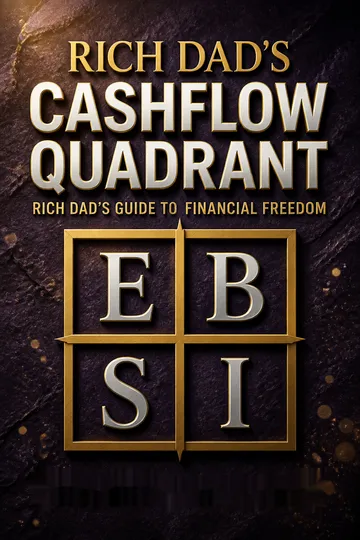
Map the destination. The CASHFLOW Quadrant is Kiyosaki’s framework for describing four ways people earn: as employees, self-employed specialists, owners of larger businesses, or investors. He argues that schools mostly prepare people for employment or individual professional work, while business ownership and investing require other skills, such as leadership, raising capital, and managing assets.
A profession can cross quadrants. A doctor might work for a hospital, run a private practice, own a hospital, or invest in one. The author’s point is that the work title alone does not determine how income is produced. He recommends choosing education and mentors based on the intended path. This does not require quitting a job: the book repeatedly favors learning and testing ideas before making a major change.
This framework usefully separates what someone does from how their work is organized and paid for. The same professional skill can be tied to wages, a small practice, an institution, or ownership, each with different demands and risks. The categories are a map, not a ranking of human worth. Employees may rationally value predictable income, benefits, or time away from work, while businesses can fail and investors can lose capital. The practical question is not which quadrant is superior, but which combination fits a person’s abilities and obligations.
Learn how tax rules reward activity, but never let tax savings choose your life.
Know the income type. Kiyosaki distinguishes earned income, portfolio income, and passive income, arguing that they receive different tax treatment. He says business owners and investors can benefit from deductions or incentives when their activity supports goals governments want, such as creating businesses, housing, or energy production. He contrasts this with employees and many self-employed professionals, who often have fewer ways to reduce taxes.
Use qualified advice. The book gives U.S. examples, including depreciation on rental property and tax-deferred exchanges for certain real estate sales. It also notes that rules vary by country and recommends professional tax guidance. Kiyosaki’s broader advice is to understand the rules before investing, but he cautions against changing careers or business structures solely to pay less tax.
Taxes are not just a penalty; they also shape decisions by changing the after-tax return on work, saving, and investment. That is a valuable way to think about public policy. The details, however, depend on jurisdiction, income, timing, and the exact transaction. A deduction does not make a bad investment good, and tax advantages can change. Kiyosaki’s emphasis on incentives is more persuasive than his implication that some people can routinely earn millions and pay nothing. Tax planning belongs with a competent, independent professional, not a sales pitch.
Borrow to acquire productive assets only when the downside is survivable.
Debt magnifies the deal. Kiyosaki rejects the idea that all borrowing is inherently bad. In his framework, debt can help buy an asset when its income covers expenses and loan payments; borrowing for something that drains cash increases financial strain. His account of an early Maui property shows the danger: he used borrowed funds for the down payment and seller financing for most of the purchase, then a failed septic system drove the unit into negative cash flow.
The lesson is not to copy the leverage. The author presents later apartment investments as examples of using rental income and refinancing to recover invested capital. But leverage adds fixed payments and can magnify losses when income falls, repair costs rise, or property values decline. Kiyosaki advises beginning small and learning to manage debt and tenants before taking on larger projects.
Debt is best understood as a multiplier, not as a wealth strategy on its own. It magnifies the difference between actual asset performance and the assumptions used to justify a loan. The Maui breakdown is especially instructive because it turns an abstract warning into an operating problem: one repair can reverse a thin surplus. A robust plan needs room for vacancies, maintenance, and higher financing costs. The book’s confident examples of large-scale borrowing should not obscure that lenders, tenants, and markets can all behave differently than a spreadsheet predicts.
Reduce investment risk by building competence, control, and protection before committing capital.
Risk is more than volatility. Kiyosaki argues that avoiding every investment does not eliminate risk; it can leave people exposed to job loss, inflation, or an inadequately funded retirement. He recommends gaining practical knowledge in selling, real estate, and market analysis, then using protections such as insurance and appropriate legal structures. His preferred investments are ones where he believes he can influence operations and cash flow.
Question the word diversified. The book criticizes portfolios spread across many funds but concentrated in the same broad category of paper assets. It favors diversification across businesses, real estate, paper assets, and commodities. That distinction can prompt useful questions about correlated risks, but the author’s broad dismissal of conventional portfolios is a claim, not a universal rule. No amount of control removes market-wide or legal risk.
The most useful shift here is from asking whether an asset is inherently safe to asking which risks are understood, transferred, or still exposed. Insurance, due diligence, and legal separation can reduce specific losses; practice can improve judgment. But control is never complete, particularly in public markets or leveraged property. Diversification across assets can reduce some risks, while spreading money across correlated funds may offer less protection than the label suggests. The book is right to challenge complacency, but its confidence in personal control should be balanced with evidence about systemic shocks.
Treat investing as a practice, progressing from small experiments to informed decisions.
Learn by doing safely. Kiyosaki presents financial education as an ongoing process, not a diploma or a single seminar. He and Kim describe studying, examining many properties, making mistakes, and applying lessons to real deals. The CASHFLOW board game was designed as a low-stakes simulation where players could practice financial decisions with game money before risking savings.
Know your current level. The book’s Five Levels of Investors range from having no money to invest, through saving and delegating decisions, to managing investments independently and building businesses with outside capital. Kiyosaki warns against trying to jump straight to the most complex level. The useful step is to identify the skills a next stage requires, then seek practice, coaching, or expertise before increasing the stakes.
Simulation and deliberate practice are valuable because they make mistakes cheaper and more visible. The approach echoes training in fields where judgment develops through feedback, not merely through reading. Yet a game cannot reproduce the legal, emotional, and financial consequences of a real investment. Nor is delegating always evidence of ignorance; a well-chosen low-cost professional service can be sensible. The investor levels work best as prompts for self-assessment, not a ladder everyone must climb. A person’s appropriate level depends on resources, expertise, time, and tolerance for loss.
Let learning compound by giving value to more people through teams and repeatable systems.
Make contribution scalable. Kiyosaki describes three Laws of Compensation: give value and expect reciprocity, serve more people, and keep applying what is learned so knowledge accumulates. He contrasts a specialist whose income depends on personal hours with a business that can serve customers through a team and repeatable operations. In his account, this shift also changed his own direction: after hearing inventor and thinker R. Buckminster Fuller speak about service, he moved toward teaching entrepreneurship.
Practice, then expand. The author’s business and CASHFLOW game were attempts to teach financial ideas to a wider audience. His story argues that service and wealth need not be opposites. It also emphasizes that scale requires leadership, communication, and sustained learning, not simply a clever product or an ambitious plan.
This connects financial success to organizational design: income can grow when useful work is not limited to one person’s hours. It also highlights a neglected entrepreneurial skill, building a team capable of delivering value consistently. The moral claim that giving more leads to receiving more is inspiring, but not a guaranteed economic law. Some valuable work is underpaid, and some profitable businesses externalize costs. Service is a meaningful test of a business, but it should be assessed alongside who benefits, who bears the risk, and whether the model is sustainable.
Judge capitalism by the real problem it solves, not by the wealth it creates.
Separate creation from extraction. In the conclusion, Kiyosaki defends capitalism by distinguishing entrepreneurs who make useful goods or services from people who exploit a system for private gain. He points to aviation, computers, and medical technology as examples of businesses turning inventions into products that improve daily life. He also argues that schools should teach students to create businesses and jobs, rather than prepare only for employment.
Ask who gains. The book’s argument is that financial education can help people become producers and contribute solutions, rather than remain dependent on wages or institutions. Its proposed entrepreneurial education would include leadership, teams, cash flow, communication, systems, legal structure, and product development. This is a call to build enterprises around real needs, not simply to accumulate money or adopt the label of capitalist.
The distinction between productive enterprise and extraction is important because markets can reward both. A business that makes a service cheaper or more accessible can create broad benefits, while a profitable activity can also shift costs onto workers, communities, or taxpayers. Measuring a company only by wealth created misses that distribution. The book’s emphasis on solving problems offers a stronger standard than equating profit with social value, but it needs questions about power and accountability alongside innovation. Entrepreneurship can create jobs; it cannot substitute for every public institution or guarantee fair outcomes.
Analysis
Unfair Advantage is a motivational argument about financial literacy, but it is also an autobiographical case for moving from wages toward ownership. Its most coherent thread is not the claim that one asset class always wins. It is the proposed sequence: learn the vocabulary of money, distinguish income from wealth, study how taxes and borrowing affect a deal, practice before taking larger risks, and acquire assets that generate income. Monopoly provides the book’s memorable teaching device, while the contrast between Kiyosaki’s two father figures gives the ideas a personal narrative. The account of an early rental property that became a liability after a septic failure is more instructive than the later stories of large acquisitions because it shows how a financial plan meets ordinary operational risk.
The book also needs to be read as a 2011 polemic. Its claims about the dollar, retirement accounts, inflation, and imminent economic collapse are presented with great certainty, but several are forecasts or contested interpretations rather than settled financial principles. Its categorical language about savings, debt, diversification, and conventional investing can mislead if treated as universal advice. Broad diversification can reduce company-specific risk, while leverage can produce losses as quickly as gains. Tax rules vary and change, and the anecdotes about returns are not independently established here.
The durable value is therefore educational rather than prescriptive. Readers can borrow the questions the book asks: What puts money in or takes it out of a household? What must happen for this asset to pay its costs? Which assumptions depend on rising prices? Who is paid to offer this advice? What protections exist if the plan fails? Those questions can improve judgment without requiring a reader to adopt Kiyosaki’s preferred strategy. Financial education is most useful when it increases discernment, not when contrarian certainty replaces conventional certainty.
Review Summary
Unfair Advantage receives mixed reviews, with ratings ranging from 1 to 5 stars. Many readers appreciate Kiyosaki's emphasis on financial education and his unique perspective on investing. However, critics argue that the book is repetitive, lacks concrete advice, and contains questionable financial strategies. Some praise the author's insights on taxes, debt, and cash flow, while others find his ideas oversimplified or potentially risky. The book's focus on real estate investing and unconventional financial wisdom resonates with some readers but alienates others.
People Also Read








Glossary
CASHFLOW Quadrant
Four ways to earnKiyosaki’s framework groups income-producing roles into four categories: employee, self-employed or small-business operator, owner of a larger business, and investor. The categories describe how work and money are organized, rather than specific professions. A doctor, for example, could work as an employee, run a practice, own a hospital, or invest.
Cash flow
Money moving in or outIn the book, cash flow is money entering or leaving a person’s or business’s finances over time. An investment produces positive cash flow when income remains after costs and debt payments; it has negative cash flow when expenses exceed income. Kiyosaki uses this measure to distinguish income-producing assets from holdings that depend mainly on resale gains.
Assets and liabilities
Cash in, cash outKiyosaki uses a cash-flow-based definition: an asset puts money into a person’s pocket, while a liability takes money out. This differs from standard accounting usage, where assets and liabilities are balance-sheet categories. His version is intended as a simple personal-finance test, especially for homes, vehicles, and investments that may have ongoing costs.
OPM
Other people’s moneyOPM means other people’s money, which Kiyosaki uses for capital borrowed from banks or supplied by investors to acquire or operate assets. He presents access to outside capital as a key investor and entrepreneur skill. Because borrowed money must be repaid and can magnify losses, using OPM depends on the investment’s actual performance and the terms of financing.
Infinite return
Income after capital returnsKiyosaki uses this term for an investment that continues producing income after the investor has recovered their original contribution, often through refinancing or other financing. The phrase describes a return calculation with little or no original capital remaining in the deal, not a guarantee of unlimited profit. The asset can still carry debt, operating costs, and risk.
Laws of Compensation
Value, service, learningThe book’s three-part principle for earning more is to give value, serve more people, and keep applying learning so skills and results compound. Kiyosaki connects these ideas to reciprocity, business growth, and education through practice. They are presented as guiding principles for work and entrepreneurship, not as a promise that greater effort or service always produces greater income.
Five Levels of Investors
Investor experience continuumThis framework describes five broad positions: people with nothing available to invest, savers, people who delegate investment decisions, do-it-yourself investors, and capitalists who build businesses and use outside capital. Kiyosaki presents the levels as differences in knowledge, activity, and access to capital. He advises developing competence gradually rather than attempting the most complex investments without experience.
B-I Triangle
Business-building frameworkThe B-I Triangle is Kiyosaki’s model of the components he believes make a business function as an asset: mission, team, leadership, cash flow, communication, systems, legal structure, and product. The product sits at the top as only one part of the whole. The framework emphasizes that a promising idea alone does not make a sustainable business.
FAQ
What's Unfair Advantage by Robert T. Kiyosaki about?
- Focus on Financial Education: The book emphasizes the importance of financial education as a means to gain an unfair advantage in wealth creation.
- Critique of Traditional Education: Kiyosaki argues that traditional education does not prepare individuals for financial success in the modern economy.
- Economic Transition: It discusses the shift from the Industrial Age to the Information Age, highlighting the obsolescence of job security and traditional savings methods.
- Real-Life Investments: Kiyosaki shares personal experiences and strategies for investing in real estate and understanding the rules of money today.
Why should I read Unfair Advantage by Robert T. Kiyosaki?
- Gain Financial Insights: The book provides insights into financial education often overlooked in traditional schooling.
- Empowerment Through Knowledge: It empowers readers to take control of their financial future by emphasizing proactive learning.
- Learn from Real Experiences: Kiyosaki shares his journey and lessons from successes and failures, making the content relatable.
- Prepare for Economic Changes: The book prepares readers for expected economic volatility, encouraging proactive financial strategies.
What are the key takeaways of Unfair Advantage by Robert T. Kiyosaki?
- Financial Education is Crucial: Kiyosaki stresses that financial literacy is essential for navigating modern finance complexities.
- Use Debt Wisely: The book teaches leveraging debt as a tool for acquiring assets and generating cash flow.
- Question Traditional Advice: Kiyosaki encourages challenging conventional wisdom about saving, investing, and job security.
- Understanding Assets vs. Liabilities: Distinguishing between assets and liabilities is fundamental to building wealth.
What are the best quotes from Unfair Advantage by Robert T. Kiyosaki and what do they mean?
- “Savers are losers.”: This highlights the belief that saving money in a depreciating currency is detrimental to wealth accumulation.
- “Choose your teachers wisely.”: Emphasizes learning from those with real-world financial success rather than traditional educators.
- “The harder you work for money, the more you pay in taxes.”: Suggests that financial education can help minimize tax burdens.
How does Unfair Advantage by Robert T. Kiyosaki define assets and liabilities?
- Assets Put Money In: Assets are defined as anything that puts money in your pocket, like rental properties or investments.
- Liabilities Take Money Out: Liabilities are things that take money out of your pocket, such as a personal residence or car.
- Importance of Financial Literacy: Understanding the difference is crucial for building wealth, as many mistakenly consider their homes as assets.
What is the CASHFLOW Quadrant in Unfair Advantage by Robert T. Kiyosaki?
- Four Types of Income: The quadrant categorizes individuals into Employees (E), Self-Employed (S), Business Owners (B), and Investors (I).
- Focus on B and I: Kiyosaki argues for operating in the B and I quadrants for financial freedom through business ownership and investments.
- Understanding Cash Flow: It helps individuals understand income sources and how to shift towards more favorable financial positions.
How does Unfair Advantage by Robert T. Kiyosaki address the concept of inflation?
- Inflation Diminishes Savings: Kiyosaki argues that inflation erodes money's purchasing power, making saving ineffective long-term.
- Invest in Tangible Assets: He suggests investing in real estate, gold, and silver to combat inflation, as they retain value over time.
- Understanding Money Dynamics: The book encourages understanding how government policies and economic conditions affect inflation and finances.
What is the significance of debt in Unfair Advantage by Robert T. Kiyosaki?
- Debt as a Tool: Kiyosaki views debt as a necessary tool for wealth creation, allowing leverage of other people's money to acquire assets.
- Tax Advantages: Using debt can provide tax benefits, as interest payments on loans can often be deducted from taxable income.
- Risk Management: While beneficial, Kiyosaki emphasizes managing debt wisely to avoid financial pitfalls.
What strategies does Unfair Advantage by Robert T. Kiyosaki suggest for investing?
- Start Small and Learn: Kiyosaki advises starting with small investments to gain experience before moving to larger deals.
- Focus on Cash Flow: Emphasizes investing for cash flow rather than capital gains, as cash flow provides ongoing income.
- Continuous Education: Stresses the need for ongoing financial education to adapt to changing market conditions.
How does Unfair Advantage by Robert T. Kiyosaki suggest one should approach financial education?
- Invest Time in Learning: Encourages prioritizing financial education through courses, books, and mentorship from successful investors.
- Question Traditional Education: Challenges the conventional education system for failing to teach practical financial skills.
- Adopt a Growth Mindset: Promotes continuous learning and adaptation, essential for navigating modern finance complexities.
What are the Five Levels of Investors in Unfair Advantage by Robert T. Kiyosaki?
- Investor Levels Explained: Kiyosaki outlines five levels, from zero financial intelligence to seasoned capitalists.
- Path to Improvement: The levels serve as a framework for assessing investment knowledge and identifying growth areas.
- Importance of Education: Highlights the significance of continuous learning and adaptation in the investment landscape.
How can I apply the concepts from Unfair Advantage by Robert T. Kiyosaki to my life?
- Start with Financial Education: Invest in financial education through books, courses, and practical experiences.
- Assess Your Financial Position: Use the CASHFLOW Quadrant to evaluate your income generation and identify improvement areas.
- Take Action: Apply principles of leveraging debt, understanding taxes, and investing in cash flow-generating assets.
About the Author
Other books by Robert T. Kiyosaki







Download PDF
Download EPUB
.epub digital book format is ideal for reading ebooks on phones, tablets, and e-readers.








