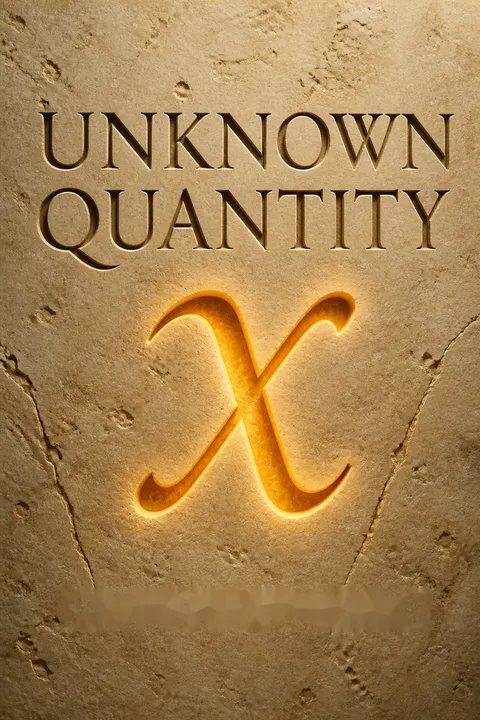


Key Takeaways
Start algebra where a statement becomes a question about the unknown.
The unknown came first. Algebra began when people moved from stating a calculation to asking what value would make it true. Babylonian clay tablets from roughly 1800 BCE contain word problems solved by procedures for particular kinds of equations. One asks for a quantity greater than its reciprocal by seven. Because Babylonian numbers used base 60, the reciprocal in this problem means 60 divided by the quantity, not 1 divided by it. The procedure yields 12 and 5. The Egyptians also posed simple problems, but the Babylonian examples show more systematic reasoning.
An early kind of abstraction. These writers had no letters like x and y. They used words for quantities and tailored procedures to specific problems. The later term Diophantine analysis refers to finding whole-number solutions to polynomial equations. The deeper shift, though, begins earlier: treating an unknown as something that can be reasoned about.
The book makes the unknown quantity more than a classroom symbol: it is the hinge between arithmetic as bookkeeping and mathematics as inquiry. The Babylonian example also keeps the origin story grounded in practical calculation rather than a lone genius having a sudden revelation. A caution is useful: surviving tablets show what scribes recorded, not the full range of mathematical thought in their societies. The history is therefore a story of preserved evidence as much as a story of invention.
Use symbols to turn separate tricks into methods that travel.
Words gave way to symbols. Al-Khwarizmi classified linear and quadratic equations and described procedures called al-jabr and al-muqabala. Al-jabr means restoring an equation by adding the same quantity to both sides; al-muqabala means reducing it by removing matching quantities. Yet he wrote equations in words. Diophantus had used symbols for an unknown and its powers centuries earlier, but his notation was limited and did not become the standard tool of later algebraists.
Letters widened the reach. In the 13th century, Fibonacci helped spread the Indian numeral system, including zero, through Europe. Around 1600, François Viète used letters for both unknowns and known quantities; René Descartes later made a more durable notation familiar. Symbols let mathematicians state general relationships and manipulate them without tying each step to one numerical example.
Symbolism is not mere shorthand. It changes what can be seen: a procedure that once had to be repeated problem by problem can become a general relationship open to inspection. The history also resists a tidy tale of steady progress. Diophantus had notation before al-Khwarizmi, yet his advance was not simply inherited and improved in a straight line. Mathematical ideas need usable conventions, communities, and means of circulation before they become common tools.
Let imaginary quantities work before demanding that they feel real.
Cubics changed the stakes. In 16th-century Italy, Scipione del Ferro found a solution to one kind of cubic equation. Nicolo Tartaglia independently solved it, then shared his method under a secrecy promise with Girolamo Cardano. Cardano generalized the approach, and his student Lodovico Ferrari solved the quartic. The formulas brought a surprise: intermediate steps could involve square roots of negative numbers, even when the final answer was an ordinary real number.
A useful impossibility. Rafael Bombelli accepted these strange quantities as valid tools. For the equation x cubed equals 15x plus 4, his calculation passes through expressions involving the square root of negative 121, then produces the real solution 4. Complex numbers were not yet understood as fully as they are now, but the equation made them difficult to ignore. Their usefulness helped turn an apparent absurdity into a legitimate mathematical object.
This episode shows how mathematics can expand by granting temporary permission to use an unfamiliar object, then asking whether the rules produce consistent results. Bombelli's example is especially persuasive because the strange intermediate quantities are not decorative: they help reach a checkable answer. Still, usefulness in one calculation does not automatically validate every proposed extension. The discipline comes from specifying rules and testing consequences, not from treating mystery itself as evidence.
A failed quintic formula revealed the hidden structure of equations.
The fifth degree resisted. After formulas had been found for general cubic and quartic equations, mathematicians expected a similar formula for the quintic. Paolo Ruffini argued that no formula using ordinary arithmetic and root extraction could solve every quintic; Niels Abel supplied a more convincing proof in 1824. This did not mean particular quintics could not be solved, or that numerical approximations were impossible. It meant no universal formula of the familiar kind existed.
Roots have a structure. Évariste Galois connected the solvability of an equation to the permutations of its roots. A group is a set of elements with a consistent rule for combining them; the Galois group records which rearrangements preserve the equation's underlying relationships. Galois showed that the group's structure determines whether solutions can be expressed using radicals. He died at 20 after a duel, and his work was recognized through publication only years later.
The quintic story is a striking reversal: a failed search for a formula became a way to classify what formulas are possible. Galois shifts the question from calculating roots to studying the symmetries among them, an unusually powerful change of viewpoint. The distinction between universal and particular solutions matters here. Without it, the theorem can sound like a claim that quintics are unsolvable at all, when the actual result is narrower and more revealing.
Study operations themselves, not only the numbers they act upon.
Symbols broke free. For centuries, algebra meant using symbols to calculate with numbers. In the 19th century, mathematicians began asking whether the symbols could represent other objects, provided those objects obeyed coherent rules. A vector space, for example, is a system of vectors that can be added and multiplied by scalars. Vectors need not be arrows in a diagram: polynomials can also serve as vectors when their addition and scalar multiplication follow the required rules.
New rules, new objects. William Rowan Hamilton sought a number system extending complex numbers. He found that useful four-part numbers, called quaternions, required multiplication to be noncommutative: changing the order can change the result. Hermann Grassmann developed a more general treatment of vector spaces and their operations. These ideas helped establish a new conception of algebra, in which structures and rules could be studied independently of familiar numerical examples.
The shift is comparable to studying grammar rather than only individual sentences: the rules become objects of investigation in their own right. This makes algebra portable across geometry, polynomials, and other domains. It also raises a real cost. Once familiar numbers no longer guide intuition, definitions and proofs must carry more of the burden. The abstraction is powerful precisely because it is disciplined, not because every formal system automatically corresponds to something useful.
Use geometry to expose algebraic structure that symbols can hide.
Geometry became a partner. The 19th century brought new geometries, including projective geometry and non-Euclidean geometry, which challenged the assumption that Euclid's rules were the only possible ones. Felix Klein proposed organizing geometries by the transformations that leave their important properties unchanged. For instance, plane motions such as sliding, turning, and flipping preserve distances, while projection preserves different properties, such as a cross-ratio formed from four points.
Topology added another lens. Topology studies what remains unchanged when shapes are stretched or squeezed without being cut. Henri Poincaré turned certain families of loops on a surface into groups, making algebra a tool for distinguishing spaces. A loop on a sphere can be shrunk to a point; some loops around a torus cannot. The bridge between geometric shape and algebraic structure allowed each field to ask questions the other could not easily express.
Klein's organizing idea makes geometry less a catalog of pictures and more a study of what survives under change. Poincaré's loops likewise turn a visual distinction into something algebra can calculate. The strength lies in choosing the right transformation or invariant for the question at hand. The limitation is that no single invariant captures every feature of a space. Algebraic summaries clarify structure, but they are not the whole geometric object.
When unique factorization fails, enlarge the system rather than quit.
Familiar primes can fail. Work connected to Fermat's Last Theorem exposed a problem in number systems built from complex numbers. In the ring of numbers shaped like a plus b times the square root of negative five, 6 can be factored as 2 times 3 or as the product of 1 plus the square root of negative five and 1 minus the square root of negative five. The factors are prime within that system, so unique factorization breaks down.
Ideals repair the picture. A ring is a system where addition, subtraction, and multiplication work reliably, though division may not. Richard Dedekind defined an ideal as a special substructure within a ring, one that remains closed when its elements are multiplied by elements of the larger ring. Ideals let mathematicians recover a useful theory of divisibility when ordinary prime factors no longer behave consistently. Kummer had developed related ideal factors while working on cases of Fermat's theorem.
The episode offers a general research strategy: when a trusted rule fails in a broader setting, identify what the rule was measuring and build a better object to preserve that information. Ideals do not make the original factorization unique again in quite the same elementary sense; they create a more flexible account of divisibility. That distinction matters. Mathematical repair often means changing the language of the problem, not pretending the old language never failed.
Build algebra from reusable structures, not isolated calculations.
Noether made the framework general. By the early 20th century, rings had appeared in number theory, geometry, and other areas, but their shared structure was not yet a unified subject. Emmy Noether's 1921 work on ideals helped turn ring theory into a coherent, axiomatic field. A field is a system in which addition, subtraction, multiplication, and division are available, except division by zero. A ring has a looser set of rules, usually allowing addition, subtraction, and multiplication but not unrestricted division.
A new style of algebra. Noether's methods treated structures abstractly, through the properties they obey rather than through one specific numerical example. Her achievement came despite the barriers facing women in German universities: she initially taught and supervised students without a regular paid post. Her work influenced the modern algebra textbooks and teaching that made groups, rings, fields, and related structures central parts of mathematics.
Noether's achievement is both technical and methodological: she showed how a collection of specialized results could become a reusable theory. Axioms make it possible to carry arguments from one setting to another without repeating every calculation. Yet this gain in generality can obscure where a structure came from or why it matters. The best use of abstraction keeps both views available: the clean definition and the concrete examples that make its consequences intelligible.
Abstract algebra can return to physics as a working language.
The abstractions found applications. Matrices, groups, and geometric structures that had developed as pure mathematics became useful in modern physics. Matrices helped express the calculations at the heart of quantum theory. Groups describe transformations in relativity and help organize families of particles. The book also traces a much more abstract strand: category theory, a framework for studying mathematical structures through mappings between them. It emerged from work connecting algebra and topology, then supported broader ways of relating different areas of mathematics.
Grothendieck widened the view. In the mid-20th century, Alexander Grothendieck reshaped algebraic geometry by raising its level of abstraction and connecting it more deeply with number theory and topology. His work exemplifies the book's long arc: algebra begins with an unknown number, then learns to study structures built from structures. The resulting ideas are remote from everyday arithmetic, yet some have become tools for describing the physical world.
The ending completes the book's central paradox: abstraction can move mathematics away from ordinary experience and later provide a precise language for physical theories. That usefulness should not be mistaken for proof that every abstract construction describes nature. A mathematical model earns that role only when it connects to observation and survives testing. Still, the recurring return from pure structure to physical application gives the history its distinctive force. The unknown quantity has become an unknown structure, and the search continues.
Analysis
The book's central argument is a history of increasing abstraction, told through the changing meaning of algebra. It begins with practical questions about quantities, follows the arrival of symbolic notation, and then tracks how symbols gradually detach from ordinary numbers. The major transitions are not simply a succession of clever formulas. They are changes in what mathematicians regard as a legitimate object of study: equations become objects, roots become a permutable system, and eventually groups, rings, vector spaces, and geometric varieties become objects in their own right.
Its strongest narrative device is the mismatch between the modest starting point and the remote destination. Babylonian scribes solve word problems; nineteenth-century mathematicians ask whether equations can be solved through radical expressions; twentieth-century algebraists build theories that connect topology, number theory, geometry, and physics. The human stories give these transitions texture. Cardano's tangled exchange with Tartaglia dramatizes the competitive culture behind the cubic, while Galois and Noether show how mathematical merit can coexist with personal or institutional exclusion.
The book is also careful to show that progress is uneven. Diophantus's notation was not simply inherited, discoveries were lost or ignored, and new mathematical systems often emerged because old rules failed. Its historical breadth is a strength, though compression across civilizations and centuries necessarily makes some developments look more linear than they were. The author's own account warns against confusing a surviving text with the full intellectual life of its society.
The most durable lesson is methodological. Algebra advances when mathematicians ask which features matter, then build a language that preserves those features while discarding irrelevant detail. That strategy can yield both greater generality and unexpected applications. But abstraction is not magic: definitions must be exact, examples must remain visible, and claims about the physical world require more than mathematical elegance. The book's title captures this productive tension. Each new layer makes the object less familiar, yet potentially more revealing.
Review Summary
Unknown Quantity receives mostly positive reviews for its engaging history of algebra, from ancient times to modern developments. Readers appreciate Derbyshire's witty writing style and biographical anecdotes about mathematicians. However, some find the later chapters challenging, as they delve into complex algebraic concepts. The book is praised for balancing mathematical explanations with compelling narratives, though a few critics note issues with eurocentrism and political comments. Overall, it's recommended for those with some mathematical background who enjoy the history of mathematics.
People Also Read







Glossary
Diophantine analysis
whole-number equation solvingThe study of whole-number solutions to polynomial equations. The name refers to Diophantus, whose Arithmetica collected problems asking for numbers that satisfy specified conditions. A problem may have no solution, one solution, or infinitely many, depending on the equation and on which kinds of numbers are allowed.
al-jabr and al-muqabala
equation completion and reductionThe two operations named in al-Khwarizmi's influential algebra text. Al-jabr restores an equation by adding an equal quantity to both sides, while al-muqabala reduces it by removing matching quantities from both sides. Together they help rewrite equations into standard forms that can be solved using the procedures available at the time.
Galois group
equation-root symmetry groupA group associated with a polynomial equation that records certain permutations of its roots while preserving the relationships determined by the equation's coefficients. Galois showed that the structure of this group answers whether the equation's roots can be expressed using arithmetic operations and extraction of roots.
Vector space
vectors with scalar operationsA mathematical structure whose elements, called vectors, can be added and multiplied by scalars from a specified number system. The vectors need not be arrows: polynomials or lists of numbers can serve as vectors if they obey the required rules. Concepts such as basis, dimension, and linear independence describe the structure.
Field
system permitting four operationsA system whose elements can be added, subtracted, multiplied, and divided, with division by zero excluded and the usual algebraic rules in force. The rational, real, and complex numbers are familiar examples. Fields provide the coefficients for many polynomial equations and serve as foundations for more elaborate algebraic structures.
Ring
addition and multiplication structureAn algebraic structure in which addition, subtraction, and multiplication are defined and obey consistent rules, while division need not always be possible. The integers and polynomial expressions are examples. Rings allow mathematicians to study divisibility and factorization in settings broader than ordinary whole-number arithmetic.
Ideal
special substructure of a ringA subset of a ring that is itself closed under addition and subtraction and has the property that multiplying any of its elements by an element of the larger ring keeps the result inside the subset. Ideals extend the language of divisibility and help recover a systematic theory of factors in number systems where unique prime factorization fails.
Category theory
structures and their mappingsA highly abstract framework for studying mathematical objects together with mappings between them. A category specifies objects, morphisms connecting those objects, and rules for composing the morphisms. Functors then relate categories. The framework arose from connections between algebra and topology and provides a common language for comparing different mathematical areas.
About the Author
Other books by John Derbyshire
Download PDF
Download EPUB
.epub digital book format is ideal for reading ebooks on phones, tablets, and e-readers.








