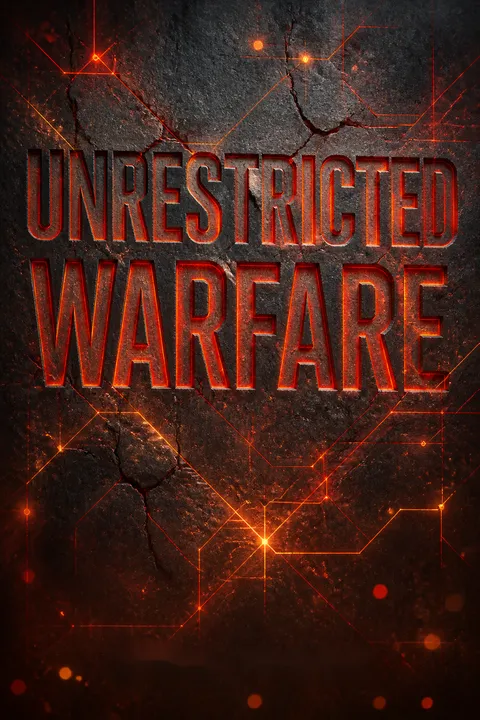


Key Takeaways
Treat war as coercion across domains, not just violence on a battlefield.
A broader definition. Qiao and Wang argue that warfare is not limited to armies, weapons, and declared battlefields. It is any organized use of means to pressure an opponent into serving one’s interests. Those means might include armed force, financial pressure, trade restrictions, cyberattacks, diplomacy, or media influence. The authors call this expanded idea unrestricted warfare: conflict can cross the boundary between military and civilian life, and between war and peace as conventionally understood.
The practical warning. A hacker, a financial operator, or a state may affect another country without firing a shot. The book’s point is not simply that new tools exist, but that their combined effects can impose strategic costs. Its broad definition, however, makes it important to distinguish deliberate coercion from ordinary competition or economic interdependence.
The useful shift is from asking whether an action looks like combat to asking what it is intended to make another actor do. That can expose pressure hidden inside apparently routine activity. But a definition broad enough to include almost any harmful policy risks making the word war less informative. Intent, coordination, and coercive purpose matter: a damaging outcome alone does not establish that an attack occurred.
Read the Gulf War as a systems lesson, not a weapons commercial.
A compressed campaign. The authors treat the 1991 Gulf War as a sign that warfare was changing. The conflict lasted 42 days, including 38 days of air strikes, while the ground campaign lasted about 100 hours. They emphasize that its effectiveness depended on more than advanced aircraft and precision weapons. Satellites, command networks, logistics, allied forces, and coordinated air operations worked together.
The less visible players. The book also examines diplomacy, sanctions, psychological pressure, and media coverage as parts of the campaign. It argues that the coalition and its control of the public narrative helped shape the conflict. The authors criticize each military service for claiming its own version of the war as the central lesson. Their larger point is that one spectacular victory cannot be reduced to a single technology or copied as a universal template.
The systems perspective is more durable than fascination with a particular weapon: capability often comes from connections among tools, organizations, and decisions. The Gulf War account also shows why a military victory can be politically contingent, since coalition support and public interpretation affect what operations remain possible. Yet the authors’ analysis is not neutral measurement. Their account selects lessons that support a theory of expanding warfare, so its interpretations should not be mistaken for a complete history of the conflict.
Combine political, financial, informational, and military tools around one objective.
More than one instrument. The book’s operational answer to a changing battlefield is combination. Its term combined war that goes beyond limits describes using tools across military and non-military domains rather than treating each as a separate kind of contest. The authors divide these combinations into action across national boundaries, across domains, and across different means and levels of conflict.
A linked campaign. In their account of the Gulf War, military force was joined with coalition diplomacy, economic sanctions, and information efforts. They also imagine attacks that begin with financial disruption or network sabotage before military pressure is applied. The key is not to use every available instrument at once. It is to make different tools reinforce a defined objective. As the authors’ own examples imply, a mix that lacks coordination can be noise rather than strategy.
This model treats strategy as a problem of interaction: a tool’s value depends partly on what other tools are doing and on the target’s dependencies. That is a strong corrective to planning in isolated institutional lanes. But combination is not automatically synergy. Financial pressure can alienate potential partners, while information campaigns can undermine credibility if exposed. The difficult work is not assembling more instruments, but anticipating how their effects, costs, and political meanings compound.
Find the opponent’s vulnerable hinge instead of matching its strongest force.
Shift the point of effort. The authors call their idea the side-principal rule: a secondary-looking factor can direct the outcome by shaping the larger force around it. In the story of Tian Ji’s horse races, a strategist accepts one loss by matching a weak horse against the king’s strongest, then uses the remaining matchups to win two races. The lesson is to seek leverage, not a fair contest.
A suggestive ratio. The authors connect this idea to the golden section, approximately 0.618, and claim to see the ratio in the timing or arrangement of historical battles. Those examples are best read as illustrations, not proof that victory follows a mathematical law. The more practical insight is to find the opponent’s critical dependency, unexpected direction, or moment of declining strength, then focus effort there rather than confronting its main advantage head-on.
The horse-race story makes asymmetry concrete: the weaker side can accept a local loss if it improves the total result. This resembles portfolio thinking, where resources are allocated for the aggregate outcome rather than equal performance in every part. The book’s numerical claims are less persuasive. A ratio noticed after a battle does not show that commanders could have used it to predict the turning point. The strategic heuristic survives without the mathematical aura.
Expect the battlefield and the cast of combatants to spill into civilian life.
New arenas, new actors. The authors describe battlefields that extend beyond land, sea, and air into networks, financial systems, media, and public opinion. They also argue that professional soldiers no longer hold a monopoly on actions with strategic effects. Hackers, financiers, software specialists, non-state groups, and ordinary citizens may all influence a conflict.
Attribution becomes difficult. The book recounts a 1994 intrusion by a 16-year-old British hacker into U.S. military and other computer systems. The authors use the episode to raise a central question: how can observers tell an experiment or crime from a politically directed attack? That uncertainty complicates defense and response. Still, the ability to cause damage does not by itself make a person a combatant, and the book’s expanded cast should not erase distinctions between civilians, criminals, and organized forces.
The account identifies a genuine analytical problem: networked societies give individuals and small groups leverage that once required larger organizations. It also separates the scale of an effect from the size of the actor producing it. The legal and moral categories remain essential, however. If every person whose action affects national security is treated as a soldier, civilian protection becomes unstable and governments gain a rationale for treating ordinary dissent or commerce as hostile activity.
Set limited objectives before expanding the methods used to reach them.
A flexible playbook. The authors present eight principles for warfare beyond conventional boundaries. In plain language, they advise planners to map all relevant arenas, coordinate actions in time, keep goals feasible, use a broad range of means, seek asymmetry, conserve resources, coordinate across domains, and keep adjusting as events unfold.
Limits still matter. The book’s phrase unlimited measures can sound like permission to use anything. The authors qualify it: objectives should remain limited, and the chosen means should serve those objectives. They warn that goals exceeding available capabilities lead to failure, citing the expansion of U.S. aims in Korea and the Egyptian campaign plan in the 1973 Middle East War. The principles are presented as guidance, not a formula guaranteeing victory. Context, changing conditions, and sound judgment still determine what is appropriate.
The pairing of bounded aims with flexible means is a useful discipline. It separates ambition from method: a state can be inventive without making its desired outcome limitless. The framework also recognizes that plans need feedback, not just initial design. Its unresolved tension is ethical as well as operational. Broad permission to choose means can quietly dissolve constraints unless legal obligations, civilian protection, and accountability are treated as part of planning rather than as obstacles to it.
Build weapon systems around tactics, rather than buying technology for its own sake.
Integration beats spectacle. The authors argue that modern weapons gain much of their value through connection with other systems. In the Gulf War, warning satellites, ground stations, command centers, and Patriot operators contributed to a coordinated response. No single device explains the whole capability. The book contrasts this with the expense of continually developing ever more advanced platforms.
Match tools to missions. Older weapons can regain usefulness when paired with newer equipment. The authors point to the B-52 bomber’s renewed role when used with cruise missiles and precision-guided weapons. They also warn that a wealthy military can spend so heavily on advanced systems that cost and complexity become liabilities. Their recommendation is to choose tactics first, then select or develop weapons that support them, while recognizing that tactics and technology influence each other.
This is a systems-engineering argument as much as a military one. A platform matters less when it cannot communicate, coordinate, or fit the mission, while a modest tool can become valuable inside a well-designed system. The caution about technology spending is especially sharp because procurement can reward visible novelty over operational fit. Still, the authors’ contrast between tactics and weapons should not become a false choice: tactics cannot compensate for every capability gap, and technology can create options that doctrine has not yet anticipated.
Bloodless pressure can still devastate societies, so do not confuse precision with restraint.
Less lethal is not harmless. The authors describe precision weapons and non-lethal tools as a turn away from maximizing casualties. A weapon might disable equipment or personnel without killing them, while cyber, financial, or media operations can disrupt systems without conventional bombardment. Such methods can reduce some direct physical destruction and may offer alternatives to indiscriminate force.
Coercion remains coercion. The book warns against treating these tools as humane simply because they leave fewer bodies on a battlefield. A financial shock or communications disruption can unsettle social order and impose costs on people far from a military target. The authors argue that a less bloody method can still compel an opponent. Their distinction is important: reduced lethality may change the process of conflict, but does not automatically make its effects just, proportionate, or politically benign.
The distinction between lethality and harm is indispensable. A conflict can become less visible while shifting its burden onto workers, patients, households, or public services. That possibility makes impact assessment broader than counting casualties. The authors’ argument is strongest as a warning against technological moralism, the assumption that cleaner instruments produce cleaner outcomes. It also raises a practical question: when an action disrupts civilian systems, what safeguards and remedies are owed to people who were never the intended target?
Use this 1999 theory as a lens, not proof of a secret master plan.
Separate text from packaging. Qiao and Wang’s 1999 book argues that states, especially those weaker in conventional military power, can gain leverage by combining military and non-military methods. The supplied edition adds the subtitle China’s Master Plan to Destroy America, and its foreword presents the book as a warning about an ongoing campaign. The editor’s note says that such English-language framing may misrepresent the original work.
Theory is not evidence. The authors describe possible tools and interpret events of their era, including the Gulf War and the Asian financial crisis. Those examples do not, on their own, establish that separate events were coordinated by one government as warfare. The book is most useful as a way to notice how economic, informational, and military pressures can interact. Its claims about intent and causation require evidence beyond the framework itself.
The distinction between an analytical framework and proof of a coordinated strategy protects readers from both complacency and paranoia. A theory can help identify vulnerabilities without proving who exploited them or why. The publisher’s subtitle makes that distinction unusually important because it converts a broad argument about changing conflict into a specific national plot. Reading the authors carefully preserves the book’s strategic insight while resisting conclusions its examples cannot establish.
Analysis
Unrestricted Warfare is best read as a strategic argument about the expansion of coercive power, not as a forecast that every economic dispute or cyber incident is literally a war. Its enduring insight is relational: political, military, economic, technological, and informational instruments can amplify or constrain one another. The Gulf War gives the authors a vivid case for that claim, while their discussion of systems, coordination, and asymmetry offers a way to examine how states pursue advantage without relying solely on battlefield force.
The book’s central weakness is also its central ambition. By expanding warfare to include almost any measure that can compel an adversary, it risks erasing the boundary between hostile action and ordinary interdependence. A financial loss, media effect, or technological dependency may be strategically consequential without being part of a deliberate attack. The framework needs tests for attribution and intent: who acted, what outcome was sought, whether actions were coordinated, and whether pressure was applied to change another actor’s choices. Without such tests, the theory can explain nearly any outcome after the fact and become difficult to disprove.
The authors’ side-principal rule is more useful as a decision heuristic than as a claimed law. It directs attention toward dependencies and leverage points, but the golden-section examples do not establish predictive mathematics. Likewise, the idea of combining instruments is not self-validating. A coalition, sanction, or information campaign can create legitimacy and leverage, but can also produce backlash or harm people beyond its intended target.
The edition’s subtitle and foreword should be distinguished from the authors’ broader thesis. The book describes methods and strategic possibilities; it does not prove a unified secret plan to destroy the United States. Its strongest contribution is a lens for seeing how modern power travels through connected systems. Its most responsible use pairs that lens with careful evidence, legal distinctions, and attention to civilian consequences.
Review Summary
Unrestricted Warfare receives mixed reviews, with ratings ranging from 1 to 5 stars. Many readers find it thought-provoking and relevant to modern warfare, praising its insights on non-traditional warfare methods. Critics argue it's outdated, poorly translated, or overhyped. Some view it as essential reading for understanding China's military strategy, while others dismiss it as propaganda. The book's discussion of financial, cyber, and psychological warfare aspects is frequently highlighted. Readers debate its authenticity and significance in contemporary geopolitics.
People Also Read





Glossary
Unrestricted warfare
Coercion across conventional boundariesThe authors’ broad conception of warfare as using military or non-military means to compel an opponent to accept one’s interests. It includes conventional force but also considers financial, informational, technological, political, and other forms of pressure. The term challenges definitions that restrict war to armed forces, declared hostilities, and physical battlefields.
combined war that goes beyond limits
Cross-domain methods combinedThe authors’ proposed method of combining resources and actions across military and non-military fields, national and transnational actors, and different levels of conflict. It is a way of thinking about how multiple instruments can support an objective, rather than a fixed operational recipe. The authors stress that the range of means may expand while objectives remain limited.
side-principal rule
Use a directing leverage pointThe authors’ principle that a directing or seemingly secondary factor can shape the outcome more than the larger force it influences. In warfare, this means seeking an opponent’s vulnerable dependency, direction, or moment of weakness instead of contesting its strongest capability directly. The book links the idea to the golden section, but its practical value is as a strategic heuristic, not a proven mathematical law.
supra-national combinations
Combine state and wider actorsThe use of national power together with international organizations, multinational entities, and non-state actors to pursue a strategic objective. The authors use coalition building and international institutions as examples of how influence can extend beyond one state’s own resources. The concept describes a wider arena for organizing pressure, not proof that all participating actors share one motive.
supra-domain combinations
Combine different arenasThe coordination of actions across domains that might otherwise be treated separately, such as military operations, diplomacy, finance, media, technology, and public opinion. The authors argue that a conflict’s central arena need not be the conventional battlefield. The concept emphasizes choosing and connecting domains according to the objective, rather than assuming military action must always lead.
supra-means combinations
Combine available instrumentsThe coordinated use of different methods, including military force, economic pressure, diplomatic action, information operations, and technology. The authors regard means as relative to objectives: an instrument can serve as a tool at one level and become the objective of action at another. Effective combination, in their account, depends on matching tools to the desired result.
rule of the golden section
Ratio used as a warfare analogyThe book applies the golden section, approximately 0.618, to military arrangements and turning points, claiming that some successful deployments and battle timings reflect this proportion. The authors use it to support their argument about asymmetrical advantage and directing factors. The historical examples are interpretive illustrations and do not establish that the ratio predicts military success.
Essential principles
Eight guides for combined warfareThe authors’ set of principles for their expanded conception of warfare: consider all relevant arenas, coordinate actions in time, set achievable objectives, select means broadly, exploit asymmetry, limit resource consumption, coordinate across domains, and continually adjust to changing conditions. They present these as necessary guides, not a guarantee of victory or a substitute for judgment.
Download PDF
Download EPUB
.epub digital book format is ideal for reading ebooks on phones, tablets, and e-readers.








