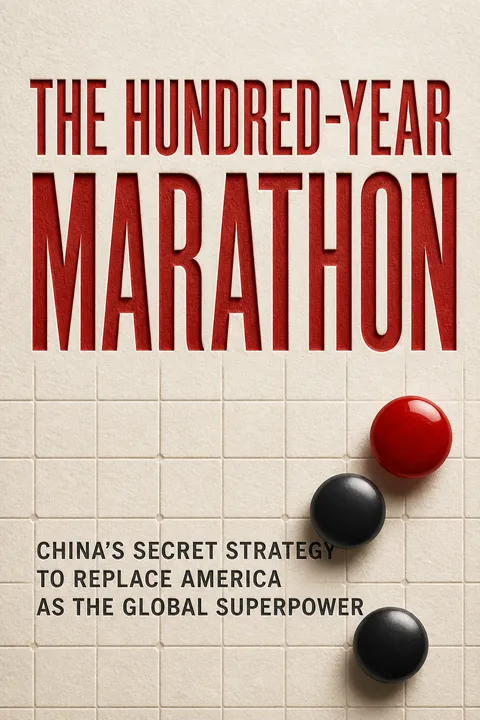


Key Takeaways
Judge China's rise as a long contest, not automatic convergence
The central warning. Michael Pillsbury argues that since the Communist Party took power in 1949, influential Chinese nationalists have sought to restore China to the top of the global hierarchy, with 2049 as a symbolic target. He calls this the Hundred-Year Marathon. He does not claim there is a single written master plan; rather, he sees a durable ambition pursued through changing tactics and concealed behind assurances of a peaceful rise.
A revealing opening scene. Pillsbury begins with artist Cai Guo-Qiang setting off explosives in a Christmas tree on Washington’s National Mall. Chinese nationalists, he says, celebrated the performance as a blow against Western symbols. His interpretation is deliberately unsettling, though the artwork alone cannot prove a coordinated state strategy. The story introduces the book’s main question: are Western observers mistaking cooperation and cultural exchange for shared political aims?
The book’s strongest provocation is not that every Chinese action conceals a master plan, but that rising powers can pursue interests that differ from those of their partners. That distinction matters in diplomacy, where cooperation on one issue is often mistaken for convergence overall. The opening artwork makes the argument memorable, but it also illustrates a risk: symbolic acts are ambiguous, and reading them as evidence of intent can become confirmation bias. The Marathon works best as a hypothesis to test against behavior, not as a key that explains every gesture.
Read strategic language in historical context, without treating culture as destiny
History as a toolkit. Pillsbury says Chinese military thinkers draw lessons from the Spring and Autumn and Warring States periods, eras of shifting alliances, deception, and competition for supremacy. One story warns a rising ruler not to ask how heavy the reigning emperor’s ceremonial cauldrons are, because doing so exposes his ambition too soon. The book uses such stories to explain why Chinese strategists may favor patience, concealed intentions, and exploiting a rival’s complacency.
Watch the situation’s momentum. A key term is shi: the evolving alignment of forces and circumstances that can create an opening for action. A strategist, in this account, tries to detect and shape that momentum rather than simply overpower an opponent. Pillsbury also emphasizes that translation matters: Zhou Enlai’s description of America as ba was rendered to Henry Kissinger as “leader,” though Pillsbury argues its historical meaning was closer to a coercive hegemon.
Historical analogies can sharpen attention to how leaders understand their choices. They are especially useful when a political phrase carries meanings that disappear in translation. Yet a tradition is not a national personality, and ancient texts do not dictate modern policy. The same history can support competing interpretations, while present-day institutions and incentives also shape decisions. Treating shi as a prompt to examine changing conditions is more useful than assuming that all Chinese actors share one timeless strategic code.
Track what an opening buys each side, not only what it promises
A tactical partnership. Pillsbury challenges the familiar story that Nixon alone initiated the opening to China. He recounts how Mao’s military advisers recommended approaching Washington as a counterweight to the Soviet Union after Sino-Soviet tensions grew dangerous. Nixon and Kissinger, seeking leverage against Moscow, then provided China with diplomatic support, intelligence, and, in later years, access to military and scientific expertise.
Benefits can outlast the alliance. Under Deng Xiaoping, U.S.-China ties expanded through student exchanges, technology cooperation, trade, and covert collaboration against Soviet influence in Afghanistan and elsewhere. Pillsbury describes this as wu wei, a strategy of achieving one’s aims by drawing on another party’s effort and resources. The relationship could be mutually useful at the time while still serving different long-term objectives. This history asks policymakers to assess the concrete benefits each side receives, not just the language of friendship.
This account highlights a familiar problem in alliance politics: partners can cooperate intensely against a shared threat while disagreeing about the order they want afterward. Such cooperation also creates path dependence. Once agencies, firms, and universities build relationships, the benefits become visible while long-term strategic costs are harder to measure. The argument is most persuasive when it identifies specific transfers or policy choices. It is less persuasive if every instance of reciprocal cooperation is treated as proof of a hidden design. Strategic benefit and strategic deception are not the same thing.
Do not mistake rapid growth for liberalization or economic convergence
A different kind of capitalism. Pillsbury argues that China’s growth did not mean the economy was becoming a Western-style free market. He points to state-owned enterprises, or SOEs, that remain under Party influence and receive financing or other advantages. The book describes large, strategically important firms as “national champions,” designed to serve state priorities as well as earn profits. It estimates that publicly controlled activity represented roughly 40 to 50 percent of China’s economy around 2014.
Engagement had unintended effects. Pillsbury recounts how international lenders, Western companies, and U.S. policy helped China gain technology, investment, expertise, and access to markets. He argues that China’s leaders used this assistance while keeping political control and important sectors in state hands. The lesson is not that trade never encourages political change, but that economic integration does not guarantee it. China’s growth, in this account, deserves analysis on its own terms rather than a presumption that it will produce democracy.
The distinction between market participation and market governance is crucial. A company can compete globally while depending on state direction, preferential finance, or political appointments. That challenges simple versions of the claim that trade automatically produces liberal institutions. At the same time, state involvement takes many forms, and its presence alone does not establish a unified plan to displace another power. The useful question is empirical: which sectors are directed, by whom, and toward what ends? The book’s figures are period-specific, so they should be treated as a snapshot, not a current measure.
Audit reassuring intelligence as rigorously as alarming intelligence
A warning that did not fit. After the 1989 Tiananmen crackdown, Pillsbury describes two sources with opposing accounts. Mr. White warned that hard-liners were gaining influence and that nationalist education would intensify. Ms. Green offered a more reassuring picture of leaders who supposedly favored cooperation and reform. U.S. officials favored her account, partly because it aligned with their existing expectations. Pillsbury later reports that she was prosecuted over her relationship with the FBI and had provided false information.
The cost of convenient conclusions. The book also recounts Chinese leaders treating the accidental 1999 bombing of their embassy in Belgrade as a deliberate American attack, a judgment reflected in Politburo minutes obtained by U.S. intelligence. Pillsbury argues that analysts had discounted warnings about intense anti-American suspicion. These episodes point to a basic discipline: test sources against independently verifiable facts, and do not confuse comforting access with reliable access.
The episode is a vivid case of confirmation bias: evidence that fits an established policy receives less scrutiny than evidence that challenges it. Intelligence analysis also faces a principal-agent problem, since informants have their own motives and handlers can become invested in a source. The corrective is not to prefer the darkest interpretation, but to make competing explanations explicit and specify what evidence would distinguish them. The book’s account is powerful as a warning about analytic process, while its reliance on disguised sources means readers cannot independently assess every claim.
Defend the systems that make military power usable
Exploit dependencies, not size. Pillsbury describes the Assassin’s Mace as a set of asymmetric capabilities intended to let a weaker force disrupt a stronger one at a critical point. Rather than build a U.S.-style global force, Chinese planners, in his account, studied vulnerabilities in satellites, communications, aircraft carriers, and digital networks. The aim would be to confuse command systems or disable key equipment before an opponent could use its conventional advantage.
A warning from simulations. Pillsbury recalls taking part in a Naval War College exercise in which a China team using unconventional tactics defeated a U.S. team. He says similar games produced comparable results when those methods were used. A war game is not a forecast, but it can expose assumptions: a fleet’s size matters less if it loses communications, targeting, or access to supplies. The book argues for building defenses around critical dependencies, not simply counting ships and aircraft.
The strategic insight extends beyond military planning: complex systems are often powerful because their parts work together, and therefore vulnerable when a few essential connections fail. Cybersecurity, logistics, and infrastructure planning face the same problem. Exercises can reveal brittle assumptions, but results depend on scenario design, participant choices, and what capabilities are allowed. A simulated defeat should prompt better questions, not be mistaken for a prediction of real war. Resilience, redundancy, and crisis communication can reduce the incentive to strike first.
Take Beijing’s fears seriously without accepting its explanations as facts
Threat perceptions shape choices. Pillsbury gathers Chinese military concerns into what he calls the Seven Fears. They include a possible blockade, interruption of energy shipments through the Strait of Malacca, attacks on aircraft carriers, and efforts to encourage unrest or territorial separation inside China. He argues that these fears help explain investment in submarines, missiles, cyber capabilities, and other tools designed to deny an opponent access.
Misreading can become dangerous. The book recalls China’s surprise intervention in the Korean War and later uses of force against India, the Soviet Union, and Vietnam to show how leaders may accept risks that outsiders consider irrational. Pillsbury warns that Chinese officials can interpret U.S. alliances and military deployments as encirclement, while Americans may interpret Chinese countermeasures as proof of expansionist intent. Each side’s defensive move can then confirm the other’s worst assumptions.
This is a security-dilemma problem: measures intended to improve one state’s safety can make another feel less secure, encouraging reciprocal escalation. Taking a rival’s fears seriously does not validate the history or conspiracy theories used to justify them. It makes those beliefs relevant to forecasting behavior. A sound policy therefore pairs deterrence with ways to clarify intentions and limit accidental escalation. The book’s warning is strongest when it distinguishes perception from reality; that distinction weakens whenever the two are treated as interchangeable.
Measure leverage at home before demanding change abroad
The proposed response. Pillsbury recommends that the United States stop treating China policy as a choice between complacent engagement and an alarmist new Cold War. His proposals include accounting for government assistance to China, measuring U.S. competitiveness, protecting sensitive technology, enforcing trade commitments, supporting dissidents, and coordinating with regional partners. The through-line is to understand what resources and relationships the United States is actually bringing to the contest.
Coalitions matter. The author urges groups that rarely cooperate, such as human-rights advocates, business leaders concerned about intellectual property, and defense analysts, to identify shared interests. He also argues that U.S. support for independent voices should be more consistent, rather than abandoned whenever it becomes diplomatically inconvenient. These are prescriptions, not guarantees. Their effectiveness depends on careful targeting, sustained public support, and avoiding steps that strengthen the very siege mentality they are meant to counter.
The emphasis on measurement and domestic capacity is more durable than a strategy built around predicting a single rival’s intentions. Competitiveness depends on education, research, infrastructure, and institutional trust, not just military budgets. Likewise, a coalition is useful only when its members agree on practical goals, not merely on whom they oppose. Some proposed pressure could close channels or validate hostile narratives, so each measure needs a plausible theory of how it changes incentives. The strongest version of the argument is selective firmness backed by credible capabilities.
Judge global power by the rules and costs a country exports
Influence travels through more than armies. In projecting a China-led world around 2049, Pillsbury worries about the spread of censorship, support for authoritarian governments, state-backed economic models, and weaker international rules. He also connects rapid growth to environmental costs. The book describes polluted rivers, coal dependence, and communities near industrial plants suffering severe health consequences. Its point is that economic dominance could shape other countries’ choices, not merely alter trade balances.
A forecast, not a certainty. Pillsbury argues that loans, telecommunications systems, business ties, and international organizations can all carry political assumptions along with economic benefits. A richer China, he warns, might make its preferred practices easier for other governments to adopt. But the predicted 2049 order depends on political choices, domestic change, and responses from other countries. The reader should treat the scenario as a set of risks to examine, not an inevitable destination.
This broader lens improves on measuring power only through GDP or military hardware. Standards, finance, digital infrastructure, and environmental spillovers can also create dependence and influence. It connects geopolitics to public health and institutional design, where costs often fall on people with little voice in the decisions. Yet the export of a model is rarely automatic: recipient governments adapt it, and economic growth can create pressure for reform as well as strengthen control. The useful task is to track concrete mechanisms of influence instead of treating a future order as predetermined.
Analysis
The book is part strategic history, part intelligence memoir, and part policy argument. Its organizing narrative is a reversal: Pillsbury presents himself as a longtime advocate of engagement who came to believe that the policy rested on mistaken assumptions about Chinese intentions, political evolution, and the influence of nationalist hard-liners. The personal account gives the argument force. The author was not an outside critic of engagement, but someone who helped advance it and describes watching warnings fail to alter policy.
The strongest contribution is a method of attention. Read political language in context, examine who benefits from cooperation, test sources rather than rewarding access, and study the other side’s own threat perceptions. These are valuable habits even if the book’s most ambitious claim is disputed. Pillsbury assembles historical allusions, military publications, defections, policy decisions, and episodes of Chinese behavior into a long strategic arc. Yet evidence that some officials favor revisionist aims does not establish that the state has a coherent, shared, century-long plan. The distinction between a faction’s ideas, official doctrine, and implemented policy requires more evidence than the narrative can always supply.
The book also risks turning strategic culture into a national essence. Warring States stories can illuminate how certain leaders reason, but they cannot stand in for the preferences of a diverse society or the interests of competing institutions. Likewise, economic assistance can build a partner’s capacity without proving that the partner intended to use it against the donor. This is a classic problem of inference from outcomes to motives.
The most useful reading is therefore neither credulous nor dismissive. Treat the Marathon as a strategic hypothesis, not a settled fact. Its enduring value lies in showing how policy can be distorted by wishful thinking, organizational incentives, poor language access, and failure to imagine that cooperation may serve different ends on each side. Readers gain most by carrying those analytic cautions forward while scrutinizing the book’s own claims with the same rigor it asks of U.S. officials.
Review Summary
The Hundred-Year Marathon is a controversial book that argues China has a secret strategy to replace the US as global superpower by 2049. Reviews are mixed, with some praising Pillsbury's insights and others criticizing it as alarmist propaganda. Supporters find it eye-opening about China's true intentions, while critics question its factual accuracy and hawkish stance. Many reviewers, regardless of their overall opinion, find the book thought-provoking about US-China relations and China's growing global influence.
People Also Read

Glossary
Hundred-Year Marathon
Long-term competition for primacyPillsbury’s name for the alleged decades-long Chinese effort to restore China to global preeminence, with 2049, the centenary of Communist rule, as a symbolic horizon. He describes it as a recurring strategic ambition rather than a single documented master plan, pursued through economic development, diplomacy, technology acquisition, and military preparation.
ying pai
Nationalist hard-linersA Chinese term meaning hawks or eagles, used in the book for nationalist military officers, officials, and commentators who favor a more competitive view of the United States and a stronger global role for China. Pillsbury argues that these voices have more influence than many Western analysts assume, though the extent of their influence is contested.
shi
Strategic momentum and opportunityA Chinese strategic concept Pillsbury describes as the alignment or unfolding tendency of circumstances. A strategist seeks to recognize how conditions are moving, shape them where possible, and act when they favor a desired outcome. The concept emphasizes positioning and timing, rather than relying only on direct force or fixed plans.
wu wei
Achieving aims through othersA Taoist term often rendered as action without forcing. In Pillsbury’s strategic discussion, it describes gaining results by drawing on another party’s effort, resources, or influence. He applies it to the possibility that China could use cooperation with the United States to advance its own development without sharing all of Washington’s long-term objectives.
Assassin’s Mace
Asymmetric capability against weaknessPillsbury’s label for a collection of capabilities intended to let a militarily weaker opponent disrupt a stronger one by targeting critical vulnerabilities. The examples discussed include systems aimed at satellites, communications, aircraft carriers, and digital networks. The term refers to an integrated approach, not necessarily one particular weapon.
national champions
State-backed strategic companiesLarge Chinese firms, often state-owned or state-controlled, that Pillsbury says receive political direction, financing, or other advantages to advance national economic and strategic priorities. Their role, in his account, differs from a model in which firms answer mainly to private owners and market incentives. The term applies especially to industries considered important to national power.
Seven Fears
Chinese military threat perceptionsPillsbury’s grouping of perceived U.S. threats found in Chinese military writings. These include fears of blockade, disrupted sea routes and energy supplies, attacks on carriers, invasion, territorial fragmentation, and support for internal unrest. The framework describes perceptions that may influence Chinese policy, not proof that the United States intends to carry out those actions.
FAQ
What is The Hundred-Year Marathon by Michael Pillsbury about?
- China’s secret strategy: The book reveals China’s covert, long-term plan to replace the United States as the global superpower by 2049, the centennial of the Communist Party’s founding.
- Historical and cultural context: Pillsbury explains how ancient Chinese stratagems, especially from the Warring States period, shape China’s modern military, economic, and diplomatic strategies.
- U.S. policy critique: The author argues that decades of American engagement and wishful thinking have underestimated China’s ambitions and inadvertently aided its rise.
Why should I read The Hundred-Year Marathon by Michael Pillsbury?
- Insider’s perspective: Pillsbury draws on decades of experience and access to Chinese military and political elites, offering a rare look into China’s strategic culture.
- Challenges assumptions: The book counters the common belief that China’s rise is peaceful or inevitable, revealing a deliberate, state-driven strategy to surpass the U.S.
- Actionable insights: Pillsbury provides concrete steps and recommendations for U.S. policymakers, scholars, and the public to better understand and respond to China’s challenge.
What are the key takeaways from The Hundred-Year Marathon by Michael Pillsbury?
- China’s patient strategy: China is executing a secret, multi-generational plan to surpass the U.S. by 2049, using deception, strategic patience, and ancient stratagems.
- U.S. misperceptions: American policymakers have repeatedly misunderstood China’s intentions, assuming engagement would lead to cooperation and democracy.
- Asymmetric competition: China invests in “Assassin’s Mace” weapons, propaganda, and economic mercantilism to neutralize U.S. advantages and shape global perceptions.
What is the “Hundred-Year Marathon” concept in The Hundred-Year Marathon by Michael Pillsbury?
- Definition: The “Hundred-Year Marathon” is China’s covert, multi-generational strategy to replace the U.S. as the world’s dominant superpower by 2049.
- Strategic patience: The plan involves decades of economic growth, military modernization, and deception to lull the U.S. into complacency.
- Cultural roots: The strategy is deeply rooted in Chinese historical stratagems, emphasizing concealment, manipulation, and long-term planning.
What are the nine core elements of China’s “Hundred-Year Marathon” strategy according to Michael Pillsbury?
- Inducing complacency: China seeks to lull the U.S. and other rivals into underestimating its ambitions and capabilities.
- Manipulating advisers: Chinese leaders use deception to influence foreign policymakers and shape their perceptions.
- Patience and timing: The strategy emphasizes waiting for the right moment to act, avoiding premature confrontation, and building strength quietly.
- Technology acquisition: Systematic theft and acquisition of technology are central to accelerating China’s rise.
- Non-military focus: Military might is not the sole focus; economic, technological, and informational advantages are prioritized.
How does Michael Pillsbury describe the role of ancient Chinese stratagems in China’s modern strategy?
- Warring States influence: China’s leaders study the Warring States period for lessons in rivalry, deception, and strategic patience.
- Concept of shi: The idea of shi, or the alignment of forces, guides China’s approach to building and exploiting strategic advantage.
- Wei qi analogy: Pillsbury likens China’s strategy to the game of wei qi (Go), where victory comes through encirclement and deception rather than direct confrontation.
What is the significance of the concept of “shi” in Chinese strategic thinking as explained in The Hundred-Year Marathon?
- Strategic configuration: Shi refers to the potential advantage or momentum that can be exploited in a given situation.
- Guides timing and tactics: Understanding shi allows China to build advantages patiently and act at the optimal moment.
- Contrast with Western views: Pillsbury argues that Western policymakers often misunderstand shi, missing the long-term, indirect nature of China’s strategy.
What is the “Assassin’s Mace” (shashoujian) in The Hundred-Year Marathon and why is it important?
- Definition: The “Assassin’s Mace” refers to secret, asymmetric weapons or tactics that allow a weaker power to defeat a stronger adversary.
- Modern application: China is developing antisatellite missiles, cyber warfare capabilities, and other technologies to neutralize U.S. advantages.
- Strategic impact: These weapons are designed to deter or defeat U.S. forces, especially in scenarios like Taiwan, by exploiting American vulnerabilities.
How does Michael Pillsbury explain U.S. policy mistakes toward China in The Hundred-Year Marathon?
- False assumptions: Pillsbury identifies five major false assumptions, including the belief that engagement would lead to cooperation and democracy.
- Ignoring hawkish voices: U.S. policymakers underestimated China’s nationalist hawks and their long-term ambitions.
- Aid and technology transfer: The U.S. inadvertently accelerated China’s rise by providing military technology, intelligence, and economic support.
How does The Hundred-Year Marathon by Michael Pillsbury describe China’s economic strategy and the role of state-owned enterprises (SOEs)?
- Mercantilist approach: China maintains state control over key industries through SOEs, which are heavily subsidized and used to dominate global markets.
- Hybrid model: Chinese SOEs combine state control with market mechanisms, including partial privatization and stock listings, but remain under Party oversight.
- Competitive edge: SOEs serve as national champions, advancing state interests and benefiting from government support, despite inefficiencies and corruption.
How does The Hundred-Year Marathon by Michael Pillsbury explain China’s approach to intellectual property and technology acquisition?
- Systematic theft: China engages in large-scale intellectual property theft, including cyber espionage and forced technology transfers.
- Economic espionage: Pillsbury cites U.S. government reports labeling China as the world’s most active perpetrator of economic espionage.
- Impact on the U.S.: This theft costs the U.S. economy billions annually and threatens American innovation and competitiveness.
What are the best quotes from The Hundred-Year Marathon by Michael Pillsbury and what do they mean?
- “The guest becomes the owner.” — Reflects China’s strategy of quietly entering and eventually taking control, symbolizing its long-term approach to supplanting the U.S.
- “Steal the firewood from under the cauldron.” — Advises undermining an opponent’s power base covertly, relating to China’s economic and strategic tactics.
- “Development is of overriding importance.” — Xi Jinping’s quote signals China’s prioritization of economic growth as the foundation for its global ambitions.
- “Better to see once than to hear a hundred times.” — Emphasizes the importance of recognizing China’s warning signs early rather than dismissing them.
Download PDF
Download EPUB
.epub digital book format is ideal for reading ebooks on phones, tablets, and e-readers.








