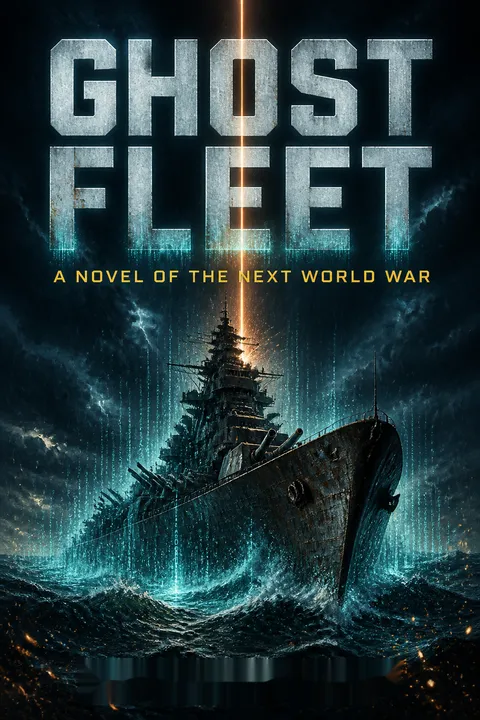


Plot Summary
Prologue
Outside the International Space Station, Colonel Rick Farmer finishes a routine repair and finds that neither the hatch nor its emergency override will open. His radio returns just long enough for Russian cosmonaut Vitaly Simakov to explain that orders forbid him from letting Farmer back inside.
Tethered above Earth with his oxygen running down, Farmer understands that the silence around him is not a technical failure. He turns toward the planet, hoping to see the distant coast where his family is vacationing.
The prologue makes technological dependence terrifyingly intimate: a door, a radio, and a colleague's obedience become more consequential than any weapon. Farmer's expertise cannot solve a crisis whose cause is political rather than mechanical. His final attention turns from professional calculation to family, establishing the book's recurring tension between systems built to preserve life and loyalties that can be redirected against it.
A Fortune in the Mariana
Deep beneath the Mariana Trench, Chinese geologist Zhu Jin finds a vast natural-gas deposit after days of searching in a cramped submersible. His wife, Liu Fang, has helped guide the expedition from the surface, while military officer Lo Wei watches for results.
A U.S. Navy P-8 aircraft spots the research vessel celebrating and makes a deliberately intimidating pass, reminding the Chinese crew that American forces watch the waters near Guam.
Zhu's discovery is more than a scientific triumph: it promises China a new source of energy at a moment when fuel scarcity and economic upheaval have made resource security a national obsession. Lo carries the result back to the leadership, where the find becomes a strategic fact with consequences far beyond the trench.
The discovery turns geology into political leverage. Zhu's achievement is produced by civilian expertise, military oversight, and borrowed technologies, a convergence that foreshadows the blurred boundaries of the coming conflict. The deposit matters not only because it may supply energy, but because its existence changes how Chinese leaders understand their options. The resource becomes a story the state can tell about necessity, destiny, and power, even though the actual find is still remote and difficult to exploit.
Wang's Pacific Gamble
Vice Admiral Wang Xiaoqian presents the Mariana discovery to the Directorate's military and business leaders as proof that China must expand its reach rather than accept American interference. He compares the country's growing power and narrowing choices with earlier empires, arguing that control of energy and sea routes now demands action.
Business leader Chen Shi warns that war could destroy the prosperity the Directorate has rebuilt, while younger industrialist Muyi Ling challenges Wang's confidence. The meeting leaves him uncertain whether the Presidium has chosen his proposal or merely tested him.
His argument nevertheless shapes the leadership's next moves. At the same time, American officers debate whether trade and debt make China a partner or simply conceal a rising threat, while Russian general Sergei Sechin privately tries to alert his American contact to the danger.
Wang's reasoning is powerful because it converts ambition into obligation. By casting expansion as something history requires, he reduces political choice and makes restraint appear like negligence. The business leaders' objections expose a competing logic: prosperity depends on stability, not merely on access to resources. Sechin's warning introduces a third position, neither trust in commerce nor confidence in military inevitability. The disagreement matters because the coming war is not caused by ignorance alone; people recognize risks, then interpret them through incompatible ideas of security.
The Rusting Insurance Fleet
In the weakened U.S. Navy, retired chief Mike Simmons patrols the reserve ships in Suisun Bay with young sailor Gabriel Torres, insisting that the vessels dismissed as scrap may be the fleet's last insurance. His son, Commander Jamie Simmons, serves as executive officer aboard the USS Coronado.
Captain Tom Riley wants Jamie to take command, but Jamie has requested a Pentagon job because his wife, Lindsey, and their twins are growing up without him. He has spent years trying not to repeat his own father's absence, and the decision threatens both his career and his closest professional relationships.
Meanwhile, his briefing on China's growing naval reach meets Riley's confidence that shared trade will prevent war. The fleet's arguments about readiness and family are still theoretical, but the ships are already sailing toward danger.
The book's military vulnerability begins as an institutional and domestic compromise. The Navy has fewer ships, aging programs, and a culture that treats family separation as the price of advancement. Jamie's choice is not simply between ambition and comfort: command asks him to inherit the very pattern of absence he resents in Mike. The Ghost Fleet offers a material image of the same dilemma. Old ships are imperfect, yet their neglected capacity may matter more than the polished systems the institution once preferred.
The Network Goes Blind
A malware packet concealed in a refugee's video crosses the supposedly isolated systems of the U.S. Defense Intelligence Agency through a landscaper's tablet and an analyst's security badge. At Shanghai Jiao Tong University, teenage hacker Hu Fang guides the intrusion through American networks and alters GPS signals, injecting errors instead of simply shutting the system down.
Above Earth, Chinese taikonaut Chang Lu removes a jammed hatch from the Tiangong-3 station's hidden weapons module. Colonel Huan Zhou then uses its chemical laser to disable dozens of American communications, surveillance, and navigation satellites.
The attacks exploit the United States' reliance on interconnected software and a small number of space assets. The country is not yet fully at war, but its military is losing the systems it would need to recognize and coordinate a response.
The attack succeeds through ordinary access and distributed complexity, not a single cinematic breach. A refugee's family video and a sailor's security badge become links in a chain that defeats defenses designed around clear boundaries. Hu and Chang represent different forms of technical labor, one manipulating information and the other physically operating a weapon in orbit. Their actions expose a central vulnerability: advanced systems concentrate capability while making their origins and dependencies difficult to inspect. The opening blow is therefore also an audit of choices made long before combat.
War Arrives Through Honolulu
Russian MiG-35s approach Japan from an unexpected direction and strike Kadena Air Base and Marine installations on Okinawa, using electronic confusion and delayed authorization to overwhelm the defenders. At Pearl Harbor, the Chinese invasion unfolds through commercial ships already inside the harbor.
Vehicles and tanks roll off cargo vessels, while small drones disrupt communications and attack American positions. A second assault reaches Honolulu by air. In the Panama Canal, a Chinese freighter smashes into the locks, obstructing the route between oceans.
Across these theaters, civilian infrastructure and military hardware are deliberately mixed, leaving defenders unsure which ordinary arrivals conceal an attack. The blows arrive before the United States can restore its satellite picture or coordinate a coherent response, turning regional tensions into a world war in a matter of hours.
The invasion weaponizes familiarity. Cargo manifests, commercial aviation, and routine shipping conceal forces until they are already inside vulnerable spaces. The attack's coordination makes the distinction between civilian and military infrastructure unusable as a guide to safety. It also reveals the strategic cost of assuming that geographic distance will provide warning: Honolulu's harbor and Japan's bases are penetrated from directions their defenses were not designed to prioritize. The war begins as a failure of interpretation as much as a failure of firepower.
Coronado Breaks Pearl
At Pearl Harbor, Jamie's sonar team detects a diver trying to attach a mine to the Coronado. Jamie sends an unmanned underwater vehicle against him, and the diver's Chinese equipment confirms that the threat is military, not local.
Before the ship can understand the wider attack, missiles strike the harbor and cripple the aircraft carrier USS Abraham Lincoln. Communications collapse. Captain Riley resists Jamie's demand to warn higher command, then dies when enemy fire tears through the bridge. Jamie takes command while sailors cut the ship loose from its pier under fire.
The Coronado escapes the harbor at dangerous speed, carrying casualties and a shaken crew into open water. The attack transforms Jamie's unwanted command responsibility into an immediate burden: he must lead without reliable communications, full crew strength, or a clear picture of the war.
Jamie becomes a commander through catastrophe rather than a planned career transition. The decisions that matter are concrete and compromised: identifying the diver, deciding whether to raise the alarm, and cutting the ship free while the harbor burns. His training makes him capable of action, but it cannot give him certainty or restore the people lost around him. The Coronado's escape also reverses the ship's status. A lightly built vessel meant for patrol survives because its crew adapts faster than the larger systems around it.
The Blue Reactor Trail
As American submarines disappear despite the fleet's confidence in their stealth, intelligence officers search for an explanation. Commander Jimmie Links remembers a cryptic conversation with Russian general Sergei Sechin at a Beijing party, where Sechin emphasized the importance of scientist Pavel Cherenkov.
Navy pilot Bill Darling connects the clue to Cherenkov radiation, the faint emission from nuclear reactors. The Directorate has apparently learned to detect that signature from space, making American nuclear submarines and carriers trackable.
The discovery explains why attacks reached forces that should have been hidden, and it points to the technology that must be disrupted. Sechin has risked passing information to the Americans, but his warning is not enough to undo the damage already done. The U.S. military must now fight while knowing that its most valued concealment has failed.
The revelation changes the meaning of stealth. The American advantage was not defeated by a better submarine hunter at sea, but by a scientific insight that made nuclear power itself legible from orbit. Sechin's indirect warning shows how intelligence can depend on context: his reference seemed like drunken trivia until Darling found the missing technical connection. Yet discovery does not equal control. The Americans gain an explanation only after the enemy has already used the capability, and the insight becomes valuable chiefly as a guide to the next gamble.
A Killer in Waikiki
Under Directorate occupation in Honolulu, Carrie Shin works at the Moana Surfrider and hides a grief she can neither explain nor master. At Duke's Bar, she draws young marine Xiao Zheng away from his squad and kills him with a sharpened piece of her sunglasses.
Later she lures Lieutenant Feng Wu, the economics minister's son, into dangerous surf, where his board leash tightens around his neck. Russian adviser Vladimir Markov investigates the killings and notices that they involve close contact rather than the explosives or gunfire typical of insurgent attacks.
Carrie's repeated self-harm and her effort to preserve traces of her dead fiancé complicate what the occupation's officials think they are hunting. Markov sees a pattern forming but does not yet know its source. The island's apparent normality now contains a hidden, intimate threat.
Carrie's violence grows from a collapse of ordinary boundaries between mourning, bodily control, and revenge. Her victims mistake intimacy for safety, while she uses the routines of hospitality and courtship to move close enough to act. Markov's investigative attention offers a counterpoint to the Directorate's preference for broad surveillance and collective punishment: he looks at manner, proximity, and motive. The contrast matters because the occupation can measure bodies and movement but cannot easily interpret a private wound that has become a method.
The Schoolyard Ambush
Major Carolyne Doyle, known as Conan, leads the North Shore Mujahideen through a hidden life of stolen supplies, improvised bombs, and attacks on Directorate patrols. During a raid near Iliahi Elementary School, the insurgents encounter armed marines and a community liaison among the children and teachers.
The firefight kills Charlie, a civilian recruit, and leaves the school exposed to a rapid Directorate response. Conan and Finn hide rather than rush back into the danger, while helicopters bring commandos into the grounds. The choice preserves the remaining fighters but costs lives and breaks trust within the group.
General Yu uses the attack to justify harsher control, while Russian adviser Markov sees that military force is deepening the population's hostility. Conan's small force now has to survive not just occupation but the damage done by its own desperate choices.
The school becomes a moral trap because both sides treat the population as terrain. The insurgents use a familiar civilian space for concealment; the Directorate answers with force that makes children part of the battlefield. Conan's decision to hold back is tactically defensible and emotionally costly, which prevents leadership from being mistaken for simple courage. The resulting fracture within her unit anticipates the larger question of resistance: survival may require choices that undermine the solidarity the resistance depends on.
The Ghost Fleet Rebuilds
After surviving Pearl Harbor, Jamie returns to San Francisco and discovers that his estranged father, Mike, has been helping Lindsey care for the twins. Their reunion is tense, sharpened by old anger over Jamie's sister Mackenzie's death and Mike's long absence.
The Navy assigns Jamie to rebuild the retired USS Zumwalt, while Mike joins its Mentor Crew of veteran sailors. Dr. Vernalise Li brings expertise in liquid-based batteries needed to power the ship's experimental rail gun.
Mike protects her from sailors who question her loyalty, and she learns to combine her advanced science with the practical knowledge of the old crew. Jamie, still pulled between family and duty, has to make a home from the same neglected ship that the Navy once discarded.
Repair becomes a form of relationship, but not a substitute for apology. Mike and Jamie work within the same institution while carrying incompatible memories of what family obligation required. Vern's position adds another kind of repair: technical expertise is useless unless the crew accepts the person who possesses it. The Zumwalt's refit therefore depends on trust as much as engineering. Its survival will require the old and new Navy to treat one another as collaborators rather than rival claims to authority.
Silicon Valley's Counterstroke
Investor Daniel Aboye tries to offer his expertise to the Pentagon but is turned away by its bureaucracy. He gathers leading programmers at Hangar One to build a way into Directorate networks, but their first attempt is defeated by automated defenses.
Cory Silkins then reveals that a loosely organized hacker community may help, provided Aboye stops treating the effort as a conventional patriotic project. Elsewhere, Wal-Mart shareholders reject management's resistance to wartime production and authorize the company to support national supply needs. Its warehouses become sites for 3-D printing replacement parts, including components needed by the Zumwalt.
When Hu Fang prepares a destructive attack on American power generators, the anonymous hackers overwhelm her virtual workspace with hostile masks, stopping her operation and leaving her incapacitated. The counterattack depends on outsiders and decentralized production, not the institutions that failed to prepare.
The American response succeeds by changing who is allowed to contribute. Aboye's credentials cannot unlock the Pentagon, but his ability to convene people outside it creates another path. Silkins insists that a network's defenders may need adversaries of their own, people skilled at breaking systems rather than merely administering them. Wal-Mart's manufacturing pivot makes logistics a form of resistance. Together, these actions challenge the idea that wartime competence belongs exclusively to the state or its contractors.
Cavendish Claims the Heavens
Billionaire Aeric Cavendish persuades the U.S. government to grant him a letter of marque in exchange for attacking the Chinese space station that dominates surveillance over the Pacific. He buys a space plane, coats it in a reflective diamond composite, and trains a small special-operations team for a boarding assault.
As the American fleets prepare to move, Cavendish's Tallyho enters Tiangong's exclusion zone while playing a deliberately baffling rock song. The station's laser cannot penetrate the reflective coating. Cavendish's team attaches thrusters that threaten to alter the station's orbit and force its crew to surrender.
Colonel Huan Zhou resists, and the resulting struggle kills members of both sides. Chang Lu finally opens the station to the boarders to prevent the remaining crew from being trapped in a fatal orbit. Cavendish takes control, removing the Directorate's most important eye in space.
Cavendish's operation is an audacious extension of privatization into war. The legal instrument meant to authorize violence also gives a wealthy individual power that the government cannot easily reclaim. His diamond coating and theatrical music turn eccentricity into tactical misdirection, but the boarding still produces intimate, physical violence. Chang's decision to open the station is not a simple surrender: it is a choice made under coercion to preserve life. The outcome damages the Directorate's surveillance while making ownership of the victory immediately contested.
The Black Widow's Bargain
Markov uses surveillance patterns and forensic traces to identify Carrie as the killer behind a string of attacks on Directorate personnel. General Yu ignores Markov's advice about counterinsurgency and orders a missile strike on a church where Carrie is believed to be hiding.
The attack leaves a finger identified as hers among the dead, and Markov is dismissed and sent toward Russia. Carrie survives. She later finds him, demands the hairbrush containing traces of her fiancé, and persuades him to take her through the security checkpoints at Directorate headquarters.
Markov presents her as a captive to General Yu, but Carrie turns the meeting into an attack, using her wig and chair to pull the general down. The outcome is left unsettled. Markov has brought his enemy into the center of power, yet his curiosity and his opposition to Yu have made him part of her plan.
Markov and Carrie approach violence from opposite directions: he wants to understand it, while she turns understanding into a means of access. Yu's church strike shows how a commander can mistake destruction for control, producing both civilian harm and a false sense of closure. Carrie's survival frustrates the state's forensic certainty, while her use of Markov exploits his professional empathy. Their encounter resists a neat division between hunter and hunted; both are studying the other, but only one has chosen the terms of the meeting.
Allies Move Through the North
The United States recognizes Kalaallit Nunaat, formerly Greenland, as an independent country in return for the escort of its Arctic passage by Greenlandic icebreakers. Poland also provides the Americans a diesel submarine, the Orzel, in exchange for nuclear weapons, giving the coalition a vessel the Directorate cannot track through reactor emissions.
Sechin has passed American intelligence information about the Cherenkov detection system and northern defenses before the Directorate captures and interrogates him. Meanwhile, Conan and her remaining insurgents disable the surveillance aerostat on Mount Ka'ala, then meet a SEAL advance team led by Duncan.
The SEALs use a small robotic lobster to map Directorate bases and establish a covert link to the fleet. These separate arrangements create a route back toward Hawaii that the Directorate's once-dominant surveillance cannot fully anticipate.
The coalition's advantage comes from assembling mismatched assets rather than restoring the prewar order. Icebreakers, an old diesel submarine, local insurgents, and a robot designed for covert reconnaissance each solve a different problem. The deals are transactional and politically awkward, yet their utility comes precisely from not fitting the enemy's model of American power. Conan's knowledge of the island supplies what distant sensors cannot: an understanding of where people and forces actually move.
The North Shore Landing
The rebuilt Zumwalt leads a force approaching Oahu under radio silence, using autonomous surface hunters to guard against submarines. Conan helps the SEALs pass target locations through a robot attached to a Directorate communications tower, allowing the fleet to coordinate without exposing its position.
From far offshore, the rail gun destroys radar sites, missile launchers, and the quick-reaction force assembled at Turtle Bay Resort. Marine Ospreys land along the North Shore, but enemy drones and missiles still bring down aircraft and kill troops.
General Gaylen Adams gathers surviving Marines and civilians near Haleiwa, where a rail-gun strike demolishes the armored column advancing against them. The landing opens a foothold on the island, not a clean victory. American troops must still fight through an occupied landscape while the Zumwalt's power system strains under each shot.
The landing is a collaboration between high-energy weapons and local knowledge. The rail gun can strike targets from beyond ordinary naval range, but it depends on people who can identify where the targets are and preserve a communications path. The civilian presence at Haleiwa also complicates the clean geometry of remote warfare: every strike has a human setting that cannot be reduced to a map icon. The foothold matters because it makes liberation possible, but its cost is already visible in the damaged aircraft and scattered units.
The Fleets Find Each Other
With space surveillance gone, Admiral Wang must decide where the American fleets will strike. He sends his joint Chinese and Russian surface force south toward Hawaii, betting that he can destroy the Zumwalt's task force before the northern fleet arrives.
The American side counters with retired F-15s, refitted from storage, and autonomous Shrike drones whose older, simpler electronics are harder to compromise. The air battle costs pilots and machines, but the Shrikes destroy two enemy carriers and cripple a third. Wang's ships then launch a heavy missile attack.
American defenses intercept many missiles, yet the USS America and USS New York are devastated, and the Zumwalt is hit. Admiral Murray is lost, leaving Jamie as task force commander. He refuses to abandon the burning America or the Marines ashore, and orders his damaged ship to hold the line.
Wang's gamble reflects the same strategic faith that drove the war: superior information should make the enemy's remaining choices predictable. Once satellites and communications vanish, he has to command through inference, while Jamie inherits authority in the middle of a crisis. The retired aircraft and autonomous drones show that technological sophistication is not a single ladder; older systems can regain value when newer ones become liabilities. The losses make the American advance less a triumphant reversal than a costly decision to remain engaged.
The Zheng He Breaks
The Zumwalt's rail gun is crippled by missile damage, and water is rising below decks. Mike and Vern repair its power coupling, then remain in the turret to keep it seated through the firing sequence. Jamie faces a choice between protecting them and using the weapon before Wang's flagship, the Admiral Zheng He, reaches gun range.
He orders the rail gun fired. The projectile tears through the Chinese flagship and breaks it apart before Wang can authorize his own guns. The Zumwalt continues firing, though the ship is badly damaged and the American task force has suffered enormous losses.
Mike and Vern survive the immediate fight, but the cost to sailors and Marines remains severe. The battle ends Wang's attempt to destroy the fleet and gives the landing force room to continue its fight on Oahu.
Jamie does not solve his conflict with Mike through confession alone; he must trust his father with a task that may kill them both. Mike's practical knowledge and Vern's engineering become inseparable from the captain's command decision. The rail gun's power is therefore both weapon and relationship: it functions because people accept mutual dependence under conditions of extreme risk. Wang's flagship falls, but the victory is not clean enough to make technological dominance seem innocent or complete.
Epilogue
The fighting ends in a bruised return to the prewar borders after the United States retakes Guam and both sides exchange prisoners. Cavendish still occupies Tiangong, resisting a Senate effort to reclaim it. Markov, now a junior Moscow detective, receives a Pushkin volume sent by Carrie, confirming that she survived and remains beyond his reach.
In San Diego, Conan freezes as an autonomous drone approaches children at play; her son Liam takes her hand and asks her to join them. A year later, Jamie sails with Lindsey, Claire, Martin, and Mike near the rebuilt Zumwalt. His family is no longer a distant image watched through a screen, and his father's place beside him has become ordinary enough to matter.
The epilogue refuses to equate military victory with psychological repair. The treaty restores borders, not bodies or memories: Conan still has to struggle to reenter ordinary life, and Cavendish's possession of the station shows how unsettled power remains. Carrie survives by remaining elusive, while Markov's gift reconnects him to the investigator and romantic he has not entirely surrendered. Jamie's family scene offers a smaller resolution than the naval battle, but a more durable one. He is present, his father is beside him, and the next generation can experience the ship as part of family history rather than as an absence.
Analysis
Ghost Fleet treats technological advantage as a temporary arrangement, not a permanent property of any nation. The Directorate wins early because it has connected its military, business, and technical systems more effectively, while the United States has trusted in expensive platforms whose components and signals it cannot fully inspect. Yet the same concentration of complexity becomes brittle. Satellite networks can be blinded, imported chips can betray their users, and centralized command can lose authority when communications fail. The American recovery does not simply restore the old hierarchy. It draws strength from what the prewar system undervalued: reserve ships, practical maintenance, small firms, citizen hackers, local resistance, and allies whose equipment seems obsolete until circumstances change.
The book also makes military decisions intimate. Jamie's command problem is inseparable from the family pattern he fears repeating. Mike's expertise is useful precisely because it grew from physical work the Navy once treated as old-fashioned. Vern's science matters only when the crew accepts her as a colleague. Conan's tactical choices are haunted by civilians and comrades she cannot protect. These relationships prevent the war from becoming a demonstration of hardware alone. Each system works through human consent, competence, and sacrifice, and each failure exposes who has been asked to bear the cost. Wang and Markov provide competing readings of power. Wang sees expansion as the unavoidable consequence of national strength; Markov sees occupation as a political relationship that cannot be repaired by killing more opponents. Both understand history, but Wang uses history to close off alternatives, while Markov uses it to ask what force cannot accomplish. The result is not a simple victory for restraint. The United States retakes ground through devastating violence, and the peace restores borders without restoring the people or institutions the war damaged. The novel's final image of a family sailing beside a repaired warship offers a modest answer: survival matters most when the living can return to one another.
Review Summary
Ghost Fleet receives mixed reviews, with criticism of underdeveloped characters and implausible plot elements. Some praise its exploration of future warfare technology and find it an exciting techno-thriller, while others find it poorly written and unrealistic. The book is noted for its detailed military technology descriptions and potential geopolitical scenarios. Readers appreciate its examination of technological vulnerabilities but criticize its lack of character depth and geopolitical context. Overall, opinions are divided on its effectiveness as both a novel and a strategic thought piece.
People Also Read



Characters
Jamie Simmons
Reluctant sea commanderJamie is a capable Navy officer whose instincts are shaped by command, history, and an uneasy relationship with his father, Mike. His wife Lindsey and their twins matter to him not as abstractions but as people whose lives keep advancing while he is at sea. He worries that military ambition will repeat the abandonment he experienced as a child, yet he also feels responsible for sailors who depend on him. His character is defined by the pressure to make decisions before certainty arrives. He wants to be a better father than Mike was, but the war forces him to discover whether that aim can coexist with the demands of leadership.
Mike Simmons
Old-school Navy chiefMike is a retired chief petty officer whose knowledge lives in his hands: knots, hulls, welding, and the improvisations that keep ships operating. His charm and authority once helped him succeed in the Navy, but he was far less reliable at home, a failure that continues to shape his relationship with Jamie. He mistrusts technology when it replaces practical understanding, though he respects new expertise when he sees it used well. His bluntness can protect a crew or wound it. Mike measures care through work, and the war gives him a chance to serve again without erasing the family history he must still face.
Vernalise Li
Battery systems expertVernalise, usually called Vern, is a University of Wisconsin professor whose research in fluid-based energy storage makes her valuable to the rebuilt fleet. She is intellectually confident but not immune to exhaustion, fear, or the social burden of being treated as suspect because of her Chinese heritage. Her engineering is practical as well as theoretical: she understands that a system must work under heat, vibration, and human error, not merely in a laboratory. Vern resists being reduced to the ship's indispensable specialist, even as her work makes her central to its survival. Her collaboration with Mike brings together different kinds of knowledge without pretending either one is sufficient alone.
Carrie Shin
Grieving island survivorCarrie is a Hawaiian hotel worker and surfer living under military occupation. She is observant, self-contained, and skilled at making herself appear less dangerous than she is. Beneath that control lies a history of intimate harm and a complicated relationship with pain, memory, and the people she has loved. She keeps fragments of her former life close, including traces that others would discard as worthless. Her capacity to read a room makes her difficult to categorize: she can perform welcome, fear, or compliance while measuring the people around her. Carrie embodies the personal cost of occupation without becoming a simple symbol of resistance.
Carolyne Doyle
Marine insurgent leaderKnown as Conan, Carolyne Doyle is a Marine pilot forced to lead a scattered resistance after the invasion of Hawaii. She is trained to make decisions under pressure and accustomed to responsibility, but the occupation strips away the support systems that once made command possible. She leads people with uneven experience, limited supplies, and no guarantee that their next action will help. Her humor and decisiveness keep fear manageable, while guilt makes her question the cost of every choice. Doyle's military discipline survives in altered form among civilians and former service members who must learn to fight without the structure they once depended on.
Wang Xiaoqian
Directorate naval strategistWang is a senior Chinese admiral and strategic thinker who sees national security through the long history of maritime power. He is disciplined, politically perceptive, and alert to the way civilian business leaders and military commanders compete for influence inside the Directorate. Wang believes that a rising state cannot avoid the responsibilities created by its growing strength, a conviction that gives his reasoning both coherence and danger. He relies on history to interpret unfamiliar events, but he also understands that no doctrine can remove uncertainty from command. His measured demeanor conceals the personal ambition involved in becoming the strategist others trust.
Vladimir Markov
Russian war observerMarkov is a Russian special operations officer assigned to advise the Directorate in Hawaii. He is skeptical of commanders who equate force with control and believes an insurgency must be understood through the population it grows from. His appetite for Pushkin, poetry, and careful observation sits uneasily beside his military profession, but it reflects a genuine curiosity about motives. Markov can be sardonic and morally detached, yet he is capable of recognizing when a situation has exceeded his experience. He is drawn to patterns that other officers dismiss, especially when the official explanation is too convenient.
Daniel Aboye
Silicon Valley mobilizerDaniel is an investor and engineer whose early life as a refugee from Sudan informs his sense of what the United States has given him. He wants to repay that debt through useful work, not profit, and is frustrated when government procedure leaves his offer unused. His gifts lie in recognizing exceptional talent and persuading people from competitive companies to work together. He can place too much symbolic weight on a project, seeing the fate of a country in the success of a small technical team. His challenge is to make room for collaborators whose motives and methods differ from his own.
Aeric Cavendish
Eccentric privateer patronSir Aeric Cavendish is an Australian-born billionaire, biotech entrepreneur, and collector of ambitious distractions. He is theatrical, acquisitive, and curious about problems that others consider too strange or impractical to pursue. His wealth lets him assemble resources outside ordinary military channels, while his appetite for spectacle can make serious plans look like entertainment. Cavendish is not driven by conventional patriotism; he wants a world in which his own ambitions can flourish. That self-interest does not prevent him from making consequential contributions, but it leaves the government unsure whether it has gained an ally or merely rented one.
Hu Fang
Cyber-militia prodigyHu Fang is a teenage programmer in the Directorate's cyber militia, recruited for her exceptional coding talent while still a child. Chronic illness kept her indoors when she was young, and networked virtual environments offered a form of movement and agency unavailable in the physical world. She enjoys the challenge of outmaneuvering systems that assume their defenses are sufficient. Her stimulant technology intensifies both her concentration and her appetite for the exhilaration of control. Hu's skill is real, but her youth and the institution's rewards leave her vulnerable to confusing technical achievement with moral purpose.
Sergei Sechin
Russian intelligence contactSechin is a Russian general who has spent years navigating the Directorate's political environment. He is charming, patient, and adept at hiding serious warnings inside conversations that appear harmless. His friendship with American officer Jimmie Links allows him to pass information without making the relationship look like an operation. Sechin is also a romantic in the private sense, drawn to stories, music, and human connection even while working in a profession built on suspicion.
Chang Lu
Taikonaut under ordersChang is a Chinese space officer and family man whose technical competence helps maintain the Tiangong station. He is conscientious and dutiful, but the work he has trained for becomes increasingly difficult to reconcile with the life he hopes to return to. A photograph of his wife and young son keeps that private obligation present inside an environment designed around procedures and machinery. Chang's perspective makes the space conflict more than a contest between weapons systems.
Tom Riley
Coronado's captainRiley commands the USS Coronado and balances an easy manner with the authority required to run a ship. He trusts economic interdependence more than Jamie Simmons does and believes the coming conflict is more likely to involve Russia than the United States. His relationship with Jamie mixes mentorship, professional pressure, and genuine friendship. Riley understands what a command career costs a family, even as he expects officers to accept those costs.
Lindsey Simmons
Jamie's family anchorLindsey is Jamie's wife and the mother of Claire and Martin. She manages the practical and emotional demands of family life while Jamie is deployed, and she understands the Navy's claims on him without pretending they are painless. Her directness prevents Jamie from hiding behind professional language when he has neglected the people waiting at home. She is resourceful, affectionate, and unwilling to let duty become an excuse for emotional disappearance.
Evangeline Murray
Fleet commanderAdmiral Murray is an experienced naval leader who escaped the opening devastation because she was serving at the Naval War College. She recognizes the potential in the Zumwalt despite its history of cost overruns and failed promises, and she pushes Jamie to think beyond the habits of a conventional ship captain. Her judgment is brisk and unsentimental, but she knows that command means choosing among bad options rather than waiting for perfect ones.
Bill Darling
P-8 patrol commanderCommander Bill Darling, called Sweetie, is a Navy aviator whose P-8 crew hunts submarines across the Pacific. He is experienced, irreverent, and attentive to the practical limits of what sensors can tell him. The loss of familiar communications and surveillance forces him to distinguish useful evidence from noise. His work with Jimmie Links helps turn an obscure scientific clue into an explanation for the fleet's most disturbing losses.
Huan Zhou
Tiangong weapons commanderHuan commands the weapons crew aboard Tiangong-3 and treats the station's military role as a source of national pride. He is confident in rehearsed procedures and alert to the importance of performance before an audience. His authority is strongest when the situation follows the plan, making unfamiliar threats a test of both his judgment and his control over the crew.
Duncan
SEAL advance leaderDuncan leads the SEAL team sent to reconnect with the Hawaiian resistance. He is confident, technically equipped, and accustomed to operating as a hunter rather than as prey. His team brings tools and training the insurgents lack, but Duncan recognizes that Conan understands the island and the occupation in ways his unit cannot quickly learn. Their partnership requires him to value local experience as much as specialized equipment.
Feng Wu
The minister's second sonKnown to American acquaintances as Frank, Feng Wu is the younger son of a powerful Directorate economics minister. He studied mechanical engineering at UCLA and retains an attachment to American culture despite serving in the occupation. His privilege gives him choices unavailable to ordinary troops, while his desire to be seen as a decent man shapes his encounters with local Hawaiians.
General Yu Xilai
Occupation hardlinerYu commands Directorate forces in Hawaii and prizes visible strength, personal bravery, and retribution for his soldiers. He sees resistance as criminality to be suppressed rather than as a political condition to be understood. His repeated stories about the invasion reveal how strongly he needs the opening victory to confirm his identity as a warrior. Markov's advice challenges both his methods and his self-image.
Lo Wei
Expedition's military watcherLieutenant Commander Lo oversees the Chinese deep-sea expedition and monitors Zhu Jin's work on behalf of the Directorate. He is impatient with delays and focused on the mission's strategic value, but can show unexpected courtesy when the discovery succeeds. His presence links scientific exploration directly to military and political priorities.
Plot Devices
Cherenkov detection
Exposes nuclear vesselsThe Directorate learns to detect the faint radiation emitted by nuclear reactors from space. This makes American submarines and carriers visible to a surveillance system that bypasses their traditional concealment. Sechin's indirect reference to the scientist Cherenkov gives Darling and Links a route to the explanation. The technology is a central revelation because it explains the early destruction of American forces and motivates the effort to seize or disable the enemy's space-based surveillance.
Compromised supply chains
Turns dependence into attackThe war exploits weaknesses in commercial and military technology networks. Malware reaches isolated American systems through everyday devices, while hidden components in imported microchips can guide missiles toward American aircraft. The danger comes from distributed manufacturing, where no single engineer or buyer can reliably verify every component. The same dependence later becomes an opportunity: Wal-Mart's production system and 3-D printers help make replacement parts when normal supply routes fail.
Tiangong-3
Controls the orbital battlefieldThe Chinese space station conceals a chemical laser capable of destroying satellites and provides surveillance that helps the Directorate track forces across the Pacific. Its position gives the Chinese an advantage over American ships, aircraft, and submarines. Cavendish's reflective space plane and boarding team are designed to defeat the station's laser and force its crew to surrender. The station's capture weakens Directorate visibility, but Cavendish's private control of it creates a new dispute after the fighting.
The Ghost Fleet
Makes discarded ships matterThe reserve fleet at Suisun Bay and other mothballed vessels are initially treated as relics of a smaller Navy. Once the active fleet is destroyed or immobilized, those ships become the foundation for a new force. Veterans such as Mike Simmons contribute knowledge that automated selection and modern equipment cannot replace, while younger sailors and engineers add skills the veterans lack. The USS Zumwalt, an expensive failure in peacetime, becomes the platform for a repaired rail gun and a new style of naval combat.
Robots and local networks
Reconnects isolated fightersThe novel repeatedly turns small autonomous systems into substitutes for vulnerable communications. The REMUS underwater vehicle helps protect a ship in harbor, robotic lobsters scout occupied territory, and a wave-powered glider carries equipment to the Hawaiian resistance. Later, a lobster attached to an enemy communications tower gives the SEALs a concealed route for passing target information to the fleet. These devices do not replace human judgment: their value depends on operators who understand what they are seeing and what risks civilians face.
About the Author
Other books by P.W. Singer
Download PDF
Download EPUB
.epub digital book format is ideal for reading ebooks on phones, tablets, and e-readers.








