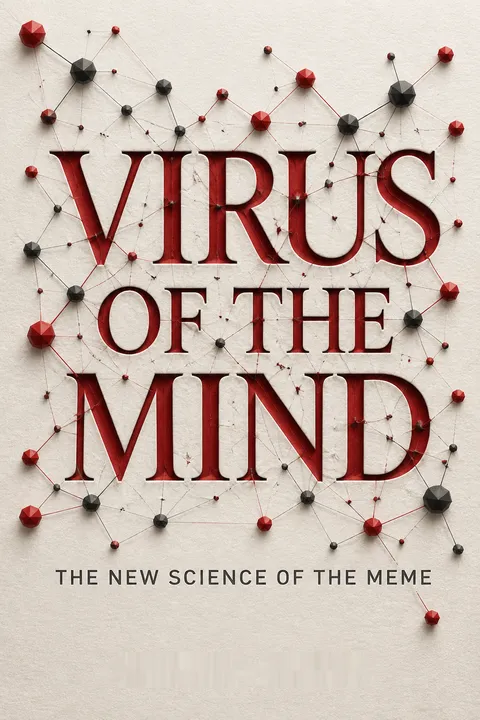


Key Takeaways
Treat thoughts as transmissible patterns, not automatically as private inventions.
A useful unit of culture. Brodie calls a meme a piece of information in a mind that influences events so copies of that information appear in other minds. A melody, belief, slogan, or way of doing something can qualify if people learn it and pass it on. The term comes from evolutionary biology, where genes replicate through living organisms. Memetics applies a similar lens to culture, asking how ideas spread, change, and disappear.
Ideas can steer behavior. A person may adopt a fashion or political belief without deciding to copy it. The idea can shape choices, which in turn expose others to it. Brodie’s point is not that every thought is a virus, but that people absorb and reproduce cultural information, often without noticing the process.
The model makes cultural transmission easier to notice: an idea is not only something a person believes, but also something that can travel through a network. This connects naturally to modern research on social diffusion, where adoption depends on exposure, trust, and the structure of relationships. The analogy to genes is evocative, but it should not be taken literally. Cultural ideas lack a clearly bounded, universally measurable unit, and people often reinterpret what they receive rather than copy it exactly. The framework is most useful as a question generator, not as a complete account of thought.
Judge ideas by what they reproduce, not by how helpful they seem.
Fitness means copying. In Brodie’s evolutionary model, a replicator is information that gets copied with enough accuracy to persist, while also changing enough for variations to appear. A replicator’s fitness means its likelihood of being copied, not its wisdom, truth, or contribution to human welfare. A catchy tune may spread farther than a careful explanation; a destructive belief may outlast a useful one.
Selection has no conscience. The author compares the persistence of memes to biological evolution: successful variants become more common because they reproduce effectively. That does not mean the process is aiming at progress or happiness. It means the conditions around an idea favor its spread. A message that is easy to remember, emotionally charged, or repeatedly shared may thrive even when it misleads or harms its hosts.
This distinction is a powerful antidote to the assumption that popular beliefs must be sound. It also resembles a central problem in platform design: systems that reward engagement can amplify material that provokes strong reactions, whether or not it informs. Yet the model can overstate the independence of ideas. Human beings do not merely serve as passive hosts; they can deliberately assess, adapt, and refuse what they encounter. The practical lesson is to examine both an idea’s consequences and the social conditions that reward its circulation, rather than treating prevalence as evidence of value.
Audit the labels, rules, and associations quietly steering your choices.
Three kinds of programming. Brodie groups memes into distinctions, strategies, and associations. A distinction is a mental category that helps sort experience, such as recognizing a brand or identifying a traffic sign. A strategy is a learned rule about what action may produce a desired result. An association links one thing to a feeling or another idea, such as a song with a happy memory.
Notice the hidden influence. These patterns shape what people perceive and do. A driver follows learned rules at an intersection; an advertisement can connect a product with attractive images or a sense of belonging. The author argues that labels are not the world itself. Categories help people navigate, but they also direct attention and can narrow what seems possible or relevant.
The three-part map is useful because it distinguishes different routes by which culture shapes action: categories affect perception, rules guide behavior, and associations color feeling. That division has clear parallels with cognitive science, where mental schemas, learned action policies, and emotional associations are studied through different methods. Its limitation is that real thoughts rarely fit neatly into one box. A brand name can be a category, a cue for behavior, and an emotional signal at once. The categories work best as an audit checklist, not a claim that the mind has three separate compartments.
Guard attention when fear, desire, status, or belonging grabs it.
Old priorities, new surroundings. Brodie argues that human attention is especially responsive to danger, food, and sex, which mattered greatly to survival and reproduction in ancestral environments. He adds social pulls such as belonging, approval, authority, and status. Memes that activate these responses can win attention more easily than calm, less urgent information.
Attention can be redirected. The author uses news coverage to show how repeated reports of distant dangers can make everyday life feel more threatening than personal experience suggests. His advice is to pause when fear takes over, ask whether the danger is physical or symbolic, and decide what action actually serves one’s purpose. Instinct can alert a person, but it need not make the decision.
The central insight is that attention is not a neutral window onto the world. Research on threat processing and attentional bias supports the broader point that emotionally salient cues can capture notice quickly. Contemporary media systems add a feedback loop: highly engaging material is often promoted more widely, intensifying the original bias. Still, the book’s evolutionary explanations should be treated as hypotheses, not proof that every preference has a prehistoric cause. Fear can also be an appropriate response to genuine danger. The useful discipline is calibration, not reflexive dismissal.
Recognize repetition, discomfort, and appealing wrappers as routes into belief.
Three routes into the mind. Brodie describes conditioning through repetition, cognitive dissonance, and the Trojan horse. Repeated messages can become familiar and feel more credible. Cognitive dissonance is the discomfort produced by conflicting beliefs or experiences; people may resolve it by changing how they interpret a situation. A Trojan horse presents an appealing message alongside less appealing ideas, letting the attractive part draw attention to the bundle.
Everyday persuasion uses them. A commercial may pair a product with positive imagery again and again. A high-pressure salesperson may create urgency that clashes with a shopper’s wish to compare options. A trusted speaker may combine widely accepted claims with a disputed conclusion. Recognizing these techniques gives people a chance to slow down, separate the claims, and ask what evidence supports each one.
These mechanisms connect memetics to established work on persuasion and cognitive consistency. Repetition can increase familiarity, and effortful commitments can shape later attitudes, but neither mechanism guarantees that a person will accept a new belief. People may reject the pitch, reinterpret the experience, or become more certain of their original view. That variability matters: the same tactic does not work on everyone, and influence is not mind control. The framework is most valuable when used to inspect the process of persuasion, including when a preferred cause or trusted group is doing the persuading.
Ask whether institutions still serve people, or mainly reproduce themselves.
Survival can replace mission. Brodie calls a self-perpetuating cultural pattern a cultural virus. Institutions compete for money, staff, attention, and members; those that attract resources are more likely to continue. Over time, the practices that preserve an organization can take precedence over its original purpose. The author illustrates this with a charity that sent a donor so much fundraising mail that the cost appeared to exceed the donor’s contributions.
Media face the same pressure. Television programs compete for viewers, while news outlets compete for attention. Sensational or emotionally charged stories can outperform uneventful reporting, even when the latter gives a more representative picture of daily life. The point is not that every institution is malicious. It is that incentives can steer organizations toward persistence and growth, regardless of whether those outcomes best serve their audiences.
This is a systems-level insight: organizations can drift without any single person intending the drift. It resonates with principal-agent problems, where an institution’s operators may face incentives different from the public’s interests, and with the idea that a measure can distort the goal it was meant to track. Ratings, donations, and membership are not inherently bad measures, but they can crowd out harder-to-measure outcomes such as accuracy or service. The account is strongest when it traces concrete incentives. It becomes less persuasive when every institutional change is treated as evidence of a virus.
Separate a religion's social power from the truth of its claims.
Beliefs can spread for many reasons. Brodie treats religions as cultural bundles whose persistence can be aided by ritual, tradition, repetition, clear explanations, belonging, and promises of security or purpose. These qualities help explain how a belief system can endure and attract adherents. They do not, by themselves, establish whether its spiritual claims are true or false.
Meaning is part of the appeal. The book also recognizes that religion can give people a sense of purpose and motivate art, charity, and sustained effort. Its memetic analysis asks how beliefs spread and shape behavior, rather than settling theological questions. That distinction matters: understanding the social mechanics of faith need not require dismissing its adherents or reducing every religious experience to manipulation.
The separation between a belief’s social success and its truth is analytically sound. An explanation of why people adopt a worldview is not a refutation of that worldview, just as the history of scientific ideas does not determine whether their findings are correct. Religious communities can also supply ritual, mutual aid, moral language, and shared identity, functions that a replication-only account may underdescribe. At the same time, sincere conviction does not guarantee accuracy. The section is most useful when it invites two distinct questions: what does this belief claim, and what social needs or structures help it persist?
Influence others deliberately, but never confuse persuasion with benevolence.
Designed influence has an agenda. Brodie calls an intentionally constructed, self-spreading system a designer virus. It can be built to spread beliefs that serve a founder’s interests, or to advance a cause the designer considers beneficial. The book’s example of a cult focuses on a mission members did not consciously choose and serious consequences for leaving. Similar recruitment structures can appear in commercial or political settings, though their aims and harms differ.
Check the commitment. Before giving an organization substantial time or loyalty, the author recommends asking whether its mission is genuinely one’s own, whether participation is an effective way to achieve it, and whether the daily work feels fulfilling. These questions do not prove an organization is harmful. They make its demands and claimed benefits easier to examine before commitment deepens.
The chapter’s ethical tension is important: techniques that increase the reach of a message can support education, mutual aid, or manipulation. Good intentions alone cannot distinguish those outcomes, because leaders can misjudge their impact and members can face pressure to comply. Useful safeguards include transparent aims, freely given consent, room for dissent, and a realistic ability to leave without punishment. These are editorial extensions of the book’s concern with autonomy. A message should be judged not only by the cause it names, but also by how it treats the people asked to carry it.
Choose a life purpose, then teach children to choose consciously too.
Move beyond inherited programming. In the book’s Learning Pyramid, Level 1 is instinctive behavior, Level 2 is acquired knowledge and belief systems, and Level 3 is consciously shaping life around a chosen purpose. Brodie recommends noticing thoughts, trying on other perspectives, and learning to quiet internal chatter as ways to see which beliefs are inherited and which still serve one’s aims.
Education can teach agency. The author argues that schooling should go beyond memorizing information and learning how to think. Children should also learn to identify what matters to them and make deliberate choices. This is not a call to leave them without guidance; it is a challenge to make education serve human development, not merely the repetition of existing customs or the production of compliant workers.
The shift from absorbing knowledge to examining one’s own assumptions is valuable, and it echoes metacognition: the ability to notice and evaluate one’s thinking. Purpose can organize effort and make trade-offs clearer, but a single prescribed purpose can become another form of programming. The book’s three levels are best read as a personal-development metaphor, not a validated developmental scale. In education, teaching agency also requires intellectual tools, supportive relationships, and exposure to competing perspectives. Children cannot choose thoughtfully if adults restrict the questions they are allowed to ask.
Analysis
The book’s durable contribution is a change in vantage point. Instead of explaining culture only through individual intention, it asks how ideas travel, mutate, and recruit human attention. That lens is especially useful for understanding why a message can flourish despite being false, damaging, or irrelevant to its original purpose. The examples of advertising, news, religion, and organizations all turn on a common mechanism: once a pattern spreads, the conditions that sustain it may become more influential than the motives of its originator.
The limitation is that the gene analogy can make cultural transmission look more discrete and automatic than it is. Memes have no agreed boundaries comparable to genes, and people reconstruct ideas through interpretation, negotiation, and resistance. Modern cultural-evolution research and network science offer more precise ways to examine transmission, but they also show that spread depends on context, relationships, and institutions, not just an idea’s inherent fitness. The book’s broad evolutionary-psychology explanations, especially claims about sex roles and historical motives, are speculative and reflect the period in which it was written. They should not be treated as settled findings.
The practical value therefore lies less in diagnosing every fashion or institution as a virus than in asking disciplined questions: What incentives help this message spread? What behavior does it encourage? Who benefits, who bears the cost, and can participants reconsider their commitment? The book also rightly exposes a dilemma: spreading a good idea requires techniques that can be used manipulatively. A defensible response is not to abandon persuasion, but to pair it with transparency, evidence, consent, and room for dissent. Memetics is a powerful interpretive lens, not a complete science of the mind or a substitute for ethical judgment.
Review Summary
Virus of the Mind receives mixed reviews. Some praise its accessible introduction to memetics and thought-provoking ideas, while others criticize its lack of scientific rigor and oversimplification. Readers appreciate the discussion on how ideas spread and influence behavior, but many find the author's digressions and self-help advice less compelling. The book's exploration of religion, advertising, and self-awareness garners interest, though some feel it takes the meme concept too far. Overall, opinions vary widely on its value and relevance.
People Also Read




Glossary
Meme
Replicating cultural informationA unit of information in a mind that influences events so that copies of itself are created in other minds. Examples can include beliefs, tunes, phrases, fashions, or learned practices. In the book, the term is used as an evolutionary analogy to genes, with cultural information transmitted through communication and imitation.
Memetics
Study of meme evolutionThe study of how memes interact, replicate, and evolve. Brodie presents it as an approach for understanding cultural change by tracking the spread of ideas and their effects on behavior. The book treats memetics as a useful explanatory model, while acknowledging that it is not the only valid way to describe the mind or culture.
Virus of the mind
Self-spreading cultural patternA cultural pattern that introduces memes into people’s minds, influences their behavior, and thereby helps the pattern continue or spread. The metaphor emphasizes penetration, copying, and transmission, not literal infection or conscious intent by an idea. Such patterns may be harmless, beneficial, or destructive to the people who carry them.
Distinction-meme
Learned way to categorizeA learned category or label that helps a person divide experience into recognizable kinds. Distinctions shape what people notice and how they interpret it. The book argues that categories such as brands, places, and social roles are useful mental tools, but they are not identical to reality itself.
Strategy-meme
Learned cause-effect ruleA learned rule of thumb linking a situation, an action, and an expected result. It guides behavior when a person encounters a familiar circumstance. Strategies can be acquired through observation, repetition, or reward, and they may become ineffective when the person’s circumstances change.
Association-meme
Learned link between ideasA learned connection between two or more ideas, objects, or feelings. When one item appears, the association can evoke another thought or emotional response. Brodie uses advertising as an example: repeated pairings can connect a product with pleasure, attractiveness, status, or belonging.
Cognitive dissonance
Discomfort from conflicting beliefsThe mental tension a person experiences when beliefs, expectations, or experiences appear inconsistent. In Brodie’s account, people may reduce this discomfort by changing an interpretation or adopting a new belief. The book treats this process as one route by which persuasion or difficult group experiences can shape attitudes.
Trojan horse
Appealing wrapper for ideasA persuasion method in which an appealing message attracts attention while additional ideas are presented alongside it. The attractive element can make the audience more receptive to the bundled claims. Brodie discusses this in advertising, political rhetoric, and other forms of communication, while emphasizing that the audience may not notice the packaging.
Cultural virus
Naturally self-perpetuating institutionA cultural pattern or institution that becomes self-perpetuating through the spread of its associated memes, without necessarily being deliberately designed for that purpose. Its practices may evolve to secure attention, resources, or participants. This can cause its continued existence to take priority over the goals for which it first appeared.
Designer virus
Intentionally spreading systemA deliberately constructed system of ideas and practices designed to recruit people and spread its message. It may serve commercial, political, religious, or other aims. Brodie emphasizes that such a system can outgrow its creator’s control, because its continuing spread depends on the behavior of the people who adopt and transmit it.
Learning Pyramid
Three-level learning modelBrodie’s model of learning levels. Level 1 concerns instinctive drives, Level 2 includes acquired knowledge and belief systems, and Level 3 means consciously organizing life around a chosen purpose. The author presents the levels as a progression toward greater agency, not as a formal scientific measure of intelligence or development.
FAQ
What's Virus of the Mind about?
- Exploration of Memetics: The book introduces the concept of memes, which are units of cultural transmission or imitation, similar to genes in biological evolution.
- Mind Viruses: Richard Brodie discusses how harmful memes, or mind viruses, can infect our thoughts and behaviors, leading to destructive patterns in our lives.
- Crisis of the Mind: The author highlights a "crisis of the mind," where individuals are often unaware of how their thoughts are influenced by external cultural forces.
Why should I read Virus of the Mind by Richard Brodie?
- Gain Self-Awareness: The book helps you understand how your thoughts and behaviors are shaped by memes, leading to greater self-awareness and control over your life.
- Cultural Understanding: It offers a new perspective on cultural evolution, showing how ideas spread and influence society.
- Practical Applications: Brodie provides practical advice on how to consciously choose the memes you want to adopt, which can lead to a more fulfilling life.
What are the key takeaways of Virus of the Mind?
- Memes as Cultural Units: Memes are the basic building blocks of culture, influencing everything from language to social norms.
- Mind Viruses Impact Behavior: Mind viruses can lead to negative behaviors and societal issues, such as cults and destructive ideologies.
- Empowerment Through Knowledge: The author encourages readers to take control of their mental programming by consciously selecting beneficial memes.
What is a meme according to Virus of the Mind?
- Basic Definition: A meme is a unit of information in a mind whose existence influences events such that more copies of itself get created in other minds.
- Cultural Transmission: Memes spread through imitation and communication, similar to how genes replicate in biological evolution.
- Types of Memes: Brodie categorizes memes into distinctions, strategies, and associations, each playing a role in how we perceive and interact with the world.
How do mind viruses spread according to Virus of the Mind?
- Communication as a Vehicle: Mind viruses spread through communication, whether verbal, written, or visual.
- Cultural Environment: They thrive in environments with high levels of communication and cultural exchange, such as media and social networks.
- Unconscious Programming: Individuals often absorb mind viruses unconsciously, leading to behaviors and beliefs that may not align with their true values.
How do mind viruses affect our daily lives?
- Subconscious Influence: Mind viruses can subtly shape our beliefs and behaviors, often without us realizing it.
- Cultural Norms: Many societal norms and expectations are the result of mind viruses that have spread over time.
- Emotional Responses: Mind viruses can trigger emotional reactions, such as fear or desire, that influence our choices.
What methods does Virus of the Mind suggest for combating mind viruses?
- Awareness and Education: Brodie emphasizes the importance of becoming aware of the memes that influence us.
- Critical Thinking: Developing critical thinking skills is essential for evaluating the validity of the memes we encounter.
- Mindfulness Practices: Engaging in mindfulness can help individuals detach from automatic reactions to memes.
What is the difference between cultural viruses and designer viruses in Virus of the Mind?
- Cultural Viruses: These are memes that evolve naturally within a culture, spreading through social interactions.
- Designer Viruses: In contrast, designer viruses are intentionally created to manipulate behavior for specific purposes.
- Intent and Control: Cultural viruses evolve organically, while designer viruses are crafted with a specific agenda in mind.
How can understanding memetics improve personal relationships according to Virus of the Mind?
- Enhanced Communication: Understanding how memes influence thoughts and behaviors can lead to more meaningful conversations.
- Conflict Resolution: Recognizing the underlying memes that drive conflicts can help address issues more constructively.
- Shared Values: Understanding memetics can help partners identify and align their core values, strengthening their connection.
What role does evolution play in Virus of the Mind?
- Evolution of Memes: Brodie draws parallels between biological evolution and the evolution of memes, suggesting that memes compete for survival in a cultural landscape.
- Natural Selection: Memes that are better at replicating themselves will thrive, similar to how genes succeed in biological evolution.
- Cultural Adaptation: Just as species adapt to their environments, memes evolve to fit the cultural context in which they exist.
What are the best quotes from Virus of the Mind and what do they mean?
- “What a waste it is to lose one’s mind or not to have a mind is very wasteful.”: This quote underscores the importance of mental engagement and awareness.
- “The true earmark of genius is taking a complex concept and making it simple.”: Brodie highlights the value of simplifying complex ideas for better understanding.
- “Warning: This book contains a live mind virus.”: This playful warning indicates that the ideas presented may challenge your current beliefs and provoke new ways of thinking.
How does Virus of the Mind relate to modern society?
- Cultural Relevance: Brodie's exploration of memes and mind viruses is particularly relevant in today's information-saturated society.
- Impact on Behavior: The book illustrates how mind viruses can shape behaviors and societal norms, influencing everything from consumer choices to political beliefs.
- Empowerment Through Knowledge: By understanding the principles of memetics, individuals can empower themselves to make informed choices about the ideas they adopt and promote.
Download PDF
Download EPUB
.epub digital book format is ideal for reading ebooks on phones, tablets, and e-readers.








